Zoom LiveTrak L-8 Podcast Console: Technical Deep Dive 2026
Zoom LiveTrak L-8 Podcasting Console: Complete Technical Analysis for Australian Creators (2026)
The Zoom LiveTrak L-8 occupies a curious space in the audio interface market — it's neither a traditional mixer nor a conventional multitrack recorder, but a purpose-built podcasting console that consolidates functions normally requiring three or four separate boxes. For Australian podcasters, livestreamers, and small-broadcast operators evaluating their first dedicated production hub, the L-8's specification sheet tells a more interesting story than the marketing copy suggests. This analysis breaks down the technical architecture, performance envelope, and practical limitations of the L-8 to help you decide whether it genuinely fits your workflow.
Technical Overview: What the L-8 Actually Is
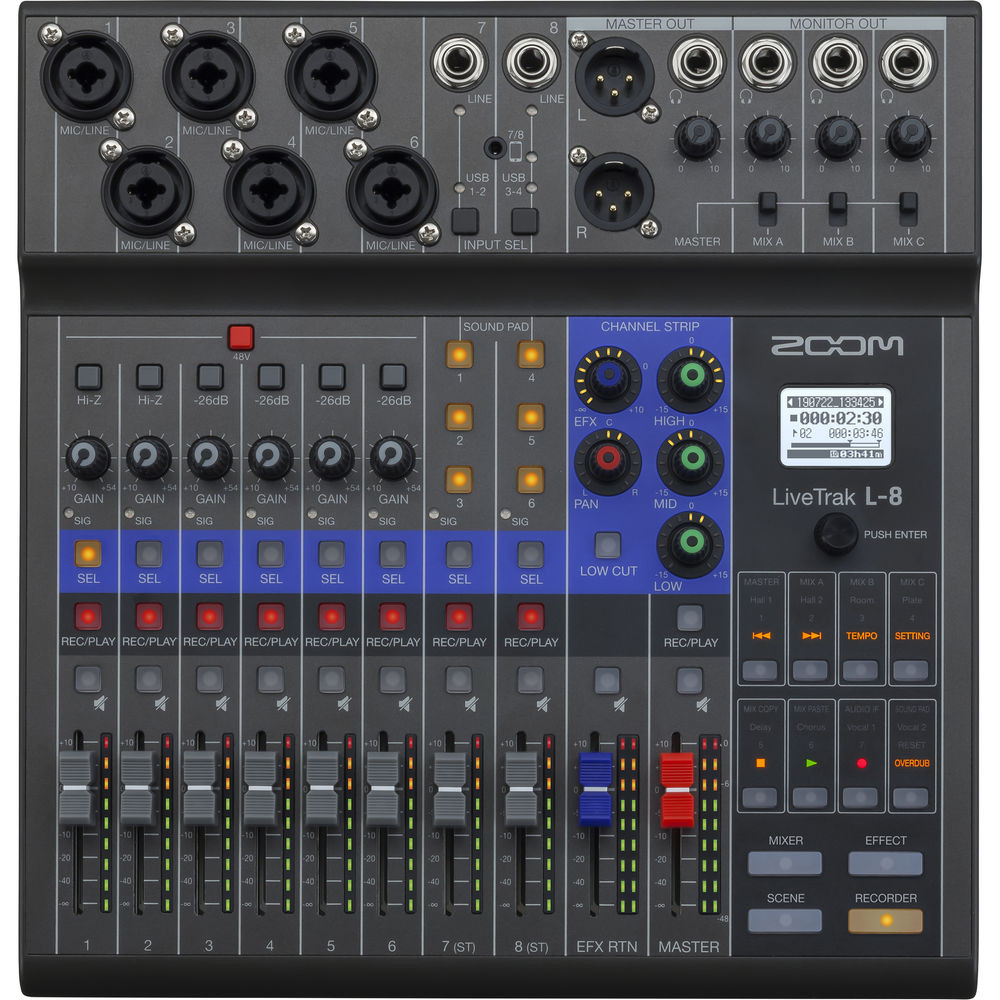
The LiveTrak L-8 is a hybrid device combining four discrete functional blocks into a single chassis weighing 1.27 kg: an 8-channel analogue front-end with 24-bit/96 kHz A/D conversion, a 12-track simultaneous SD card recorder, a 4-channel USB 2.0 audio interface, and a battery-capable mobile mixing surface. The signal path supports up to 6 mic preamps (channels 1–6), with channels 7/8 configured as stereo line/instrument inputs or assignable to dedicated smartphone and USB sources.
This architecture matters because it removes a common podcast pain point: routing remote callers, music beds, and live mics through a single chain without latency, double-recording, or fragile loopback configurations. The L-8's mix-minus implementation on channel 7 (the dedicated TRRS smartphone input) is the key engineering feature most buyers underestimate.
Core Specifications at a Glance
| Specification | Value | Practical Impact |
|---|---|---|
| Channels | 8 (6 mic + 2 stereo/line) | Supports 4–6 host roundtables comfortably |
| Mic Preamps | 6 × XLR with +48V phantom (switchable per channel) | Each can be muted independently — avoids pops |
| Preamp EIN | −128 dBu (150Ω input, IHF-A) | Quiet enough for dynamic broadcast mics |
| Max Input Gain | +57 dB | Marginal with low-output mics like SM7B without a CloudLifter |
| A/D & D/A | 24-bit, up to 96 kHz | Broadcast-grade resolution |
| SD Recording | 12 tracks simultaneous (8 channels + stereo mix + sub mix) | Full backup safety net per session |
| USB Interface | 4-in / 4-out, 24-bit/96 kHz, Class Compliant | Works with Mac, Windows, iPad without drivers |
| Headphone Outputs | 5 × independent stereo with discrete level control | Each participant gets their own monitor mix |
| Sound Pads | 6 trigger pads × 3 banks (18 sounds total) | Stingers, jingles, ad reads on-the-fly |
| Display | 2.4" colour LCD | Visual confirmation of recording, levels, settings |
| Power | USB bus, AC adapter, or 4× AA batteries | Battery runtime ~2 hours alkaline, longer with lithium |
| Dimensions | 377 × 257 × 73 mm | Desk-friendly, transportable |
| Weight | 1.27 kg (without batteries) | Genuinely portable for field recording |
Preamp Architecture and Real-World Performance
Zoom's preamp lineage in the LiveTrak series shares DNA with their H-series field recorders — these are clean, low-noise circuits designed for spoken-word fidelity rather than musical character. The −128 dBu EIN figure is competitive with mid-tier interfaces like the Focusrite Scarlett range, and noticeably quieter than budget mixers like the Behringer Xenyx series under typical podcasting conditions.
The +57 dB gain ceiling is the L-8's most discussed limitation. For Australian podcasters using common dynamic broadcast microphones — particularly the Shure SM7B (−59 dBV sensitivity) or Electro-Voice RE20 — you'll be running the gain at maximum for normal speaking levels. This isn't fatal: the preamps remain reasonably quiet at full gain, but you lose headroom for quiet talkers. A Cloudlifter CL-1 or sE Electronics DM1 inline preamp (≈$200–280 AUD) solves it completely and is a worthwhile addition if your hosts use SM7Bs.
With condenser mics (Audio-Technica AT2020, Rode NT1) or higher-output dynamics (Shure SM58, Rode PodMic), gain headroom is a non-issue. The PodMic in particular — −57 dBV sensitivity — pairs ideally with the L-8 and typically sits around 2 o'clock on the gain knob for comfortable speech.
Phantom Power Implementation
One often-overlooked detail: phantom power on the L-8 is individually switchable per channel, not globally. This matters because mixing condensers and ribbon mics (some vintage ribbons can be damaged by misapplied +48V) is safe, and you won't accidentally pop a connected dynamic when patching in a condenser mid-session. Pre-amp inputs also feature a high-pass filter at 80 Hz/120 Hz/160 Hz, which is genuinely useful for rumble rejection in untreated rooms.
The Mix-Minus Implementation: Why It Matters
Mix-minus is the technical foundation of professional remote interviews. When a guest calls in via phone or app, they need to hear the entire show except their own voice — otherwise they get a confusing delayed echo of themselves. Doing this manually requires bus routing on a traditional mixer, often configured incorrectly by inexperienced engineers.
The L-8 handles mix-minus automatically on channel 7 via the TRRS smartphone input. Plug a 4-pole TRRS cable from your phone into channel 7, and the L-8 routes the phone's outgoing audio (their voice) into your mix while simultaneously sending the phone a feed that excludes their own input. The guest hears clean broadcast-quality audio of everyone else; your recording captures their voice on a discrete track for post-production editing.
This works seamlessly with WhatsApp, Skype, Zoom, Teams, FaceTime Audio, or any standard call app — the implementation is at the hardware level, not dependent on software. For Australian podcasters interviewing international guests where good audio matters, this single feature eliminates the most fragile part of the production chain.
Considering the L-8 for your podcast setup? View the Zoom LiveTrak L-8 at MusiconStage Australia for current pricing and availability.
Multitrack Recording: 12-Track Architecture
The L-8 records up to 12 simultaneous tracks to SD/SDHC/SDXC card (up to 512 GB supported, exFAT). That breaks down as:
- Tracks 1–8: Pre-fader, pre-EQ recordings of each input channel
- Tracks 9–10: Stereo master mix (post-fader, post-EQ, post-effects)
- Tracks 11–12: Sub-mix output (configurable for live broadcast or backup)
The pre-fader, pre-EQ recording on individual tracks is critical for post-production flexibility. You capture pristine isolated audio from each mic regardless of how the live mix sounded — invaluable when a host inevitably forgets to unmute themselves or a guest's gain was set too low. You can fully rebuild the mix in your DAW from these stems.
File format options include 16-bit or 24-bit WAV at 44.1/48/96 kHz. For podcast work, 24-bit/48 kHz is the standard choice — broadcasting-quality, manageable file sizes (≈8 MB per minute per track), and seamless DAW compatibility. A 2-hour podcast at 24-bit/48 kHz across 10 tracks generates approximately 9.6 GB, which fits comfortably on a 32 GB card with overhead for safety.
Recommended SD Cards for Reliable Operation
Zoom maintains an official compatibility list, but in practice any genuine SanDisk Extreme, Samsung Pro Plus, or Lexar Professional card rated U3/V30 or higher will handle the L-8's sustained write requirements (approximately 4.5 MB/s for 12-track recording). Avoid no-name cards or older Class 10 cards without UHS-I ratings — recording dropouts are recoverable in post but never welcome.
USB Interface Mode and Computer Integration
The L-8 operates as a 4-in/4-out USB 2.0 Class Compliant audio interface. The four inputs to your DAW comprise:
- Channels 1–2 (typically your host mics)
- Channels 3–4 (additional mics)
- Stereo master mix
- Sub-mix output
This is fewer discrete inputs than the SD card recorder offers, which is the L-8's primary trade-off versus dedicated audio interfaces like the Zoom UAC-232 or Focusrite Scarlett 18i20. For workflows that record exclusively to the SD card and use USB only for live streaming or remote backup, this is irrelevant. For workflows wanting all 8 channels into your DAW simultaneously over USB, the L-8 falls short — you'd need to record to SD and import after the session.
Class Compliant operation means zero driver installation on macOS, iPadOS, or Linux. Windows users get ASIO performance via Zoom's downloadable driver. Latency is acceptable for monitoring (≈8–12 ms round-trip at 48 kHz with reasonable buffer sizes) though not class-leading.
Sound Pads: 18 Trigger Slots for Production Value
The six rubber trigger pads, multiplied across three banks (A/B/C), give you 18 instant-trigger sounds. Each pad supports WAV file playback from the SD card, with adjustable trigger modes:
- One-shot: Plays through completely, even if pad released
- Hold: Plays only while pad held
- Loop: Repeats until pad pressed again
The L-8 ships with preloaded sounds (applause, laughter, sound effects) but the genuine utility is loading your own intro stinger, ad spot, sponsor read, recorded interview segments, or background bed loops. For comedy podcasts, gaming streams, or radio-style productions, this eliminates needing a second device or laptop running soundboard software. Volume per pad is individually adjustable from the LCD menu.
Comparative Analysis: L-8 vs Key Alternatives
| Feature | Zoom L-8 | RØDECaster Pro II | Zoom PodTrak P8 |
|---|---|---|---|
| Channels | 8 (6 mic) | 4 mic + 4 sources | 6 (6 mic) |
| Max Gain | +57 dB | +76 dB | +70 dB |
| Sample Rate | 96 kHz | 48 kHz | 48 kHz |
| USB Channels | 4-in/4-out | 14-in/2-out | 2-in/2-out |
| Sound Pads | 18 (6 × 3 banks) | 8 | 9 |
| Headphone Outs | 5 independent | 4 independent | 4 independent |
| Touchscreen | No (LCD only) | Yes (5.5") | Yes (3.5") |
| Battery Power | Yes (4× AA) | No | Yes (4× AA) |
| Mix-Minus | Yes (TRRS) | Yes (Bluetooth + USB) | Yes (TRRS) |
| Australian Price (approx) | $650–750 AUD | $1,050–1,200 AUD | $500–600 AUD |
The L-8 sits in the technical sweet spot — more inputs and recording tracks than the PodTrak P8, lower cost than the RØDECaster Pro II, and the only one of the three offering true 96 kHz operation. The trade-offs versus the RØDECaster Pro II are the lack of touchscreen (some find Zoom's button-driven menus slower), no built-in Bluetooth, and fewer USB channels. Versus the PodTrak P8, you gain two channels, the higher sample rate, and dual sub-mix capability, but lose the touchscreen.
Power Architecture: The Underrated Strength
The L-8 powers from any of three sources: the supplied AD-17 9V AC adapter (best for studio use), USB bus power from a connected computer or power bank, or four AA batteries (for field work). Real-world battery runtime with alkaline AAs lands around 2–2.5 hours of recording; lithium AAs extend this to roughly 4 hours; quality NiMH rechargeables (Eneloop Pro) hit similar lithium-class numbers and prove more economical long-term.
For Australian podcasters who record on-location at events, conventions, or interviews outside studios, this triple-power flexibility is operationally significant. Bus-powering from a 10,000 mAh USB-C power bank gives you essentially unlimited field recording — a workflow option neither the RØDECaster series nor traditional rack mixers offer.
What Specifications Actually Matter for Podcasting
Marketing materials emphasise channel count and effects, but for podcast applications the genuinely consequential specifications are:
- Preamp noise floor (EIN): Determines how usable the recording is in quiet rooms. The L-8's −128 dBu is competitive.
- Gain range: Matters enormously if you use low-output dynamic broadcast mics. The L-8's +57 dB is the weakest point.
- Independent headphone monitoring: Critical for multi-host shows. Five independent outputs with separate level controls is best-in-class.
- Discrete pre-fader recording: Saves bad live mixes in post. The L-8 records pre-fader, pre-EQ on tracks 1–8.
- Mix-minus quality: Determines remote caller audio quality. The L-8's hardware implementation is reliable.
- Build quality and connector reliability: The L-8's XLR/TRS combo jacks are Neutrik-quality; pots are smooth-action without scratchiness from new.
Limitations You Should Know Before Buying
Honest technical assessment requires acknowledging where the L-8 falls short:
- No Bluetooth: Modern podcasters often connect via Bluetooth for laptops and phones. The L-8 requires wired TRRS or USB connections.
- +57 dB gain ceiling: Tight with SM7B-class dynamic mics without an inline preamp boost.
- No automatic loudness normalisation: Unlike the RØDECaster Pro II's APHEX processing, the L-8 doesn't auto-balance host levels.
- Menu-driven configuration: The 2.4" LCD with button navigation is slower than touchscreen-based competitors for setting up sound pads or routing.
- 4-channel USB limit: Cannot stream all 8 inputs individually to your DAW simultaneously — recording must happen on SD for full multitrack USB capture.
- Built-in effects are basic: Reverb and compression are present but lack the depth of a dedicated processor.
None of these are deal-breakers for the intended audience, but they're worth knowing before purchase rather than discovering after.
Who Should Buy the LiveTrak L-8
The L-8 is the technically correct choice for:
- Roundtable podcasters with 3–6 hosts using condenser or higher-output dynamic mics
- Field recording podcasters who value battery operation
- Streamers needing live broadcast plus backup recording simultaneously
- Small radio production setups wanting integrated sound pad triggering
- Educators recording lectures or interviews with multiple participants and phone callers
- Musicians wanting a portable rehearsal recorder with mix-down capability
It's less ideal for solo podcasters (a simpler interface like the Zoom PodTrak P4 makes more sense), heavy SM7B users without preamp boosters, or producers needing all 8 channels into a DAW in real time.
Ready to upgrade your podcast production? Check current Australian pricing and stock on the Zoom LiveTrak L-8 at MusiconStage.
Technical FAQ
Can the L-8 record to SD and USB simultaneously?
Yes — this is one of its core strengths. The SD card captures all 12 tracks while the USB connection sends 4 channels to your DAW or streaming software. You get a perfect backup of every session regardless of computer issues.
What's the maximum SD card capacity supported?
Up to 512 GB SDXC formatted in exFAT. Zoom officially supports SDHC and SDXC standards. Cards must be UHS-I U3/V30 minimum for reliable 12-track recording.
Does the L-8 work with the Shure SM7B?
Yes, but barely without help. At +57 dB max gain, you'll be running the SM7B near maximum for normal speech. A Cloudlifter CL-1 or sE Electronics DM1 inline activator (+25 dB) is recommended for headroom and noise floor improvement.
Can multiple L-8s be linked for larger productions?
No — the L-8 doesn't support cascade linking. For productions needing more than 8 channels, the Zoom LiveTrak L-12 or L-20 are the upward paths within the LiveTrak family.
Is the L-8 compatible with iOS and iPadOS for mobile production?
Yes, fully. Class Compliant USB operation means you can connect via a USB-C to USB-A adapter (or Lightning Camera Connection Kit for older devices) and use the L-8 with apps like Ferrite, GarageBand, or any standard recording app on iPad.
What's the warranty in Australia?
Zoom Australia products distributed through authorised dealers like MusiconStage carry a 12-month manufacturer warranty serviced locally. Always purchase from authorised Australian dealers to ensure warranty validity.
Final Technical Verdict
The Zoom LiveTrak L-8 is one of the most thoughtfully engineered podcast consoles in its price tier. The combination of 96 kHz audio path, 12-track SD recording, hardware mix-minus, 18 sound pad slots, 5 discrete headphone outputs, and triple-power flexibility delivers genuine production capability that would require $2,000+ of separate equipment to replicate piece by piece. The compromises — gain ceiling, no touchscreen, no Bluetooth, limited USB channels — are real but matched against the price point, sensible.
For Australian podcasters past the entry-level USB mic stage but not yet ready for full broadcast consoles, the L-8 represents the technical sweet spot. It will serve a serious 4–6 host podcast operation for years without becoming the bottleneck in your production quality. The audio you capture with this console — given competent mic technique and a reasonable acoustic environment — will be indistinguishable from productions running ten times the gear budget.
If your workflow aligns with the L-8's design philosophy (multi-host, multi-track, portable, broadcast-oriented), buy with confidence. If you need touchscreen workflows or all-USB multitrack streaming, look at the RØDECaster Pro II or dedicated interface paths instead. Either way, you now have the technical context to decide based on specifications that actually matter rather than marketing copy.
Order the Zoom LiveTrak L-8 from MusiconStage Australia with Australian warranty support and authorised dealer pricing.