
Shure SLXD24/Beta58 Wireless Mic System: Australian Pro Audio Guide 2026
Shure SLXD24/Beta58 Wireless Mic System: What Australian Performers and Engineers Actually Need to Know
If you've spent any time researching professional wireless microphone systems, you've almost certainly come across the Shure SLX-D series. It sits in that sweet spot between Shure's entry-level BLX range and the broadcast-grade Axient Digital platform — and for most Australian performers, venues, and houses of worship, it's exactly where the money should go.
The SLXD24/Beta58 (H57 band) pairs Shure's latest digital wireless technology with one of the most respected live vocal capsules ever made. It's not cheap, but it's the kind of gear that pays for itself in reliability, sound quality, and the sheer absence of headaches on show day. Let's break down exactly what you're getting, who it's built for, and whether it's the right choice for your setup.
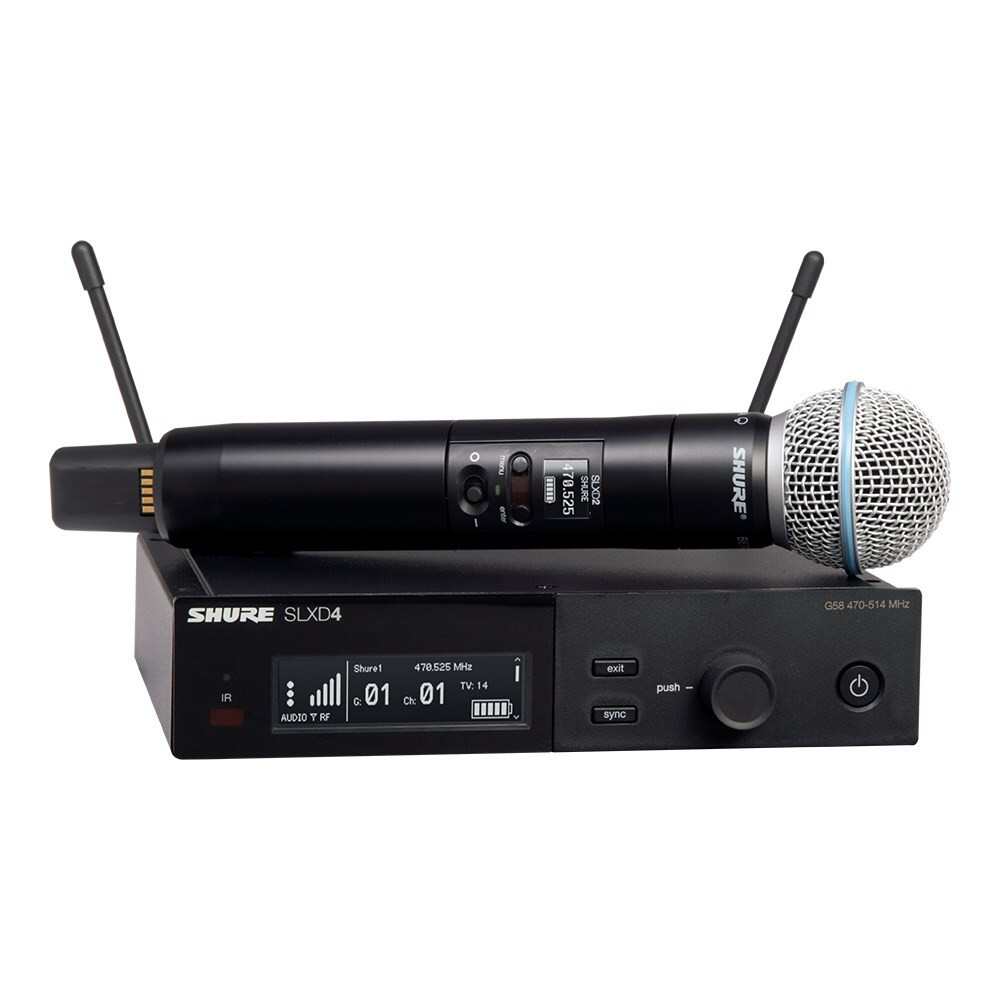
Looking to grab one now? View the Shure SLXD24/Beta58 H57 with full specs and pricing at MusiconStage with shipping across Australia.
Understanding the SLX-D Platform: Why Digital Wireless Matters
Before diving into the specifics of this particular system, it's worth understanding why Shure developed the SLX-D platform in the first place. The older analogue SLX series served the industry well for years, but digital wireless transmission offers some fundamental advantages that genuinely change the experience of using wireless microphones.
Digital wireless systems like the SLX-D transmit audio as a digital signal rather than an analogue FM carrier. This means the audio quality doesn't degrade as you move further from the receiver or as battery voltage drops — you get consistent, full-fidelity sound right up until the signal drops out entirely. There's no companding (the compression and expansion process that analogue systems use), which means no pumping, breathing, or those subtle artefacts that experienced engineers can hear on analogue wireless.
The SLX-D platform specifically uses 24-bit digital audio at 48 kHz, which delivers a dynamic range of over 120 dB. To put that in practical terms, you're getting audio quality that's essentially indistinguishable from a wired connection. For vocalists who rely on the nuance and dynamics of their performance, this is a significant upgrade over any analogue wireless system at a similar price point.
The Beta58 Capsule: Why It's Not Just Another SM58
Shure offers the SLXD24 with several capsule options, and the Beta58A supercardioid capsule is the premium choice for a reason. While the SM58 is legendary (and rightly so), the Beta58A is a different beast altogether, and understanding the differences matters when you're choosing which system to invest in.
Beta58A vs SM58: The Key Differences
| Feature | Beta58A | SM58 |
|---|---|---|
| Polar Pattern | Supercardioid | Cardioid |
| Frequency Response | 50 Hz – 16 kHz | 50 Hz – 15 kHz |
| Output Level | Higher (hotter signal) | Standard |
| Presence Peak | More pronounced (brighter) | Moderate |
| Off-Axis Rejection | Superior (tighter pickup) | Good |
| Best For | Loud stages, powerful vocalists | General purpose, versatile |
The supercardioid pattern of the Beta58A is tighter than the SM58's cardioid, which means it rejects more sound from the sides and rear. On a loud stage — think pub gigs, festival stages, or anywhere with wedge monitors cranked — this translates to significantly better gain-before-feedback. You can push the vocal higher in the mix before things start ringing.
The trade-off? A supercardioid pattern has a small lobe of sensitivity at the rear, which means monitor placement matters. Your wedge monitors need to be positioned at roughly 120 degrees off-axis rather than directly behind the mic. Any decent sound engineer knows this, but it's worth mentioning if you're setting up your own monitoring.
The Beta58A also has a brighter, more present sound with a pronounced midrange peak that helps vocals cut through a dense mix. For rock, pop, gospel, and any genre where the vocal needs to sit on top of a full band, the Beta58A is simply more effective than the SM58 in most scenarios.
H57 Frequency Band: Critical Information for Australian Users
This is where things get specifically important for Australian buyers, and it's a detail that too many retailers gloss over. The H57 band operates in the 520–564 MHz range, and choosing the correct frequency band isn't optional — it's a legal requirement.
In Australia, the use of wireless microphones is regulated by the Australian Communications and Media Authority (ACMA). You need to operate in frequency ranges that are either licence-free for wireless microphones or covered by a class licence. The H57 band falls within the range commonly used for professional wireless audio in Australia, but it's always worth checking current ACMA regulations, as spectrum allocations can change.
Why does this matter practically? If you buy a wireless system in the wrong frequency band — say, one intended for the US market — you might find it interferes with other services, delivers poor performance due to local RF congestion, or puts you on the wrong side of telecommunications law. Always buy the correct regional variant, and the H57 designation on this system confirms it's configured for use in this part of the world.
RF Performance and Channel Count
The SLXD24 system can coordinate up to 32 compatible channels in a single frequency band. For a single vocalist or presenter, that's obviously more than enough. But for churches, theatres, conferences, and touring productions running multiple wireless systems simultaneously, this channel density is genuinely impressive for a mid-tier system.
The SLX-D platform uses intelligent frequency management that automatically scans the local RF environment and selects clean frequencies. In Australian cities — particularly Sydney, Melbourne, and Brisbane where the RF spectrum is increasingly congested — this automatic scanning is more than a convenience feature. It can be the difference between a clean show and a night of dropouts and interference.
What's in the Box: Full System Breakdown
The SLXD24/Beta58 H57 is a complete wireless system. Here's exactly what you receive:
- SLXD2 handheld transmitter with integrated Beta58A capsule
- SLXD4 single-channel digital wireless receiver
- Power supply for the receiver
- Two AA batteries for the transmitter (or you can use the optional Shure SB903 rechargeable lithium-ion battery)
- Mic clip and zippered carrying bag
The SLXD2 Handheld Transmitter
The transmitter feels exactly like you'd expect a Shure handheld to feel — solid, well-balanced, and built like it can survive being dropped on a concrete floor (which, let's be honest, it will be at some point). The Beta58A capsule is integrated, not interchangeable on this model, which keeps things simple and ensures optimal RF performance.
Battery life is a standout feature. You're looking at up to 8 hours on two AA batteries, or up to 8 hours on the optional SB903 rechargeable battery. The transmitter displays remaining battery life in hours and minutes on both the transmitter itself and the receiver — not a vague bar graph, but actual time remaining. For anyone who's ever had a mic die mid-sermon or mid-set, this level of precision is genuinely reassuring.
The SLXD4 Receiver
The half-rack receiver is clean and straightforward. It features XLR and 6.35mm outputs, a bright LCD display showing channel, frequency, audio level, battery status, and RF signal strength. There's also a headphone output for monitoring, which is handy during setup and soundcheck.
One particularly useful feature is the encryption capability. The SLX-D system supports AES-256 encryption, the same standard used in government and financial communications. For corporate events, legal proceedings, or any situation where audio privacy matters, this is a significant advantage over analogue systems (which can be picked up by anyone with a scanner).
Real-World Performance: Where This System Shines
Specs are important, but what really matters is how this system performs in the situations you'll actually use it in. Here's an honest assessment based on what this hardware is designed to deliver.
Live Music Performance
For vocalists performing with a full band, this is where the SLXD24/Beta58 combination really earns its keep. The Beta58A's supercardioid pattern and presence peak mean vocals cut through even dense, loud mixes. The digital transmission means there's no signal degradation as you move around the stage — you get the same audio quality at the back of a 20-metre stage as you do standing next to the receiver rack.
Latency is under 2.9 milliseconds, which is essentially imperceptible. Even musicians with extremely sensitive timing won't notice any delay. Compare this to some budget digital wireless systems that introduce 5-10ms of latency, and you can understand why professionals gravitate toward the SLX-D platform.
Houses of Worship
Australian churches are one of the largest markets for wireless microphone systems, and the SLXD24/Beta58 is particularly well-suited here. The 8-hour battery life comfortably covers even marathon services. The ability to run up to 32 channels means you can expand with additional systems for a worship team, pastors, and guest speakers without frequency conflicts.
The encryption feature is also relevant for churches — pastoral conversations, prayer sessions, and counselling that happen through wireless mics remain private.
Corporate Events and Presentations
For conference presenters, MCs, and corporate events, the system's reliability is its primary selling point. RF dropouts during a CEO's keynote or a product launch are career-ending moments for AV technicians. The SLX-D's robust digital transmission, intelligent frequency selection, and clear battery status displays all contribute to the kind of worry-free operation that corporate AV demands.
Ready to upgrade your wireless setup? Shop the Shure SLXD24/Beta58 H57 with delivery across Australia from MusiconStage.
Honest Pros and Cons
No product is perfect for every situation. Here's a balanced assessment.
What You'll Love
- Audio quality — 24-bit/48kHz digital transmission with no companding artefacts. It sounds like a wired mic.
- Battery life — 8 hours is genuinely impressive and covers virtually any event scenario.
- Build quality — Shure's legendary durability. This gear is built for the road.
- RF performance — Up to 32 channels, automatic frequency scanning, and reliable digital transmission.
- Beta58A capsule — Superior feedback rejection and vocal clarity compared to the SM58 option.
- Encryption — AES-256 for situations requiring audio privacy.
- Precise battery metering — Hours and minutes remaining, not a vague indicator.
What to Consider
- Price point — This is a professional system priced accordingly. If you're a bedroom musician who never performs live, it's overkill. Budget options exist for casual use.
- Non-interchangeable capsule — Unlike the higher-end ULX-D or Axient systems, you can't swap the Beta58A capsule for a different one. You're committed to the Beta58A sound.
- Supercardioid technique — The Beta58A requires slightly more mic technique awareness than a standard cardioid. Singers who move the mic significantly off-axis will notice more tonal variation.
- Single-channel receiver — If you need multiple channels, you'll need multiple receivers (or step up to the SLXD4D dual-channel receiver, sold separately).
- No Dante networking — If you need networked audio, you'll need to look at the ULX-D or Axient Digital platforms.
How It Compares: SLXD24/Beta58 vs the Competition
Understanding where this system sits in the market helps you make a more confident decision. Here's how it stacks up against the most common alternatives Australian buyers consider.
vs Shure BLX24/Beta58 (Shure's Budget Option)
The BLX is Shure's entry-level wireless and uses analogue transmission. The SLXD24 offers dramatically better audio quality (digital vs analogue with companding), better RF performance, longer battery life, AES-256 encryption, and significantly higher channel density. If you're performing professionally or in any critical-audio scenario, the step up to SLX-D is absolutely worth the investment. The BLX is fine for karaoke nights and casual use, but it's not in the same league.
vs Sennheiser EW-D (Direct Competitor)
Sennheiser's EW-D series is the most direct competitor. Both are digital wireless systems in a similar price bracket. The EW-D offers excellent audio quality and a slimmer transmitter form factor. The SLXD24 counters with Shure's ecosystem advantage (more capsule options across the platform), arguably better RF management software, and the Beta58A capsule, which many engineers prefer over Sennheiser's e835/e845/e865 options for live vocals. Honestly, both are excellent systems — your preference may come down to which capsule sound you prefer and which brand your existing gear ecosystem supports.
vs Audio-Technica ATW-3212/C710 (Mid-Range Alternative)
Audio-Technica's 3000 Series is another solid digital wireless option. It offers good audio quality and reliable performance, often at a slightly lower price point. However, the Shure SLX-D platform generally has better availability of accessories, wider industry support, and the Beta58A capsule has a more established reputation in live sound. A-T is a perfectly valid choice, but Shure's service network and ecosystem depth in Australia give it an edge for professional use.
Setting Up Your SLXD24/Beta58: Practical Tips
Getting the most out of this system requires proper setup. Here are some practical considerations that'll save you time and frustration.
Antenna Placement
The SLXD4 receiver has two rear-mounted antennas for diversity reception. Position them at roughly 45-degree angles (forming a V shape) for best coverage. If the receiver is rack-mounted in a metal rack, consider using the optional front-mount antenna kit — metal racks can significantly attenuate RF signals.
For larger venues, maintain line-of-sight between the transmitter and receiver antennas wherever possible. The system's range extends well beyond what most venues require, but walls, metal structures, and LED video walls can all create RF shadows.
Gain Structure
Set the transmitter gain so that the loudest vocal passages peak around -6 to -3 dB on the receiver's meter. The 120+ dB dynamic range means you have enormous headroom, so don't be afraid to leave yourself some margin. Digital clipping (unlike analogue saturation) sounds terrible, so it's better to run slightly conservative.
Battery Management
If you're using the system regularly, invest in the Shure SBC203 dual docking charger and a pair of SB903 rechargeable batteries. The rechargeable batteries provide the same 8-hour runtime as AAs, and the charger can top them up in about 3 hours. Over the course of a year of regular use, the rechargeable setup pays for itself compared to buying AAs — and it's far better for the environment.
Who Should Buy This System?
Let's be direct about who this system is and isn't for.
This system is ideal for:
- Professional and semi-professional vocalists who perform regularly
- Houses of worship needing reliable, high-quality wireless
- Venue installations (pubs, clubs, theatres, function centres)
- Corporate AV companies and event production
- Schools and community organisations with serious audio needs
- Anyone currently using analogue wireless who wants a significant upgrade
You might want to look elsewhere if:
- You're a casual hobbyist who rarely performs — the BLX range or even a quality wired mic might serve you better
- You need interchangeable capsules — consider the ULX-D platform
- You need Dante or networked audio — again, ULX-D or Axient Digital
- You primarily need a lavalier or headset mic — look at the SLXD14 bodypack system instead
Frequently Asked Questions
Can I use this system without a licence in Australia?
Wireless microphone use in Australia is governed by ACMA regulations. Many frequency ranges used by professional wireless mics fall under class licences that don't require individual licensing, but it's your responsibility to verify that your specific operating frequencies comply with current regulations. Check the ACMA website for the latest spectrum allocation information relevant to your area.
How far does the wireless range extend?
Shure rates the SLX-D system for up to 100 metres (330 feet) in typical conditions. In practice, most indoor venues won't come close to testing this limit. Outdoor stages with clear line-of-sight can often exceed the rated range, while venues with significant RF interference or physical obstacles may see somewhat reduced range. For virtually all Australian venue scenarios, range is not a concern.
Can I use rechargeable AA batteries?
You can use standard rechargeable NiMH AA batteries, but the battery metering won't be as accurate because NiMH batteries have a different discharge curve than alkaline or Shure's dedicated lithium-ion batteries. For precise battery time remaining, use either quality alkaline AAs or the Shure SB903 rechargeable battery.
Is the Beta58A capsule replaceable if damaged?
While the capsule isn't designed to be user-swappable in the field (unlike the ULX-D system), Shure's authorised service centres can replace a damaged capsule. Shure's Australian service network is well-established, so repairs and maintenance are straightforward.
Can I expand to multiple channels later?
Absolutely. You can add additional SLXD24 systems and coordinate up to 32 channels in the H57 band. You can also mix and match SLX-D handheld and bodypack transmitters. All SLX-D receivers can be managed together using Shure's Wireless Workbench software for frequency coordination.
The Bottom Line
The Shure SLXD24/Beta58 H57 represents the current sweet spot in professional digital wireless for Australian users. It delivers audio quality that rivals systems costing significantly more, wrapped in Shure's trademark reliability and build quality. The Beta58A capsule is a genuinely excellent choice for live vocals — its supercardioid pattern and presence peak make it one of the best handheld wireless options for cutting through a live mix.
Is it the cheapest wireless option available? Not even close. But if you value reliable, professional-grade wireless audio and you're performing, installing, or engineering in any serious capacity, the SLXD24/Beta58 is the kind of investment that eliminates an entire category of worry from your setup. You stop thinking about your wireless and start focusing on the performance — and that's exactly what professional gear should do.
For Australian buyers specifically, ensuring you get the H57 band variant is essential for regulatory compliance and optimal RF performance in our spectrum environment. And with Shure's strong local distribution and service network, you're well-supported long after the purchase.
Browse the Shure SLXD24/Beta58 H57 at MusiconStage — authorised Australian dealer with genuine Shure products and shipping nationwide.