
Shure SLXD24/Beta58 H57 Digital Wireless: Full Tech Guide 2026
Shure SLXD24/Beta58 H57 Digital Wireless System: The Complete Technical Guide for 2026
Wireless microphone systems live or die on two things: how clean the audio sounds, and how reliably the signal holds up when the RF environment gets crowded. The Shure SLXD24 with Beta58A capsule (H57 band) sits in a genuinely interesting spot in the market - it borrows a substantial amount of technology from Shure's higher-end Axient and ULX-D digital platforms, then delivers it at a price point that working musicians, houses of worship, and hire companies across Australia can actually justify. This guide digs into the specifications that matter, explains the underlying technology in plain language, and gives you the context to decide whether the SLXD24/Beta58 belongs in your rig.
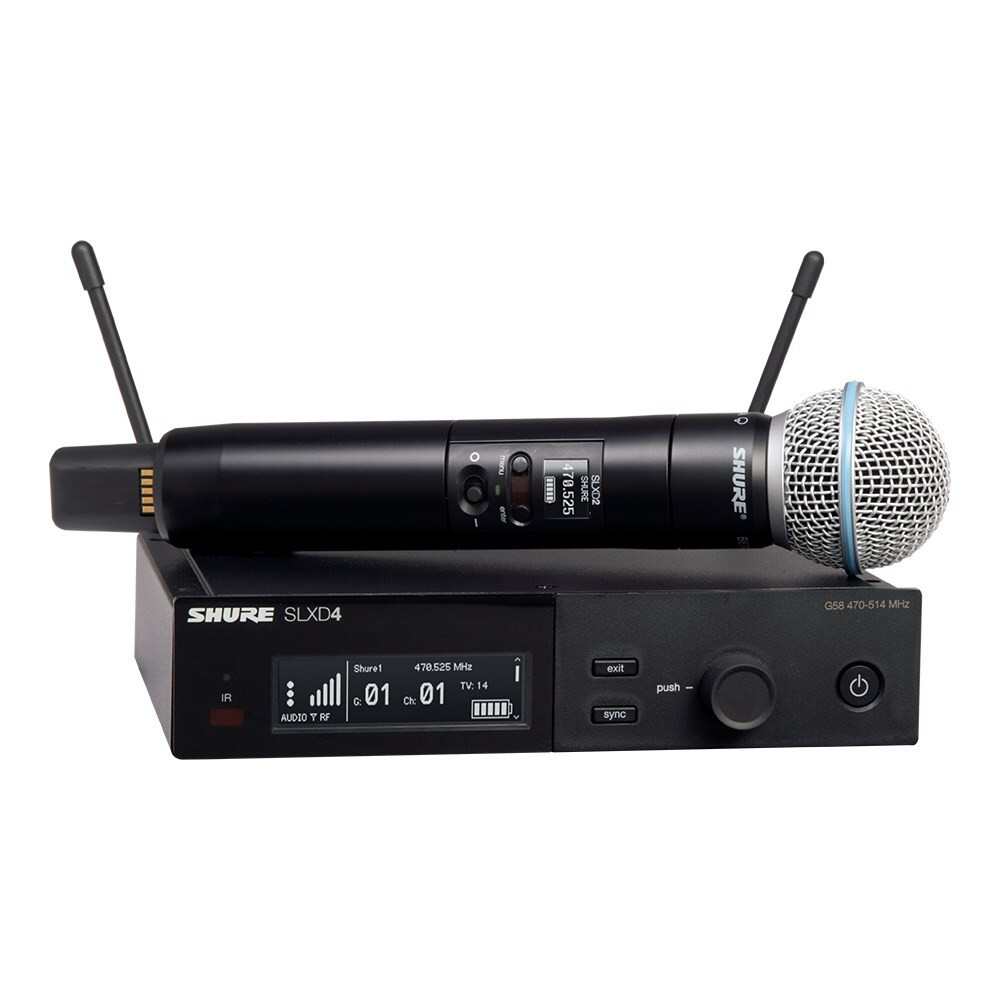
What You're Actually Buying: System Overview
The SLXD24 is a half-rack single-channel digital wireless receiver bundled with the SLXD2 handheld transmitter fitted with a Beta58A capsule. The "H57" designation refers to the tuning band - in this case the 520-564 MHz UHF range - which is a critical detail for Australian buyers, so we'll come back to that. This is a true digital system, not an analogue system with a digital display bolted on. The audio is converted to a 24-bit digital signal at the transmitter and transmitted across the RF link as data, which is fundamentally why it sounds and behaves the way it does.
At the heart of the transmitter sits the Beta58A, arguably one of the most recognisable stage vocal capsules ever produced. It's a supercardioid dynamic element, and pairing it with digital wireless transmission gives you a combination that's been road-tested on stages worldwide for decades - now delivered without the compression companding artefacts that plagued older analogue wireless.
Core Technical Specifications
| Specification | Detail |
|---|---|
| System type | Digital wireless, UHF |
| Audio resolution | 24-bit / 48 kHz |
| Modulation | Shure proprietary digital predictive switching diversity |
| Frequency band (H57) | 520-564 MHz |
| Tuning bandwidth | 44 MHz per band |
| Latency | 3.2 ms |
| Audio frequency response | 20 Hz - 20 kHz (capsule dependent) |
| Dynamic range | >120 dB (A-weighted) |
| Simultaneous channels (per band) | Up to 32 (region/bandwidth dependent) |
| Transmitter capsule | Beta58A supercardioid dynamic |
| Transmitter power output | 10 mW |
| Battery | 2x AA or Shure SB903 rechargeable |
| Runtime | Up to 8 hours (AA alkaline) |
| Operating range | Up to 100 m line-of-sight |
| Receiver form factor | Half-rack, mountable |
The Digital Advantage: Why 24-Bit Matters Here
The single most important technical distinction between the SLXD series and cheaper analogue wireless comes down to how the audio travels across the air. Analogue wireless systems use a technique called companding - the audio is compressed before transmission and expanded on the other end to fit within the available RF bandwidth. This process works, but it introduces subtle artefacts: a slight "breathing" on the noise floor, altered transient response, and a dynamic range ceiling that no amount of good capsule design can overcome.
The SLXD24 sidesteps all of this. By converting the signal to 24-bit digital audio at 48 kHz, it transmits a true representation of what the capsule captures. The practical result is a system with greater than 120 dB of dynamic range - meaning it handles a whispered introduction and a belted chorus with the same composure, without the noise floor swelling audibly between phrases. For anyone who has fought with analogue wireless hiss on quiet passages, this is an immediately noticeable improvement.
There's a trade-off worth understanding, though. Digital conversion introduces latency. The SLXD24's 3.2 ms figure is genuinely low for a digital system and sits comfortably below the threshold where most vocalists notice any delay through stage monitors or in-ear systems. For context, sound travels roughly one metre in about 3 ms through air, so the wireless link adds no more delay than standing a metre further from your monitor wedge. It's a non-issue in practical use.
RF Performance and Spectrum Efficiency
Where digital transmission really earns its keep is spectrum efficiency. Because the SLXD24 transmits data rather than a continuous analogue carrier, it packs more usable channels into the same slice of UHF spectrum. Within a single frequency band you can run up to 32 compatible systems simultaneously depending on regional spectrum and channel bandwidth - a figure that comfortably outstrips comparable analogue systems in the same price tier.
The receiver uses predictive diversity with two antennas, continuously evaluating signal quality and switching to whichever antenna delivers the cleaner path. Combined with the digital signal's inherent resistance to the gradual degradation analogue suffers, the audible result is different in character: instead of increasing hiss and dropouts as you approach the range limit, a digital system holds full quality right up until it doesn't. The up to 100 metre line-of-sight range is more than sufficient for pub gigs, function centres, and mid-sized halls.
The H57 Band: Read This Before You Buy in Australia
This is the single most important thing to verify before purchasing any UHF wireless system in Australia, and it trips up more buyers than any spec on the sheet. Wireless microphones operate in frequency bands that are regulated by the Australian Communications and Media Authority (ACMA), and the available spectrum has shifted over the years as portions were reallocated for mobile broadband (the "digital dividend").
The H57 band covers 520-564 MHz. This sits within the range that remains available for licence-exempt wireless microphone use in Australia under current ACMA arrangements, making it a sensible and compliant choice for most users. That said, spectrum regulation is nuanced and can vary by location and over time, so it's always worth confirming the current status for your specific use case. The upside of the SLXD's 44 MHz of tuning bandwidth is that even within the band you have enormous flexibility to find clear frequencies and avoid interference from TV broadcast and other wireless gear operating nearby.
If you're comparing this system against a grey-import or an overseas-tuned unit, be extremely cautious - a transmitter tuned for a band that's been reallocated in Australia can be legally unusable and practically useless. Buying an Australian-market H57 unit from a local retailer removes that risk entirely. Check current availability and band details for the SLXD24/Beta58 H57 here.
The Beta58A Capsule: Why This Element, Specifically
Shure could have fitted any number of capsules to this transmitter, and the choice of the Beta58A tells you who this system is aimed at. The Beta58A is a supercardioid dynamic capsule, and that supercardioid polar pattern is the defining characteristic. Compared to the standard cardioid SM58, the supercardioid pattern has a tighter pickup angle at the front and a small rear lobe of sensitivity.
In real-world terms, this means:
- Superior gain-before-feedback - the tighter pattern rejects more off-axis sound, letting you push monitor and PA levels higher before the system rings out. On loud stages this is a genuine advantage.
- Tighter rejection of stage bleed - drums, backline, and adjacent vocalists sit further back in the mix because the capsule simply hears less of them.
- A brighter, more present voicing - the Beta58A has a lifted presence peak that helps vocals cut through a dense band mix without heavy EQ.
The trade-off with supercardioid is that it demands slightly more disciplined mic technique - the rear lobe means monitor placement matters, and singers who wander off-axis will notice more level variation than with a cardioid. For trained performers this is a non-issue and the feedback rejection is well worth it. The capsule also incorporates a hardened steel grille and internal shock mount to reduce handling noise, which matters enormously for a handheld that gets passed around and gripped tightly under pressure.
Power, Runtime, and the Battery Question
The SLXD2 transmitter runs on two AA batteries, delivering up to 8 hours on quality alkalines - enough for a full day of rehearsal and a gig, or a lengthy service. But the more important detail for regular users is compatibility with the Shure SB903 rechargeable battery. When fitted with the SB903, the receiver's display shows accurate runtime remaining in hours and minutes rather than a vague three-segment battery icon.
This metering precision is a legitimately valuable feature that separates the SLXD series from budget wireless. Knowing you have "1 hour 47 minutes" remaining rather than "one bar" transforms battery management from guesswork into planning. For hire companies and venues running multiple systems, the rechargeable pathway also drastically reduces the ongoing cost and environmental waste of disposable AAs over the system's life.
How It Compares: Positioning Against Alternatives
| Consideration | SLXD24/Beta58 | Typical analogue UHF | Higher-tier digital (ULX-D) |
|---|---|---|---|
| Audio transmission | 24-bit digital, no companding | Analogue companded | 24-bit digital |
| Dynamic range | >120 dB | Typically <110 dB | >120 dB |
| Latency | 3.2 ms | ~1 ms (analogue) | 2.9 ms |
| Encryption | Not standard | None | AES-256 available |
| Networking/Dante | No | No | Yes (some models) |
| Relative cost | Mid | Low | High |
The honest assessment: the SLXD24 gives you the core audio quality benefits of Shure's flagship digital platforms - the same 24-bit resolution and clean dynamic performance - without the networking, encryption, and advanced spectrum management of ULX-D and Axient. For the vast majority of live performers, worship teams, and event operators who need one to a handful of channels of superb-sounding wireless, those flagship features are overkill. This is precisely the calculation Shure made when they positioned SLX-D, and it's why the system has become such a popular workhorse.
Against analogue systems at a similar or slightly lower price, the SLXD24's advantages in audio cleanliness, channel density, and battery metering are substantial enough that it's genuinely hard to recommend analogue for a new purchase unless budget is the absolute deciding factor.
What the Specs Don't Tell You: Practical Considerations
- Frequency coordination scales with channel count. A single SLXD24 sets up in minutes with automatic frequency scanning. Running eight or more systems requires proper coordination - the SLXD does this well, but plan setup time accordingly for multi-channel deployments.
- The Beta58A voicing is a commitment. If your vocalists are used to an SM58's warmer, more forgiving character, the Beta58A's brighter presence will sound different. Most find it an upgrade for live cut-through, but it's worth an ears-on comparison if you can.
- Half-rack form factor is deceptively convenient. Two receivers mount side by side in a single rack unit, making this an efficient choice for small racks and portable systems.
- Digital means clean-until-cliff. Manage your range and RF environment properly; digital doesn't warn you with gradual hiss the way analogue does. Watch the receiver's RF meter.
Who Should Buy This System
The SLXD24/Beta58 H57 is an excellent fit for solo performers and duos wanting professional wireless vocal reproduction, houses of worship needing reliable single-channel systems with easy battery management, function and covers bands who value feedback rejection on loud stages, and hire companies wanting a durable, great-sounding rental unit that clients recognise and trust. It's a particularly strong choice if audio quality is a priority but you don't need Dante networking or encryption.
It's less ideal if you specifically need encrypted transmission for confidential applications, require Dante integration into a networked audio system, or genuinely need the highest possible channel counts across a large festival-scale deployment - in those cases, stepping up to ULX-D or Axient is the right call.
Frequently Asked Technical Questions
Is the SLXD24 legal to use in Australia?
The H57 band (520-564 MHz) sits within spectrum available for wireless microphone use under current ACMA arrangements, making it a compliant choice for most users. Because spectrum rules can vary and evolve, buying an Australian-market unit from a local retailer is the safest way to ensure ongoing compliance for your situation.
Can I mix the SLXD2 handheld with other Shure capsules?
Yes. The SLXD2 transmitter accepts interchangeable Shure capsules including the SM58, SM86, Beta58A, and Beta87A, so you can retune the vocal character without buying a new transmitter body.
Does the 3.2 ms latency cause problems with in-ear monitors?
No. At 3.2 ms the delay is well below the threshold most performers can perceive and is equivalent to standing one metre further from a speaker. It's a non-issue for both wedge and in-ear monitoring.
How many can I run at once?
Within the H57 band you can operate up to 32 compatible systems simultaneously, subject to available clear spectrum in your location. For a single unit, setup is automatic via the receiver's frequency scan.
The Verdict
The Shure SLXD24/Beta58 H57 represents one of the smartest value propositions in mid-tier wireless. It delivers the audio characteristics that genuinely matter - true 24-bit digital transmission, greater than 120 dB dynamic range, low 3.2 ms latency, and the trusted supercardioid Beta58A capsule - without loading you up with flagship features most users will never touch. The clean digital audio, excellent battery metering with the SB903 pathway, and strong RF performance make it a system you can trust night after night. For Australian performers and venues wanting professional wireless that sounds superb and simply works, it's an easy recommendation. View the Shure SLXD24/Beta58 H57 at MusiconStage and confirm current stock and band availability before you buy.