
Shure GLXD24/SM58 Wireless System: Technical Review 2026
Shure GLXD24/SM58 Wireless Digital Handheld System: The Complete Technical Review (2026)
Few microphone names carry the weight of the Shure SM58. It's been the workhorse of stages worldwide for decades. So when Shure married that legendary capsule to its GLX-D digital wireless platform, the result was a system that promised studio-grade transmission with the bulletproof reliability performers expect. But specifications tell the real story — and the GLXD24/SM58 has plenty worth dissecting.
In this technical deep-dive, we'll break down exactly what makes this system tick, how its 2.4 GHz digital architecture compares with traditional UHF rivals, and whether the spec sheet justifies the investment for Australian musicians, venues and AV professionals.
System Overview: What You're Actually Buying
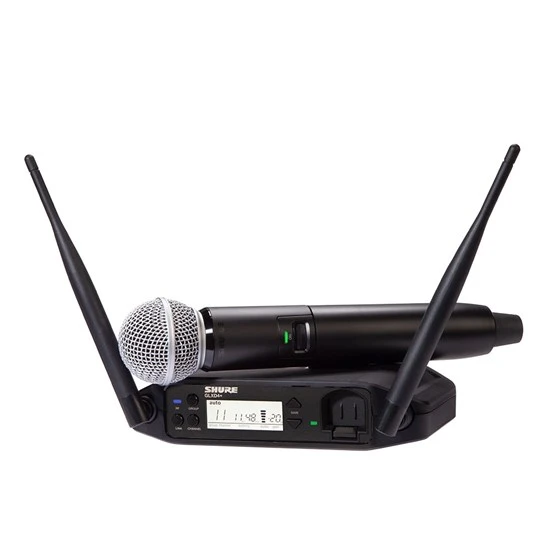
The GLXD24/SM58 is a complete two-piece wireless system comprising the GLXD4 tabletop receiver and the GLXD2 handheld transmitter fitted with the SM58 cardioid dynamic capsule. Unlike entry-level wireless kits that pair a generic capsule with a transmitter, this system delivers the genuine SM58 — the same element found in the wired version that has defined live vocal sound since 1966.
What sets this apart from older analogue wireless is the digital signal chain. Audio is converted, transmitted and reconstructed entirely in the digital domain, eliminating the companding artefacts and noise-floor compromises that plague budget analogue systems.
| Specification | GLXD24/SM58 System |
|---|---|
| Operating Band | 2.4 GHz ISM (globally license-free) |
| Audio Resolution | 24-bit / 44.1 kHz digital |
| Frequency Response | 20 Hz – 20 kHz |
| Dynamic Range | >120 dB (system, A-weighted) |
| Audio Latency | ~4 ms |
| Operating Range | Up to 30 m (100 ft) line of sight |
| Capsule | SM58 cardioid dynamic |
| Battery | Shure SB902 rechargeable Li-ion |
| Battery Life | Up to 16 hours per charge |
| Simultaneous Systems | Up to 8–11 (region dependent) |
| Frequency Management | LINKFREQ automatic |
The 2.4 GHz Question: Why Shure Went Digital
This is the single most important technical decision behind the GLX-D platform, and it's worth understanding properly because it affects everything else.
Traditional professional wireless operates in the UHF television bands. The problem? In Australia, the spectrum landscape has shifted dramatically — the 700 MHz band was reallocated to mobile carriers years ago, and ongoing spectrum repacks mean UHF wireless users must remain vigilant about which frequencies are legal to operate. Worse, crowded UHF environments in metro areas can require careful coordination.
The GLXD24/SM58 sidesteps all of this by operating in the 2.4 GHz ISM band — the same globally license-free spectrum used by Wi-Fi and Bluetooth. There's no licensing requirement, no spectrum-repack anxiety, and the system works identically whether you're gigging in Sydney, Perth or touring overseas.
The trade-off is that 2.4 GHz is a shared, sometimes congested band. Shure's answer is its LINKFREQ Automatic Frequency Management, which continuously scans the spectrum, identifies clear channels and automatically moves the link if interference appears. The receiver and transmitter maintain a back-channel so the system can hop intelligently rather than simply dropping out. In practice, this makes the system remarkably resilient even in venues saturated with Wi-Fi traffic.
What 24-bit / 44.1 kHz Actually Delivers
The headline audio spec is genuine 24-bit digital transmission. For non-engineers, here's why that matters: 24-bit resolution provides a theoretical dynamic range exceeding 140 dB, which means the system can capture the quietest breath and the loudest belted note without audible quantisation noise or the "pumping" you hear from analogue companders.
The quoted >120 dB system dynamic range comfortably exceeds what most live PA systems can reproduce, meaning the wireless link is never the weak point in your signal chain. The flat 20 Hz–20 kHz response preserves the SM58's natural voicing rather than colouring it the way cheap wireless often does.
The SM58 Capsule: Performance Under the Hood
No technical review of this system is complete without examining the capsule, because it's the component that actually touches the sound.
The SM58 is a moving-coil dynamic element with a tailored frequency response built specifically for vocals. Its key characteristics:
- Cardioid polar pattern — rejects sound from the rear, maximising gain-before-feedback and isolating the vocalist from stage spill and monitor wedges.
- Presence boost — a gentle rise in the 2–6 kHz region that adds clarity and intelligibility, helping vocals cut through a dense mix.
- Bass roll-off — controlled low-end that counteracts proximity effect, so close-mic technique won't turn muddy.
- Pneumatic shock mount and integral pop filter — minimises handling noise and plosives, which is exactly why it survives real-world stage abuse.
The practical upshot is feedback resistance. In reverberant rooms — function centres, school halls, houses of worship — the SM58's tight cardioid pattern gives engineers meaningful headroom before the system rings. That's a genuine technical advantage no amount of EQ wizardry can fully replicate.
View full specifications and current pricing on the Shure GLXD24/SM58 at MusiconStage →
Battery Technology: The Underrated Standout
Here's a spec that quietly separates the GLX-D from much of its competition. Where most wireless handhelds run on disposable AA batteries with unpredictable runtime, the GLXD2 transmitter uses Shure's SB902 intelligent rechargeable lithium-ion battery.
This isn't a minor convenience feature — it's a meaningful operational and cost advantage:
- Up to 16 hours of continuous use per charge, comfortably covering even the longest event days.
- Accurate runtime metering — because the battery is intelligent, the receiver displays remaining time in hours and minutes, not a vague three-bar gauge. You know precisely when you need to swap.
- Fast charging — roughly 15 minutes of charge yields about an hour of operation, ideal for between-set top-ups.
- Long-term economy — eliminating disposable AAs pays for itself quickly for anyone gigging weekly, and it's the more environmentally responsible choice.
Over a few years of regular use, the savings on disposable batteries alone can offset a significant portion of the system's purchase price — a point worth factoring into any total-cost-of-ownership comparison.
Range, Latency and Real-World Performance
The quoted 30 metre (100 ft) line-of-sight range is conservative and realistic. For the overwhelming majority of applications — pub stages, conference rooms, places of worship, school auditoriums, wedding receptions — this is more than ample. Range claims on wireless gear are notoriously optimistic across the industry, so Shure's relatively modest figure reflects dependable real-world performance rather than a best-case lab number.
Latency sits at approximately 4 milliseconds. For context, that's well below the threshold where performers perceive any delay between singing and hearing themselves through monitors — sound travels roughly 1.4 metres in 4 ms, so the wireless adds less delay than standing a step further from your speaker. Vocalists won't feel the system fighting them.
Multi-System Scalability
For bands and multi-mic productions, the GLX-D platform supports running up to 8–11 compatible systems simultaneously depending on the regional variant and RF environment. The automatic frequency management coordinates these so you don't need an RF technician to deploy a handful of channels. For larger deployments, the rack-mount GLXD-R variants offer frequency diversity and tighter coordination, but for most users the tabletop GLXD4 receiver here is the right tool.
How It Compares: GLXD24/SM58 vs The Alternatives
Technical buyers want context, so let's position this system honestly against its real competitors.
| Factor | Shure GLXD24/SM58 | UHF Analogue Systems | Budget 2.4 GHz Kits |
|---|---|---|---|
| Audio quality | 24-bit digital, no companding | Analogue, compander artefacts | Variable, often compressed |
| Capsule | Genuine SM58 | Varies by system | Generic capsules |
| Licensing | License-free worldwide | Spectrum-dependent | License-free |
| Battery | Intelligent Li-ion, 16 hrs | Usually AA | Usually AA |
| Interference handling | Automatic, intelligent hopping | Manual coordination | Often basic/none |
| RF range | 30 m reliable | Often longer | Variable |
Versus premium UHF (e.g. Shure's own QLX-D or ULX-D): High-end UHF still wins on raw range and on very-high-channel-count deployments for large touring productions. If you're running 20+ channels across a festival stage, UHF remains the professional standard. But UHF demands frequency coordination expertise and ongoing spectrum awareness — overkill for the gigs the GLXD24 is designed for.
Versus budget 2.4 GHz systems: Cheaper 2.4 GHz handhelds may share the same band, but they rarely match the GLX-D's intelligent frequency management, genuine 24-bit path, authentic SM58 capsule or rechargeable intelligent battery. This is precisely where the price difference is justified by tangible engineering.
What Specifications Actually Matter for Buyers
If you're evaluating wireless systems, here's how to read the spec sheet like an engineer:
- Capsule first, transmitter second. The element determines your tone and feedback behaviour. A genuine SM58 is a known, trusted quantity — generic capsules are a gamble.
- Dynamic range over advertised "clarity." A >120 dB figure tells you the link won't compress or add noise. Beware systems that don't publish this number.
- Frequency agility, not just frequency band. Operating at 2.4 GHz is meaningless without intelligent interference management. LINKFREQ is the differentiator here.
- Battery metering precision. "Up to X hours" matters less than knowing exactly how many minutes remain mid-show. Intelligent batteries remove the guesswork.
- Latency under 5 ms. Anything higher risks a perceptible delay in monitoring; the GLXD24's ~4 ms is well within safe territory.
Technical Red Flags to Avoid
- Systems that don't publish dynamic range or latency figures — usually because the numbers aren't flattering.
- UHF systems sold without clear guidance on legal operating frequencies for Australia.
- "24-bit" claims paired with heavy companding — read the full signal-path description, not just the headline.
- No automatic frequency management on a 2.4 GHz system — you'll be fighting Wi-Fi manually.
Who Should Buy the GLXD24/SM58?
This system hits a clear sweet spot. It's ideal for:
- Solo performers and singer-songwriters who want set-and-forget reliability without RF coordination headaches.
- Cover bands and function acts running a few wireless channels who value the SM58's feedback resistance in difficult rooms.
- Houses of worship, schools and corporate AV needing dependable speech and vocal reproduction with minimal technical oversight.
- Touring musicians who cross regions and need a license-free system that works identically everywhere.
It's arguably less suited to very-high-channel-count festival productions or applications demanding range well beyond 30 metres — those remain UHF territory.
Frequently Asked Technical Questions
Will it interfere with the venue's Wi-Fi?
The system coexists with Wi-Fi rather than blocking it, and LINKFREQ steers the audio link around congestion. In extremely saturated environments, positioning the receiver with clear line of sight and keeping it away from large Wi-Fi access points yields the most stable results.
Is the wireless SM58 the same as the wired SM58?
The capsule element is the genuine SM58 cardioid dynamic, so the core tonal character and feedback behaviour match the wired classic. The handheld transmitter adds the digital electronics and rechargeable battery in the body.
Can I run multiple GLXD24 systems together?
Yes — up to 8–11 compatible systems depending on the regional variant and RF conditions, with the platform coordinating frequencies automatically.
What happens when the battery runs low mid-set?
The receiver displays remaining runtime in hours and minutes, so you'll have clear warning. A short 15-minute charge delivers roughly an hour of operation if you need an emergency top-up.
The Verdict: Engineering That Earns Its Price
The Shure GLXD24/SM58 is a genuinely well-engineered system that solves real problems Australian performers face: spectrum uncertainty, battery anxiety and the perennial fight against feedback in less-than-ideal rooms. Its 24-bit digital path, intelligent automatic frequency management, authentic SM58 capsule and intelligent rechargeable battery aren't marketing buzzwords — each maps to a tangible operational benefit.
For the working musician, AV professional or venue that needs dependable, great-sounding wireless without the complexity of high-end UHF coordination, this system represents one of the strongest value propositions in its class. The specifications hold up to scrutiny, and the real-world performance follows.
If a license-free, studio-grade digital wireless system built around the world's most trusted vocal capsule fits your requirements, the GLXD24/SM58 deserves a place at the top of your shortlist.
Check availability and order the Shure GLXD24/SM58 wireless system at MusiconStage →