
Shure GLXD24/SM58 Wireless System: A Beginner's Guide to Going Wireless 2026
Shure GLXD24/SM58 Wireless System: A Beginner's Guide to Going Wireless in 2026
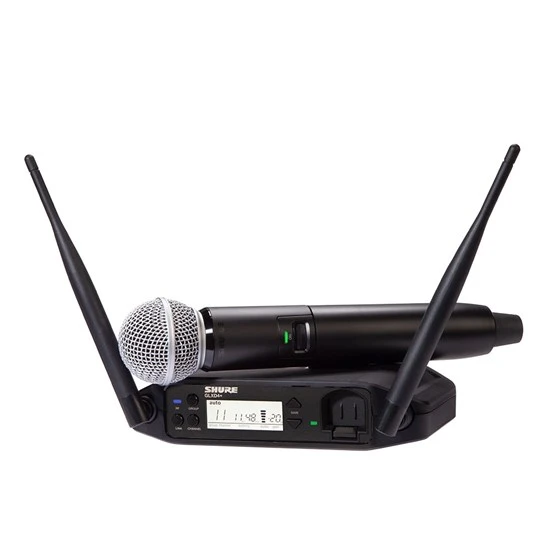
If you've ever watched a singer move freely across a stage — no cable trailing behind them, no awkward tangles mid-performance — you've seen a wireless microphone system at work. And if you're now thinking about making the jump from a wired mic to wireless yourself, you're in the right place.
The Shure GLXD24/SM58 is one of the most popular wireless microphone systems in Australia, and for good reason. It pairs Shure's legendary SM58 microphone capsule (the same one you'll find on stages worldwide) with modern digital wireless technology. But if terms like "digital wireless," "frequency management," and "bodypack receiver" already sound confusing, don't worry — we're going to break everything down in plain English.
By the end of this guide, you'll understand exactly what this system does, who it's for, and whether it's the right choice for your needs.
What Is a Wireless Microphone System, Exactly?
Let's start with the basics. A wireless microphone system has two main parts:
- A transmitter — this is the part you hold or clip on. It picks up your voice (or instrument) and sends the audio signal through the air using radio waves.
- A receiver — this sits near your mixer, PA system, or audio interface. It catches those radio waves and converts them back into an audio signal you can plug into your sound system.
Think of it like a walkie-talkie, except instead of talking back and forth, your voice travels one way — from the microphone to the sound system — with studio-quality audio the whole way.
With the Shure GLXD24/SM58, the transmitter is built into the handheld microphone itself. You hold it, sing or speak into it, and the receiver (which sits on a table or mounts in a rack) does the rest. No cables between you and the sound system.
Why the SM58 Capsule Matters (Even If You're New to All This)
Here's something worth understanding: the "SM58" in this product's name isn't just a model number. The Shure SM58 is arguably the most famous microphone in the world. It's been the go-to vocal mic on stages since 1966 — yes, for over 60 years.
Why does that matter to you as a beginner? A few reasons:
- It sounds great on voices. The SM58 was specifically designed for vocals. It has a natural warmth and a presence boost that helps vocals cut through a mix without sounding harsh.
- It handles loud volumes without distortion. Whether you're a quiet spoken-word performer or a belting rock vocalist, the SM58 capsule copes beautifully.
- It rejects background noise. The SM58 uses a "cardioid" pickup pattern — meaning it mainly captures sound from directly in front of it. This helps reduce feedback (that awful squealing sound) and keeps stage noise from bleeding into your mic.
- It's nearly indestructible. There are legendary stories of SM58s surviving being run over by trucks. While we don't recommend testing that, the point is this mic is built to last.
So when you buy the GLXD24/SM58, you're getting that trusted SM58 sound — just without the cable.
Digital vs Analogue Wireless: What's the Difference?
If you've started researching wireless mics, you might have noticed some are labelled "digital" and others "analogue." Here's the simple version:
Analogue wireless (the older technology) converts your voice into a radio signal directly. It works, but it can pick up interference — you might hear hissing, buzzing, or even taxi radio chatter bleeding through in worst-case scenarios.
Digital wireless (what the GLXD24 uses) converts your voice into digital data first — essentially ones and zeros, like a music file — then transmits that data wirelessly. The receiver decodes it back into audio. The advantages are significant:
- Cleaner audio — no companding artefacts (a subtle "breathing" sound that analogue systems can produce)
- Better interference rejection — digital signals are much harder to disrupt
- Automatic frequency management — the system finds clear channels on its own (more on this shortly)
- Consistent sound quality — whether you're one metre or thirty metres from the receiver, the audio stays the same
For beginners, digital wireless is genuinely easier to use. You spend less time troubleshooting and more time performing.
Understanding the GLXD24/SM58: Key Features Explained Simply
Automatic Frequency Management (LINKFREQ)
This is one of the GLXD24's best features for beginners, and here's why: with older wireless systems, you had to manually find a clear radio frequency — and if someone nearby was using the same frequency, you'd get interference. It was fiddly and sometimes stressful.
The GLXD24 uses Shure's LINKFREQ technology, which automatically scans the environment and selects the best available frequency. It even monitors during use and can hop to a cleaner channel if interference appears. You essentially turn it on and it sorts itself out. For someone new to wireless, this is a genuine game-changer.
2.4 GHz Band Operation
The GLXD24 operates on the 2.4 GHz frequency band. What does that mean for you? Two important things:
- No licensing required in Australia. Some wireless systems use UHF frequencies that require coordination or licensing from the ACMA (Australian Communications and Media Authority). The 2.4 GHz band is licence-free worldwide, so you can use this system anywhere without paperwork or fees.
- Works internationally. If you travel with your gear, this system operates legally in virtually every country — handy for touring musicians.
The trade-off? The 2.4 GHz band is also used by Wi-Fi routers, Bluetooth devices, and other electronics. Shure's intelligent frequency management handles this well, but it's worth knowing that extremely Wi-Fi-dense environments (like a tech conference with hundreds of laptops) can sometimes pose challenges.
Rechargeable Battery System
The GLXD24/SM58 comes with a built-in rechargeable lithium-ion battery in the handheld transmitter. You'll get approximately 12 hours of continuous use on a full charge — that's enough for multiple gigs or a full day of presentations without worrying about power.
The transmitter charges directly via the receiver when docked, or you can charge it with a USB cable. No more buying AA batteries before every performance. Over time, this saves you a surprising amount of money and hassle.
The receiver displays the remaining battery life, so you always know where you stand.
Operating Range
Shure rates the GLXD24 at up to 30 metres (about 100 feet) of operating range in typical conditions. For most applications — pub gigs, church services, corporate presentations, school events, small-to-medium venues — that's more than adequate.
If you need to cover a very large venue (a major concert hall or outdoor festival), you'd typically step up to Shure's higher-tier systems like the QLXD or ULXD ranges. But for the vast majority of Australian performers and presenters, 30 metres is plenty of freedom.
Build Quality
The handheld transmitter has the same rugged metal construction you'd expect from an SM58. It feels solid and professional in the hand — not plasticky or cheap. The receiver is compact and can sit on a table, mount in a standard equipment rack, or be tucked out of sight near your PA system.
Who Is the GLXD24/SM58 Actually For?
This system hits a sweet spot that makes it suitable for a wide range of users:
- Solo musicians and singers playing pubs, clubs, weddings, and functions across Australia
- Cover bands wanting reliable wireless without the complexity of professional touring systems
- Public speakers and presenters who need to move around a room or stage
- Churches and worship teams — this is one of the most popular wireless choices for Aussie churches
- Schools and community groups running events, concerts, and assemblies
- DJs and MCs who need a quality wireless mic for announcements
- Content creators who want professional vocal capture without being tethered to a desk
If you're performing or speaking in venues with capacities up to a few hundred people, this system is genuinely excellent. It's professional enough that you won't outgrow it quickly, yet accessible enough that a complete beginner can set it up in minutes.
Setting Up the GLXD24/SM58: What to Expect
One of the best things about this system for newcomers is how straightforward setup is. Here's the basic process:
- Place the receiver near your mixer or PA system. Ideally, keep it within line of sight of where you'll be performing — avoid hiding it behind metal objects or inside closed cabinets.
- Connect the receiver to your mixer or PA using the included XLR cable (the standard three-pin audio cable used in professional sound).
- Power on the receiver and then switch on the handheld transmitter. They'll automatically link to each other — no manual frequency coordination needed.
- Check your audio levels on the mixer. Speak or sing into the mic at your normal volume and adjust as you would any microphone.
- You're live. That's genuinely it.
The whole process takes about two to three minutes. Compare that to older analogue wireless systems where you might spend fifteen minutes scanning frequencies and coordinating channels, and you can see why digital wireless has become so popular.
Common Beginner Mistakes to Avoid
Even with a system this user-friendly, there are a few things worth knowing:
Don't Cup the Microphone Head
We see this constantly — performers wrapping their hand around the mesh grille of the SM58. It looks cool (maybe), but it completely ruins the microphone's pickup pattern. Sound quality drops, feedback risk skyrockets. Hold the mic by the body, below the grille.
Keep the Receiver's Antennas Clear
Don't stack gear on top of the receiver or hide it behind metal objects. The antennas need a clear path to the transmitter for the best performance. Even a few centimetres of clearance makes a difference.
Charge Before Every Gig
Yes, the battery lasts 12 hours. But develop the habit of docking and charging after every use. The one time you forget is the time you'll be halfway through a set with a dying mic.
Don't Ignore the Battery Indicator
The receiver shows you remaining battery life. Glance at it during soundcheck. If you're below 30%, charge up before the show.
Start with One System
If you need multiple wireless mics (say, for a band), know that the 2.4 GHz band has limited channel capacity. Shure recommends a maximum of four GLXD systems operating simultaneously in the same space. If you need more channels, you'll want to look at their UHF-based systems.
How Does It Compare? Understanding Your Options
As a beginner, it helps to understand where the GLXD24/SM58 sits in the broader market:
- Budget wireless systems ($100–$300): These exist, but audio quality, reliability, and build quality are noticeably lower. For casual home use they might suffice, but for anything public-facing, the quality gap is real.
- Shure GLXD24/SM58 (mid-range, professional-grade): This is where you get genuinely professional sound and reliability without the complexity and cost of touring-grade systems. It's the sweet spot for most working musicians and presenters in Australia.
- Shure QLXD/ULXD and equivalent ($1,500+): These are touring and installation-grade systems with extended range, more simultaneous channels, advanced networking features, and metal rack-mount receivers. Overkill for most beginners, but essential for large venues and professional production companies.
The GLXD24/SM58 genuinely occupies the "best value for serious use" category. You're not compromising on sound quality — you're getting the same SM58 capsule the pros use — and the digital wireless technology is robust and reliable.
Frequently Asked Questions from Beginners
Can I use this with any PA system or mixer?
Yes. The receiver has a standard XLR output, which connects to virtually any mixer, PA system, powered speaker, or audio interface. If your gear has a microphone input, this system will work with it.
Do I need a licence to use this in Australia?
No. The 2.4 GHz band is licence-free in Australia. You can use the GLXD24 anywhere without ACMA licensing.
How far can I go from the receiver?
Up to approximately 30 metres in typical indoor conditions. Walls, metal structures, and other obstacles can reduce this, but for most venue sizes it's more than sufficient.
Can I use multiple GLXD systems at once?
Yes, up to about four systems simultaneously in the same space. Each system automatically finds its own clear frequency. If you need more than four wireless channels, consider Shure's UHF-based systems.
What if the battery dies during a performance?
The receiver shows remaining battery life, giving you advance warning. A full charge provides approximately 12 hours. If you're ever caught short, Shure also offers a battery adapter that accepts standard AA batteries as a backup.
Is the sound quality as good as a wired SM58?
Virtually identical. Shure's digital wireless technology transmits uncompressed audio, so you're hearing the SM58 capsule's natural sound without the degradation that older analogue wireless systems sometimes introduced.
Is it suitable for recording, or just live use?
Both. The receiver's XLR output can connect directly to an audio interface for recording. The clean digital transmission means you get excellent quality for studio, podcast, or content creation work as well.
What You'll Need (and What's Included)
The GLXD24/SM58 system typically includes:
- GLXD4 tabletop receiver
- GLXD2/SM58 handheld transmitter with built-in rechargeable battery
- USB charging cable
- Power supply for the receiver
- Microphone clip adapter
What you'll need separately:
- An XLR cable to connect the receiver to your mixer or PA (most sound setups already have these)
- A PA system, mixer, powered speaker, or audio interface to plug into
- A microphone stand if you want hands-free use (the included clip adapter fits standard stands)
Is the Shure GLXD24/SM58 Worth It for Beginners?
Here's an honest assessment: this isn't the cheapest wireless microphone system you can buy. But it's one of the best values in professional audio, and here's why that matters even for beginners.
Cheap wireless systems can create more problems than they solve — dropouts mid-performance, interference issues, poor sound quality, batteries dying unpredictably. These aren't just annoyances; they can genuinely undermine your confidence when you're starting out.
The GLXD24/SM58 removes those worries. It's a "set it and forget it" system that lets you focus on your performance, your presentation, or your message — not on whether your gear is going to let you down. For many Australian performers and speakers, it's the last wireless system they ever need to buy.
If you're serious about performing, speaking, or presenting — even if you're just beginning — investing in reliable, professional-grade gear from the start saves you money and frustration in the long run. You won't need to replace it as you improve.
Check out the Shure GLXD24/SM58 at MusiconStage — one of Australia's trusted music and audio retailers with local support and competitive pricing.
Getting Started: Your First Steps After Purchase
Once your GLXD24/SM58 arrives, here's a simple roadmap:
- Fully charge the transmitter before your first use. Dock it in the receiver or connect via USB and let it charge completely.
- Do a home test. Connect the receiver to whatever system you have — even a simple powered speaker works — and practice. Walk around, test the range in your space, and get comfortable with the feel of the mic.
- Learn proper mic technique. Hold the mic about 5–15cm from your mouth, pointed at your lips, and keep your hand below the grille. This single habit will dramatically improve your sound.
- Soundcheck at your venue. Arrive early to any gig or event. Set up the receiver, turn on the transmitter, and do a proper soundcheck before the audience arrives.
- Develop a charging routine. After every use, dock the transmitter or plug it in. Make it automatic, like charging your phone.
The learning curve with this system is genuinely gentle. Most people are comfortable within their first use.
Final Thoughts
Going wireless is one of those upgrades that, once you've made it, you'll wonder why you waited. The freedom to move, the cleaner stage setup, the elimination of cable-related issues — it all adds up to a more professional, more enjoyable experience.
The Shure GLXD24/SM58 is the system that thousands of Australian musicians, speakers, worship leaders, and presenters trust for exactly this purpose. It combines the world's most proven vocal microphone with intelligent, modern digital wireless technology — and it does it in a package that a complete beginner can set up in minutes.
Whether you're singing at your local pub, speaking at a corporate event, leading worship on Sunday morning, or hosting a school concert, this system delivers professional results without professional-level complexity.
Ready to go wireless? View the Shure GLXD24/SM58 at MusiconStage and take the next step.