
Shure DMK57-52 Drum Mic Kit: Australian Buyer's Guide 2026
Shure DMK57-52 Drum Mic Kit: The Honest Australian Buyer's Guide
Ask ten working sound engineers in Australia what they'd grab if they had to mic a drum kit tomorrow with a limited budget, and a surprising number will describe something almost identical to the Shure DMK57-52. Three SM57s, a Beta 52A on the kick, and clamps that let you get the 57s where they actually need to be. It's not a glamorous answer. It's just the one that keeps working, gig after gig, decade after decade.
This guide covers what's actually in the box, how each mic behaves on a real kit, where this kit falls short, and who should probably buy something else instead. If you're weighing this up against buying mics individually or stepping up to a seven-piece kit, that comparison is here too.
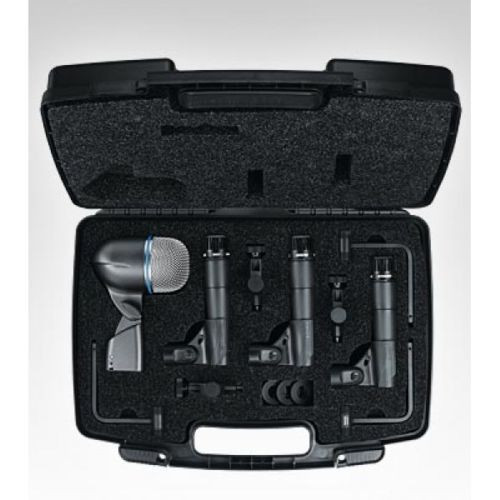
What's Actually in the Box
Shure has kept the DMK57-52 package consistent for years, which is genuinely useful when you're buying second-hand spares or replacing a single component. Here's the full contents:
- 3 × Shure SM57 — cardioid dynamic instrument microphones for snare and toms
- 1 × Shure Beta 52A — supercardioid dynamic kick drum microphone
- 3 × Shure A56D — universal drum microphone mounts (rim clamps with swivel adjustment)
- 1 × Hard-sided carrying case — moulded foam interior sized for the full kit
The A56D mounts deserve more attention than they usually get. Sold separately they're a meaningful chunk of the kit's value, and they're the difference between a workable drum setup and a forest of boom stands that the drummer will inevitably kick over during the second song. Each clamp grips drum rims from roughly 6mm to 13mm thickness and gives you tilt and rotation adjustment, so you can dial the 57 in over the snare without it fouling the hi-hat or the drummer's stick path.
Considering it? View the Shure DMK57-52 kit pricing and availability — genuine Shure stock with full Australian warranty.
The SM57 on Drums: Why It Still Wins
The SM57 has been in production since 1965, and its continued dominance on snare drums isn't nostalgia — it's a set of engineering choices that happen to suit percussion almost perfectly.
The presence peak does the work for you
The SM57's frequency response runs roughly 40Hz to 15kHz, but the shape matters more than the range. There's a broad presence lift centred around 5–6kHz, climbing several dB above the midrange. On a snare, that's exactly where stick attack and shell crack live. You get definition without reaching for an EQ, which matters when you're mixing a pub gig on a 16-channel analogue desk with two-band EQ per channel.
The flip side: that same peak can sound harsh on a bright piccolo snare or a heavily rimshot-driven player. A small high-shelf cut around 6kHz usually sorts it, but it's worth knowing the mic has an opinion.
Proximity effect is a tool, not a flaw
Being cardioid, the SM57 has substantial proximity effect — put it 25mm from a rack tom and you'll get a low-mid bloom that thickens the drum considerably. Experienced engineers use this deliberately. Thin-sounding 10" rack toms often come alive with a close 57; a boomy 16" floor tom might want the mic pulled back to 60–80mm and angled more across the head to tame it.
SPL handling that genuinely doesn't quit
Shure doesn't publish a maximum SPL figure for the SM57 because, practically speaking, there isn't one that matters. It's a passive moving-coil dynamic with no active electronics to overload. Drummers who hit hard — and metal, punk and hard rock players in Australian pub venues absolutely do — will not distort this microphone. The preamp will clip long before the capsule does.
Off-axis behaviour and bleed
This is the honest limitation. The SM57's cardioid pattern gives you roughly 6dB of rejection at 90° and around 25dB at 180°, but the rejection isn't equally effective across all frequencies. Hi-hat bleed into the snare mic is a real, permanent fact of life with this kit. The practical fix is placement discipline: aim the rear of the mic at the hi-hat, keep the capsule 25–40mm above the head near the rim, and angle it 45–60° toward the centre. Get that right and the bleed becomes usable ambience rather than a problem.
The Beta 52A: A Kick Mic With Strong Opinions
The Beta 52A is the component that separates this kit from a bag of general-purpose dynamics. It's purpose-built for kick drums and low-frequency sources, and it's voiced accordingly.
The frequency shape
The response runs 20Hz to 10kHz with two deliberate features: a low-end lift below 100Hz for weight, and a pronounced presence boost in the 3–5kHz region for beater attack. Between them sits a scoop through the low mids — roughly 300–600Hz — which is where the boxy, cardboard-y character of a kick drum tends to live.
What that means in practice: the Beta 52A delivers a modern, scooped kick sound almost straight out of the box. Plug it in, put it in the port, and you'll get something that sits in a rock or pop mix with minimal EQ. That's a genuine time-saver at soundcheck.
What it also means: if you want a warm, round, jazzy kick with plenty of body and a soft attack, the Beta 52A is fighting you. Jazz and acoustic-leaning engineers often prefer something flatter. This is a legitimate reason to consider a different kick mic, and it'd be dishonest not to say so.
Supercardioid and high SPL
The Beta 52A's supercardioid pattern gives tighter front-focused pickup than a standard cardioid, which helps reject hi-hat and cymbal wash on a loud stage. Maximum SPL is rated at 174dB — an absurd figure that means you can put it anywhere near a kick drum without concern.
It also has an integrated stand mount with a locking swivel rather than a separate clip, so it can sit on a short boom or a bass drum mount without extra hardware. Small thing, but it's one less part to lose in a dark load-out.
Placement that actually works
- Just inside the port, off-centre, aimed at the beater — maximum attack and click. Best for rock, metal, and anything needing definition through a loud mix.
- Centred inside the drum, halfway to the batter head — balanced attack and body. A safe default if you're unsure.
- Just outside the port, 50–100mm back — more low-end bloom and resonance, less click. Works well if you have a solid PA with real sub extension.
- Deep inside, close to the batter head — very clicky and dry. Useful for triggering or for very dense mixes, less pleasant on its own.
Move the mic 50mm and the sound changes more than any EQ move you'll make. Spend the time on placement first.
Setting Up a Four-Mic Kit: A Practical Approach
Four mics is a constraint, and constraints reward planning. Here's how most engineers deploy this kit on a standard five-piece.
The standard allocation
Beta 52A on kick, SM57 on snare, and the two remaining 57s on toms. With a five-piece kit (kick, snare, two rack toms, one floor tom) you're one mic short, so you choose: mic the two most-used toms, or position one 57 between two toms as a shared microphone.
The shared-mic approach works better than people expect. Place the 57 between a rack tom and floor tom, roughly equidistant, angled down at about 45°. You lose some level and isolation on each, but for pub and club work where toms are used for fills rather than featured parts, it's entirely serviceable.
The alternative allocation
Here's a genuinely useful trick that doesn't get mentioned often: kick, snare, and a spaced pair of SM57s as overheads. The 57s aren't condensers and won't give you glassy cymbal detail — but they will give you a raw, mid-forward drum image reminiscent of classic 60s and 70s recordings, and crucially, they're far more feedback-resistant than condensers on a loud stage.
For a live band in a small Australian venue where the drums are already loud in the room, this can produce a more coherent result than three close-miked toms. Worth experimenting with before you assume the standard allocation is the only option.
Phase and polarity
With four mics on one source, phase relationships matter. Two habits worth building:
- Check the kick and snare together. If the low end thins out when both are up, flip polarity on one and compare.
- Keep tom mics roughly the same distance from their drum heads. Wildly different distances create comb filtering when the drummer plays a fill across the kit.
The Australian Context: Costs, Warranty and Practicalities
Buying a bundled kit through an Australian retailer is meaningfully different from importing individual mics, and the difference isn't just price.
Warranty
Shure microphones carry a two-year limited warranty, and Australian purchases through an authorised dealer are supported locally rather than requiring an international return. Grey-market SM57s bought from overseas marketplaces sometimes aren't covered here at all — and given how many counterfeit SM57s circulate, buying through a legitimate Australian channel also means you're getting the real thing. Fake 57s look convincing externally and sound noticeably worse.
The bundle maths
Priced individually, three SM57s plus a Beta 52A plus three A56D mounts plus a hard case typically adds up to noticeably more than the DMK57-52. The saving is real, though it's worth being clear-eyed: you're only saving money if you actually want all four mics and the mounts. If you already own two SM57s, buying one more plus a Beta 52A separately may make more sense.
Cables and stands aren't included
Budget for four XLR cables and at least one short boom stand for the kick mic. The A56D mounts handle the toms and snare, but the Beta 52A needs either a short boom or a bass drum mount. This catches people out regularly.
Ready to go? Shop the Shure DMK57-52 drum mic kit with full Australian warranty and delivery nationwide.
Honest Pros and Cons
What it does well
- Reliability that's genuinely proven. SM57s survive being dropped, stepped on, rained on at outdoor gigs, and packed badly for years. Very few microphones can claim that.
- Enormous resale and redeployment value. If you stop miking drums, the SM57s become guitar cab mics, brass mics, and backup vocal mics. Nothing goes to waste.
- Zero learning curve. Every engineer, every venue, every rider knows these mics. Turn up with SM57s and nobody asks questions.
- The Beta 52A is a strong kick mic on its own merits. It'd be a reasonable purchase standalone.
- The mounts and case are real value, not filler to justify a bundle price.
Where it falls short
- No overhead or hi-hat microphones. This is the big one. Cymbals will only be captured as bleed. For recording, you'll want to add a pair of condensers.
- Only four channels. A six-piece kit or a drummer with two floor toms will leave you improvising.
- SM57s aren't the last word on toms. Purpose-built tom mics with wider low-frequency response and tighter patterns — the Beta 56A, or Sennheiser's e604 — offer better isolation and more low-end weight.
- The Beta 52A's voicing isn't universal. If your genre wants a warm, unscooped kick, look elsewhere.
- No case space for cables. The foam is cut for mics and mounts only.
How It Compares to the Alternatives
| Option | Mics included | Best suited to | Key trade-off |
|---|---|---|---|
| Shure DMK57-52 | 3× SM57, 1× Beta 52A | Live sound, versatile studios, multi-purpose use | No overheads; SM57s are generalists not specialists |
| Shure PGA Drum Kit | Kick, snare, toms, condensers | Beginners on tight budgets | Lower build quality; mics have little use outside drums |
| Shure DMK 7-piece kits | Beta 52A, Beta 57A/SM57, Beta 56A toms, condensers | Studios and larger stages needing full coverage | Substantially higher cost |
| Buying individually | Your choice | Engineers with specific preferences | Costs more; no case or mounts included |
| Audix DP4 / Sennheiser e600 kits | Purpose-built drum mics | Drum-focused isolation and tone | Mics are less useful for anything other than drums |
The distinction that matters most: purpose-built drum kits give you better drums; the DMK57-52 gives you better value across your whole rig. If drums are all you'll ever mic, an Audix or Sennheiser drum-specific kit is arguably a better tonal fit. If you're a band, a small hire company, a church, or a school building a general-purpose mic locker, the three SM57s will earn their keep on guitar amps, horns, and percussion long after the drum gig is over.
Who This Kit Is Genuinely Right For
Strong fit
- Gigging bands who want to bring their own drum mics rather than trust whatever the venue has
- Small hire companies and production outfits building durable, redeployable stock
- Churches and schools needing reliable, idiot-proof mics that survive rotating volunteer operators
- Home and project studios that already own a pair of condenser overheads and need close mics
- Rehearsal spaces where gear takes a beating
Consider something else if
- You're recording jazz or acoustic music and want a natural, unhyped kick sound
- You need a complete, ready-to-record solution including overheads in one purchase
- Your kit has six or more drums and you want everything individually miked
- You already own several SM57s — buy the Beta 52A on its own instead
- Maximum tom isolation is critical to your workflow
Common Questions
Do I need overheads as well?
For live sound in small to medium venues, usually not — cymbals are typically loud enough acoustically that they don't need reinforcement, and bleed into the snare and tom mics carries them adequately. For recording, yes. A pair of small-diaphragm condensers as overheads transforms what this kit can produce.
Will an SM57 work on kick drum instead of the Beta 52A?
It'll make a sound, but not a good one. The SM57's response rolls off well before you get the sub-100Hz weight a kick needs. That's precisely why the Beta 52A is in the kit.
Does the SM57 need phantom power?
No. Both the SM57 and Beta 52A are passive dynamic microphones. Phantom power won't damage them if it's on, but it does nothing useful either.
Can the A56D mounts fit any drum?
They fit standard drum rims from about 6mm to 13mm. Very thick die-cast hoops or unusually shaped rims can be a tight fit. They're not designed for rimless or vintage wooden-hoop drums.
How many preamp channels do I need?
Four, all with standard XLR mic inputs. No phantom power required, which means even basic mixers and older interfaces will handle this kit fine.
Can I use these mics for anything besides drums?
Absolutely, and this is a large part of the kit's value. SM57s are a studio standard on electric guitar cabinets, excellent on brass and saxophone, useful on acoustic guitar in loud environments, and perfectly adequate as backup vocal mics. The Beta 52A works well on bass cabinets and floor toms.
Is the case airline-safe as checked luggage?
It's a moulded case with foam, so it offers good protection, but it's not a road case with a locking latch system. For domestic flights within Australia it's generally fine; for frequent touring, most people transfer the mics into a larger flight case or rack drawer.
The Verdict
The Shure DMK57-52 isn't the most exciting drum microphone kit available, and it's not the one that will give you the most polished drum sound out of the box. What it is, is the one that keeps being useful.
Three SM57s and a Beta 52A is a combination that has been miking drums professionally since before most of us were doing sound, and the reason it persists is that it's honest gear: durable, predictable, forgiving of imperfect technique, and endlessly redeployable. The A56D mounts and case turn a collection of microphones into an actual working system you can pack and unpack in the dark.
Its limitations are clear and worth accepting knowingly. You'll want overheads eventually. A six-piece kit will stretch it. And the Beta 52A has a definite sonic personality that suits rock and pop more than jazz. None of that undermines the core proposition — for a gigging band, hire company, church, school or project studio in Australia, this remains one of the soundest value propositions in live audio.
If you're buying your first set of drum mics and you want something you'll still be using in fifteen years, this is a genuinely sensible place to start.
Browse the Shure DMK57-52 drum microphone kit at MusiconStage — genuine Shure product with full Australian warranty, expert advice from people who use this gear, and delivery across Australia.