
Shure BLX288/SM58 Dual Wireless System: Full K14 Specs & Guide 2026
Shure BLX288/SM58 Dual Wireless System: Full K14 Technical Breakdown for Australia 2026
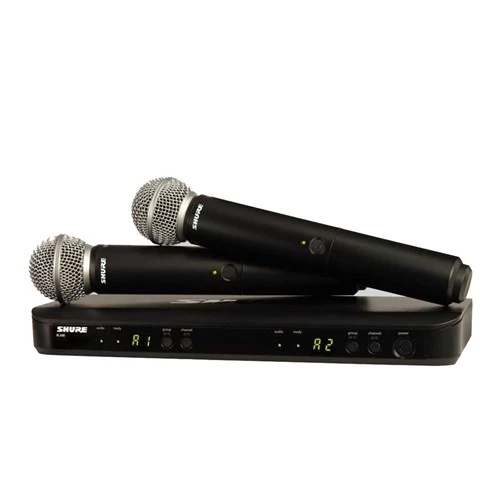
If you've spent any time around live sound in Australia — whether it's corporate AV, pub gigs, worship services, or community events — you've almost certainly heard an SM58 in action. Now pair two of them with a reliable dual-channel wireless receiver, and you've got the Shure BLX288/SM58. It's one of the most requested dual wireless packages in the country, and for good reason.
But "popular" doesn't always mean "right for your situation." In this guide, I'm going to pull apart every meaningful specification of this system, explain what the K14 frequency band actually means for Australian users, and give you the technical context to decide whether this is the correct investment for your setup — or whether you should be looking elsewhere.
What's Actually in the Box
The BLX288/SM58 combo system ships as a complete, ready-to-use package. Here's what you're getting:
- 1x BLX88 Dual-Channel Wireless Receiver — half-rack format, metal chassis
- 2x BLX2/SM58 Handheld Wireless Transmitters — each fitted with a genuine SM58 capsule
- 2x AA Batteries (for initial use)
- 1x Power Supply
- 1x Rack Mount Kit
- Quick Start Guide and documentation
It's worth noting that the SM58 capsules on these transmitters are identical to those found on the wired SM58. That's not always the case with wireless systems from other manufacturers, where the capsule may be a modified or budget variant. Shure uses the real thing here.
Complete Technical Specifications
Let's lay out the full spec sheet, then I'll explain which numbers actually matter and why.
| Specification | Detail |
|---|---|
| System Type | Dual-channel analogue wireless |
| Frequency Band (K14) | 614–638 MHz |
| Number of Channels | 2 independent channels |
| Compatible Frequencies | 12 preset channels per group (up to 12 compatible systems) |
| Operating Range | Up to 100 metres (line of sight) |
| RF Output Power (Transmitter) | 10 mW |
| Audio Frequency Response | 50 Hz – 15 kHz |
| Dynamic Range | >100 dB (A-weighted, typical) |
| THD | <0.5% at 1 kHz |
| Receiver Outputs | 2x XLR balanced, 2x 6.35mm (1/4") unbalanced |
| Receiver Format | Half-rack, single rack-space (with optional dual mount) |
| Transmitter Power | 2x AA batteries |
| Battery Life | Up to 14 hours per transmitter |
| Microphone Capsule | SM58 — cardioid dynamic |
| SM58 Capsule Frequency Response | 50 Hz – 15 kHz (wireless system limited) |
| Polar Pattern | Cardioid (unidirectional) |
| Companding | Shure proprietary companding |
| Receiver Dimensions | 197 x 140 x 43 mm |
| Transmitter Dimensions | 252 mm length, 51 mm diameter |
The K14 Frequency Band: Why It Matters in Australia
This is genuinely the most important technical detail for Australian buyers, and it's the one most often glossed over. The K14 band operates at 614–638 MHz, and it's specifically designated for use in Australia and the broader Asia-Pacific region.
Here's why this matters: Australia's radio spectrum is regulated by the ACMA (Australian Communications and Media Authority). Wireless microphone systems operating in certain UHF bands require compliance with local regulations. The K14 band sits within the spectrum that's been allocated for wireless audio devices following the digital dividend restack, which saw some older frequency bands (like the 694–820 MHz range) repurposed for mobile broadband.
Critical point: Do not purchase a BLX288 system in a different frequency band (such as H9, H10, or J10) and expect it to work legally or reliably in Australia. Those bands are allocated for different regions and may interfere with — or be interfered by — Australian telecommunications infrastructure. The K14 variant exists specifically for this market. If you're buying from an Australian retailer like MusiconStage, you're getting the correct band. Just be wary of grey imports.
With 12 preset frequency channels available within the K14 band, you can run up to 12 compatible BLX systems simultaneously in the same venue. That's 12 microphones if using single-channel receivers, or 24 mics across 12 dual-channel units — though in practice, RF coordination and local interference will usually limit you before hitting that theoretical maximum.
SM58 Capsule: Technical Deep Dive
The SM58 capsule has been an industry standard since 1966. That's not hyperbole — it's a statement of engineering longevity that few products in any industry can match. But what actually makes it work so well in a wireless context?
Cardioid Polar Pattern Performance
The SM58's cardioid pattern provides approximately 6 dB of rejection at 180 degrees (directly behind the microphone). In a live setting, this translates to meaningful isolation from foldback wedges, room noise, and other sources behind the vocalist. It's not the tightest rejection pattern available — hypercardioid capsules offer more — but cardioid provides the most forgiving pickup angle for vocalists who move around naturally.
The pickup angle is roughly 130 degrees wide at -3 dB, meaning a singer can move quite a bit before you notice significant level drop. For presenters, MCs, and performers who aren't surgically attached to a mic stand, this is a genuine advantage.
Proximity Effect and Handling
Like all cardioid dynamic microphones, the SM58 exhibits proximity effect — a bass boost that increases as the sound source gets closer to the capsule. Experienced vocalists use this to their advantage, working the mic for tonal colour. Less experienced users might find things getting muddy when they cup the grille or press their lips right against it.
The pneumatic shock mount system inside the SM58 capsule is specifically engineered to reduce handling noise. In a wireless context, this is critical — there's no cable to act as a strain relief, and performers tend to handle wireless mics more aggressively than wired ones. The SM58's handling noise rejection is genuinely excellent for its price point.
The 50 Hz – 15 kHz Reality
You'll notice the system's audio frequency response tops out at 15 kHz rather than the 20 kHz you might expect from a studio microphone. This is a deliberate design choice in the BLX analogue wireless system. The companding process (compression at the transmitter, expansion at the receiver) and the analogue FM transmission introduce a bandwidth limitation.
In practice? For vocal applications, 15 kHz is absolutely sufficient. The fundamental frequencies of the human voice sit between roughly 85 Hz and 300 Hz, with harmonics and sibilance extending to around 8–12 kHz. The 15 kHz ceiling means you're capturing everything that matters for speech and singing. You'd only notice the limitation if you were trying to use this system for close-miking instruments with significant high-frequency harmonic content — cymbals, for instance — which isn't what this system is designed for.
Receiver Architecture and Connectivity
The BLX88 dual receiver packs two independent receiver channels into a half-rack form factor. Each channel operates with its own antenna, frequency selection, and output path. The receiver uses dual-antenna diversity on each channel, meaning it's constantly monitoring signal strength across two antennas and switching to whichever provides the stronger signal. This significantly reduces dropout risk from multipath interference — the bane of wireless systems in reflective environments like concrete venues and large halls.
Output Options
Each channel provides both a balanced XLR output and an unbalanced 6.35mm (quarter-inch) output. The XLR outputs are what you'll use in any professional setting — they provide proper impedance matching with mixing consoles and snake systems, and the balanced signal rejects electromagnetic interference over long cable runs. The quarter-inch outputs are there for convenience with powered speakers, guitar amps, or other gear that uses unbalanced inputs.
Each channel also has an independent volume control on the receiver, which is genuinely useful for quick gain staging before your signal hits the mixing desk.
QuickScan Frequency Selection
The BLX88 includes Shure's QuickScan feature, which automatically scans the local RF environment and selects the cleanest available frequency. In the K14 band, it cycles through the 12 preset channels and identifies which frequencies have the least interference. This takes about 5–10 seconds and takes the guesswork out of frequency coordination for smaller setups.
For larger installations running multiple wireless systems, you'll want to manually coordinate frequencies using Shure's compatibility groups. Each group contains frequencies that have been tested to operate simultaneously without intermodulation interference — a critical consideration that many users overlook.
Real-World Performance Expectations
Operating Range
Shure rates the BLX system at 100 metres line of sight. In real-world Australian venues, here's what you can actually expect:
- Indoor venues (pubs, small halls, churches): 40–70 metres reliably, depending on wall materials and RF congestion
- Outdoor events: 60–90 metres with clear line of sight
- Heavily obstructed environments (behind concrete pillars, multiple walls): 15–30 metres
The 10 mW transmitter power is on the lower end compared to Shure's higher-tier systems (the SLX-D runs at 1 or 10 mW selectable, while the ULX-D pushes up to 20 mW). For most applications this system targets — function bands, presenters, houses of worship, corporate events — 10 mW provides more than adequate coverage.
Battery Life
The 14-hour battery life from two standard AA batteries is genuinely impressive and one of the BLX platform's strongest selling points. This means you can run an all-day corporate conference, a full church service, or a multi-set gig without changing batteries. I'd still recommend starting each event with fresh batteries — carrying a spare set per transmitter is just good practice — but the runtime gives you enormous headroom.
The LED battery indicator on each transmitter shows a five-segment gauge, giving you a rough sense of remaining life. It's not precise enough to tell you "you have 2.3 hours left," but it'll warn you well before you hit zero.
Latency
As an analogue FM wireless system, the BLX288 has effectively negligible latency — we're talking sub-millisecond. This is actually one advantage analogue wireless still holds over some digital wireless systems, where encoding and decoding can introduce 1.5–4 ms of delay. For most applications, either is imperceptible, but it's worth noting for the technically curious.
BLX288/SM58 vs the Competition: Technical Comparison
Let's compare the BLX288/SM58 against the systems Australian buyers most commonly cross-shop it with.
| Feature | Shure BLX288/SM58 | Sennheiser XSW 1-835 Dual | Shure SLXD24D/SM58 |
|---|---|---|---|
| System Type | Analogue | Analogue | Digital |
| Channels | 2 | 2 | 2 |
| Frequency Range (AU) | 614–638 MHz (K14) | Varies by region band | 614–638 MHz (K57) |
| Bandwidth per Channel | 24 MHz | ~24 MHz | 24 MHz |
| Max Compatible Systems | 12 | 10 | 32 |
| Audio Response | 50 Hz – 15 kHz | 50 Hz – 16 kHz | 20 Hz – 20 kHz |
| Dynamic Range | >100 dB | >100 dB | >120 dB |
| Latency | <1 ms (analogue) | <1 ms (analogue) | 2.9 ms |
| Battery Life | 14 hours (AA) | 10 hours (AA) | 8 hours (AA) / rechargeable option |
| Encryption | No | No | AES-256 |
| Networking | No | No | Optional Dante via expansion |
| Price Bracket (AUD) | $$ | $$ | $$$$ |
Against the Sennheiser XSW 1-835 Dual
The Sennheiser XSW 1 series is the most direct competitor at a similar price point. Technically, the two systems are closely matched — both are analogue, both use proprietary companding, and both offer similar range and dynamic range specs. The key differentiators are the microphone capsules (Sennheiser's e835 vs Shure's SM58) and ecosystem compatibility.
The SM58 has a slightly more pronounced midrange presence peak around 5–10 kHz, which helps vocals cut through a live mix. The e835 is a touch flatter in that range, which some users prefer for speech applications. Honestly, both are excellent — this comes down to tonal preference and brand ecosystem.
Shure wins on battery life here: 14 hours vs roughly 10 for the XSW 1.
Against the Shure SLXD24D/SM58
This is the "should I spend more?" comparison. The SLX-D is Shure's digital wireless platform, and the jump in specifications is significant: full 20 Hz – 20 kHz audio bandwidth, >120 dB dynamic range, AES-256 encryption, and support for up to 32 compatible channels in the same band.
If you're running a large-scale installation with many wireless channels, the SLXD's spectral efficiency (more channels in the same bandwidth) and digital clarity justify the premium. For a duo act, a two-presenter corporate gig, or a worship service with two vocalists? The BLX288/SM58 delivers the goods without the additional cost.
Who This System Is Actually For
Based on the technical capabilities and limitations, here's where the BLX288/SM58 genuinely excels — and where it doesn't.
Ideal Applications
- Duo and trio acts — Two wireless vocal mics with rock-solid reliability and the SM58 tone that sits perfectly in a live mix
- Corporate presentations — Dual presenters, MC plus speaker, panel discussions with two roaming mics
- Houses of worship — Pastor and worship leader, or two vocalists in a praise team
- Schools and community events — Durable, simple to operate, extremely difficult to break
- DJs and MCs — Two mics for DJ plus MC, or dual MC setups
- Wedding and function bands — Reliable dual wireless for vocalists who need to move freely
Where You Might Need Something Different
- Large multi-channel installations (8+ wireless channels): The 12-system limit and analogue spectral efficiency will constrain you. Step up to SLX-D or ULX-D.
- Broadcast and recording applications: The 15 kHz bandwidth ceiling and analogue companding artefacts may not meet broadcast quality standards. Digital systems are the better choice here.
- High-security corporate environments: No encryption means the audio signal can theoretically be intercepted. If confidentiality matters, the SLXD's AES-256 encryption is what you need.
- Extreme range requirements: If performers need to roam beyond 50-60 metres indoors, you'll want a higher-powered system.
Setup and Practical Considerations
Getting Started
One of the BLX system's greatest strengths is its simplicity. Out of the box, the process is:
- Power on the receiver and run QuickScan to find clean frequencies
- Set each transmitter to match the corresponding receiver channel
- Connect XLR outputs to your mixer
- Sound check and adjust receiver output levels
There's no firmware to update, no app to install, no network to configure. For users coming from wired SM58s who want to go wireless for the first time, the learning curve is essentially zero.
Antenna Placement Tips
The BLX88 receiver uses rear-mounted antennas. For best performance:
- Keep the receiver elevated — at or above waist height, ideally with line of sight to the performance area
- Don't rack it inside a closed metal equipment case during use. Metal enclosures act as a Faraday cage and severely degrade reception
- Maintain at least one metre separation from other wireless receivers to avoid intermodulation
- Keep the receiver away from digital equipment, LED lighting drivers, and power supplies, which are common sources of RF interference in Australian venues
Battery Management
Use quality alkaline or lithium AA batteries — not rechargeable NiMH unless you're prepared for shorter runtime and less accurate battery metering (NiMH cells have a different discharge curve that can confuse the level indicator). Lithium AAs are lighter, last longer in extreme heat (relevant for outdoor Australian gigs), and have a flatter discharge curve.
Build Quality and Durability
The BLX2/SM58 transmitters inherit the legendary durability of the SM58 platform. The die-cast metal body and hardened steel mesh grille can withstand drops, knocks, and the general abuse that wireless mics endure in the field. There are well-documented cases of SM58s surviving being run over by trucks, frozen in blocks of ice, and dropped from significant heights. While I wouldn't recommend testing those claims deliberately, the build confidence is real.
The BLX88 receiver uses a metal chassis that's suitably robust for rack mounting and transport. It's not as tank-like as Shure's higher-end receivers, but it's well above the plastic-bodied units you'll find at the budget end of the market.
Technical FAQs
Can I use three or more wireless mics with this receiver?
No. The BLX88 is a dual-channel receiver — it supports exactly two transmitters simultaneously. For more channels, you'd need to add additional receivers. You can pair a second BLX88 for four channels, or mix and match with other Shure wireless systems in compatible frequency groups.
Is the K14 band future-proof in Australia?
As of 2026, the 614–638 MHz range remains allocated for wireless audio devices under ACMA regulations. However, spectrum policy does evolve. The K14 band is currently considered stable for the medium term, but keeping an eye on ACMA announcements is prudent for any significant wireless investment.
Can I swap the SM58 capsule for a different one?
Yes. The BLX2 transmitter accepts other Shure capsule heads, including the SM86 (condenser, brighter tone), Beta 58A (supercardioid, tighter pattern, more presence), and Beta 87A (condenser, studio-quality clarity). This modularity is a genuine advantage of the Shure ecosystem.
Does it work with Shure's Wireless Workbench software?
No. Wireless Workbench compatibility begins at the SLX-D tier. The BLX system is designed for standalone operation without network monitoring or remote management.
The Verdict: Technical Assessment
The Shure BLX288/SM58 K14 occupies a sweet spot that's difficult to argue with: proven SM58 capsule performance, reliable analogue wireless transmission, genuine dual-channel capability, outstanding battery life, and dead-simple operation — all at a price point that makes it accessible to working musicians, event companies, churches, and schools across Australia.
It's not a digital system. It doesn't have app control, encryption, or 20 kHz bandwidth. It doesn't need to. For the vast majority of dual-wireless vocal applications in Australian venues, the BLX288/SM58 delivers exactly what's needed without unnecessary complexity or cost.
The K14 frequency band ensures you're operating legally and interference-free within Australian spectrum regulations, and the SM58's cardioid pattern, handling noise rejection, and midrange presence peak make it the vocal microphone that sound engineers reach for instinctively.
If you need two wireless SM58s that just work, every single time — this is the system to buy. It's earned its reputation, and the K14 variant is purpose-built for Australian conditions.
Ready to go wireless with confidence? Grab the Shure BLX288/SM58 K14 from MusiconStage and get it shipped to your door anywhere in Australia.