
Shure BLX288/SM58 Dual Wireless Mic System: AU Guide 2026
Shure BLX288/SM58 Dual Wireless Mic System (K14): The Complete Australian Buyer's Guide for 2026
If you've spent any time running sound for a band, a function room, a church or a school hall, you already know the SM58. It's the dynamic vocal microphone that's been on more stages than almost any other capsule in history. The Shure BLX288/SM58 takes that legendary sound and cuts the cable, giving you two handheld wireless transmitters running into a single dual receiver. For anyone who needs a reliable two-mic wireless setup without stepping up to the price of a full professional rig, this is one of the most sensible options on the Australian market.
This guide breaks down exactly what you get, how the system performs in real venues, what the K14 frequency band means for Australian users, and who should (and shouldn't) buy it. The goal is simple: help you decide whether this is the right wireless system for your situation before you spend a cent.
Keen to see it in stock? View the Shure BLX288/SM58 K14 pricing and availability with shipping across Australia.
What Exactly Is the BLX288/SM58?
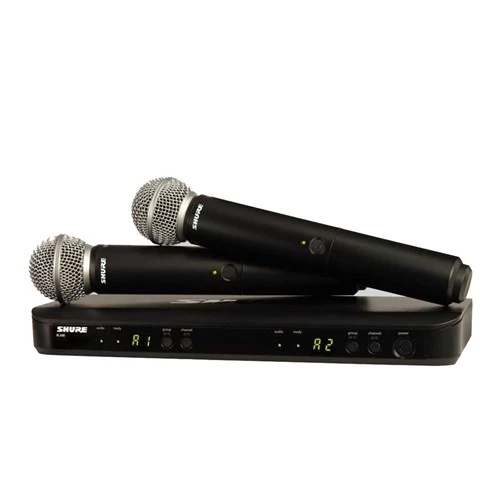
The BLX288/SM58 is a two-channel analogue wireless system. In plain terms, you get two handheld microphones that transmit wirelessly, plus one half-rack receiver that picks up both signals and sends them out to your mixer or PA. The "288" tells you it's a dual system; the "SM58" tells you the capsule on each handheld transmitter is the genuine Shure SM58 cardioid dynamic element — the same one used on the wired classic.
That capsule choice matters. The SM58 has a tailored vocal response with a presence lift in the upper mids that helps voices cut through a mix, a gentle bass roll-off that controls handling boom and proximity, and a cardioid pattern that rejects sound from behind the mic to fight feedback. With the BLX288, you're getting that exact voicing without a lead running back to the desk.
The system is built around three core pieces:
- Two BLX2/SM58 handheld transmitters — each houses an SM58 capsule, runs on 2 x AA batteries, and has an on/off switch with a battery status LED.
- One BLX88 dual receiver — a single half-rack unit that receives both microphones, with independent audio outputs and clear signal indicators per channel.
- QuickScan frequency selection — a one-button feature that finds a clean, open frequency for you, which is genuinely helpful if radio frequency wrangling isn't your strong suit.
Understanding the K14 Frequency Band (Important for Australia)
You'll notice this system is specified as K14. That code refers to the frequency band the system operates in — for the BLX range, K14 covers roughly 614 to 638 MHz. This is a critical detail for Australian buyers, because wireless microphone operation here is governed by the Australian Communications and Media Authority (ACMA).
In Australia, the 614–694 MHz range has generally remained available for licence-exempt wireless microphone use under the relevant class licence, unlike the 694–820 MHz portion that was reallocated to mobile broadband. The K14 band sits comfortably inside the usable range for most of the country, which is exactly why it's the band offered for the local market. Still, regulations and spectrum allocations can change over time and can vary by location, so it's always worth confirming current ACMA guidance for your specific area before buying any wireless system.
The practical takeaway: buying the K14 version sold for the Australian market means you're getting a band intended to be legal and usable here, rather than importing a US or European band that may not be appropriate. That's a small detail that saves real headaches.
Key Specifications at a Glance
| Feature | Detail |
|---|---|
| System type | Dual-channel analogue wireless (handheld) |
| Microphone capsule | 2 x Shure SM58 cardioid dynamic |
| Frequency band (AU) | K14 (approx. 614–638 MHz) |
| Compatible channels | Up to 12 per band (region dependent) |
| Operating range | Up to approx. 100 m line-of-sight (typical real-world: 30–60 m) |
| Transmitter power | 2 x AA batteries per handheld |
| Battery life | Up to approx. 14 hours per transmitter |
| Frequency setup | QuickScan one-button frequency selection |
| Receiver form | Single half-rack BLX88 dual receiver |
One honest note on range: Shure's headline figures are line-of-sight maximums. In a real venue with walls, bodies, and other wireless gear, you should plan around a comfortable working distance of 30 to 60 metres. For the vast majority of pubs, function rooms, churches and school halls, that's more than enough.
How It Sounds and Performs
Because the capsule is a real SM58, the tonal character is exactly what experienced engineers expect: a forward, intelligible vocal with strong feedback resistance. If you've mixed a wired SM58 before, you'll feel right at home — your usual EQ moves translate directly. There's no learning a new voicing or fighting an unfamiliar capsule.
The wireless transmission is analogue, which means it doesn't have the latency some entry-level digital systems can introduce, and the audio is clean and consistent within range. Where you need to be realistic is RF behaviour. Analogue systems like the BLX series can be more susceptible to interference and have less spectral flexibility than higher-end digital systems such as Shure's QLX-D or ULX-D lines. In a crowded RF environment — think a large multi-stage event with dozens of wireless channels — the BLX288 has limits. For a single venue running two mics, it's rock solid.
The QuickScan feature deserves a specific mention. Press it and the receiver scans for a clean, open frequency and locks the matching transmitter to it via the IR sync. For operators who don't want to think about frequency coordination, this removes most of the guesswork and is one of the genuine quality-of-life wins of the BLX platform.
Ready to upgrade your setup? Shop the Shure BLX288/SM58 dual wireless system from an authorised Australian dealer.
Who Is This System Best Suited To?
The BLX288/SM58 sits in a clear sweet spot: it's for people who need two dependable wireless vocal mics and value proven sound and ease of use over advanced RF features they'll never touch. Realistic users include:
- Pubs and live music venues running a lead vocalist plus backing vocals or a second singer.
- Houses of worship needing a wireless mic for the speaker and a second for song leading or a roving presenter.
- Schools and community theatre covering presentations, assemblies and small productions where two handhelds get passed around.
- Wedding and event MCs who want a primary mic and a backup or co-host mic from one tidy receiver.
- Mobile DJs and karaoke hosts who need two singer mics without a tangle of cables.
If your work involves large-scale productions, many simultaneous wireless channels, or touring through unpredictable RF environments, you should genuinely look at a digital system higher up the Shure range. That's not a knock on the BLX288 — it's just being honest about where its design tops out.
Honest Pros and Cons
| Strengths | Limitations |
|---|---|
| Genuine SM58 capsule with proven, familiar vocal sound | Analogue transmission is more interference-prone than digital systems |
| Two mics into one compact receiver saves space and rack room | Limited simultaneous channel count vs. pro digital rigs |
| QuickScan makes frequency setup genuinely easy | Runs on disposable AA batteries (no built-in rechargeable cradle) |
| Strong feedback rejection thanks to cardioid pattern | Plastic-bodied transmitters feel less premium than metal pro models |
| Reliable, low-latency performance within range | Real-world range shorter than headline line-of-sight figure |
| K14 band intended for legal Australian use | Fewer encryption/security features for sensitive applications |
Practical Buying and Setup Advice
A few tips to get the most out of this system once it arrives:
- Keep a stock of AA batteries. With up to ~14 hours per transmitter you won't change them often, but having a fresh set on hand for an important gig is cheap insurance. Consider quality rechargeable AAs to cut long-term running costs.
- Run QuickScan at every new venue. RF conditions differ from room to room. A quick scan before doors open avoids surprises mid-show.
- Position the receiver with a clear line of sight. Antennas behind a metal rack or a wall of bodies will cost you range. Up high and visible to the performance area is ideal.
- Mind the gain structure. The SM58 is a dynamic capsule, so set healthy input gain at your desk and you'll get a clean, strong signal.
- Confirm local RF conditions. If you regularly work alongside other wireless operators, coordinate bands so you're not competing for the same frequencies.
Frequently Asked Questions
Is the capsule a real SM58 or a copy?
It's the genuine Shure SM58 cardioid dynamic capsule, the same element found on the wired SM58. That's the whole point of the system — legendary sound, no cable.
Can I use both microphones at the same time?
Yes. The BLX288 is specifically a dual system. Both handhelds run simultaneously into the single dual receiver, each with its own audio output to your mixer.
How many of these can I run together?
Within the K14 band you can typically run multiple compatible channels, but the exact number depends on your local RF environment and other wireless devices in use. For two or three dual systems in a single venue you're generally fine; large multi-system deployments need more careful coordination.
Is it legal to use in Australia?
The K14 band is offered for the Australian market and sits within frequencies generally available for licence-exempt wireless microphone use. Because spectrum rules can change and vary by location, confirm current ACMA guidance for your area before purchase.
Does it work with any mixer or PA?
Yes. The receiver provides standard audio outputs that connect to virtually any mixer, powered speaker or PA system with a microphone or line input.
The Verdict
The Shure BLX288/SM58 K14 earns its popularity by doing one job extremely well: delivering two reliable, great-sounding wireless vocal mics with minimal fuss. You get the trusted SM58 sound, easy QuickScan setup, and a tidy single-receiver design, all in a band intended for legal Australian use. It won't replace a high-channel-count digital system for major touring productions, and the analogue platform has its ceiling — but for pubs, worship venues, schools, events and DJs, it hits a genuinely smart balance of quality, simplicity and value.
If you need two wireless mics you can trust week in and week out without becoming an RF engineer, this is one of the easiest recommendations in its class.
Browse the Shure BLX288/SM58 K14 dual wireless system — authorised dealer with genuine Shure products and support across Australia.