
Sennheiser HD25 Plus Professional: The Industry-Standard DJ & Broadcast Headphone in 2026
Sennheiser HD25 Plus Professional: Why These Headphones Still Dominate After Three Decades
There's a reason you'll spot the Sennheiser HD25 in virtually every DJ booth, broadcast studio, and outside broadcast van across Australia — and it's not because sound engineers are resistant to change. It's because, after more than 30 years on the market, nobody has managed to build a closed-back, on-ear monitoring headphone that does the job better at this price point. The HD25 Plus Professional takes that legendary platform and adds practical extras that make the package even harder to ignore.
Let's get properly technical about what makes these headphones tick, who they're genuinely built for, and whether the 'Plus' variant justifies itself over the standard HD25.
Core Technical Specifications
| Specification | HD25 Plus Professional |
|---|---|
| Transducer Type | Dynamic, closed-back |
| Frequency Response | 16 Hz – 22,000 Hz |
| Impedance | 70 ohms |
| Sound Pressure Level (SPL) | 120 dB (1 kHz, 1 Vrms) |
| Total Harmonic Distortion (THD) | < 0.3% |
| Ambient Noise Attenuation | Up to 13 dB passive isolation |
| Contact Pressure | Approximately 3.5 N |
| Weight (without cable) | Approximately 140 g |
| Ear Coupling | Supraaural (on-ear) |
| Cable Length (straight) | 1.5 m |
| Cable Length (coiled) | 3 m (extends to approx. 3 m) |
| Connector | 3.5 mm with screw-on 6.3 mm adapter |
What the Specs Actually Tell You
Impedance: 70 Ohms — The Sweet Spot
The 70-ohm impedance is one of the HD25's most underappreciated design decisions. It's low enough to be driven comfortably by portable devices, DJ mixers, and broadcast field recorders without a dedicated headphone amplifier, yet high enough to avoid the current draw issues and distortion that plague ultra-low impedance headphones when plugged into professional equipment with higher output impedance.
For Australian DJs running Pioneer DJM mixers or Allen & Heath Xone units, this impedance means you'll get full volume with headroom to spare from the booth output. Broadcast engineers using Sound Devices recorders or Zoom F-series field units will find the same — no need to crank the headphone amp to uncomfortable levels.
120 dB SPL Sensitivity — Built for Loud Environments
That 120 dB sensitivity figure at 1 kHz with 1 Vrms input is genuinely impressive and directly explains why DJs and broadcast engineers working in high-SPL environments gravitate toward the HD25. When you're monitoring in a club where the subs are pushing 110 dB through the booth, you need headphones that can cut above the ambient noise without the headphone amplifier clipping. The HD25 delivers this effortlessly.
Paired with the passive isolation of around 13 dB, you're effectively hearing your cue mix at a comfortable monitoring level even in punishing acoustic environments. This combination of high sensitivity and decent isolation is precisely why you'll see these on heads in festival DJ booths from Splendour in the Grass to Stereosonic successor events.
THD Below 0.3% — Cleaner Than You'd Expect
For a dynamic driver headphone at this price, sub-0.3% total harmonic distortion is a strong result. To put that in context, many competing DJ headphones in the same bracket sit between 0.5% and 1.0% THD. That lower distortion figure means the HD25 gives you a more accurate representation of your source material, which matters enormously when you're beatmatching by ear or monitoring a live broadcast feed where you need to catch audio anomalies quickly.
The 'Plus' Package: What You Get Beyond the Standard HD25
The 'Plus' designation on this model isn't about different drivers or altered tuning — the acoustic performance is identical to the standard HD25. What Sennheiser have done is bundle the headphone with a genuinely useful accessory kit that addresses the most common needs of working professionals:
- Two cables included: A 1.5 m straight cable and a coiled cable (extending to approximately 3 m). DJs tend to prefer the coiled cable for booth work, while broadcast engineers and location sound recordists often favour the straight cable for less mechanical noise transfer.
- Two sets of ear pads: The standard leatherette pads and a set of velour pads. The velour option is a genuine comfort upgrade for extended studio sessions and alters the sound signature slightly — more on that below.
- Protective pouch: A soft carry pouch that's more useful than you'd think for protecting the headphones in a gear bag between gigs.
If you were to purchase these accessories individually for a standard HD25, you'd spend a fair bit more than the price difference between the two models. For working professionals who will inevitably need a spare cable (cables are always the first thing to go), the Plus package makes practical and financial sense.
Sound Signature: Honest and Unforgiving
The HD25's frequency response curve is characterised by a slightly forward midrange presence, tight and controlled bass, and clear high-frequency reproduction without harshness. This isn't a "fun" consumer tuning — it's a monitoring signature designed to let you hear problems in your audio quickly.
Bass response (16 Hz – 200 Hz): Extends down to 16 Hz, though the meaningful low-end presence starts around 30-40 Hz in practice. Bass is punchy and well-defined rather than bloated. You'll hear individual kick drum hits clearly, which is exactly what DJs need for accurate beat-matching. Sub-bass is present but not emphasised — these won't give you the exaggerated low end that consumer bass-heavy headphones provide, and that's by design.
Midrange (200 Hz – 4 kHz): This is where the HD25 really earns its reputation. The slightly forward midrange means vocals, snares, and the fundamental frequencies of most instruments sit clearly in the mix. For broadcast monitoring, this characteristic makes speech intelligibility exceptional — you'll catch sibilance issues, plosives, and background noise contamination immediately.
Treble (4 kHz – 22 kHz): Detailed without being fatiguing. There's enough high-frequency energy to hear cymbal detail and hi-hat articulation, but Sennheiser have avoided the aggressive treble peak that plagues many monitoring headphones and causes fatigue during long sessions.
Velour Pads vs Leatherette: The Sonic Difference
Swapping to the velour pads included in the Plus package does alter the sound. The velour material is less acoustically reflective than leatherette, which results in:
- Slightly reduced bass impact (the seal against the ear is less airtight)
- A marginally wider perceived soundstage
- Reduced isolation from ambient noise
- Significantly improved comfort for sessions longer than an hour
For studio mixing and production work, the velour pads are arguably the better choice. For DJ monitoring and high-SPL environments, stick with the leatherette — you need that seal.
Build Quality and Design Philosophy
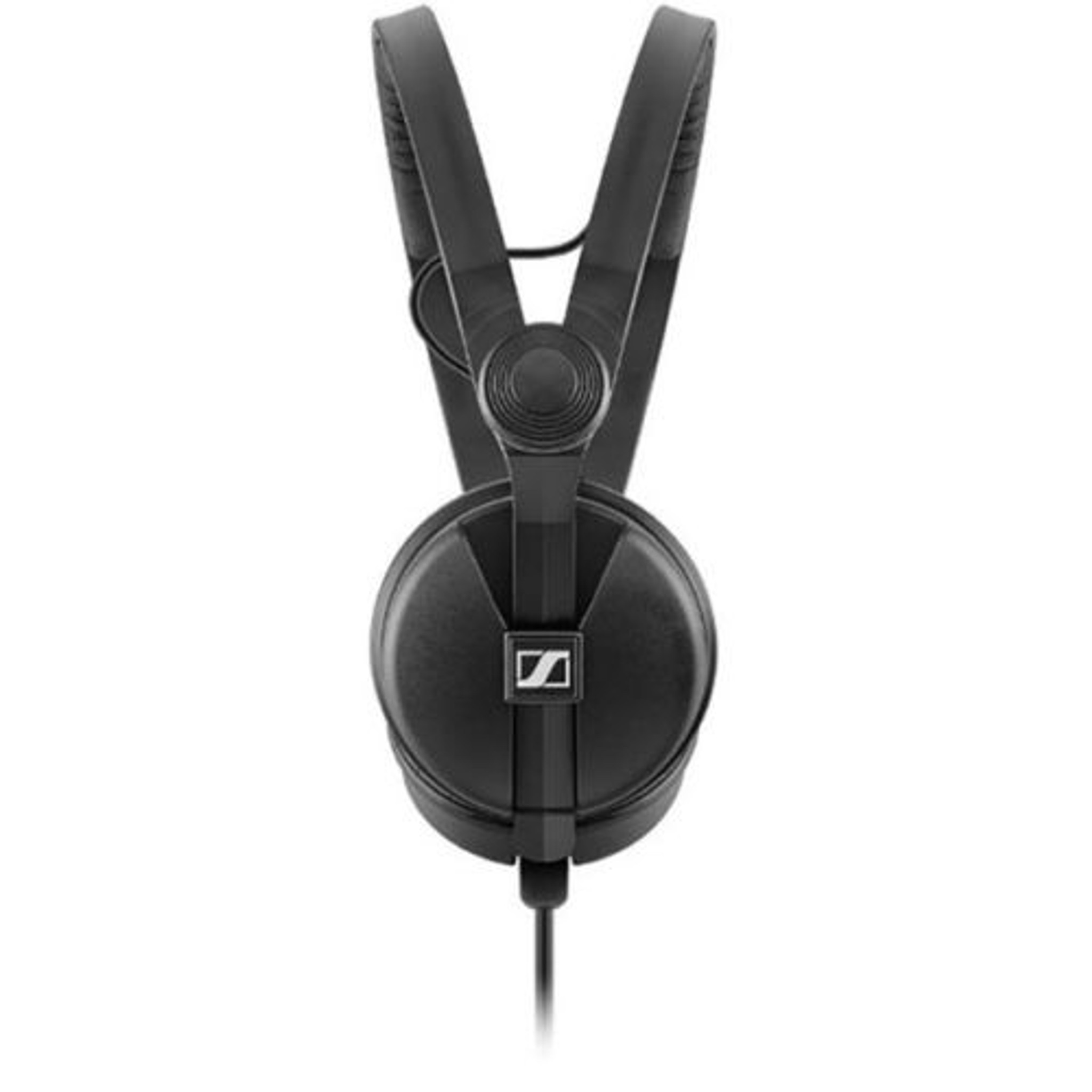
The HD25's split headband design looks unconventional, but it's one of the most functionally clever designs in professional audio. The dual-band system distributes clamping force evenly, allows for single-ear monitoring (a must for DJs who flip one cup forward), and provides a remarkably secure fit even during physical movement.
The clamping force of approximately 3.5 N is deliberately firm. New HD25 owners often find the clamp tight initially, but this serves two critical purposes: it maintains acoustic seal for consistent bass response, and it keeps the headphones physically on your head in active use. The headband does loosen slightly with use, settling into a comfortable but secure fit.
Every component is modular and user-replaceable — headband, drivers, ear pads, and cables can all be swapped without tools in most cases. This is where the HD25's value proposition becomes extraordinary for professional use. Rather than replacing the entire headphone when a cable fails or a pad wears out, you replace a $20-40 component. Many Australian DJs and engineers report running the same HD25 chassis for 10+ years with periodic part replacements.
The capsules themselves are mounted in a lightweight yet robust plastic housing. It's not the most premium-feeling material, but it's been proven over decades to withstand the rigours of professional use. The lightweight construction at approximately 140 g means these disappear on your head during long sessions — a significant advantage over heavier circumaural alternatives.
Technical Comparison: HD25 Plus vs the Competition
| Feature | Sennheiser HD25 Plus | Audio-Technica ATH-M50x | Pioneer HDJ-X7 | Beyerdynamic DT 770 Pro (80Ω) |
|---|---|---|---|---|
| Type | On-ear, closed | Over-ear, closed | Over-ear, closed | Over-ear, closed |
| Impedance | 70 Ω | 38 Ω | 36 Ω | 80 Ω |
| Sensitivity | 120 dB | 99 dB | 102 dB | 96 dB |
| Frequency Range | 16–22,000 Hz | 15–28,000 Hz | 5–30,000 Hz | 5–35,000 Hz |
| Weight | ~140 g | ~285 g | ~270 g | ~270 g |
| Single-ear monitoring | Yes (split headband) | Yes (swivelling cups) | Yes (swivelling cups) | No |
| Modular/replaceable parts | Fully modular | Detachable cable only | Detachable cable only | Non-detachable cable |
| Best suited for | DJ / broadcast / field | Studio mixing | DJing | Studio monitoring |
Key Takeaways from the Comparison
vs Audio-Technica ATH-M50x: The M50x is a superb studio headphone with a wider frequency range on paper and a more comfortable over-ear fit for extended sessions. However, its lower sensitivity means it struggles more in high-SPL environments without cranking the headphone amp. It's also nearly double the weight of the HD25, which matters during four-hour DJ sets. Choose the M50x for studio work; choose the HD25 for anything involving live performance or fieldwork.
vs Pioneer HDJ-X7: Pioneer's DJ-focused offering has the broader frequency spec and similar swivel-cup functionality, but it doesn't match the HD25's sensitivity figure. The Pioneer feels more modern and has a more consumer-friendly sound signature with enhanced bass. If you want headphones that sound exciting while DJing, the X7 is appealing. If you want headphones that tell you the truth, the HD25 wins.
vs Beyerdynamic DT 770 Pro: The DT 770 is arguably the better pure listening headphone with its wider soundstage and extended frequency response, but it's not designed for DJ or field use. No single-ear monitoring, no detachable cable, and nearly twice the weight. It's a studio headphone through and through.
Real-World Applications Across Australia
DJ Performance
The HD25 remains the default choice for Australian DJs for very practical reasons. The high sensitivity means you can hear your cue mix clearly over a club system pushing serious SPL. The split headband allows natural single-ear cueing. The lightweight design means your neck isn't aching at 3 AM. And the modular construction means when some punter's elbow catches your cable mid-set, you're replacing a $30 cable rather than the entire headphone.
Broadcast and Location Sound
Australian broadcast engineers — particularly those working in outside broadcast for networks covering sports, events, and news — have relied on the HD25 for decades. The closed-back design with decent passive isolation means you can monitor programme audio in noisy environments. The forward midrange makes speech intelligibility a standout feature, which is critical when you're checking presenter audio against crowd noise.
Studio and Production
While the HD25 isn't primarily a studio mixing headphone, it has a legitimate role in production environments. Many engineers use it as a secondary reference specifically because of its midrange clarity. It's also excellent for editing work — the lightweight, on-ear design is less fatiguing than heavier over-ear alternatives when you're doing fine edits over several hours.
Ready to add the industry standard to your kit? Check the current price on the Sennheiser HD25 Plus Professional at Music on Stage.
What to Consider Before Buying
The On-Ear Factor
This is the most polarising aspect of the HD25. On-ear (supraaural) headphones press against your ears rather than enclosing them. For some people, this is never comfortable regardless of how long they wear them. If you've exclusively used over-ear headphones and find on-ear pressure uncomfortable, no amount of pad break-in will change the fundamental design. If possible, try before you buy — most Australian music retailers that stock Sennheiser will have a demo unit available.
Initial Clamping Force
Brand new HD25s clamp firmly. This is intentional and the force does reduce with use, but the first week or two can feel tight, particularly if you have a larger head. Some professionals gently stretch the headband over a stack of books overnight to accelerate the process, though this isn't officially recommended.
Not a Flat Studio Reference
Despite their monitoring pedigree, the HD25s are not ruler-flat. The slight midrange emphasis and controlled bass make them excellent for critical listening in noisy environments, but if you need the flattest possible response for mixing decisions, dedicated open-back studio headphones like the Sennheiser HD 600 or AKG K702 will serve you better. The HD25 excels at what it's designed for — high-SPL monitoring, DJ cueing, and broadcast work.
Cable Orientation
The cable enters from the left ear cup only. This is standard for the HD25 and isn't configurable. For most users this is a non-issue, but it's worth noting for anyone with a specific workflow requirement.
Longevity and Value Proposition
Here's where the HD25 Plus makes its strongest case in the Australian market. The total cost of ownership over, say, five years of professional use is remarkably low. The headphone itself is a mid-range investment, but because every single component is user-replaceable, your maintenance cost is limited to occasional pad replacements (every 12-18 months with heavy use) and the rare cable swap.
Compare this to competing headphones where a failed cable or worn-out pads mean either an expensive repair or outright replacement. The HD25's modular philosophy isn't just convenient — it's genuinely economical for working professionals.
Sennheiser's parts availability for the HD25 has been outstanding. Replacement parts have been continuously available for decades, and given the model's commercial success, there's every reason to expect this will continue. This is not a headphone that will become a throwaway item when one component wears out.
Frequently Asked Technical Questions
Do I need a headphone amplifier for the HD25 Plus?
No. The 70-ohm impedance and 120 dB sensitivity mean any professional audio device — DJ mixer, audio interface, field recorder, or even a modern smartphone — will drive the HD25 to adequate volume. A dedicated amp won't hurt, but it's genuinely unnecessary for normal professional use.
Can I use these for critical mixing?
For reference checks and specific tasks like editing, EQ decisions on individual tracks, and checking translation across playback systems — absolutely. For final mix decisions as your primary monitoring? You'd be better served by open-back headphones or, ideally, calibrated monitors. The HD25's strengths lie elsewhere.
What's the difference between HD25, HD25 Plus, and HD25 Light?
The HD25 and HD25 Plus use identical drivers and acoustic design. The Plus adds a second cable (coiled), velour ear pads, and a carry pouch. The HD25 Light is a different, more affordable model with a simplified single headband, different drivers, and notably different sound — it's not simply a lighter HD25.
How do the HD25s handle Australian summer heat?
The on-ear design actually works in your favour here. Because the pads sit on rather than around your ears, there's less surface contact and heat buildup compared to full-size over-ear headphones. The velour pads included in the Plus package also breathe better than the standard leatherette. For outdoor gigs and festival sets in Australian heat, the HD25 is a more comfortable choice than most over-ear alternatives.
The Verdict: Who Should Buy the HD25 Plus Professional?
The Sennheiser HD25 Plus Professional isn't trying to be everything to everyone — and that's precisely its strength. It's a purpose-built professional monitoring tool that happens to be so good at its intended job that three decades of competition haven't displaced it.
Buy the HD25 Plus if you are:
- A DJ at any level who values accurate monitoring over hyped bass
- A broadcast engineer or location sound recordist working in noisy environments
- A touring professional who needs headphones that survive life on the road
- Anyone who values long-term reliability and modular repairability
- A producer wanting a secondary reference headphone for midrange detail
Look elsewhere if you:
- Primarily need a flat studio reference for critical mixing (consider open-backs)
- Find on-ear headphones fundamentally uncomfortable
- Want enhanced bass for casual listening (consumer headphones will suit you better)
- Need active noise cancellation (this is passive isolation only)
The Plus variant specifically makes sense for anyone who plans to use these professionally. The included spare cable and alternative ear pads aren't luxuries — they're practical items you'd end up buying separately anyway. Getting them bundled at a lower total cost is simply good sense.
Grab the Sennheiser HD25 Plus Professional from Music on Stage and find out why these headphones have been the professional's choice for over 30 years. With fast Australian shipping and local support, you'll have the industry standard on your head in no time.