
Sennheiser HD 25 On the Job: Real DJ & Field Uses 2026
Sennheiser HD 25 On the Job: Real DJ & Field Uses 2026
There's a reason you keep spotting the same pair of black on-ear headphones in club booths in Fortitude Valley, hanging off camera ops at the Melbourne Cup, and slung around the neck of every second front-of-house engineer at a regional festival. The Sennheiser HD 25 has been in continuous production since 1988, and it hasn't survived nearly four decades because of marketing. It survived because it does a small number of jobs extremely well, and because when you inevitably break one, you can fix it yourself at the gig.
This guide isn't a spec sheet recital. It's about how the HD 25 actually behaves in the situations Australian audio people find themselves in — a 105 dB room, a 38-degree outdoor wedding, a three-hour tracking session, a live cross from a windy carpark. Where it excels, where it genuinely annoys people, and how to decide if it's the right tool for what you actually do.
Who actually buys these, and why
In our experience the HD 25 buyer falls into four camps, and they're buying it for four slightly different reasons:
- Club and mobile DJs — they need to hear a kick drum through a wall of PA noise while holding one cup to one ear.
- Broadcast, ENG and camera operators — they need something light, isolating, and durable enough to live in a camera bag for five years.
- Live sound engineers and system techs — they need a fast reference for line checks, ringing out wedges, and identifying a buzzing DI at 30 metres from the desk.
- Drummers and tracking musicians — they need isolation and enough SPL to hear a click over an acoustic kit without bleeding into the overheads.
Notice what's missing from that list: people mixing records. That's deliberate, and we'll come back to it.
Scenario one: the club booth at 100+ dB
This is the HD 25's home ground. Picture a Friday night — the room is loud, the booth monitor is fighting the mains, and you've got about four bars to find the downbeat of the next track.
Three things matter here, and the HD 25 nails all three.
Isolation. It's a closed-back supra-aural (on-ear) design with a fairly firm clamp, and the passive isolation is genuinely good — not over-ear good, but good enough that the cue mix stays intelligible when the room is punishing. Crucially, it isolates without needing you to crank the volume to dangerous levels, which is the real long-term win for your hearing.
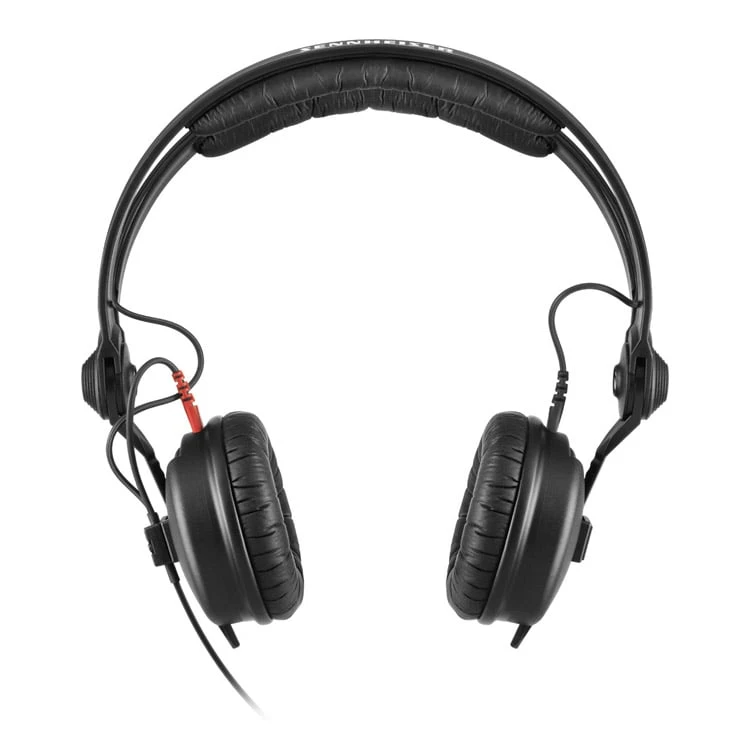
The split headband. The two-strand headband looks like a design quirk until you use it. You can slide the strands apart to grip the top of your head, which lets you wear the headphones with one cup on and one cup off without the whole thing sliding forward. It's the single most copied feature in DJ headphone design.
The rotating right cup. Flip it up and back for classic one-ear cueing. It's a hinge, not a friction joint that wears out in six months, and it holds position.
How they sound in a cue mix
Forward, punchy, mid-heavy. There's a lift in the upper bass and low mids that makes kicks and snares pop out of a busy mix, and the top end is present enough to lock onto a hi-hat pattern. At 70 ohms they're an easy load — every DJ mixer headphone amp on the market drives them loud, and they'll hit around 120 dB SPL if you're reckless enough to ask for it.
That voicing is a deliberate tool. It is not flat, and it's not trying to be.
Check current pricing and stock on the Sennheiser HD 25 →
Scenario two: the mobile and wedding DJ
Different job entirely. You're loading in at 2pm, the ceremony is outdoors, the reception is in a function room with a low ceiling, and the headphones are going to spend more time around your neck than on your head.
The HD 25 does well here for reasons that have nothing to do with sound quality:
- At roughly 140 g without the cable, they're light enough to forget you're wearing them across a six-hour booking.
- The coiled steel-reinforced cable (about 1.5 m relaxed, stretching to roughly 3 m) means you can step away from the controller to talk to the MC without unplugging.
- Nothing on them is precious. They're plastic, they're matte black, they don't scratch conspicuously, and they take being tossed into a road case.
The honest downside for mobile work: on-ear pads press on your ear cartilage, and after four or five continuous hours in an Australian summer, that gets sweaty and sore. Most mobile DJs we talk to swap to velour pads for long bookings — more on that shortly.
Scenario three: camera ops, ENG and location sound
Walk any Australian broadcast compound and you'll see HD 25s everywhere. For field work, the case is straightforward: they're small, they isolate, they're single-sided cabled so nothing tangles around your shoulder rig, and they fold flat-ish into a pouch.
Where they earn their keep is on fault-finding. That forward midrange makes it easy to hear a dodgy connector crackle, wind rumble hitting a capsule, or a radio mic dropout, even when you're standing next to a generator. You're not making aesthetic judgements in the field — you're checking that the recording is clean and usable — and the HD 25 is arguably better at that than a flatter, politer headphone.
One practical note for Aussie conditions: they cope well with heat and humidity, but salt air and beach shoots are hard on any headphone. The saving grace is that every part that corrodes or perishes is replaceable.
Scenario four: the tracking room and the drum kit
Drummers get an unusually good deal here. You need enough isolation to hear a click over a live kit, low enough weight that the headphones don't shift when you move, and enough SPL headroom that the click stays above the snare. The HD 25 handles all three, and the tight clamp that annoys DJs at hour five is exactly what a drummer wants at bar 32.
For guide vocals and overdubs they're perfectly serviceable, though singers often prefer something over-ear for comfort. And be aware: at very high monitoring levels there is some leakage. It's less than most, but it's not zero, and a sensitive large-diaphragm condenser 40 cm away will pick up a click that's been pushed too hard.
Scenario five: front of house and system tech work
For engineers, the HD 25 is a diagnostic tool rather than a mixing tool. Solo a channel, identify the problem, move on. It's fast for that — problems announce themselves in the midrange.
What it won't do is help you make final EQ decisions. The bass lift and midrange forwardness mean a mix that sounds balanced on HD 25s will typically translate thin and bright somewhere else. Use them to find things, not to judge things.
Being honest: where the HD 25 struggles
No product is right for everyone, and a lot of disappointed HD 25 buyers bought them for the wrong job.
- They are not neutral reference headphones. If you're mixing or mastering, look elsewhere. The tonal balance is tuned for cutting through noise, not for accuracy.
- On-ear comfort is polarising. The clamp is firm out of the box. Some people never mind it; others find two hours is their ceiling. If you wear glasses, expect pressure on the arms.
- Soundstage is small. Closed, on-ear, and intimate. Fine for work, unremarkable for pleasure listening.
- The cable isn't a standard detachable jack. It routes through the headband and terminates in a 3.5 mm plug with a screw-on 6.3 mm adapter. It is user-replaceable, but you can't just clip in any third-party cable the way you can on some modern DJ cans.
- Bass extension is punchy, not deep. You'll feel the kick, but you won't get the sub rumble that a large over-ear closed-back delivers.
- They're not cheap for what they physically are. A lot of buyers look at the plastic build and the small drivers and wonder where the money went. The answer is in reliability and parts support, not materials.
The modular design is the real feature
This is the part that doesn't show up in a spec comparison and is the single strongest practical argument for the HD 25 over anything else in its class.
Every component comes apart by hand — no tools, no soldering:
- Ear pads pull off and push on
- Capsules (the drivers themselves) unclip from the yokes
- The headband strands unhook
- The cable unplugs from inside the headband
Practically, this means a dead left channel at a Saturday gig isn't a dead pair of headphones — it's a five-minute swap with a spare capsule from your kit bag. It means a pair bought in 2015 can be brought back to as-new for a fraction of replacement cost. And it means you can genuinely tune the comfort and sound to your job: swap the stock leatherette pads for velour and you get noticeably better long-session comfort and a slightly softer top end, at the cost of some isolation and bass punch. Many long-session users run velour for weddings and studio work, and stock pads for clubs.
For hire companies and multi-op production houses, that repairability changes the total cost of ownership calculation entirely.
How the alternatives perform in the same scenarios
Versus Pioneer DJ HDJ-X series: Pioneer's over-ear DJ cans are more comfortable for long sets and have deeper bass, and the swivel mechanism is more flexible. But they're bulkier, heavier in the bag, and parts support is nowhere near as good. If you're a resident club DJ playing four-hour sets and comfort is your priority, Pioneer is a fair call. If you're carrying them everywhere and want a ten-year pair, HD 25.
Versus Audio-Technica ATH-M50x: The M50x is the better all-rounder — more comfortable, better for casual listening, detachable cables, more even tonality. But it's noticeably bigger, the isolation is comparable rather than better, and one-ear cueing is awkward. For studio-plus-occasional-DJ use, M50x. For DJ-first, HD 25.
Versus Sony MDR-7506: A broadcast classic and cheaper, with a lovely detailed top end. But the pads perish famously fast, it's less isolating in genuinely loud rooms, and it's a floppy thing to carry. Great for edit suites and voiceover booths; less convincing in a club.
Versus the HD 25 Light / HD 25 Plus: The Light variants use a single headband and simpler construction — cheaper, lighter clamp, less isolation, no split-headband trick. The Plus bundle adds a second set of velour pads, a straight cable and a carry pouch, which is genuinely good value if you know you'll want both pad types. The standard HD 25 sits in the sweet spot if you want the full-strength original and will buy accessories as needed.
See the Sennheiser HD 25 Professional DJ Headphones at MusiconStage →
Matching them to your experience level
If you're starting out
If you're a bedroom DJ moving toward your first paid gigs, the HD 25 is a genuinely sensible first serious purchase — not because it's beginner-friendly, but because you won't outgrow it. The main thing to understand upfront is the sound signature: don't panic when your mixes sound different on speakers. That's expected.
If you're gigging regularly
This is the target user. Buy them, buy a spare cable, and learn where the parts come apart. Consider a second set of velour pads if your bookings run past three hours.
If you're a working professional or hire company
Standardise on them. Being able to keep a small box of capsules, pads and cables that services an entire crew's headphones is operationally worth more than a slightly better-sounding alternative that becomes e-waste the moment a driver fails.
Practical tips and mistakes to avoid
- Stretch the headband gently before your first long gig. Rest them over a box slightly wider than your head for a day. Don't force them — the clamp relaxes naturally over a few weeks of use.
- Position the pads on your ear, not over it. The isolation depends on a good seal against the side of your head; a lot of "they don't isolate" complaints are really "they're sitting wrong".
- Don't hang them by one cup on a mic stand. The yokes are tough but repeated one-sided stress is how headbands eventually give up.
- Replace pads before they crumble. Perished pads kill isolation and bass response, and people often blame the drivers. Pads are consumables — budget for a set every 12–18 months with heavy use.
- Keep the 6.3 mm adapter screwed on if you use it. The screw-on design is there so it doesn't fall off in a dark booth. Use it.
- Don't buy them expecting a hi-fi listening experience. They're a work tool. Judge them on that.
Frequently asked questions
Are the HD 25s loud enough with a laptop or phone?
Yes. At 70 ohms with high sensitivity, they go plenty loud straight out of a laptop headphone jack or a phone dongle. No amp needed — which is part of why they're so popular for field work.
Will they leak into microphones during recording?
At sensible monitoring levels, minimally. Push a click track hard for a loud drummer and yes, a close overhead can catch it. Keep the click as quiet as the performer can work with.
How long do they realistically last?
Indefinitely, if you maintain them. Pads are the first consumable, then the cable, then eventually a capsule. Plenty of Australian engineers are still running pairs bought a decade ago on their second or third set of parts.
Are they comfortable enough for an eight-hour day?
Honestly, for most people not without a break. They're outstanding for two to three hours. Beyond that, velour pads help a lot, but if you genuinely wear headphones all day every day, an over-ear design will treat your ears better.
Can I use them for general music listening?
You can, and plenty do. Expect punchy, mid-forward, intimate sound rather than spacious and refined. They're enjoyable for rock, electronic and hip hop; less so for orchestral material.
What's the difference between the HD 25 and the HD 25 Plus?
The headphones themselves are the same. The Plus adds an extra set of velour ear pads, a straight cable in addition to the coiled one, and a soft carry pouch. If you already know you want velour and a straight cable, the bundle usually works out better value.
Do they fold up for travel?
They collapse and flatten enough to slip into a small pouch or a camera bag pocket, though there's no rigid folding mechanism like some DJ headphones. Most people just drop them in a bag — they cope fine.
The verdict: buy them for the job, not the spec sheet
The Sennheiser HD 25 is a specialist tool that happens to be broadly capable. If your work involves hearing something clearly in a loud environment — a cue mix in a club, a boom feed on a windy street, a click behind a drum kit — it's still the reference standard nearly four decades on, and the modular repairability means it's arguably the cheapest professional headphone you'll ever own once you count the years.
If you want comfort for long sessions, deep sub bass, or accurate mixing reference, spend your money elsewhere. There's no shame in that — it's just a different job.
For Australian DJs, engineers, camera ops and drummers who need something that works, keeps working, and can be fixed in the back of a van at midnight, it remains very hard to beat.
Buy the Sennheiser HD 25 Professional DJ Headphones with Australian support and warranty →