
Sennheiser EW 300 G3 IEM System: Australian Buyer's Guide 2026
Sennheiser EW 300 G3 IEM System: Complete Australian Buyer's Guide 2026
If you've spent any time mixing monitors or performing on Australian stages, you already know the difference a reliable in-ear monitor system makes. The gap between hearing yourself properly and fighting a dodgy wedge mix is the gap between a great show and a forgettable one. The Sennheiser EW 300 G3 A IEM System in B Band (626–668 MHz) sits right in that sweet spot where professional reliability meets accessible pricing — and it's been a staple on stages worldwide for good reason.
But is it still the right choice in 2026? With newer systems from Shure, Audio-Technica, and even Sennheiser's own Evolution Wireless Digital line competing for your attention, that's a fair question. This guide breaks down everything you need to know — specs, real-world performance, frequency considerations for Australia, and how it stacks up against the competition.
What Exactly Is the Sennheiser EW 300 G3 IEM System?
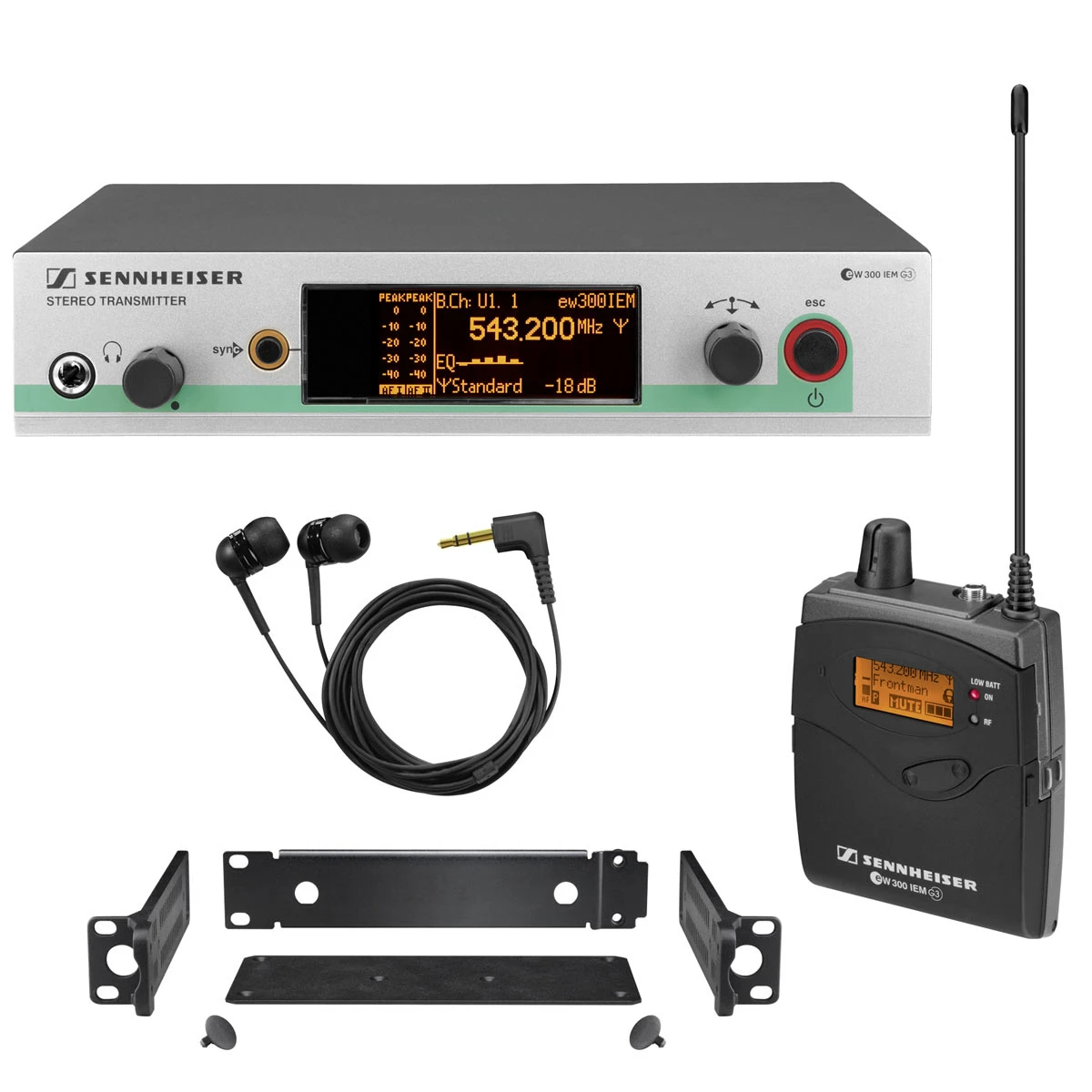
The EW 300 G3 is part of Sennheiser's third-generation Evolution Wireless 300 series, which has earned a reputation as a workhorse across touring rigs, houses of worship, and corporate AV setups. The IEM variant pairs a half-rack SR 300 G3 stereo transmitter with an EK 300 G3 bodypack receiver, giving performers a wireless stereo monitor feed.
This particular unit operates on the B Band (626–668 MHz), which is a critical detail for Australian users — and we'll get into why shortly.
Key Specifications at a Glance
| Specification | Detail |
|---|---|
| Frequency Range | 626–668 MHz (B Band) |
| Bandwidth | 42 MHz |
| Switching Bandwidth | Up to 42 MHz |
| Compatible Frequencies | Up to 1,680 tuneable frequencies |
| Transmitter Output Power | 30 mW (adjustable) |
| Audio Frequency Response | 25 Hz – 15 kHz |
| Signal-to-Noise Ratio | ≥ 90 dB(A) |
| THD | < 0.9% |
| Bodypack Battery Life | Approx. 6–8 hours (2x AA) |
| Transmitter Format | Half-rack 19" compatible |
| Receiver Weight | Approx. 160g (without batteries) |
Frequency Band Considerations for Australia
Right — let's address the elephant in the room. The B Band (626–668 MHz) sits within the UHF spectrum, and Australian frequency regulations managed by the ACMA (Australian Communications and Media Authority) have undergone significant changes in recent years, particularly around the 600 MHz and 700 MHz bands due to mobile broadband rollouts.
Before purchasing any wireless system operating in this band, you absolutely need to check current ACMA regulations for your state and intended use. The 626–668 MHz range has historically been usable for wireless audio in parts of Australia, but spectrum allocation can vary by region, and digital dividend changes have affected which frequencies remain interference-free.
Practical advice: Contact Sennheiser Australia or a reputable dealer like MusiconStage to confirm current compliance and usability in your area. This isn't a minor detail — operating on a congested or restricted frequency will give you dropouts, interference, and potentially legal headaches.
Real-World Performance: What the EW 300 G3 Actually Delivers
Specs are one thing. What matters is how this system behaves when the house lights go down and you're relying on it to keep you connected to the mix.
Audio Quality
The EW 300 G3 uses Sennheiser's HDX compander, which is a noticeable step up from the basic compander in the EW 100 series. You get a wider dynamic range and less of that "pumping" compression artefact that cheaper wireless IEM systems are notorious for. The audio response tops out at 15 kHz — which is lower than wired monitoring but perfectly adequate for live in-ear use. Most performers won't notice the missing high-frequency air during a live set, especially with quality earphones paired to the receiver.
The stereo image is solid, and the adjustable focus control on the bodypack lets performers dial in their preferred balance between the left and right channels without needing the engineer to make changes at the rack.
Build Quality and Reliability
This is where the G3 series genuinely earns its keep. The SR 300 transmitter is built like proper pro audio gear — metal chassis, solid connectors, and a clear LCD display that's readable even in dim backstage conditions. The EK 300 bodypack feels robust without being bulky, and the belt clip mechanism actually holds up after years of use (something that can't be said for every competitor).
Sennheiser's track record with the G3 line for touring reliability is well documented. These units have survived van tours, festival rains, and the general abuse that Australian live sound environments dish out.
Range and RF Performance
With 30 mW of output power, the EW 300 G3 delivers reliable coverage for most live sound scenarios — club stages, medium-sized venues, and houses of worship. In open environments with clear line-of-sight, you can expect solid performance up to around 80–100 metres, though real-world range depends heavily on the RF environment, antenna placement, and interference sources.
For larger venues or situations with heavy RF congestion (think festivals with dozens of wireless channels), you'll want to pay close attention to antenna positioning. The system supports external antennas and Sennheiser's antenna distribution systems, which is essential for professional multi-channel deployments.
How the EW 300 G3 Compares to the Competition
No buyer's guide is complete without honest comparisons. Here's how the Sennheiser EW 300 G3 IEM stacks up against the systems most commonly cross-shopped in the Australian market.
EW 300 G3 vs Shure PSM 300
| Feature | Sennheiser EW 300 G3 | Shure PSM 300 |
|---|---|---|
| Compander | HDX | Standard / MixMode |
| Stereo/Mono | Full stereo | Stereo + MixMode option |
| Frequency Agility | 1,680 frequencies | Up to 960 frequencies |
| Battery Life | 6–8 hours | 6–7 hours |
| Audio Response | 25 Hz – 15 kHz | 38 Hz – 15 kHz |
| Display | LCD with detailed menus | Simpler interface |
| Build Quality | Excellent | Excellent |
| Price Range (AUD) | $$–$$$ | $$–$$$ |
The Shure PSM 300 is probably the most direct competitor, and it's a genuinely good system. Shure's MixMode technology (available on P3RA receivers) lets performers blend two separate mono mixes from a single transmitter, which is incredibly useful when channel count is tight. The Sennheiser counters with broader frequency agility and the HDX compander, which many engineers consider slightly more transparent-sounding.
Best for: The PSM 300 edges ahead if you need MixMode flexibility. The EW 300 G3 wins on frequency coordination in dense RF environments.
EW 300 G3 vs Sennheiser EW-D (Digital)
Sennheiser's own Evolution Wireless Digital line represents the future of the platform. The EW-D IEM system offers true digital transmission, meaning no compander artefacts, lower latency, and significantly better audio quality on paper. It also features automatic frequency management and a much cleaner signal chain.
The catch? The EW-D commands a premium price, and the G3 remains available at a more accessible price point. For performers and venues that don't need the absolute cutting edge, the G3 delivers proven performance at lower cost.
Best for: Choose the EW-D if budget allows and you want future-proof digital quality. Stick with the G3 if you need reliable analogue performance and value for money.
EW 300 G3 vs Audio-Technica M3
Audio-Technica's M3 wireless IEM system is another option that appears in the Australian market at a competitive price point. Build quality is respectable, and A-T has a loyal following. However, the M3 generally offers fewer tuneable frequencies and a less sophisticated compander compared to the EW 300 G3's HDX system. For multi-channel deployments, Sennheiser's frequency coordination tools give it a clear advantage.
Best for: The M3 can work for single-channel setups on a tighter budget. For anything involving multiple wireless channels on the same stage, the Sennheiser is the safer choice.
Who Should Buy the Sennheiser EW 300 G3 IEM?
Not every IEM system is right for every user. Here's where the EW 300 G3 genuinely makes sense — and where it doesn't.
Ideal Users
- Working musicians who gig regularly and need a system that won't let them down mid-set. The G3's reliability record is hard to argue with.
- Houses of worship running multiple wireless channels. The frequency agility and Sennheiser's coordination tools make multi-channel setups manageable.
- Small to mid-sized venues looking to offer professional-grade monitoring without jumping to flagship pricing.
- Sound engineers already invested in the Sennheiser G3 ecosystem who want to keep their wireless inventory consistent for simpler maintenance and coordination.
Maybe Look Elsewhere If...
- You're on a strict budget — entry-level systems like the Sennheiser EW 100 G4 or basic Shure PSM offerings might serve you at a lower price point, though you'll sacrifice audio quality and features.
- You need the absolute best audio quality — digital systems like the Sennheiser EW-D or Shure PSM 900/1000 deliver noticeably superior audio, albeit at a significantly higher cost.
- You're running large festival-scale deployments — at that level, you're likely looking at Shure PSM 1000, Sennheiser 2000 series, or Wisycom systems with more sophisticated RF management.
Setting Up the EW 300 G3 for Australian Stages
Getting the most out of this system isn't just about plugging it in. A few practical tips specific to Australian use:
Antenna Placement
Don't leave the stock antennas on the back of the transmitter stuffed in a rack. For any serious deployment, use external antennas mounted at the front of the rack or on stands with clear line-of-sight to the stage. Sennheiser's A 1031-U omnidirectional antennas are a solid choice. In venues with metal structures (which describes most Australian pubs and clubs), antenna placement makes or breaks RF performance.
Frequency Scanning
Always run a frequency scan before the show. The G3's built-in scan function identifies clear frequencies in your operating range. In Australian capital cities, UHF congestion has increased significantly with digital TV and mobile services, so don't assume the frequencies that worked last week will work tonight.
Earphone Pairing
The system ships with Sennheiser IE 4 earphones, which are functional but basic. For a system at this price point, investing in quality aftermarket IEMs is strongly recommended. Options like the Sennheiser IE 100 Pro, Shure SE215, or custom-moulded earphones from local Australian audiologists will dramatically improve your monitoring experience. The receiver's EQ settings can then be fine-tuned to match your earphone choice.
Battery Management
The bodypack runs on 2x AA batteries. For professional use, invest in quality rechargeable AAs (Eneloop Pro being the industry standard) and carry spares. The battery indicator on the receiver is reasonably accurate, but swapping batteries at setbreak is a habit worth developing. Six to eight hours of battery life sounds generous until you factor in soundcheck, show, and the time someone left the pack on in the case.
Value Analysis: Is It Worth the Money in 2026?
Here's the honest assessment. The EW 300 G3 occupies an interesting position in the market in 2026. It's a mature, proven analogue system in an era where digital wireless is rapidly becoming the standard. That maturity is both its strength and its limitation.
Arguments For
- Proven reliability — years of real-world touring have ironed out any issues
- Strong ecosystem — accessories, replacement parts, and knowledge base are widely available
- Competitive pricing — often available below current-generation digital equivalents
- Familiar workflow — engineers who've used G3 systems can deploy them without a learning curve
- Adequate audio quality — the HDX compander delivers clean, usable audio for live performance
Arguments Against
- Analogue compression artefacts — digital systems genuinely sound more transparent
- Frequency band concerns — Australian spectrum changes may limit long-term usability in the B Band
- Generation age — the G3 platform, while reliable, isn't receiving new development
- No app control — newer systems offer smartphone and tablet-based remote management
Common Questions Australian Buyers Ask
Can I use the B Band legally in Australia?
This requires verification with current ACMA regulations and may depend on your location and licensing status. Always check before purchasing. A reputable Australian dealer will guide you through compliance requirements.
How many systems can I run simultaneously?
Within the 42 MHz bandwidth of B Band, you can typically coordinate 8–16 channels depending on the RF environment and other wireless devices in use. Sennheiser's Wireless Systems Manager software helps calculate compatible frequencies.
Is it worth upgrading from an EW 100 G3 IEM?
If you're finding the audio quality of the EW 100 limiting — particularly the compander pumping on dynamic material — the EW 300's HDX compander is a meaningful upgrade. The receiver also offers more detailed EQ and focus controls. Whether that justifies the cost depends on how critical monitoring quality is to your performance.
Should I wait for a newer model?
Sennheiser's Evolution Wireless Digital line is the clear successor platform. If you're making a long-term investment and budget allows, the EW-D IEM system is worth serious consideration. If you need a reliable system now at a more accessible price, the G3 remains a solid choice.
Final Recommendation
The Sennheiser EW 300 G3 IEM System is a proven, reliable wireless in-ear monitor that continues to deliver professional-grade performance for Australian musicians, engineers, and venues. It's not the newest kid on the block, and digital systems have raised the bar for audio quality — but the G3's combination of reliability, frequency flexibility, and real-world durability still makes it a compelling choice at its price point.
For gigging musicians, worship teams, and venue installations where dependable monitoring matters more than bleeding-edge specs, it's hard to go wrong here. Just make sure you verify B Band frequency compliance for your specific location in Australia before committing.
Ready to upgrade your stage monitoring? Check the Sennheiser EW 300 G3 IEM System at MusiconStage for current Australian pricing and availability.
If you're weighing up your options or need advice on frequency compatibility for your area, get in touch with the MusiconStage team — they deal with these systems daily and can point you in the right direction.