
Radial Tx Rackmount Catapult: Australian Buyer's Guide 2026
Radial Tx Rackmount Catapult: Complete Australian Buyer's Guide 2026
If you've spent any time wrestling with tangled XLR runs, hunting for the right cable in a dimly lit stage wing, or trying to send eight channels of audio across a venue without losing your mind, you already understand why analogue snake systems still matter in 2026. The Radial Tx Rackmount Catapult is one of the most practical solutions on the Australian market for sending up to four balanced audio signals over a single Cat 5 cable — but is it the right pick for your rig, or are you better served by a competitor or a different topology altogether?
This buyer's guide breaks down exactly what the Tx Rackmount Catapult does well, where it falls short, and how it stacks up against alternatives ranging from traditional copper snakes to full digital solutions. We've written this for Australian sound engineers, AV integrators, houses of worship, and gigging musicians who need an honest, balanced view before parting with their hard-earned dollars.
Understanding the Audio Snake Landscape in 2026
Before diving into specifics, it helps to understand where the Radial Tx sits in the broader category. Audio snake systems fall into roughly three camps:
- Traditional copper multi-cores: The classic rubber-coated XLR snake. Reliable, simple, but heavy, expensive per metre, and a nightmare to coil after a long gig.
- Cat 5/Cat 6 based analogue extenders: Products like the Radial Catapult family, Whirlwind Mini Catt, and ART CleanBox Pro setups. Send multiple analogue signals over standard network cabling — light, cheap to run, easy to terminate.
- Digital snakes: Dante, AVB, MADI, and proprietary systems from Allen & Heath, Behringer, and others. Vastly higher channel counts and lower noise floors, but require digital-capable consoles at both ends.
The Radial Tx Rackmount Catapult lives firmly in the middle camp — and crucially, it's a transmitter, meaning it sends signals from a source location (typically a stage) back to a destination (typically front of house) via a Catapult Rx receiver at the other end.
What the Radial Tx Rackmount Catapult Actually Is
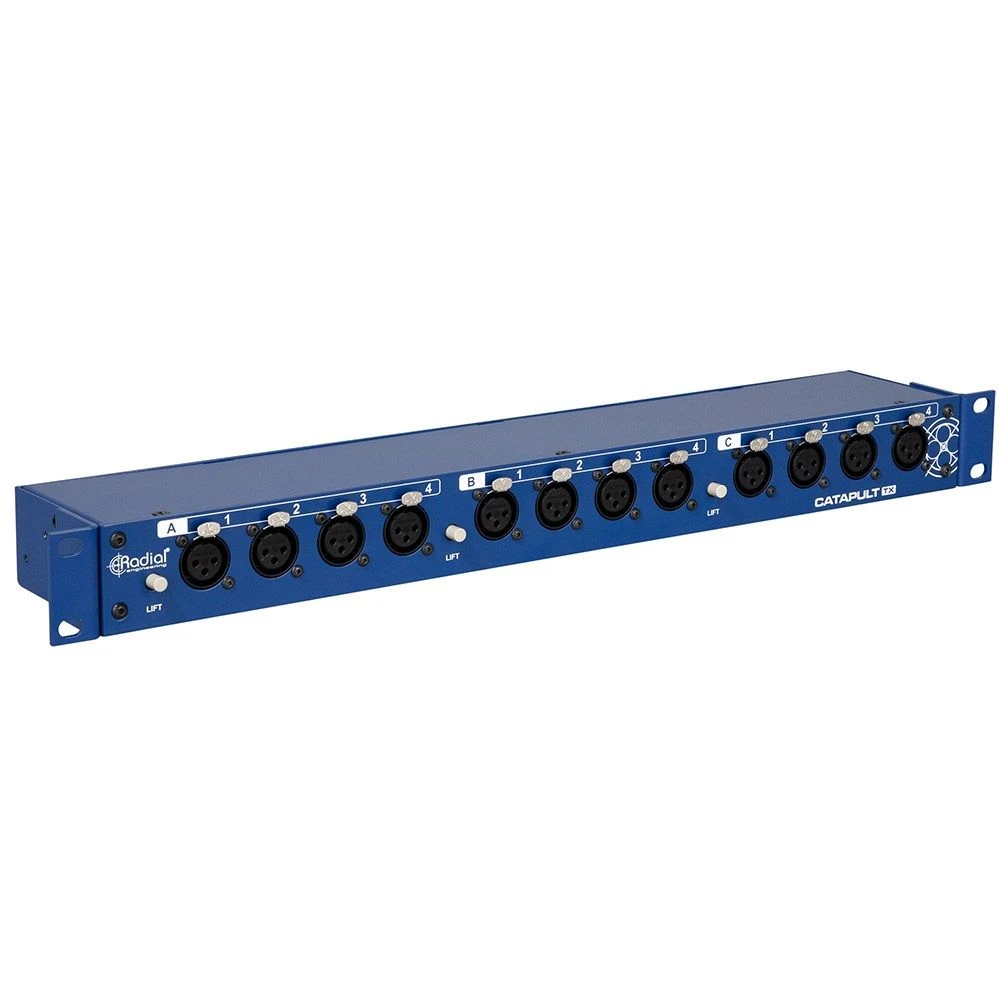
The Tx Rackmount Catapult is a single rack space unit that takes four balanced audio inputs via XLR and packs them into a single shielded Cat 5e cable for transmission. At the receiving end, a matching Catapult Rx unit (sold separately) unpacks the signals back to standard XLR outputs.
Key specifications worth understanding:
- Four balanced audio channels over one Cat 5e/6 cable
- 1U rackmount form factor — easy to integrate into existing racks
- Transformer-isolated inputs on premium Catapult models for ground loop elimination
- Passive operation — no power supply required (a huge reliability win)
- Maximum cable run of approximately 90 metres with quality Cat 5e shielded cable
- 20Hz-20kHz frequency response with negligible insertion loss
The passive, transformer-coupled design is the headline feature here. There's no DSP, no firmware to update, no batteries to charge, and nothing to fail catastrophically mid-show. You plug it in, it works, and it keeps working for decades.
Radial Tx Catapult vs Key Alternatives: Detailed Comparison
| Feature | Radial Tx Rackmount Catapult | Whirlwind Mini Catt | Traditional 8-Ch Copper Snake (15m) | Behringer S16 Digital Snake |
|---|---|---|---|---|
| Channel Count | 4 balanced | 4 balanced | 8 balanced | 16 in / 8 out digital |
| Cable Type | Single Cat 5e | Single Cat 5e | Multi-core copper | Single Cat 5e (AES50) |
| Max Cable Run | ~90m | ~90m | ~30m practical | ~100m |
| Power Required | No (passive) | No (passive) | No | Yes (PoE or PSU) |
| Weight (transmitter end) | ~1.5kg (1U rack) | ~0.5kg (stagebox) | ~6-10kg | ~2.5kg |
| Console Compatibility | Any analogue console | Any analogue console | Any analogue console | X32/M32 family only |
| Build Quality | Premium (14-gauge steel) | Solid plastic enclosure | Variable | Plastic enclosure |
| Australian Price Tier | Mid-range | Entry to mid-range | Mid to high | Mid-range |
Where the Tx Rackmount Catapult Wins
- Build quality is genuinely premium. Radial's reputation for tank-like construction holds up here — 14-gauge steel chassis, military-spec PCB, and component-level attention to detail that cheaper rivals simply don't match.
- Rackmount integration is a real advantage for permanent installs, broadcast trucks, and touring rigs where everything lives in 19-inch racks. The Mini Catt's pendant-style enclosure is fine on a stage floor but awkward to integrate into a rack tour.
- Zero latency, zero clock issues, zero firmware headaches. Because it's purely passive analogue transport, there's nothing to go wrong in a software sense.
- Console-agnostic. Works with any console with balanced XLR I/O — no Dante card, no MADI bridge, no proprietary expansion needed.
Where the Tx Rackmount Catapult Falls Short
- Only four channels per run. If you need 16 channels of stage inputs, you'll need four Tx/Rx pairs — at which point a digital snake starts looking compelling on price and cable management.
- No remote preamp control. Unlike Dante stageboxes, gain still has to be set on the source-side preamp or at the console — meaning long cable runs to mic preamps if your console isn't on stage.
- Cat 5e cable quality matters. Cheap unshielded Cat 5 will introduce noise, especially in environments with dimmer packs or lighting rigs. Budget for quality shielded cable.
- It's a transmitter only. You absolutely need a matching Catapult Rx at the other end — first-time buyers sometimes don't realise the Tx and Rx are sold separately.
Situation-Specific Recommendations
Best for Houses of Worship and Permanent Installs
If you're wiring up a church, school hall, or community venue and want a clean, rackmount solution that won't require service calls every six months, the Radial Tx Rackmount Catapult is genuinely hard to beat. The passive design means no power supply to fail, the rackmount form factor integrates cleanly into existing equipment racks, and the build quality means it will likely outlast the building it's installed in.
Best for Touring Sound Engineers
For touring rigs running analogue consoles or hybrid setups, the Tx Catapult is a strong choice when you need a few clean channels back to FOH without deploying a full digital infrastructure. It's particularly useful for sending stage-mic feeds, talkback, or measurement microphones back to the console position without dragging copper.
Best for Broadcast and AV Integration
The 1U rackmount form factor and transformer isolation make this a natural fit for broadcast OB vans and corporate AV systems where ground loops from building power are a persistent problem.
When You Should Choose Something Else
- You need 16+ channels: Consider a Behringer S16, Allen & Heath dLive stagebox, or a Dante-based system. Multiple Catapult pairs become impractical above 8 channels.
- You need remote preamp control: A digital snake is the only sensible answer — Catapult systems can't adjust gain remotely.
- You're on a tight budget for a one-off gig: A traditional copper snake might be cheaper if you only need 8 channels over short distances and already own one.
- You need bidirectional audio with monitor sends: Look at a complete digital snake solution rather than buying multiple Catapult Tx and Rx units.
Value Analysis: Is It Worth the Money?
The Catapult family sits in the mid-tier price bracket — more expensive than budget Chinese-made alternatives, less expensive than fully digital systems with comparable channel counts. The value proposition rests on three pillars:
- Longevity: Radial gear is famously bulletproof. A Catapult bought today will almost certainly still be working in 20 years.
- Reliability: Passive analogue transport means no firmware bugs, no driver issues, no software incompatibility down the line.
- Resale value: Radial products hold their value remarkably well on the Australian used market.
Per channel, the Catapult system isn't the cheapest option — but per channel-decade of reliable service, it's arguably one of the best-value investments in the analogue transport category.
You can view current pricing and availability for the Radial Tx Rackmount Catapult at MusiconStage.
Decision-Making Framework: Five Questions to Ask Yourself
- How many channels do I genuinely need? If it's four or fewer (per direction), the Catapult is a no-brainer. Eight is workable with two units. Sixteen-plus, look digital.
- Is my console analogue or digital? If you're running a digital console with Dante/AES50, you're probably better served by matching digital stageboxes that integrate natively.
- How long is my cable run? Under 90m, Catapult is fine. Over 100m, digital snakes typically handle distance better.
- How important is gain control from FOH? If critical, you need digital. If you can set-and-forget, analogue Catapult works beautifully.
- What's my reliability requirement? For touring, broadcast, and installs where downtime is unacceptable, the passive Catapult design is genuinely more reliable than anything with a chip in it.
Common Mistakes to Avoid When Buying
- Buying only the Tx unit: You need both Tx and Rx to make a working system. Confirm both are in your order.
- Skimping on Cat 5 cable: Cheap unshielded cable will introduce noise. Spend the extra dollars on shielded, professional-grade Cat 5e or Cat 6.
- Assuming it does what a digital snake does: No remote preamp control, no DSP, no networking. It's literally analogue audio over a different physical cable.
- Underestimating channel needs: Buy for the gig you'll grow into, not the gig you have today.
Frequently Asked Questions
Can I use regular Cat 5 cable from Bunnings?
You can, but it's not recommended for professional use. The Catapult is designed to work with shielded Cat 5e or Cat 6. Cheap unshielded cable will pick up EMI from lighting rigs, dimmer packs, and motor noise — exactly the problems a balanced analogue system is meant to avoid.
Does the Tx Catapult work with the Mini Catapult Rx?
Yes — Radial designed the Catapult family to be cross-compatible. The Tx Rackmount can pair with various Rx units depending on whether you need rackmount, stagebox, or pendant-style receivers at the destination end.
Will it cause any signal degradation or loss?
Insertion loss is negligible — typically under 0.5dB across the audio band — provided you stay within recommended cable lengths and use quality shielded Cat 5e or better.
Can I send phantom power through it?
No. The Catapult is for line-level and mic-level signal transport only. Phantom power must be supplied at the preamp end (typically from your console or standalone preamp).
Final Recommendation
The Radial Tx Rackmount Catapult is a specialist tool that excels in its narrow remit: getting up to four channels of clean balanced audio from point A to point B over a single Cat 5e cable, reliably, for decades, without ever needing a firmware update. For Australian buyers running houses of worship, permanent installs, broadcast rigs, or hybrid analogue-digital touring setups, it's one of the best-built and most reliable products in the category.
It's not the right tool if you need 16+ channels, remote preamp control, or you're already invested in a Dante or AES50 ecosystem. For those scenarios, a proper digital snake will serve you better.
But for the right use case, the Catapult is genuinely outstanding — and the passive, transformer-coupled design means you're buying a tool that will likely outlive your current console, your current rig, and possibly your current career.
Ready to add the Tx Rackmount Catapult to your rig? View the Radial Tx Rackmount Catapult on MusiconStage for current Australian pricing and availability.