
Radial Catapult TX Rackmount: Cat5 Audio Snake for Aussie Pros
Radial Catapult TX Rackmount: The Cat5 Audio Snake That Actually Belongs in Your Rack
If you've ever wrestled with a heavy, tangled analogue multi-core snake across a venue floor, you already understand why Cat5-based audio distribution exists. But not all Cat5 audio snakes are created equal. The Radial TX Rackmount Catapult sits firmly at the professional end of the spectrum — a transformer-isolated, rack-mountable transmitter designed for permanent installations and touring rigs where reliability isn't optional.
This isn't a budget solution for running a couple of channels across a room. It's a seriously engineered piece of signal infrastructure from Radial Engineering, a Canadian company with decades of reputation for building bulletproof audio tools. Whether you're outfitting a church, a conference centre, a broadcast facility, or a touring rack, the Catapult TX Rackmount deserves a proper look.
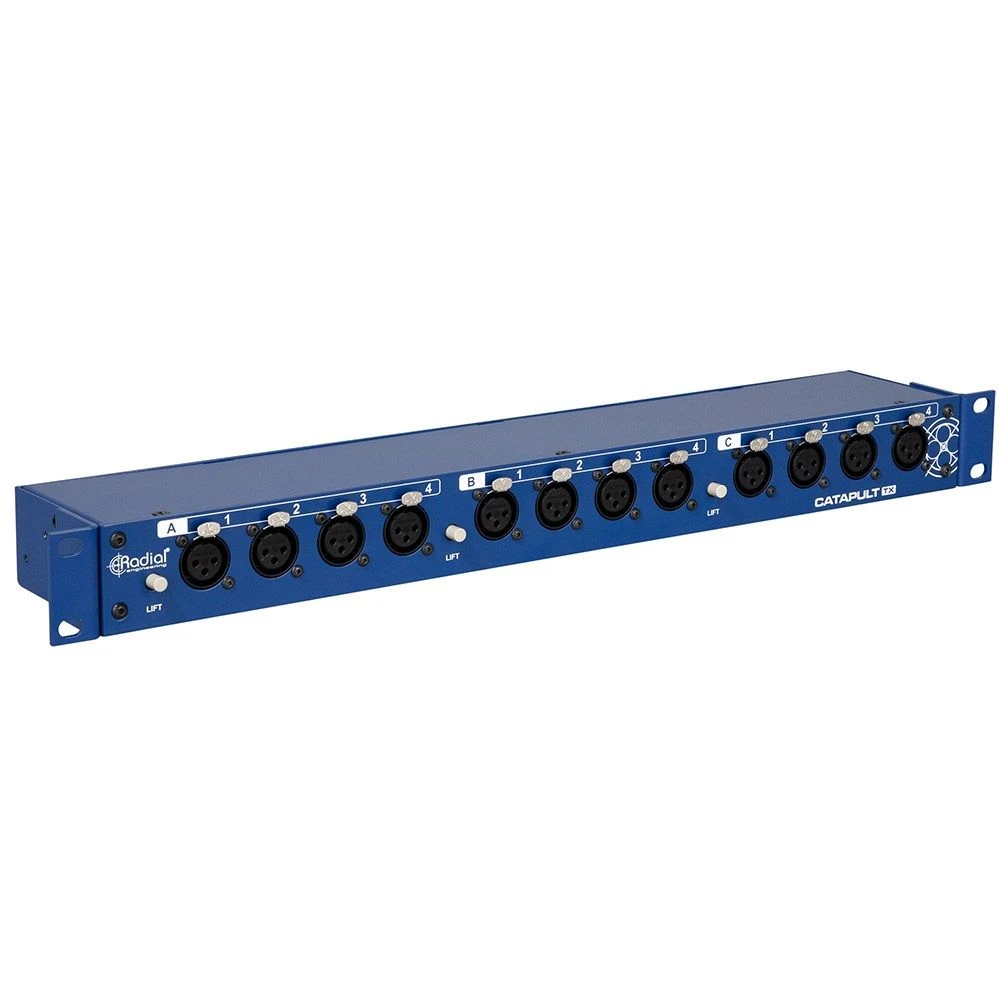
Want to check pricing and availability? View the Radial TX Rackmount Catapult at MusiconStage — Australia's authorised Radial dealer with free shipping nationwide.
What Exactly Is the Radial Catapult System?
Before diving into the TX Rackmount specifically, it's worth understanding the Catapult system as a whole. Radial's Catapult range is a modular Cat5 audio snake system that replaces traditional heavy multi-core copper snakes with lightweight, inexpensive Cat5e or Cat6 Ethernet cable. The system uses a transmitter (TX) and receiver (RX) pair to send multiple channels of balanced analogue audio over a single shielded Cat5 cable.
The key word there is analogue. Unlike digital snakes (such as Dante or AES50 systems), the Catapult doesn't convert your audio to digital. It uses custom-wound transformers to pass balanced analogue signals through the twisted pairs inside a standard Cat5 cable. Each twisted pair carries one balanced audio channel, giving you four channels per Cat5 cable.
This is a fundamentally different approach to digital snakes, and it has some real advantages:
- Zero latency — analogue signal, no conversion delay whatsoever
- No clocking issues — there's no digital clock to sync or lose
- No software or firmware — nothing to configure, update, or crash
- Transformer isolation — inherent ground loop rejection and electrical isolation
- Simplicity — plug in, route audio, done
The TX Rackmount: Purpose-Built for Permanent and Touring Rigs
Radial makes several Catapult variants. The floor-standing models are popular for quick stage deployments, but the TX Rackmount is designed for a different workflow entirely. This unit fits into a standard 19-inch equipment rack, making it ideal for:
- Permanent installations (churches, conference rooms, theatres, broadcast studios)
- Touring FOH or monitor racks
- Broadcast trucks and OB vans
- Recording studio tie-lines
- Any setup where your signal distribution lives in a rack
The rackmount form factor isn't just about tidiness (though that matters). It means the Catapult TX integrates directly into your existing signal chain — sitting right alongside your mixer, processors, and other rack gear. Your Cat5 runs go out the back to wherever you need audio delivered, and the whole thing is secured and protected inside your rack.
How It Works: The Signal Path Explained
Understanding the Catapult's signal path helps you appreciate why Radial's approach works so well.
The Transmitter Side (TX)
On the TX Rackmount, you connect your audio sources — typically line-level outputs from a mixer, processor, or other equipment — via standard XLR connectors on the rear panel. Each XLR input feeds into a custom-wound Radial transformer. The transformer serves two critical functions:
- Impedance matching — it adapts the balanced audio signal to travel efficiently over Cat5 cable's twisted pairs
- Galvanic isolation — it electrically disconnects the sending and receiving equipment, eliminating ground loops before they can start
The transformed signals are then routed to RJ45 Cat5 connectors. Four balanced audio channels ride on the four twisted pairs inside each Cat5 cable. The TX Rackmount features multiple RJ45 outputs, allowing you to run several Cat5 lines to different locations from a single rack unit.
The Receiver Side (RX)
At the other end, a Radial Catapult RX unit (available in rackmount or floor-standing versions) receives the Cat5 cable and converts back to standard XLR audio outputs. Again, transformers provide isolation at the receiving end. The result is clean, hum-free audio that arrives at full professional level.
Cable Runs and Distance
Radial specifies the Catapult system for cable runs of up to approximately 100 metres (328 feet) using quality shielded Cat5e cable. In practice, many users report excellent results at these distances and sometimes beyond, though signal quality depends heavily on cable quality. Radial strongly recommends using shielded Cat5e or Cat6 cable (STP, not UTP) to maintain rejection of electromagnetic interference, especially in environments with lighting dimmers, power cables, and other RF sources common in live venues.
Key Features That Set It Apart
Radial's Custom Transformer Design
This is the heart of what makes the Catapult special. Radial doesn't use off-the-shelf transformers — they wind their own, specifically designed for the impedance characteristics of Cat5 cable. This matters because standard audio transformers are designed for 600-ohm or bridging impedance loads, not the characteristic impedance of twisted-pair data cable. Get the transformer design wrong and you get frequency response problems, especially at the high end.
Radial's custom transformers deliver a frequency response that's genuinely flat across the audio spectrum. You're not losing top-end shimmer on your cymbals or clarity on vocals just because you're running over Cat5 instead of dedicated audio cable. The transformers also provide excellent common-mode rejection, which is how the system achieves its ground loop immunity.
True Galvanic Isolation
Every channel passes through a transformer, which means there is no direct electrical connection between the input and output sides. This is galvanic isolation in the truest sense — not a ground lift switch, not a coupling capacitor, but a genuine electromagnetic barrier between circuits.
For Australian installers and sound engineers, this is a massive practical benefit. Anyone who's worked in older RSLs, town halls, or multi-use venues knows the ground loop nightmare that can occur when you connect equipment in different locations running on different power circuits. The Catapult's transformer isolation eliminates this class of problem completely.
Passive Operation (No Power Required)
One of the most underappreciated features of the Catapult system is that it's entirely passive. There are no active electronics, no power supply, no phantom power considerations. The transformers pass signal through electromagnetic coupling alone.
This has profound implications for reliability:
- No power supply to fail
- No active components to generate noise or heat
- No firmware bugs or software glitches
- No boot-up time — instant audio as soon as cables are connected
- Nothing to configure or misconfigure
In a world where digital snakes occasionally lock up, lose sync, or need firmware updates mid-tour, there's something deeply reassuring about a signal path that's purely electromagnetic. It either works or a cable is broken — and troubleshooting a cable is something any tech can do in minutes.
Robust Build Quality
Radial builds their gear to survive professional use, and the TX Rackmount is no exception. The steel chassis is designed for permanent rack installation, with solid RJ45 and XLR connectors rated for thousands of mating cycles. This isn't consumer-grade networking equipment repurposed for audio — it's purpose-built audio infrastructure that happens to use Cat5 as its transport medium.
Practical Applications: Where the TX Rackmount Excels
Houses of Worship
Churches and worship spaces across Australia are one of the biggest markets for the Catapult system. The typical scenario: a mixing console at FOH needs to send audio to amplifiers, speakers, or a broadcast/recording system in a different part of the building. Running traditional multi-core snake cable through walls, ceilings, and conduit is expensive and inflexible. Cat5 cable, by contrast, is cheap, thin, flexible, and easy to run through existing network infrastructure.
The TX Rackmount sits in the FOH rack. Cat5 cables run through existing conduit (or are easily pulled through new runs) to RX units at amp racks, stage locations, or cry rooms. Transformer isolation means no ground hum even though these locations may be on different electrical circuits. And because it's passive, there's no power point needed at the remote end if you're using a passive RX unit.
Conference and Corporate AV
Conference centres, boardrooms, and corporate AV installations benefit enormously from Cat5 audio distribution. Many of these spaces already have Cat5/Cat6 infrastructure run throughout the building for data networking. While you shouldn't share cables with active data networks (the signal types are incompatible), the same conduit paths and termination points can be used for dedicated audio Cat5 runs.
The TX Rackmount in a central equipment rack can distribute audio to multiple zones, breakout rooms, or presentation spaces. It's particularly useful for distributing background music, paging audio, or presentation feeds to multiple locations simultaneously.
Theatre and Live Performance
In theatrical applications, the Catapult system provides a lightweight, flexible alternative to heavy multi-core snakes. A TX Rackmount at the mixing position can send channels to amp racks backstage, monitor positions in the wings, or recording equipment in a control room. The zero-latency analogue signal path means no concerns about monitor delay for performers — what they hear is in perfect time with what they play.
Broadcast and Recording
Broadcast trucks, outside broadcast setups, and recording studios use the Catapult for tie-line distribution. The transformer isolation is especially valued in broadcast, where equipment from multiple vendors and power sources must interconnect without introducing hum or noise. The rackmount form factor fits naturally into broadcast truck rack systems and studio machine rooms.
Touring Sound
For touring engineers who carry their own FOH racks, the TX Rackmount provides a clean way to send audio to house systems, recording splits, or broadcast feeds at each venue. Instead of carrying heavy multi-core cables, you carry a couple of Cat5 cables. At each venue, you patch your Catapult into whatever infrastructure exists at the remote end.
The Catapult vs. Digital Snakes: An Honest Comparison
It would be disingenuous to discuss the Catapult without addressing the elephant in the room: digital audio snakes. Systems like Dante, AES50, AVB, and proprietary digital snakes from major console manufacturers are enormously popular and capable. So why would anyone choose an analogue Cat5 system?
When the Catapult Makes More Sense
- Simplicity is paramount — no network configuration, no IP addresses, no clocking
- Absolute zero latency required — critical for some monitoring and broadcast applications
- Budget constraints — the Catapult system costs significantly less than most digital snake solutions
- Reliability in mission-critical applications — passive operation means fewer failure points
- Small to medium channel counts — when you need 4-16 channels, not 64
- Integration with analogue consoles — no digital conversion needed
- Permanent installs where simplicity matters — volunteer-operated systems benefit from zero configuration
When a Digital Snake Makes More Sense
- High channel counts — digital snakes can carry 64+ channels on a single cable
- Remote preamp control — digital systems allow gain adjustment from FOH
- Complex routing — digital networks offer flexible, software-configurable routing
- Redundancy features — enterprise digital networks offer failover paths
- Integration with digital consoles — many consoles have built-in digital snake protocols
The honest truth is that the Catapult and digital snakes serve overlapping but different markets. For many Australian installers and engineers, the Catapult fills a sweet spot where you need reliable, high-quality audio distribution without the complexity and cost of a digital network. It's not trying to replace Dante in a large venue — it's providing a better solution for the many situations where Dante is overkill.
Considering the Catapult for your setup? Check out the Radial TX Rackmount Catapult at MusiconStage — free delivery across Australia and genuine Radial warranty support.
Specifications and Technical Details
| Specification | Detail |
|---|---|
| Audio Channels | 4 balanced channels per Cat5 cable |
| Audio Connectors | XLR (rear panel) |
| Network Connectors | RJ45 (shielded Cat5e/Cat6) |
| Signal Type | Balanced analogue audio |
| Isolation | Transformer-isolated (custom Radial transformers) |
| Power Required | None (fully passive) |
| Maximum Cable Run | ~100 metres (328 ft) with quality shielded Cat5e |
| Form Factor | Standard 19" rackmount (1RU) |
| Construction | Steel chassis |
| Country of Design | Canada (Radial Engineering) |
Note: Always use shielded Cat5e or Cat6 cable for best results. Standard unshielded UTP cable may work in low-interference environments but is not recommended for professional installations.
Installation Tips for Australian Technicians
Having covered what the Catapult TX Rackmount does, here are some practical considerations for getting the best results in typical Australian install scenarios.
Cable Selection Matters
Don't skimp on Cat5 cable. Use shielded (STP or FTP) Cat5e or Cat6 from a reputable brand. In Australia, cable sold through professional audio distributors is generally a safer bet than the cheapest option from an electrical wholesaler. Look for solid-core cable for permanent runs (better signal integrity over distance) and stranded-core for flexible patch cables.
Keep Audio and Data Separate
Even though the Catapult uses Cat5 cable, the signal it carries is analogue audio, not Ethernet data. Do not connect Catapult units to network switches, routers, or PoE devices — this can damage the transformers or connected equipment. Label your audio Cat5 runs clearly to avoid confusion, especially in buildings with existing data networks.
Conduit and Cable Routing
Cat5 cable is much thinner and lighter than multi-core audio snake cable, which is a huge advantage in Australian venue installations where running cable through roof spaces and wall cavities can be challenging. A single Cat5 cable carrying four audio channels is dramatically easier to pull through conduit than four individual shielded audio cables or a four-pair multi-core.
Maintain separation from power cables and lighting dimmer circuits where possible. While the Catapult's transformer isolation provides excellent noise rejection, keeping audio cable runs physically separated from high-current or noisy electrical wiring is always good practice.
Termination Quality
Use quality RJ45 connectors and terminate them properly. A poorly crimped RJ45 is the most common source of problems in Cat5 audio systems. If you're not confident in your crimping, use pre-made cables for short runs or have a qualified data cabler terminate your permanent runs. Always test with a cable tester before commissioning.
Pros and Cons: The Balanced View
What We Genuinely Like
- Transformer isolation on every channel — ground loop problems simply vanish
- Completely passive operation — nothing to power, configure, update, or reboot
- Radial build quality — this is gear built to last decades in professional use
- Dramatic cable weight reduction — Cat5 vs. multi-core is no contest
- True zero latency — analogue signal path means no conversion delay
- Rackmount form factor — integrates cleanly into professional rack systems
- Simple troubleshooting — it's transformers and connectors, not firmware and network stacks
- Cost-effective — significantly cheaper than digital snake alternatives for small channel counts
Honest Limitations
- Limited channel count per cable — four channels per Cat5 run means you need multiple cables for larger channel counts
- No remote preamp control — unlike digital snakes, you can't adjust gain from FOH
- Distance limitations — 100m maximum is fine for most venues but won't suit very large installations without repeaters
- Analogue signal degradation — over very long runs, you may see some high-frequency rolloff (though Radial's transformer design minimises this)
- No built-in redundancy — if a cable fails, that run goes down (though you can easily carry spare Cat5)
- Requires matched TX/RX pairs — you need both ends of the Catapult system for it to work properly
Who Should Buy the TX Rackmount?
The Radial TX Rackmount Catapult is the right choice if you fall into one or more of these categories:
- Installers fitting out churches, conference rooms, theatres, or corporate spaces who need reliable audio distribution without digital complexity
- Touring engineers who want a rack-integrated way to send audio to house systems, broadcast, or recording splits
- Broadcast professionals who need transformer-isolated audio distribution in OB trucks or studios
- Venue technicians who are tired of dealing with heavy multi-core snakes and ground loop problems
- Anyone running analogue consoles who wants the cable convenience of Cat5 without converting to digital
It's probably not the right choice if you need high channel counts (32+ channels), remote preamp control, or complex software-configurable routing. In those cases, a digital snake system like Dante or AES50 will serve you better.
Frequently Asked Questions
Can I use regular Ethernet cable from Bunnings?
You can, but you shouldn't for professional installations. Radial recommends shielded Cat5e or Cat6 cable. The unshielded UTP cable commonly sold at hardware stores may pick up interference from lighting dimmers, power cables, and other RF sources common in live venues. Invest in proper shielded cable — it's still dramatically cheaper than dedicated audio multi-core.
Does it work with any Cat5 audio receiver, or only Radial RX units?
The Catapult system is designed to work as a matched TX/RX pair. Radial's transformers are specifically wound for the impedance characteristics of Cat5 cable, and the pinout is Radial's own standard. While it's technically possible to wire a custom breakout, you'll get the best results — and maintain the transformer isolation on both ends — by using genuine Radial RX units.
Can I send phantom power through the Catapult?
No. The Catapult passes audio signals only. Phantom power (48V DC) cannot pass through the transformers. If you need phantom power at the remote end, you'll need to provide it locally (from a mixer, preamp, or standalone phantom power supply at the stage end).
Is there any signal loss over a 100-metre run?
With quality shielded Cat5e cable and proper termination, signal loss over 100 metres is minimal. You may see very slight high-frequency attenuation on the longest runs, but in practice it's negligible for most applications. Radial's transformer design is specifically optimised to maintain frequency response over Cat5 cable lengths.
Can I use it for microphone-level signals?
The Catapult is designed primarily for line-level signals. While it can pass mic-level signals, the signal-to-noise ratio over long Cat5 runs is better with line-level sources. For mic-level applications over distance, consider using a preamp at the stage end to bring signals up to line level before the Catapult, or look at a digital snake solution with built-in preamps.
What's the difference between the rackmount and floor versions?
Functionally, they're the same system — same transformers, same signal path, same audio quality. The difference is purely mechanical: the rackmount version fits a standard 19-inch rack, while the floor versions are designed to sit on a stage floor or tabletop. Choose based on where the unit will live in your setup.
Australian Availability and Support
Radial Engineering products are distributed in Australia through authorised dealers, which means you get genuine manufacturer warranty and local support. This matters — parallel imports of pro audio gear can leave you without warranty coverage if something goes wrong.
When purchasing the TX Rackmount, remember you'll also need at least one RX unit (rackmount or floor model) and appropriate shielded Cat5e cable to complete the system. Factor the complete system cost into your budget when comparing against alternatives.
Final Verdict: Is the Radial TX Rackmount Catapult Worth It?
The Radial TX Rackmount Catapult does one thing exceptionally well: it gets professional-quality analogue audio from your rack to a remote location over lightweight, inexpensive Cat5 cable, with transformer isolation that eliminates ground loops. It does this without power, without configuration, without software, and without compromise on audio quality.
It's not trying to be a digital snake. It's not trying to replace Dante. It's solving a specific, common problem — reliable audio distribution over distance — with an elegantly simple, bulletproof approach. For the right application, it's genuinely hard to beat.
For Australian installers, sound engineers, and venue technicians who value reliability and simplicity, the Catapult system remains one of the smartest investments in signal infrastructure you can make. The rackmount version specifically earns its place in any professional rack where clean, isolated audio distribution is needed.
Ready to simplify your audio distribution? Order the Radial TX Rackmount Catapult from MusiconStage — authorised Australian Radial dealer with free nationwide shipping and full manufacturer warranty support.