
Radial Catapult TX Rackmount Audio Snake: Australian Buyer's Guide 2026
Radial Catapult TX Rackmount: The Cat 5 Audio Snake That Changed How Aussie Venues Run Cable
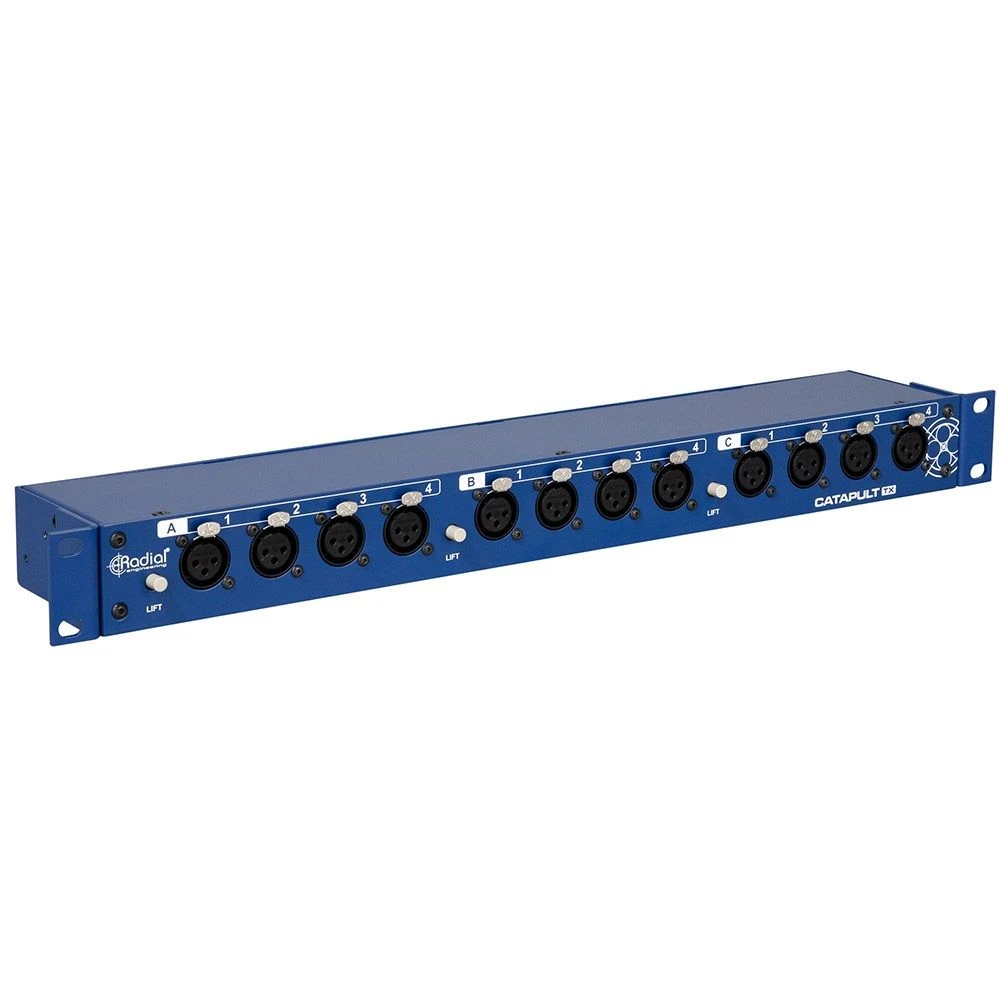
If you've ever spent an hour untangling a heavy analogue snake in the back of a pub, church hall, or outdoor stage, you already know why Cat 5 audio snakes exist. The Radial TX Rackmount Catapult represents one of the most trusted solutions for converting balanced analogue audio to Cat 5 cable — and it's been a quiet workhorse in Australian venues, hire companies, and touring rigs for years.
But is it actually the right choice for your setup? In this guide, we'll break down exactly what the Catapult TX Rackmount does, how it compares to other Cat 5 audio snake options on the market, and who it's genuinely best suited for. Whether you're running a small venue, kitting out a church, or building a portable PA rig, this guide will help you decide if the Radial Catapult system belongs in your rack.
What Exactly Is the Radial Catapult TX Rackmount?
The Catapult TX is the transmit (send) side of Radial's Catapult Cat 5 audio snake system. It takes up to 4 channels of balanced analogue audio via standard XLR inputs and sends them down a single Cat 5 or Cat 6 Ethernet cable. At the other end, you need a Catapult RX (receive) unit to convert back to XLR outputs.
The "Rackmount" designation means this unit is designed for permanent installation in a standard 19-inch equipment rack, occupying a single rack unit (1RU). This sets it apart from Radial's floor-based Catapult units, which are built as rugged stage boxes.
Key Specifications
| Specification | Details |
|---|---|
| Channels | 4 balanced audio channels per Cat 5 cable |
| Connectors (Audio) | XLR female inputs |
| Connectors (Network) | Ethercon (ruggedised RJ45) |
| Cable Type | Cat 5 / Cat 5e / Cat 6 (shielded recommended) |
| Maximum Cable Run | Up to 100 metres (standard Ethernet spec) |
| Format | 1RU rackmount |
| Power | Passive — no power required |
| Construction | 14-gauge steel chassis |
| Manufacturer | Radial Engineering (Canada) |
Why Cat 5 Audio Snakes Still Matter in 2026
You might be thinking: "With digital snakes, Dante, and AVB everywhere, why would anyone still use analogue-over-Cat5?" Fair question. Here's why the Catapult system remains relevant:
- Zero latency — These are passive transformers, not digital converters. There's no A/D-D/A conversion happening, which means absolutely zero latency. For monitoring-critical applications, this matters.
- No power required — The Catapult TX is completely passive. No power supply, no phantom power concerns on the snake itself. Plug in and go.
- Simplicity — No network configuration, no firmware updates, no IP addressing. XLR in one end, XLR out the other. It just works.
- Cost-effective cable runs — A 50-metre Cat 5 cable costs a fraction of a 50-metre 4-channel analogue snake, and it's far lighter and easier to manage.
- Reliability — Passive transformer isolation means no ground loops, no digital glitches, and no driver compatibility issues. Radial's transformer-based design provides galvanic isolation between send and receive.
For plenty of Australian setups — particularly churches, small-to-medium venues, corporate AV installs, and portable PA rigs — a Cat 5 analogue snake system is genuinely all you need. Not everything requires a Dante network.
Radial Catapult System: Understanding the Full Lineup
Before diving into comparisons, it's worth understanding how the Catapult TX Rackmount fits within Radial's broader Catapult range. This is where buyers sometimes get confused.
| Model | Format | Direction | Best For |
|---|---|---|---|
| Catapult TX4 (Floor) | Stage box | Transmit (send) | Stage end — portable setups |
| Catapult RX4 (Floor) | Stage box | Receive | FOH/monitor end — portable setups |
| Catapult TX4M (Mini) | Compact stage box | Transmit | Tight spaces, pedalboards |
| Catapult TX Rackmount | 1RU rack | Transmit | Permanent installs, rack systems |
| Catapult RX Rackmount | 1RU rack | Receive | FOH rack, permanent installs |
Important: The TX Rackmount is the transmit unit only. You'll need a corresponding RX unit (rackmount or floor) at the receive end to complete the system. This is a common point of confusion — the TX and RX are sold separately because different setups require different combinations.
Radial Catapult TX vs Competing Cat 5 Audio Snake Systems
The Catapult isn't the only Cat 5 audio snake on the market. Let's see how it stacks up against the main alternatives Australian buyers are likely to encounter.
Radial Catapult TX vs Whirlwind Catdusa
The Whirlwind Catdusa is probably the closest direct competitor. Like the Catapult, it uses Cat 5 cable to carry multiple balanced audio channels.
| Feature | Radial Catapult TX Rackmount | Whirlwind Catdusa |
|---|---|---|
| Channels per Cat 5 | 4 | 4 |
| Isolation | Transformer-isolated | Transformer-isolated |
| Build Quality | 14-gauge steel, Radial's signature tank-like construction | Solid steel, professional grade |
| Connector Type | Ethercon (locking RJ45) | Standard RJ45 (some models Ethercon) |
| Rackmount Option | Yes — dedicated rackmount model | Breakout cable format primarily |
| Availability in Australia | Good — stocked by major dealers | More limited availability |
Verdict: The Catdusa is a solid product, but the Radial Catapult wins on Australian availability and the purpose-built rackmount format. If you need a rack-integrated solution, the Catapult TX Rackmount is the more refined option. The Catdusa works well as a simple breakout adapter.
Radial Catapult TX vs Going Full Digital (Dante/AVB)
This is the bigger question most buyers wrestle with in 2026. Should you even be looking at analogue-over-Cat5, or should you jump straight to a digital snake system?
| Factor | Radial Catapult (Analogue/Cat5) | Digital Snake (Dante/AVB) |
|---|---|---|
| Latency | Zero (passive) | Sub-millisecond (still very low) |
| Channel Count | 4 per cable | Up to 64+ per cable |
| Setup Complexity | Plug and play | Requires network configuration |
| Cost (4 channels) | $$ | $$$$ |
| Power Required | No | Yes |
| Audio Quality | Transparent (transformer-coupled) | Depends on converters used |
| Scalability | Limited (4ch per cable) | Highly scalable |
| Redundancy | Simple — swap cable | Network redundancy available |
| Troubleshooting | Dead simple | Requires network knowledge |
Verdict: If you need more than 8-12 channels over distance, digital is almost certainly the better investment. But for 4-8 channel runs — think side-fills, delay speakers, broadcast feeds, monitor sends — the Catapult's simplicity and zero-config approach is genuinely hard to beat. Many professional setups use both: a Dante network for the main snake and Catapult systems for auxiliary runs.
Who Should Buy the Radial Catapult TX Rackmount?
Best For: Permanent Installations
If you're wiring a venue, church, school hall, or conference room and need to run a handful of audio channels between rooms or between the stage and a control position, the rackmount Catapult is ideal. Mount the TX in a rack near the stage, run Cat 5 through the walls (far cheaper and easier than running multicore), and mount the RX in your control room rack. Done.
Best For: Broadcast and Recording Feeds
Need to send a stereo or 4-channel feed from FOH to a broadcast position, recording room, or streaming setup? The Catapult system handles this beautifully. The transformer isolation eliminates ground loop issues that plague long analogue runs — a common headache in broadcast environments.
Best For: Touring Racks
Hire companies and touring engineers who build purpose-designed racks love the rackmount format. You can integrate the Catapult TX into a monitor rack or side-fill rack, providing clean, reliable audio transport without adding heavy multicore to the load-in.
Consider Alternatives If...
- You need more than 8 channels — Multiple Catapult units start to become less practical than a single digital snake solution.
- You need bidirectional channels — The Catapult is unidirectional (TX sends, RX receives). If you need sends and returns, you'll need separate TX and RX units at each end, doubling your cable count.
- Your runs exceed 100 metres — Cat 5 spec maxes out at 100m. For longer runs, you'll need fibre-based solutions.
- You want a portable stage box — The rackmount version is designed for rack installation. For stage use, look at the Catapult TX4 floor model instead.
Build Quality and Reliability: What to Expect
Radial Engineering has built their reputation on making products that survive the real world. The Catapult TX Rackmount continues this tradition:
- 14-gauge steel construction — This isn't a flimsy sheet metal box. Radial's chassis work is genuinely overbuilt, which matters when gear lives in road racks that get thrown into trucks.
- Transformer isolation on every channel — Radial uses custom-wound transformers, not cheap off-the-shelf components. This provides genuine galvanic isolation, eliminating ground loops and protecting connected equipment.
- Ethercon connectors — The Cat 5 connection uses Neutrik Ethercon (locking RJ45), not standard RJ45 jacks. This prevents accidental disconnection — crucial in live environments where cables get kicked.
- Passive design — No active components means nothing to fail electronically. No capacitors to age, no power supplies to die. The only failure point is the cable itself.
- Made in Canada — Radial manufactures in their own facility in Vancouver. Quality control is tight, and the company's reputation for after-sales support is excellent.
Practical Setup Tips for Australian Installers
Having worked with these units in various Australian environments, here are some practical considerations:
Cable Selection Matters
Use shielded Cat 5e or Cat 6 cable (STP or FTP) for audio applications. Standard unshielded Cat 5 (UTP) will work, but shielded cable provides better rejection of interference — especially important in Australian venues where dimmer racks, LED drivers, and power cabling may run close to your audio runs.
Labelling Your System
Since each Cat 5 cable carries 4 channels, clear labelling is essential. Mark both ends of every cable with which channels it carries and which Catapult unit it connects to. When troubleshooting at 2am during a corporate event, you'll thank yourself.
Rack Placement
The TX Rackmount generates no heat (passive design), so it can go anywhere in your rack without worrying about ventilation. Place it near your patch bay or wherever your XLR inputs originate for the cleanest cable management.
Combining Multiple Units
Need more than 4 channels? Multiple Catapult units can be racked together. Two TX Rackmount units give you 8 channels over two Cat 5 cables — still significantly lighter and easier to manage than an 8-channel multicore.
Value Analysis: Is the Catapult TX Rackmount Worth It?
Let's talk value honestly. The Radial Catapult system isn't the cheapest way to get audio from A to B. You're paying a premium for:
- Radial's transformer quality — Custom-wound transformers that maintain audio transparency
- Build quality — 14-gauge steel that survives touring and permanent installation alike
- Ethercon connectors — Professional-grade, locking connections
- Reputation and support — Radial's track record and warranty support
Could you find cheaper Cat 5 audio adapters? Yes. Will they provide the same isolation quality, build durability, and long-term reliability? Generally, no. In professional audio, the cost of a failure during a show always outweighs the savings on cheaper gear. The Catapult system is priced at the professional tier because it performs at the professional tier.
For the cost comparison, consider what you'd spend on a traditional multicore snake for the same run length. A quality 4-channel, 30-metre multicore with Neutrik connectors isn't cheap either — and it's heavier, bulkier, and more prone to cable damage. The Catapult system pays for itself in convenience and weight savings over time.
Common Questions Australian Buyers Ask
Can I use regular Ethernet cable?
Yes, any Cat 5, Cat 5e, or Cat 6 cable will work. Shielded cable is recommended for best noise rejection. You cannot, however, run audio and network data on the same cable simultaneously — the Catapult uses all four pairs for audio.
Does it carry phantom power?
No. Phantom power (+48V) does not pass through the Catapult system. Condenser microphones will need phantom power supplied from the mixer or a separate phantom power supply at the microphone end.
Can I use it with existing in-wall Cat 5 cabling?
Yes — and this is one of the most compelling use cases. Many Australian venues and churches already have Cat 5 infrastructure from network installations. The Catapult lets you repurpose those existing cable runs for audio without pulling new cable.
What's the audio quality like?
Radial's transformers are designed for transparency. In practice, the Catapult system introduces minimal coloration. Most users report no audible difference compared to a direct XLR connection. The frequency response is flat across the audible range, and the transformers handle professional signal levels without issue.
TX or RX — which end goes where?
The TX (transmit) goes at the source of your audio. If you're sending audio from the stage to FOH, the TX goes at the stage end and the RX goes at the FOH position. Think of it like this: TX = where the audio starts its journey.
Final Recommendation
The Radial TX Rackmount Catapult is a premium, purpose-built solution for a specific problem: getting balanced audio channels from point A to point B using lightweight Cat 5 cable, in a rack-integrated format. It does this job exceptionally well.
Buy the Catapult TX Rackmount if:
- You need a rack-integrated Cat 5 audio snake transmitter
- You're doing a permanent installation (venue, church, school)
- You value zero-configuration, passive reliability
- Ground loop isolation is important for your application
- You want to repurpose existing Cat 5 infrastructure for audio
Look elsewhere if:
- You need high channel counts (12+) — consider digital
- You want a portable stage box — get the Catapult TX4 floor model
- Your budget is extremely tight — though be wary of cheap alternatives
For Australian buyers, the Catapult system remains one of the most practical solutions for small-to-medium channel count audio transport. It's not glamorous, it's not cutting-edge digital technology — but it's bulletproof, zero-latency, and does exactly what it promises every single time you plug it in.
Check the current price of the Radial TX Rackmount Catapult at MusiconStage
Need help choosing between the rackmount and floor models, or want to spec a complete Catapult system for your venue? Get in touch with MusiconStage — they can help you work out exactly which configuration suits your setup.