
Radial Catapult TX Rack vs Snakes: Aussie Buyer's Guide 2026
Radial Tx Rackmount Catapult vs the Alternatives: An Australian Buyer's Guide for 2026
Getting multiple channels of balanced audio from one end of a room to the other sounds like a solved problem until you actually have to buy the gear. Do you spend up on a digital stagebox? Coil a heavy analogue multicore into the back of the van every weekend? Or run humble Cat 5 and be done with it?
The Radial Tx Rackmount Catapult sits squarely in that third camp, and it's a category a lot of Australian installers, houses of worship, corporate AV crews and studio owners genuinely misunderstand. This guide compares it fairly against every realistic alternative, explains where it wins, and — just as importantly — tells you when you should buy something else entirely.
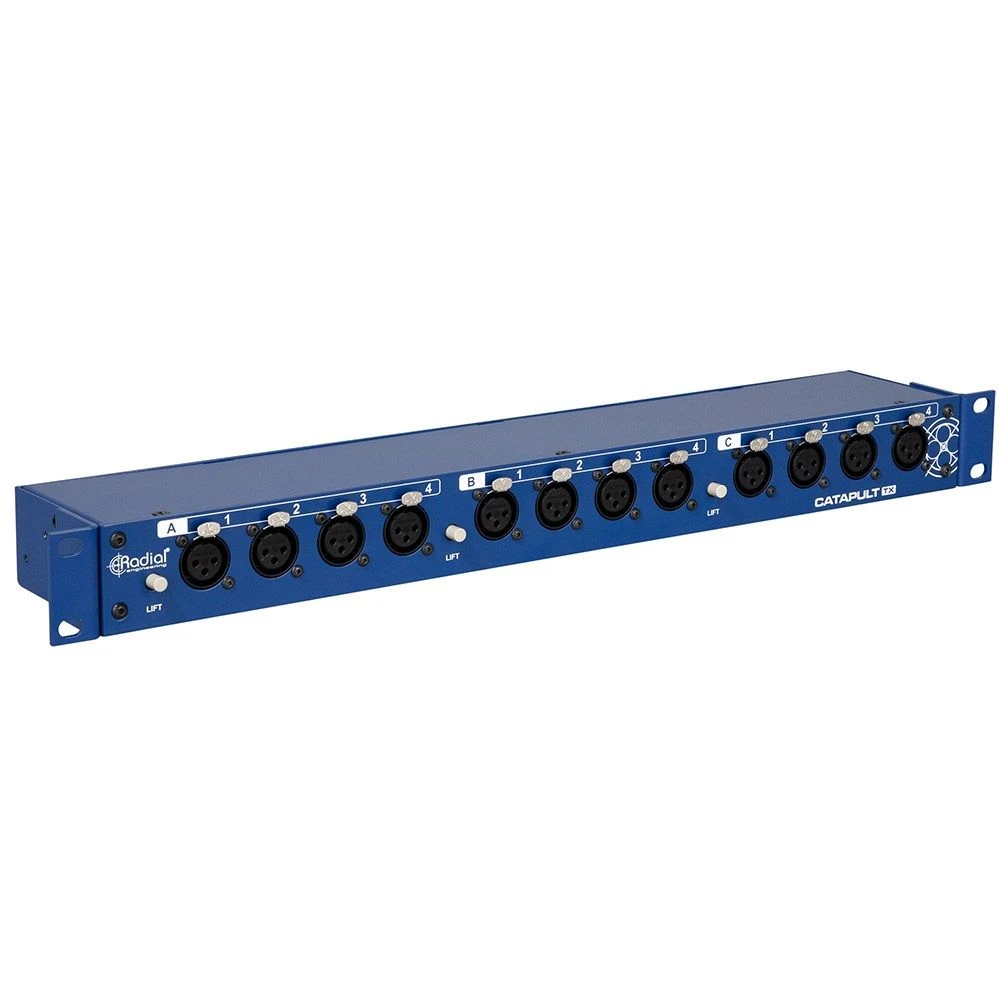
First, what the Tx Rackmount Catapult actually is
The Catapult system is a passive analogue audio snake that travels down standard Cat 5 cable. Each Catapult card carries four channels of balanced audio over a single Cat 5 run, using the four twisted pairs inside the cable. The rackmount frame is a rack-mountable chassis that accepts multiple Catapult cards, so a fully populated unit turns a rack space into a sizeable multichannel send or return point.
The single most important thing to understand before you buy: the "Tx" in the name means transmitter. This is the sending end. It takes your audio inputs and packs them onto Cat 5. To unpack them at the other end, you need a matching Rx (receiver) — either the Rx rackmount version or a Rx stage box. Buying a Tx on its own and expecting a complete snake is the classic first-timer mistake, and it's the reason these units get returned.
Second important point: this is not networked audio. It uses the same cable as your office network, but the signal on it is plain old analogue. Never plug a Catapult into a network switch, and never plug a live network port into a Catapult. The cable is shared; the protocol is not.
The market landscape: four ways to move multichannel audio
Before comparing products, compare approaches. Most buyers who end up disappointed chose the wrong category, not the wrong brand.
| Approach | How it works | Best suited to | Main trade-off |
|---|---|---|---|
| Analogue multicore snake | Dedicated multi-pair cable with fan-out or stage box | Traditional touring rigs, analogue consoles | Heavy, bulky, expensive per metre, hard to repair on site |
| Cat 5 analogue (Catapult) | Four balanced channels per Cat 5 run, passive | Installs, studios, AV, permanent infrastructure | Still analogue — channel count scales by adding cables |
| Digital stagebox (Dante, AES50, etc.) | Preamps at the stage, digital transport to console | Live bands, festivals, big channel counts | Needs power, needs a compatible console, latency and config |
| Wireless / IP over WAN | Encoded audio over network or RF | Temporary links, difficult cable paths | Reliability, latency and spectrum management |
Read that table honestly and a pattern emerges. The Catapult approach is not competing to be the most feature-rich option — it's competing to be the simplest, most reliable and least failure-prone option. That's a legitimate thing to want, and for a surprising number of jobs it's the correct thing to want.
Radial Tx Rackmount Catapult vs a traditional analogue multicore
This is the comparison most Australian buyers are actually making, so let's do it properly.
Where the Catapult clearly wins
- Cable cost and availability. Shielded Cat 5e is a commodity. You can buy it at any data supplier in Sydney, Melbourne, Perth or a regional town, in any length, terminated, for a fraction of what an equivalent length of multicore costs.
- Weight and pack-down. A 50 m Cat 5 run weighs almost nothing next to 50 m of multi-pair copper. Anyone who has loaded a snake into a Hiace at 1 am understands the value here.
- Field repairability. A damaged RJ45 is a five-minute fix with a crimper. A damaged multicore is a job for a workshop.
- Building infrastructure. Most modern Australian venues, schools and offices already have structured Cat 5/Cat 6 cabling in the walls. The Catapult lets you use it for audio.
- Rack integration. The rackmount format keeps the whole thing tidy, permanently mounted and out of harm's way — a real advantage over a fan-out that lives in a road case.
Where the multicore still wins
- Ruggedness underfoot. A purpose-built touring multicore with a heavy jacket will survive abuse that will eventually kill an RJ45 connector. Locking or shrouded connectors help, but this is a genuine point in the multicore's favour.
- One cable, many channels. A 24-way multicore is one cable. Twenty-four channels of Catapult is six Cat 5 runs. For high channel counts on a moving stage, that's more things to coil and more things to trip over.
- No end boxes required. A multicore with a fan-out needs no matching hardware at each end. The Catapult requires Tx and Rx pairs, which is real money.
Verdict: for permanent and semi-permanent installs, the Catapult approach wins decisively. For a touring band that throws gear on and off a stage 200 nights a year, a good multicore or a digital stagebox is often the smarter buy.
Radial Tx Rackmount Catapult vs a digital stagebox
This comparison gets emotional, so let's be even-handed. A Dante or AES50 stagebox does things the Catapult simply cannot: hundreds of channels down one cable, remote preamp control, bidirectional audio, and integration with a modern digital console's routing.
But the Catapult does three things a digital stagebox cannot:
- It needs no power. Passive means no PSU, no wall wart, no PoE switch, nothing to fail at the far end of a long cable run. In a ceiling void or a locked comms cupboard, that matters enormously.
- It adds no latency and no conversion. Analogue in, analogue out. No clocking, no sample rate negotiation, no A/D–D/A stage in the path.
- It doesn't care what gear is at either end. Any console, any amp, any brand, any vintage. There's no firmware, no IP address, no network config and no compatibility matrix.
That third point is the one experienced integrators keep coming back to. Digital audio networking is brilliant when everything is from a compatible ecosystem and someone competent is available to configure it. It's a liability when a volunteer at a community hall has to make it work on a Sunday morning.
| Factor | Tx Rackmount Catapult | Digital stagebox | Better choice |
|---|---|---|---|
| Power required at far end | No | Yes | Catapult |
| Latency added | None | Small but non-zero | Catapult |
| Console compatibility | Universal | Ecosystem-dependent | Catapult |
| Channels per cable | Four | 32–64+ | Digital |
| Remote preamp control | No | Yes | Digital |
| Bidirectional on one cable | No | Yes | Digital |
| Failure modes | Cable only | Cable, power, config, firmware | Catapult |
| Learning curve | Essentially none | Moderate to steep | Catapult |
Check current Australian pricing and stock on the Radial Tx Rackmount Catapult if the passive, no-configuration approach is what your site needs.
Rackmount vs stage box: which Catapult format is right?
Radial offers the Catapult in both rackmount frames and compact stage-box enclosures. They carry the same signals — the difference is entirely about where the box lives.
| Consideration | Rackmount Catapult | Stage box Catapult |
|---|---|---|
| Typical location | Equipment rack, comms room, FOH rack | Stage floor, desk, portable rig |
| Channel density | High — multiple cards in one rack space | Four channels per box |
| Expandability | Add cards as needs grow | Add whole boxes |
| Portability | Needs a rack | Grab and go |
| Cable management | Excellent, permanent | Ad hoc |
| Best for | Installs, studios, fixed AV | Freelancers, small mobile rigs |
Best for permanent infrastructure: the rackmount, without question. The moment you have more than eight channels to move, or the moment the gear is going to live in the same place for years, the rack format pays for itself in tidiness and expandability alone.
Best for a one-person mobile operation: the stage box. Don't buy a rack unit and then have to buy a rack to put it in.
Choosing your card type — the decision most buyers get wrong
The Catapult range uses interchangeable cards, and the card type matters more to your final result than the frame does. Broadly, the range splits into direct (non-isolated) cards and transformer-isolated cards, with variants optimised for mic level and line level.
- Direct cards are the simplest and cleanest path, and are the right pick when both ends share a power source and you have no hum issues to solve.
- Transformer-isolated cards break the ground connection between ends. This is your answer to buzz and hum across a large building, between a stage and a control room on different circuits, or in any run between separate structures. Because transformers block DC, be aware that an isolated path will not pass phantom power — plan to power condenser mics at the mic-side console or preamp.
- Level matters. Mic-level and line-level cards are optimised differently. Sending line-level signal down a mic-optimised path (or vice versa) is a recipe for headroom or noise-floor complaints that get blamed on the snake.
Because card configurations and channel counts vary between listings, confirm the exact card fitment and channel count with the retailer before ordering — it's a two-minute conversation that prevents a genuinely annoying mistake.
Situation-specific recommendations
Best for houses of worship and community venues
Strong recommendation. These sites typically have existing structured cabling, volunteer operators, and a hard requirement that things work without an engineer present. Passive, unconfigurable and unpowered is a feature, not a limitation. Transformer-isolated cards are usually worth the extra here, because older buildings and mixed power circuits are where hum lives.
Best for recording and post-production studios
Excellent fit. Moving line-level signals between a control room, live room and machine room without a wall of individual XLR runs is exactly the problem this solves. No conversion in the path also keeps purists happy.
Best for corporate AV and boardroom installs
Very strong fit. Cat 5 is already in the walls and in the budget, the channel counts are modest, and the gear needs to be invisible and maintenance-free for a decade.
Best for touring live sound
Consider carefully. If you're moving 32 channels nightly, a digital stagebox is the better tool. The Catapult still earns a place in a touring rack as a sub-system — moving your effects returns, playback rig or broadcast splits neatly — just not as your main snake.
Best for a budget-first buyer
Be honest with yourself. If the total spend on a Tx plus a matching Rx exceeds what a simple multicore would cost for your channel count and distance, buy the multicore. The Catapult's economics improve as runs get longer and as you exploit existing building cabling — on short runs, it can be the more expensive answer.
Price versus value: how to think about it
The sticker price on any Tx unit is only part of the equation. Build the real number like this:
- Tx unit + cards for your channel count
- Matching Rx unit + cards — non-negotiable
- Cable, which is where the Catapult claws back most of its cost on long runs
- Installation labour, usually lower because Cat 5 is easier to pull and terminate
- Ten-year running cost, where a passive device with no power supply and no firmware is very hard to beat
Radial's build reputation is a legitimate part of the value case. The brand's 14-gauge steel enclosures and book-end chassis design have a long track record in Australian racks and road cases, and the company's warranty support is well regarded. Cheaper Cat 5 audio adaptors exist; the difference tends to show up in connector quality, transformer quality and what happens after three years in a hot ceiling space.
Common mistakes to avoid
- Buying only the Tx. Say it again — you need the Rx too.
- Using unshielded cable in electrically noisy buildings. Shielded Cat 5e is cheap insurance, particularly near dimmer racks and LED lighting.
- Patching into a network switch. It will not work and may damage equipment. Label both ends clearly — ideally in a colour nobody uses for data.
- Expecting phantom power through isolated cards. Plan condenser mic power at the source end.
- Ignoring run length. Cat 5 has a practical limit, and analogue signal quality degrades with distance. For very long runs, or runs between buildings, get advice before committing.
- Mixing card types across a link without checking. Match your Tx and Rx card characteristics.
Five questions to ask before you order
- How many channels do I need today, and how many in three years?
- Which direction does the audio travel, and have I correctly identified which end needs Tx and which needs Rx?
- Is there existing Cat 5/Cat 6 in the building I can use?
- Am I sending mic level or line level — and do I need transformer isolation to kill a ground loop?
- Is there any chance I'll want remote preamp control or 32+ channels later? If yes, price a digital stagebox before deciding.
The honest final verdict
The Radial Tx Rackmount Catapult is not the most exciting product in a rack, and it shouldn't be. It's infrastructure. Its job is to move analogue audio across a building on cheap cable, add nothing to the signal, need no power, and never require attention again.
Judged on that brief, it's excellent — and for Australian installers, studios, worship venues and corporate AV, it's frequently the correct answer even when a flashier digital solution is technically capable of the same job. Buy it if you value reliability, universal compatibility and zero configuration over channel density and remote control.
Don't buy it if you need high channel counts on a nightly-touring rig, want remote preamp control, or are running so short a distance that a simple multicore is cheaper. Those are real limitations, not deal-breakers — they're just signposts pointing to a different product.
If your site fits the profile, view the Radial Tx Rackmount Catapult at MusiconStage and talk to the team about pairing it with the right Rx unit and card configuration for your channel count. Getting that pairing right the first time is the whole game.