
Radial Catapult Mini RX4: Cat 5 Audio Snake Receiver for Aussie Pros
Radial Catapult Mini RX4: Why Cat 5 Audio Snakes Are Replacing Traditional Copper Runs
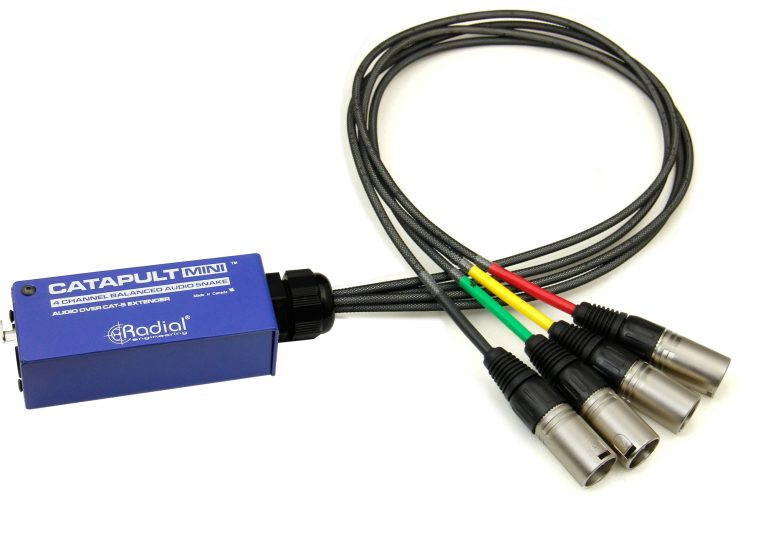
If you've ever dragged a heavy, tangled multicore audio snake across a stage or through a venue ceiling, you already know the pain. Traditional copper snakes are bulky, expensive per metre, and a genuine nightmare to troubleshoot when one channel decides to play up mid-show. The Radial Catapult Mini RX4 is Radial Engineering's answer to that problem — a compact 4-channel receiver that pulls balanced, mic-level audio from a single shielded Cat 5 cable and delivers it through four XLR outputs with transformer isolation.
It sounds almost too simple, and honestly, that's the beauty of it. But simple doesn't mean basic. There's proper engineering behind how Radial handles audio-over-Cat-5, and understanding the details matters before you invest. Let's dig into what this unit actually does, who it's built for, and whether it makes sense for your setup here in Australia.
Looking to grab one now? View the Radial Catapult Mini RX4 with full specs and Australian pricing at MusicOnStage.
What Is the Radial Catapult Mini RX4, Exactly?
The Catapult Mini RX4 is the receiver half of Radial's Catapult Mini system. It's designed to work with the Catapult Mini TX4 (the transmitter), forming a two-box system that sends four channels of balanced, mic-level audio over a single shielded Cat 5 cable. The TX4 takes in four XLR inputs at one end, sends them down the Cat 5, and the RX4 outputs them as four XLR balanced signals at the other end.
The key distinction here is that this is not a digital system. There's no analogue-to-digital conversion happening. The Catapult Mini uses the four twisted pairs inside a Cat 5 cable as four individual balanced audio paths — one pair per channel. It's analogue audio riding on Cat 5 infrastructure, which means zero latency, no sample rate concerns, and no clocking issues. The audio quality is governed by the cable quality and transformer performance, not by converters.
The Role of Transformer Isolation
This is where Radial's reputation for build quality really matters. Each of the four channels in the RX4 passes through a custom Radial transformer. These transformers serve several critical functions that you won't get from a simple passive Cat 5 breakout box:
- Ground loop elimination: Transformers provide galvanic isolation between the sending and receiving ends, which means ground loops — one of the most common and frustrating noise problems in live sound — are physically broken by the transformer's magnetic coupling.
- Common-mode noise rejection: The balanced signal riding on each twisted pair already provides good noise rejection, but the transformer adds another layer by rejecting any common-mode interference that's crept onto the cable run.
- Impedance matching: The transformers ensure proper impedance matching between the Cat 5 cable characteristics and standard microphone-level audio equipment, maintaining signal integrity across the full frequency range.
- Protection: Transformers provide a degree of protection against voltage spikes and phantom power issues that could damage connected equipment.
Without these transformers, you'd essentially just have a fancy patch panel. With them, you have a properly engineered audio transport system that maintains signal integrity over long cable runs — and that distinction matters enormously in real-world applications.
Key Specifications and Technical Details
| Feature | Detail |
|---|---|
| Channels | 4 balanced audio channels |
| Output Connectors | 4 × XLR female (balanced) |
| Input Connector | Shielded RJ45 (Cat 5 / Cat 5e / Cat 6) |
| Signal Level | Mic level (designed for mic-level signals) |
| Isolation | Custom Radial transformers on each channel |
| Cable Type | Shielded Cat 5 (STP recommended) |
| Maximum Cable Length | Up to ~100 metres (depending on cable quality and signal level) |
| Construction | 14-gauge steel chassis |
| Power | Passive — no power required |
| Mounting | Compact floor/surface mount design |
A few things stand out in those specs. First, this is a passive device — no power supply, no batteries, no phantom power passthrough concerns. It just works. Second, Radial specifies shielded Cat 5 (STP, not UTP), which is important. The shielding provides an additional layer of protection against electromagnetic interference, particularly relevant in stage environments surrounded by lighting dimmers, power amplifiers, and wireless equipment.
Why Shielded Cat 5 Matters
Standard unshielded Cat 5 (UTP) is designed for data networking where occasional bit errors can be corrected by protocol. Audio doesn't have that luxury — interference shows up as audible noise, hum, or buzzing. Shielded Cat 5 (STP) wraps each twisted pair (or the entire cable bundle) in a foil or braided shield that drains interference to ground. In a live sound environment, where you might be running audio cable alongside power cables, dimmer packs, and LED drivers, that shielding isn't optional — it's essential.
The good news is that shielded Cat 5 cable is significantly cheaper per metre than traditional multicore audio snake cable, and it's far lighter and more flexible. A 50-metre run of quality shielded Cat 5 might cost you a fraction of what four individual mic cables would, and it takes up a fraction of the space in your cable trunk.
How It Fits Into a Real-World Setup
Understanding the Catapult Mini system means understanding the TX/RX relationship. Here's how a typical deployment works:
- Stage end: The Catapult Mini TX4 sits near your mic positions or instrument sources. Four XLR cables connect your mics/DIs to the TX4's four XLR inputs.
- Cable run: A single shielded Cat 5 cable runs from the TX4 to the RX4. This replaces what would otherwise be four individual mic cables or a 4-channel multicore.
- FOH/Mixing end: The RX4 sits near your mixing console. Four short XLR cables connect the RX4's outputs to your mixer's inputs.
The result? You've replaced four heavy copper runs with a single, lightweight Cat 5 cable. For a 30-metre stage-to-FOH run, you've gone from carrying roughly 120 metres of mic cable to carrying one 30-metre Cat 5. The weight difference alone is significant, and the setup time savings are even more valuable during tight load-ins.
Practical Applications Where the RX4 Shines
Live Sound — Small to Medium Venues
This is the bread-and-butter use case. For pub gigs, small festivals, corporate events, and house-of-worship installations across Australia, the Catapult Mini system is a genuine game-changer. Most small-venue sound setups use somewhere between 4 and 16 channels. A single TX4/RX4 pair handles four of those channels. Need more? Stack multiple pairs. Two sets give you 8 channels; three give you 12. Each additional pair only needs one more Cat 5 cable run.
For the touring musician or small hire company doing regular gigs around Sydney, Melbourne, Brisbane, or regional towns, the reduction in cable weight and setup time is hard to overstate. Anyone who's packed a 16-channel analogue snake into a hatchback knows the struggle. Replacing even part of that with Cat 5 makes a genuine difference to your back and your bump-in time.
Permanent Installations
Churches, conference rooms, school auditoriums, and community halls often need audio runs through walls and ceilings. Running Cat 5 through conduit is dramatically easier than running multicore audio cable. Cat 5 is thinner, more flexible, and available in plenum-rated versions for installation in air-handling spaces (which many Australian building codes require for ceiling runs). The Catapult Mini system turns a complicated audio infrastructure project into something much closer to a standard network cabling job — and the electricians or IT contractors doing the cable pull will thank you for it.
Broadcast and Recording
Studio environments and broadcast trucks benefit from the clean signal path and ground isolation. In situations where you're sending mic-level audio between rooms or between a stage and a recording truck, the transformer isolation eliminates the ground loop issues that plague long copper runs between separately earthed power systems. In Australia's broadcast sector, where outside broadcast vans frequently connect to venue power with different earthing characteristics, this kind of isolation is genuinely valuable.
Theatre and Corporate AV
Theatre sound designers working in performing arts centres and corporate AV technicians setting up conferences both deal with the same challenge: getting clean audio from point A to point B across distances that make direct mic cable runs impractical or ugly. The Catapult Mini's small form factor means it can be discreetly tucked behind a stage riser, under a lectern, or inside an equipment rack without drawing attention.
Ready to simplify your audio runs? Shop the Radial Catapult Mini RX4 at MusicOnStage with shipping across Australia.
Cat 5 Audio vs Traditional Multicore Snakes: An Honest Comparison
The Catapult Mini system isn't the right choice for every situation. Here's a balanced look at how it stacks up against traditional copper multicores.
Where Cat 5 Audio Wins
- Weight and bulk: A Cat 5 cable is dramatically lighter and thinner than a multicore snake. For touring and mobile applications, this is the single biggest advantage.
- Cable cost: Shielded Cat 5 is cheap. Even premium shielded Cat 5e cable costs a fraction of quality multicore per metre. Over long runs, the cable savings alone can justify the hardware investment.
- Installation flexibility: Cat 5 fits through smaller conduit, bends around tighter corners, and is available in plenum-rated versions for building installations.
- Ground isolation: The transformer isolation in the Catapult Mini eliminates ground loops by design, something that traditional copper snakes can't inherently do.
- Repairability: If a Cat 5 cable gets damaged, you replace one inexpensive cable. If a channel in a multicore snake fails, you're looking at a much more expensive and difficult repair.
- Scalability: Need more channels? Add another TX/RX pair and another Cat 5 cable. No need to buy an entirely new, larger snake.
Where Traditional Snakes Still Have the Edge
- Channel count per cable: A 32-channel multicore is one cable. To match that with Catapult Minis, you'd need eight TX/RX pairs and eight Cat 5 cables. For large-channel-count applications, traditional snakes (or digital snake systems like Dante or AES50) are more practical.
- No additional hardware: A traditional snake is just cable and connectors. No boxes to forget, lose, or damage.
- Phantom power passthrough: Traditional copper snakes pass phantom power transparently. The Catapult Mini's transformers are designed for mic-level signals, and phantom power handling needs to be considered carefully in the system design.
- Familiarity: Every sound tech knows how a multicore snake works. The Catapult system requires a brief explanation for new crew members, though it's hardly complicated.
And What About Digital Snakes?
It's worth noting where the Catapult Mini sits relative to digital audio networking solutions like Dante, AVB, or AES50. Digital snakes can carry dozens of channels over a single Cat 5/6 cable, which makes them far more channel-efficient. However, they require powered hardware at both ends, introduce latency (albeit tiny), need clocking, and cost significantly more. The Catapult Mini occupies a sweet spot: the cable convenience of Cat 5 with the simplicity and zero-latency of analogue. For applications where you need 4–16 channels and want dead-simple, reliable operation, the analogue Cat 5 approach is hard to beat.
Build Quality and the Radial Engineering Difference
Radial Engineering has built its reputation on products that work reliably in the real world — not just on a spec sheet. The Canadian company is best known for their DI boxes (the Radial JDI and J48 are industry standards), and they bring the same design philosophy to the Catapult series.
The RX4's chassis is constructed from 14-gauge steel, which is the same heavy-duty construction used across Radial's professional product line. This isn't a plastic box that'll crack the first time a road case shifts during transport. It's built to handle the realities of touring and live production — kicked across stages, buried under cable piles, and generally treated with the casual brutality that live sound gear endures.
The XLR connectors are quality components, and the RJ45 jack is designed for reliable connection even after hundreds of plug/unplug cycles. And because the unit is entirely passive, there are no active electronics to fail, no firmware to crash, and no power supply to forget at home. It either works or it doesn't, and in practice, these units just work — year after year.
Practical Tips for Getting the Best Results
Cable Selection
Don't cheap out on the Cat 5 cable. Use shielded (STP) Cat 5e or Cat 6 from a reputable manufacturer. The cable is the most critical link in the chain. For permanent installations, use solid-core cable. For touring applications, use stranded-core cable, which handles repeated coiling and uncoiling far better. In Australia, you'll find quality shielded Cat 5e at most electrical wholesalers and professional audio suppliers.
Cable Length Considerations
The Catapult Mini system works reliably up to around 100 metres with quality cable and mic-level signals. For most live sound applications in Australian venues, this is more than sufficient — few pubs or clubs require a FOH run longer than 50 metres. For outdoor festival stages where longer runs might be needed, test your specific cable at full length before the gig.
Labelling and Organisation
When using multiple TX/RX pairs, label each pair clearly. A simple colour-coding system (coloured tape or coloured Cat 5 cables) prevents the inevitable confusion during a rushed load-in. Channels 1–4 on the blue cable, 5–8 on the red, and so on. It takes five minutes to set up and saves twenty minutes of troubleshooting.
Connector Care
RJ45 connectors are more fragile than XLR connectors — that's just the reality. Protect the Cat 5 cable ends during transport, and carry spare pre-terminated cables. Consider using Cat 5 cables with booted connectors (the little plastic strain relief over the RJ45 clip) to prevent the locking tab from snapping off.
Who Should Buy the Catapult Mini RX4?
Ideal For:
- Gigging musicians and small bands running their own sound who want to reduce cable weight and setup time
- Small hire companies and freelance sound engineers looking for lightweight, reliable snake solutions
- Houses of worship installing permanent audio infrastructure through walls and ceilings
- Schools and community halls needing simple, reliable audio connectivity between stage and mix positions
- Corporate AV technicians setting up conferences and presentations
- Theatre sound designers needing discreet audio transport in performance spaces
Probably Not Ideal For:
- Large-format live sound requiring 24+ channels — a digital snake system (Dante, AES50) will be more practical at that scale
- Applications requiring phantom power passthrough — you'll need to provide phantom power at the mixer end or use a separate phantom power supply at the source end
- Line-level signal transport — the RX4's transformers are optimised for mic-level signals; for line-level applications, look at Radial's other Catapult models designed for that purpose
Frequently Asked Questions
Can I use regular unshielded Cat 5 cable?
Technically, it will pass audio. Practically, you're gambling with noise problems, especially in electrically noisy environments like stages with lighting dimmers. Radial recommends shielded Cat 5 for good reason. The cost difference between shielded and unshielded cable is minimal — don't risk your audio quality to save a few dollars per metre.
Does it pass phantom power?
The transformer isolation in the Catapult Mini means phantom power from your mixer won't pass through to the microphone end. You'll need to provide phantom power locally at the stage end if your mics require it. This is easily solved with an inline phantom power supply or by using mics/DIs with their own power sources.
Can I use it with Cat 6 cable?
Yes. Cat 6 (and Cat 6a) cable uses the same RJ45 connector and is backwards compatible. In fact, Cat 6 cable often has better shielding and tighter twist rates, which can provide slightly better noise rejection. Just ensure you're using shielded variants.
What's the maximum cable run length?
Radial rates the system for runs up to approximately 100 metres with quality shielded Cat 5. In practice, most users report excellent results well within this range. Longer runs are possible but should be tested with your specific cable before relying on them for a show.
Do I need the TX4 as well?
Yes, the RX4 is the receiver half of a two-box system. You need a Catapult Mini TX4 at the sending end to input your audio. The TX4 and RX4 are sold separately, giving you flexibility in system configuration, but you need both for a complete working system.
Is there any latency?
No. Zero. None. This is analogue audio being carried on copper conductors. The signal travels at near the speed of light through the cable. Unlike digital snake systems, there is no A/D conversion, processing, or D/A conversion to introduce delay. What goes in comes out at essentially the same instant.
How does it handle interference from nearby power cables?
The combination of balanced signal transmission (inherent noise rejection from the twisted pairs), shielded cable (physical barrier against electromagnetic interference), and transformer isolation (common-mode rejection) provides excellent immunity to interference. That said, standard best practices still apply: avoid running audio cables directly parallel to mains power cables for extended distances where possible.
Buying in Australia: What You Need to Know
Radial Engineering products are well-distributed in Australia through authorised dealers. When buying from an authorised Australian retailer like MusicOnStage, you get the benefit of local warranty support and Australian consumer law protections (which are among the strongest in the world, regardless of what the manufacturer's warranty card says).
A few things to keep in mind for Australian buyers:
- Shielded Cat 5 cable sourcing: Companies like Belden, Canare, and Klotz make excellent shielded Cat 5e suitable for audio applications, all readily available from Australian pro audio and electrical suppliers.
- No power requirements: Since the RX4 is passive, there are no voltage or power frequency concerns for Australian use. It works identically worldwide.
- Climate considerations: For permanent outdoor or semi-outdoor installations (common in Australian hospitality venues with outdoor stages), use outdoor-rated shielded Cat 5 cable with UV-resistant jacketing.
Ready to upgrade your audio snake setup? Order the Radial Catapult Mini RX4 from MusicOnStage — authorised Australian dealer with genuine Radial products and reliable delivery across the country.
Final Verdict: Simple Engineering Done Right
The Radial Catapult Mini RX4 isn't flashy. It doesn't have Bluetooth, it doesn't connect to an app, and it won't impress anyone at a trade show with blinking lights. What it does is solve a real, everyday problem for audio professionals with elegant simplicity: getting clean, isolated, balanced audio from point A to point B using lightweight, inexpensive Cat 5 cable instead of heavy, expensive multicore snakes.
For small-to-medium live sound applications, permanent installations, and anywhere you need four channels of reliable mic-level audio transport, the Catapult Mini system delivers exactly what Radial promises. The transformer isolation is genuine engineering, not marketing — it physically eliminates ground loops and provides measurably better noise rejection than a passive breakout. The 14-gauge steel construction means it'll outlast most of the gear you use it with.
Is it for everyone? No. If you need 32 channels, look at a digital snake. If you only ever work in one venue with permanently installed copper, your existing snake is probably fine. But if you're a gigging musician, a small hire company, or a venue looking to install or upgrade audio infrastructure with minimal hassle, the Catapult Mini RX4 (paired with its TX4 counterpart) is a genuinely smart investment that pays for itself in saved time, reduced weight, and cleaner audio.
Sometimes the best technology is the technology you don't have to think about. You plug it in, it works, and you get on with making great sound. That's the Catapult Mini RX4 in a nutshell.