
Radial Catapult Mini RX: Cat 5 Audio Snake Tech Explained 2026
Radial Catapult Mini RX: Cat 5 Audio Snake Tech Explained 2026
If you have ever spent twenty minutes untangling a fan-out behind a stage, the appeal of running four channels of balanced audio down a single, inexpensive Cat 5 cable becomes obvious very quickly. The Radial Catapult Mini RX is the receive-end half of exactly that idea: a passive, transformer-isolated 4-channel receiver that converts ordinary shielded Cat 5 into a tidy, hum-free analogue snake. This is not a digital networking product and it does not pretend to be one — it is a deliberately simple piece of analogue infrastructure that solves a real cabling problem with transformers and good engineering rather than DSP.
This guide breaks down how the Catapult Mini RX actually works, what its specifications mean in real-world use, where the mic-level transformers help and where they impose limits, and how it compares with traditional multicore snakes and Dante-style networked audio. The goal is to give technically-minded Australian buyers enough depth to decide whether this is the right tool for their rigs.
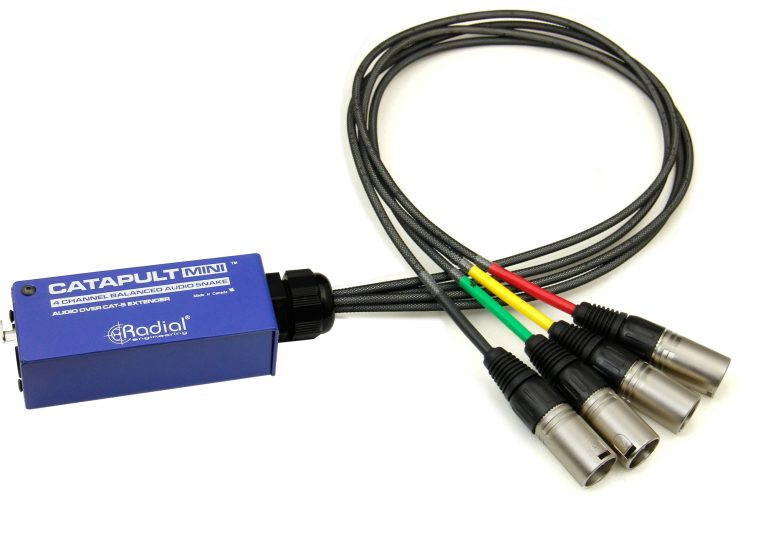
What the Catapult Mini RX Actually Does
The Catapult system splits a four-channel analogue audio link into two halves. A transmitter (the Catapult Mini TX) accepts four balanced sources on XLR and maps each one onto a twisted pair inside a single Cat 5 cable. The Catapult Mini RX sits at the far end, takes that Cat 5 cable in on an RJ45 connector, and breaks the four channels back out to four balanced XLR outputs.
The clever part is in the standard you already own. A Cat 5/5e cable contains four twisted pairs. A balanced audio channel needs exactly one twisted pair (hot, cold and a shared shield/ground). Four pairs therefore equals four balanced channels — no compression, no sample rate, no latency, no clocking. What goes in the TX is electrically the same signal that comes out the RX, with the cable and the transformers being the only things in the path.
The RX in this model is the transformer-isolated variant fitted with mic-level transformers. That single design choice is responsible for most of this unit's strengths and most of its limitations, so it is worth understanding properly before looking at anything else.
Key Specifications at a Glance
| Specification | Detail | Why It Matters |
|---|---|---|
| Channels | 4 balanced audio, single cable | One Cat 5 run replaces a 4-way fan-out |
| Configuration | Receiver (RX) — female XLR outputs | Pairs with a Catapult Mini TX sender |
| Isolation | Transformer-isolated, mic-level transformers | Galvanic isolation kills ground-loop hum |
| Power | None — fully passive | Nothing to fail, no PSU, no phantom draw |
| Cable interface | RJ45 for shielded Cat 5/5e | Cheap, field-terminable, widely stocked |
| Recommended cable | Shielded (STP/FTP) Cat 5e | Shield is essential for noise rejection |
| Typical cable run | Up to roughly 90 m with quality shielded cable | Covers most stage and install distances |
| Chassis | 14-gauge steel book-end enclosure | Survives real touring and install abuse |
| Signal level | Optimised for mic level; tolerates line with care | Transformer headroom is the key constraint |
Treat the cable-length figure as a practical guide rather than a hard cliff. Passive analogue transport degrades gracefully — you lose a little high-frequency extension and signal-to-noise as runs get very long, rather than hitting a digital-style dropout. With good shielded Cat 5e, mic-level signals over typical stage distances are well within comfortable territory.
The Mic-Level Transformers: Why They Are the Whole Story
Transformer isolation is the headline feature, and Radial has a long pedigree here. Each output channel passes through a transformer that magnetically couples the signal from the cable to the XLR while breaking the direct electrical (galvanic) connection between the source equipment and the destination console.
What you gain
- Ground-loop immunity: When a stage and a front-of-house position sit on different electrical circuits, the resulting ground potential difference is the classic cause of low-frequency hum and buzz. A transformer interrupts that loop entirely, so the Catapult Mini RX frequently solves hum problems that no amount of cable swapping will fix.
- Common-mode rejection: The transformer reinforces the balanced line's natural rejection of induced noise, which matters when Cat 5 is run alongside lighting and power infrastructure.
- Bulletproof reliability: A passive transformer has no firmware, no power supply and effectively nothing to fail. For broadcast feeds, press splits and permanent installs, that predictability is a genuine engineering advantage, not a marketing line.
- Inherent DC blocking: Transformers will not pass phantom power or DC offsets through the link, which protects downstream gear and avoids surprises.
What it costs you
- Level handling: These are mic-level transformers. They are happiest with microphone and instrument-level signals. Hot, full-scale line-level outputs (a +4 dBu console send near clip, for example) can push a small mic transformer toward core saturation, which shows up as low-frequency distortion before anything else in the chain complains. For line feeds, pad the source down or keep levels conservative.
- Frequency-response trade-offs: Real transformers are not perfectly flat to the edges of the audio band. Expect a very subtle softening at the frequency extremes compared with a direct-coupled link. For vocals, drums and most live sources this is inaudible-to-flattering; for reference-grade line transport, a direct-coupled Catapult variant is the more honest choice.
- Insertion loss: Passive isolation is not free — there is a small level drop through the transformer that you simply make up at the receiving preamp.
None of these are faults. They are the well-understood physics of passive transformer isolation, and choosing the mic-level RX means you have decided that isolation and reliability are worth more than the last fraction of a dB of headroom. That is the correct trade for the jobs this box is built for.
Why Shielded Cat 5 Specifically
The product name calls out shielded Cat 5 for a reason, and skipping past it is the single most common way to get disappointing results from a Catapult system. Inside the cable, each twisted pair carries one balanced channel. The twisting handles externally induced noise via common-mode rejection, but four audio pairs bundled tightly together also need protection from crosstalk and from strong external fields such as dimmer racks and power runs.
- Use STP/FTP, not bargain UTP: The overall shield gives the system a defined ground reference and a meaningful improvement in noise floor on long or electrically noisy runs. Standard unshielded patch cable will technically pass audio but undermines the entire point of buying an isolated receiver.
- Use solid, properly terminated cable: Stranded thin patch leads and questionable field crimps add resistance and reflection points. Quality Cat 5e terminated to spec behaves far better over distance.
- Keep runs sensible: Analogue over copper is forgiving, but every extra metre adds capacitance that gently rolls off the top end and reduces signal-to-noise. Plan the shortest practical path.
- Mind your pin mapping: Catapult devices follow a consistent pair-to-channel format, so an RX talks happily to a matching TX. If you cross it with non-Catapult Cat 5 audio gear, confirm the pinout first — the connector being identical does not guarantee the wiring convention is.
Performance in the Real World
The honest summary is that a passive transformer-isolated link, fed sensible mic-level signals over good shielded Cat 5, is sonically transparent for the overwhelming majority of live and install applications. The transformer's character is gentle, and on dynamic mics, instrument DIs and stage submixes it is the kind of thing engineers describe as “rounded” rather than “coloured.”
Where it shines in practice:
- Stage sub-snakes: Four channels from a drum riser, keyboard world or guest position back to the main multicore patch, on one tidy cable.
- Hum rescue on broadcast and recording splits: Feeding an OB truck, a recording rig or a video crew that is on a different power phase — the isolation often removes hum that has defeated every other approach.
- Installations: Conference rooms, houses of worship and AV rooms where structured Cat 5 cabling already exists in the walls and a permanent four-channel analogue link is wanted with zero power dependency.
- Backup and redundancy: A passive analogue path that keeps working when a networked system has a switch, clock or software problem is a comforting thing to have patched and ready.
Where to be cautious: very long runs combined with quiet ribbon or low-output passive sources can leave you fighting noise floor, because the insertion loss plus a long cable means a lot of make-up gain at the preamp. And again, do not feed it hot line outputs without padding — respect the mic-level design and it will not let you down.
How It Compares to the Alternatives
| Approach | Strengths | Trade-offs |
|---|---|---|
| Catapult Mini RX (this unit) | Passive, transformer-isolated, cheap cable, zero latency, nothing to fail | 4 channels per cable, mic-level headroom limits, copper distance limits |
| Traditional analogue multicore | Many channels, robust, no pinout questions | Heavy, bulky, expensive, no isolation, no hum cure |
| Dante / AES67 network audio | Huge channel counts, long distances, remote gain & routing | Needs power, switches, clocking, config and a learning curve |
| Direct-coupled Catapult variant | Flatter response, more line-level headroom | No galvanic isolation — ground loops remain your problem |
The decision usually comes down to one question: do you need scale and control, or do you need isolation and dead-simple reliability? If you are routing forty channels with remote preamps across a large venue, this is not the product — a networked system is. But if you need four solid, isolated channels down a single cheap cable that will still be working in ten years with no firmware updates, the transformer-isolated Catapult Mini RX is hard to beat on engineering merit.
Check current pricing and availability on the Radial Catapult Mini RX at MusiconStage.
What Technically-Minded Buyers Should Check Before Buying
- You need the matching TX. The RX is one half of a system. Confirm you have or are buying a Catapult Mini TX (or a compatible Catapult sender) at the source end — an RX on its own does nothing.
- Confirm your signal levels. If your sources are line-level outputs, plan to pad them or accept conservative gain staging. If they are mics and DIs, this unit is squarely in its element.
- Budget for proper shielded Cat 5e. The cable is part of the system, not an afterthought. Cheap UTP will measurably undo the isolation you paid for.
- Count your channels honestly. Four per cable scales by adding cables and units. That is fine for two, eight or twelve channels; beyond that, weigh the cost and clutter against a networked solution.
- Future-proofing: Because it is passive and standards-based, a Catapult link does not become obsolete the way a discontinued digital format can. That longevity is a legitimate part of its value.
Technical FAQs
Is the Catapult Mini RX a Dante or digital device?
No. It is fully analogue. There is no conversion, sample rate or latency — just balanced audio mapped onto the twisted pairs of a Cat 5 cable, with transformer isolation at the receive end.
Can it pass phantom power to condenser microphones?
No. The isolation transformers block DC, so phantom power will not pass through the link. Power condenser mics at their own end of the chain, before the signal enters the Catapult system.
Can I run line-level signals through it?
You can, but treat it with respect. These are mic-level transformers, so hot line outputs near clip risk low-frequency saturation distortion. Pad the source or keep send levels modest, or choose a direct-coupled Catapult variant if pristine line transport is the priority.
Will ordinary network patch cable work?
It will pass audio, but you should use shielded Cat 5e. The shield is central to the noise performance and to getting the full benefit of the isolated design.
Does it need power?
No. It is entirely passive — no power supply, no batteries, no phantom draw. That is a deliberate reliability decision.
How far can I run the cable?
With good shielded Cat 5e and mic-level signals, runs up to roughly 90 metres are practical for typical applications. Performance falls off gradually with distance rather than dropping out, so plan the shortest sensible path for the best signal-to-noise.
Expert Verdict
The Radial Catapult Mini RX is a focused, well-engineered solution to a specific problem: getting four channels of clean, isolated, analogue audio from A to B on a single cheap cable, with nothing that can fail. It is not a Swiss Army knife and it is not trying to compete with networked audio on scale or features. Judged on what it is actually for — stage sub-snakes, hum-killing splits, and rock-solid permanent installs — the transformer-isolated design is exactly the right engineering choice.
If your sources are mic and instrument level, you commit to proper shielded Cat 5, and four channels per run suits your workflow, this is one of the most dependable pieces of analogue infrastructure you can patch into a rig. Reliability this absolute, with no power and no software, has a value that does not show up on a spec sheet but becomes very obvious at 11pm on a difficult gig.
View the Radial Catapult Mini RX and pair it with a matching TX at MusiconStage. If you are building or troubleshooting a four-channel link and want a second opinion on levels and cabling, the MusiconStage team can help you spec it correctly the first time.