
Pioneer PLX-500B Technical Deep Dive: Direct-Drive Specs Decoded 2026
Pioneer PLX-500B Technical Deep Dive: Direct-Drive Specs Decoded 2026
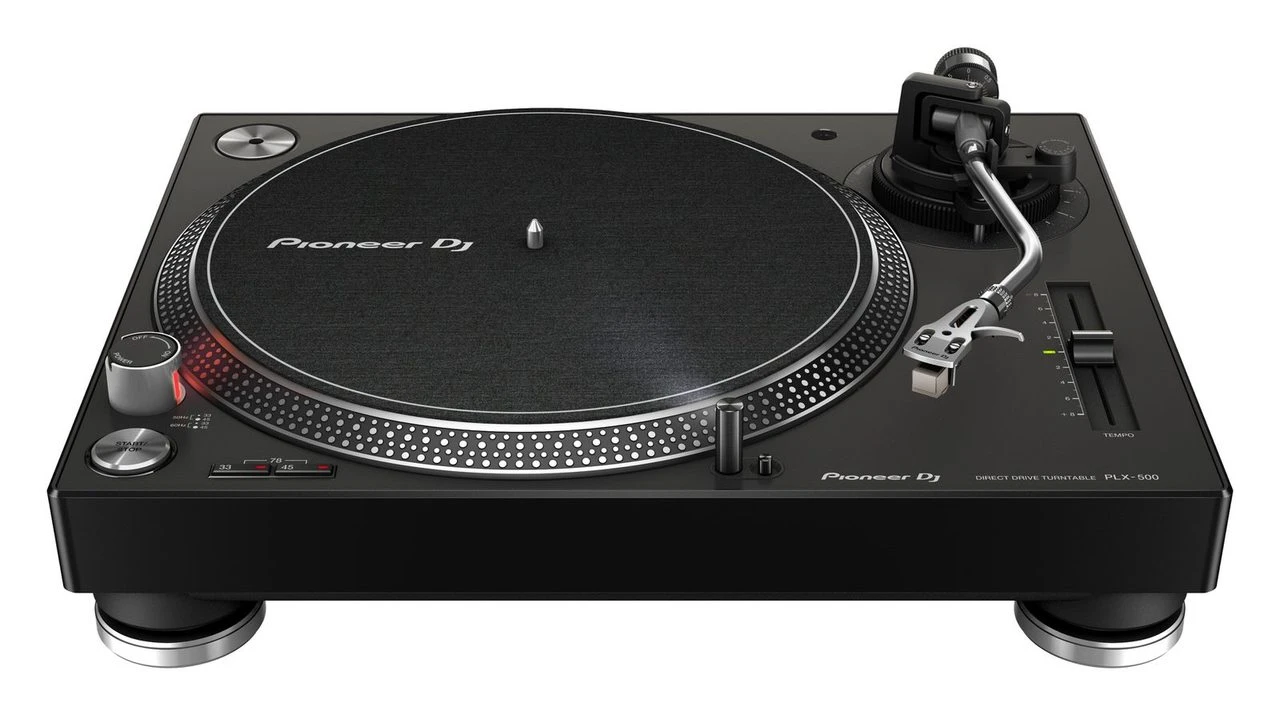
The Pioneer PLX-500B sits in an interesting position in the direct-drive turntable market. It's pitched at the entry-level DJ and the home listener who wants serious vinyl playback without stepping up to the flagship PLX-1000. But the spec sheet tells a more nuanced story than the price suggests, and understanding what's genuinely there — versus what's been pared back from the PLX-1000 — is the difference between a smart purchase and a regret.
This technical breakdown is for Australian buyers who care about torque figures, tonearm geometry, and signal chain integrity. We'll go through the specifications that actually matter, where Pioneer has made deliberate trade-offs, and what those trade-offs mean for your real-world use. If you're cross-shopping the PLX-500B against a Technics SL-1200MK7, an Audio-Technica AT-LP120XUSB, or a Reloop RP-2000 USB, this guide gives you the technical context to make the call.
Core Technical Specifications
| Specification | Value |
|---|---|
| Drive System | Direct-drive, quartz-locked |
| Motor Type | Brushless DC, 3-phase coreless |
| Starting Torque | 1.6 kg·cm |
| Start-Up Time | Under 0.3 seconds (33⅓ rpm) |
| Speeds | 33⅓, 45, 78 rpm |
| Pitch Range | ±8% / ±16% (selectable) |
| Wow & Flutter | 0.15% WRMS |
| Signal-to-Noise Ratio | Greater than 50 dB |
| Tonearm Type | Static-balanced, S-shaped, universal |
| Effective Tonearm Length | 230 mm |
| Overhang | 15 mm |
| Cartridge | PC-HS01 headshell + included MM cartridge |
| Built-in Phono Pre-amp | Yes (switchable PHONO/LINE) |
| USB Output | USB-B, 16-bit/44.1 or 48 kHz |
| Power Requirements | AC 220–240 V, 50/60 Hz |
| Dimensions | 450 × 159 × 353 mm |
| Weight | 10.7 kg |
Several numbers in that table deserve unpacking, because raw specs without context are just marketing collateral.
View the Pioneer PLX-500B at MusiconStage
Direct-Drive Architecture: What 1.6 kg·cm Actually Means
Starting torque is the most-quoted and least-understood spec in the DJ turntable world. The PLX-500B's 1.6 kg·cm sits in a specific bracket: noticeably above belt-drive consumer decks (which typically don't even publish a torque figure because they spool up gradually), comfortably above entry direct-drive units like the Audio-Technica AT-LP120XUSB at around 1.6 kg·cm as well, but well below the Pioneer PLX-1000's 4.5 kg·cm and the Technics SL-1200MK7's roughly 1.8 kg·cm.
For practical purposes, 1.6 kg·cm gives you:
- Reliable scratching and back-cueing — the platter resists slowing under reasonable hand pressure and recovers quickly
- Consistent pitch under load — slip-mat drag and stylus friction don't measurably affect speed
- Sub-0.3 second spin-up — fast enough for live mixing transitions
What it doesn't give you is the extreme stop-on-a-coin response of a 4.5 kg·cm deck favoured by turntablists doing fast cuts, transformer scratches, or aggressive baby-scratch routines. If your use case is bedroom DJing, mobile gigs, weddings, or audiophile listening, the difference is academic. If you're doing competitive battle scratching, the PLX-1000 is a different tool.
The Quartz-Locked Phase Servo
Pioneer's quartz-locked control loop measures platter rotation against a quartz crystal reference and corrects deviation in real time. The published wow & flutter figure of 0.15% WRMS is good but not class-leading — the SL-1200MK7 hits roughly 0.025% WRMS, an order of magnitude better. For DJ use this is irrelevant; the human ear can't reliably detect wow & flutter below about 0.3% on transient material. For critical audiophile listening of sustained piano or held vocal notes, more capable decks exist.
The signal-to-noise ratio of >50 dB is a more telling number. This is mid-pack performance — adequate for casual listening through compressed sources or DJ playback, but it sets a ceiling on the noise floor of any USB recording you make from the deck. If you're digitising rare vinyl for archival quality, this is one of the spec compromises you're inheriting at this price point.
Tonearm Geometry and Tracking
The S-shaped static-balanced tonearm with 230 mm effective length and 15 mm overhang is essentially the standard SL-1200-derived geometry that most direct-drive DJ turntables use. The choice matters because:
- Universal headshell mount (SME-type bayonet) means you can swap to any standard half-inch mount cartridge — Ortofon Concorde, Shure M44 successors, Audio-Technica AT-VM95 series, and so on
- Adjustable VTA (vertical tracking angle) via the height collar lets you optimise stylus geometry to record thickness and cartridge body
- Anti-skating dial calibrated to typical tracking forces between 0 and 4 grams
- Tonearm rest with locking clip — important detail for transport, often missing on cheaper decks
The included headshell is the PC-HS01 with a factory-fitted moving-magnet cartridge. It works out of the box, tracks at around 3 grams, and is built for durability rather than refined audiophile reproduction. Most PLX-500B owners eventually swap the cartridge — for DJ use to an Ortofon Concorde Mix or DJ S, for listening use to an Audio-Technica AT-VM95E or Ortofon 2M Red. The platform happily accepts any of these.
The Built-In Phono Pre-Amp: Convenience vs. Compromise
The PLX-500B's switchable PHONO/LINE output is one of its key differentiators from the PLX-1000, which is phono-only. Setting the switch to LINE engages an internal RIAA-equalised pre-amp, letting you plug straight into any line-level input — powered speakers, an AV receiver, a computer audio interface line input, or a Bluetooth transmitter.
The technical trade-off:
- Pros: No external phono stage required. Simpler signal chain, lower cost-of-entry for casual listeners, and a sensible solution for users without a dedicated stereo amplifier
- Cons: Internal pre-amps in this price bracket are functional rather than refined. The dynamic range, channel separation, and noise floor of an external phono stage at $200–500 will measurably outperform the built-in unit
For DJ use, you'll bypass this entirely — set the switch to PHONO and run into your mixer's phono input as normal. For home listening, start with LINE mode and upgrade to an external stage like a Pro-Ject Phono Box or Schiit Mani only if you find yourself wanting more from the deck.
USB Digitisation: Specifications and Limitations
The USB-B output is a feature genuinely useful for archiving vinyl to digital. Pioneer ships the deck with rekordbox software (the dj_player edition) which handles capture, track splitting, and metadata. The technical reality:
- Bit depth and sample rate: 16-bit / 44.1 or 48 kHz. This is CD-equivalent quality — not 24-bit/96 kHz "high-res" capture
- A/D converter: Integrated within the turntable's electronics; not a Burr-Brown or AKM premium chip
- Practical archival quality: Excellent for personal listening, sufficient for streaming uploads, marginal for serious vinyl preservation work where 24-bit/96 kHz capture via an external interface is the standard
If your goal is digitising a record collection for use on phones, computers, and car stereos, the PLX-500B's USB output does that job competently. If you're a vinyl archivist serving a label catalogue, you'd run the analogue output into a Universal Audio or Focusrite interface at higher resolution.
Performance Comparison: PLX-500B vs Direct Competitors
| Feature | Pioneer PLX-500B | Audio-Technica AT-LP120XUSB | Reloop RP-2000 USB | Technics SL-1200MK7 |
|---|---|---|---|---|
| Drive | Direct, quartz-locked | Direct, DC servo | Direct | Direct, coreless |
| Starting Torque | 1.6 kg·cm | ~1.6 kg·cm | 1.8 kg·cm | ~1.8 kg·cm |
| Wow & Flutter | 0.15% WRMS | 0.2% WRMS | 0.15% WRMS | 0.025% WRMS |
| Built-in Phono | Yes | Yes | Yes | No |
| USB Output | Yes (16-bit) | Yes (16-bit) | Yes (16-bit) | No |
| Pitch Range | ±8% / ±16% | ±8% / ±16% / ±24% | ±8% / ±16% | ±8% / ±16% |
| 78 rpm Support | Yes | Yes | No | No (firmware) |
| Weight | 10.7 kg | 10.5 kg | 9.6 kg | 9.6 kg |
The picture this paints: the PLX-500B trades off audiophile-grade wow & flutter performance against the SL-1200MK7 (which costs roughly 3× more in Australia) but matches or exceeds the AT-LP120XUSB on most parameters while retaining USB capture and 78 rpm support that the SL-1200MK7 omits. Against the Reloop RP-2000 USB, the PLX-500B has slightly less torque but better build mass and the more developed rekordbox software ecosystem.
Build Quality and Mechanical Considerations
Weight matters in turntable design because mass damps vibration. The PLX-500B's 10.7 kg chassis combines a die-cast aluminium platter, a high-density resin plinth, and four height-adjustable insulator feet with rubber damping. Practical implications:
- Acoustic feedback resistance: The mass and damping help reject airborne bass from PA systems — important for DJ use in club environments
- Adjustable feet: Critical for accurate cartridge tracking; a deck that isn't level will mistrack and put uneven wear on stylus and record
- Resin plinth versus cast aluminium (PLX-1000): Lower internal damping than the flagship; you may notice resonance at high SPL exposure
The platter itself is heavier than typical entry-level decks — the rotational inertia contributes to speed stability under load, which is part of why the published wow & flutter figure holds up under real DJ use rather than only in lab conditions.
What Specifications Actually Matter for Your Use Case
The honest answer depends entirely on what you'll do with the deck.
For Bedroom/Mobile DJs
Torque, pitch fader resolution, and tonearm geometry. The PLX-500B delivers on all three. Ignore wow & flutter beyond the published figure — it's not your bottleneck.
For Vinyl Listeners
S/N ratio, the included cartridge's tracking ability, and resonance behaviour. The deck is competent here, but plan to upgrade the cartridge within the first 6–12 months for genuine sonic gains.
For USB Vinyl Digitisation
The signal path from cartridge → internal phono stage → A/D converter is the limit. For casual personal libraries, this is fine. For archival work, plan to use the analogue PHONO output into a higher-quality external phono stage and audio interface.
For Beginning Turntablists
Torque is the limiting factor. The PLX-500B handles back-cueing and basic scratching, but if you intend to develop advanced scratch technique, budget for the PLX-1000 instead.
Technical Red Flags to Watch For (Generally)
When evaluating any direct-drive turntable in this price bracket, watch for these specifications and details:
- No published torque figure — usually means it's low
- Belt-drive marketed as DJ-suitable — belts slip under back-cueing pressure
- Plastic tonearm bearings or non-adjustable VTA — limits cartridge upgrades
- USB output without published bit depth and sample rate — likely 8-bit or compressed
- No earth/ground terminal — induced hum will be a constant nuisance
The PLX-500B passes all of these checks.
Setup Considerations for Australian Users
The deck arrives configured for the Australian market with a 240V power supply and standard AS/NZS plug. A few setup notes worth flagging:
- Cartridge alignment: The factory-fitted cartridge is set to a baseline alignment. Use a Baerwald or Stevenson alignment protractor for optimised tracking — particularly important if you swap the cartridge
- Tracking force: Set to manufacturer spec for your cartridge using the counterweight scale; verify with a digital stylus force gauge if you're particular
- Anti-skate: Match to tracking force as a starting point, then fine-tune by ear on inner-groove tracks
- Earth wire connection: Always connect to the dedicated earth post on your mixer or amplifier when in PHONO mode to eliminate hum
Future-Proofing and Upgrade Path
One of the genuine strengths of the PLX-500B platform is that it ages well because it conforms to industry-standard turntable conventions. The headshell mount, tonearm geometry, and platter spindle are interchangeable with decades of DJ and audiophile accessories. Upgrade paths include:
- Cartridge and stylus upgrades (huge sonic returns)
- Better slip-mats (Dr. Suzuki, Ortofon 2-pack) for DJ feel
- External phono stage to bypass the internal pre-amp
- Premium platter mat (acrylic, leather, cork) for resonance tuning
- Isolation platforms for vibration-prone environments
This means the deck doesn't become a dead-end purchase. You're buying into an ecosystem that lets you progressively improve the listening or DJing experience without replacing the entire platform.
Verdict: Where the PLX-500B Earns Its Place
The Pioneer PLX-500B is best understood as a professionally-credentialed direct-drive deck at a price point where most competitors are making bigger compromises. It's not a flagship — the PLX-1000 owns that role with its aluminium plinth, higher torque motor, and refined tonearm. It's not an audiophile reference — decks like the Rega Planar 3 or Pro-Ject Debut Carbon EVO play in a different sonic league for pure listening.
What the PLX-500B is: a well-engineered hybrid that gives you genuine direct-drive DJ functionality, switchable phono/line output for flexibility, USB digitisation for archival work, and a tonearm that accepts every cartridge in the industry standard. For Australian buyers wanting a deck they can DJ on tonight and digitise records with tomorrow, that combination is uncommonly hard to fault at the price.
Buy the Pioneer PLX-500B from MusiconStage Australia with local stock and warranty support.
Frequently Asked Technical Questions
Can I scratch on the PLX-500B?
Yes. The 1.6 kg·cm torque and quartz-locked direct drive support back-cueing, baby scratches, and basic chirps without difficulty. Advanced battle scratching benefits from the PLX-1000's higher torque, but the PLX-500B is more than capable for hobbyist and intermediate work.
What cartridge should I upgrade to?
For DJ use, an Ortofon Concorde Mix or DJ S provides robust tracking with the integrated headshell design. For listening upgrades, an Audio-Technica AT-VM95E or Ortofon 2M Red mounted on the included PC-HS01 headshell delivers audible improvement.
Is the USB recording quality good enough for keeping records?
For personal listening libraries, yes — 16-bit/44.1 kHz is CD quality. For archival or commercial use, a 24-bit/96 kHz capture chain via the analogue output and a dedicated audio interface produces materially better results.
Does it work with rekordbox DJ software?
Yes, the included rekordbox dj_player edition supports the PLX-500B, and the USB connection enables digital track recording into the rekordbox library directly.
How does it compare to the PLX-1000?
The PLX-1000 has roughly 3× the torque, a heavier aluminium plinth, no built-in phono pre-amp, and no USB output. It's a touring/club professional tool. The PLX-500B is a versatile home and mobile-DJ deck. Different products for different users.
Order the Pioneer PLX-500B from MusiconStage — Australian stock with full manufacturer warranty.