
Pioneer DJM-A9 vs Top DJ Mixers: Complete Australian Comparison 2026
Pioneer DJM-A9 vs Top DJ Mixers: Complete Australian Comparison 2026
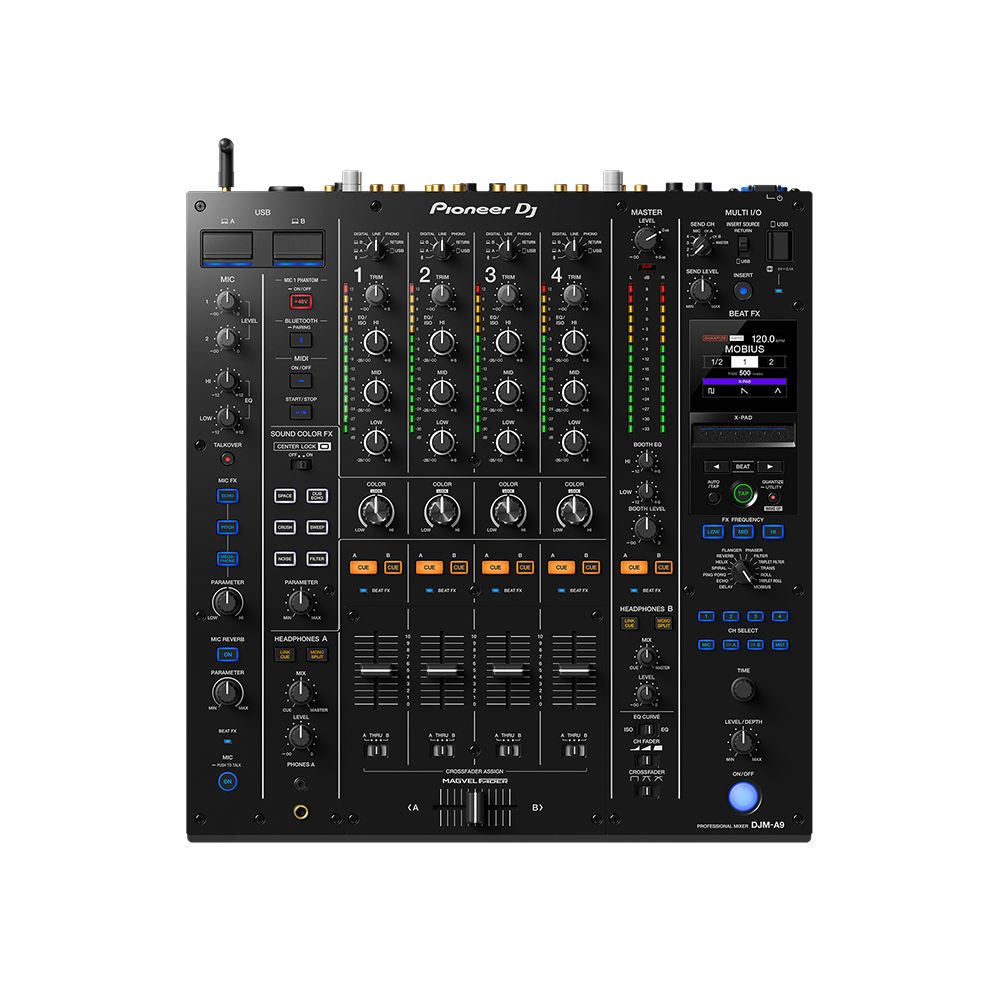
If you're shopping for a flagship 4-channel DJ mixer in Australia right now, the Pioneer DJ DJM-A9 is almost certainly on your radar. It's the mixer that replaced the legendary DJM-900NXS2 — a deck that dominated professional DJ booths worldwide for the better part of a decade. But does the A9 actually justify the upgrade? And how does it stack up against serious competitors like the Allen & Heath Xone:96 or the newer Denon DJ X1850 Prime?
This guide breaks down everything Australian DJs need to know before dropping serious cash on a top-tier mixer. We've compared specs, real-world performance, workflow differences, and value across the board — so you can decide which mixer genuinely fits your style, your venue, and your budget.
The Flagship DJ Mixer Landscape in 2026
The professional 4-channel mixer market has never been more competitive. Pioneer DJ still commands the lion's share of club installations, but that dominance isn't as automatic as it used to be. Allen & Heath has carved out a serious following among house, techno, and analogue-loving DJs, while Denon's ecosystem keeps maturing with every firmware update.
Here's what's worth understanding about the current market:
- Pioneer DJ DJM-A9 — The new club standard. Built to integrate seamlessly with CDJ-3000s and rekordbox, with Bluetooth audio streaming and a completely redesigned effects engine.
- Allen & Heath Xone:96 — The analogue purist's choice. Dual filters, outstanding sound quality, and a mixing experience that rewards technical skill.
- Denon DJ X1850 Prime — The ecosystem challenger. Excellent value, solid build, and tight integration with Denon's SC6000 media players.
- Pioneer DJ DJM-V10 — Pioneer's own 6-channel flagship for DJs who need more channels and a different EQ philosophy.
The DJM-A9 sits right at the top of Pioneer's "club-standard" line. It's not their most expensive mixer (that's the V10), but it's the one designed to be the default in professional DJ booths around the world.
Pioneer DJM-A9: What You Actually Get
Let's start with what makes the DJM-A9 tick before we compare it against the competition.
Build and Design
The A9 looks familiar if you've ever stood behind a DJM-900NXS2 — and that's intentional. Pioneer kept the layout intuitive for anyone who's played on Pioneer gear before, but the chassis is noticeably refined. The faders feel smoother, the knobs have a more premium resistance, and the overall construction feels like it'll survive years of booth abuse. At roughly 8.7kg, it's substantial without being a nightmare to transport.
Sound Engine
This is where Pioneer made the biggest leap. The DJM-A9 runs a 64-bit mixing processor, a genuine step up from the 900NXS2's 32-bit architecture. In practice, this means cleaner summing when you've got multiple channels riding hot — something every DJ who's mixed four decks simultaneously will appreciate. The signal-to-noise ratio sits at over 107dB, and the frequency response stretches comfortably beyond audible range.
The A9 also introduces compressor EQ as an alternative to the standard isolator EQ. This is more than a gimmick — it lets you control dynamics per channel in a way that smooths transitions rather than cutting frequencies. It's something the techno and house crowd in Melbourne and Sydney have taken to quickly.
Bluetooth Audio
Yes, a flagship professional mixer now has Bluetooth built in. Before you scoff — this isn't designed for mixing. It's a practical addition for streaming tracks during setup, playing requests from a phone in an emergency, or running background audio between sets. It supports Qualcomm aptX Adaptive, so latency and audio quality are genuinely usable. Is it a headline feature? No. But it's one of those things you'll use more than you expect.
Effects
Pioneer completely rebuilt the effects engine. The A9 offers 22 Beat FX and 6 Sound Colour FX per channel. The new additions include Shimmer (a reverb/pitch effect that adds ethereal texture) and Triplet timing across all beat effects. The X-Pad, which lets you control two effect parameters simultaneously with one finger, is responsive and genuinely musical to use.
Connectivity
Four channels with phono/line switching on every channel, two mic inputs with dedicated EQ, dual USB connections for DJ changeover, a dedicated booth output, and both XLR and RCA master outs. It also supports 96kHz/24-bit audio over USB for studio-quality recording.
Head-to-Head Comparison
| Feature | Pioneer DJM-A9 | A&H Xone:96 | Denon X1850 Prime | Pioneer DJM-V10 |
|---|---|---|---|---|
| Channels | 4 | 4 + 2 aux | 4 | 6 |
| Processing | 64-bit | Analogue summing | 64-bit | 64-bit |
| Filter Type | Digital (Sound Colour FX) | Dual analogue VCF filters | Digital sweep FX | Digital + frequency isolator |
| Beat FX | 22 | None (external send/return) | 12 | 22 |
| Bluetooth | Yes (aptX Adaptive) | No | No | No |
| USB Ports | 2 (DJ changeover) | 2 | 2 | 2 |
| Phono Inputs | 4 | 4 | 4 | 6 |
| Send/Return | 2 digital | 2 analogue | 1 digital | 2 digital |
| EQ Options | Standard + Compressor EQ | 4-band analogue EQ | 3-band EQ + sweep | 4-band EQ + isolator |
| Weight | ~8.7kg | ~8.9kg | ~5.1kg | ~12.8kg |
| Approx. AU Price | $3,800 – $4,200 | $2,800 – $3,200 | $2,200 – $2,600 | $4,500 – $5,000 |
Detailed Comparison Breakdown
Sound Quality
This is where the debate gets genuinely interesting. The DJM-A9's 64-bit summing engine is technically excellent — it handles multiple channels at high volume with minimal distortion and a clarity that's noticeably improved over the 900NXS2. Pioneer's digital signal path is clean, precise, and very "modern" sounding.
But then there's the Xone:96, which takes a fundamentally different approach. Allen & Heath's analogue summing gives tracks a warmth and depth that many DJs describe as more "musical." Those dual VCF filters — one high-pass, one low-pass — produce resonant sweeps that are genuinely addictive once you learn to work them. If your sets lean into long, layered transitions in house or techno, the Xone:96's sound character is hard to beat.
The Denon X1850 is no slouch either. Its 64-bit processing is solid, though most DJs would agree it doesn't quite match the A9's refinement in the high end. Where Denon competes well is in the low-frequency department — the bass response is punchy and well-defined.
Winner for sound purity: Xone:96 (analogue warmth) | Winner for digital clarity: DJM-A9
Effects and Creative Tools
If effects are central to your mixing style, this isn't even close. The DJM-A9's effects suite is the most comprehensive on any 4-channel mixer. Twenty-two beat effects with triplet timing, six Sound Colour FX per channel, the X-Pad for expressive control — it's a creative playground. The new Shimmer effect has become a favourite among progressive and melodic techno DJs for good reason.
The Xone:96 has no built-in effects at all. This is by design — Allen & Heath provides dual send/return loops so you can route external effects processors. If you own a Strymon, Eventide, or any quality effects unit, this approach gives you far more sonic flexibility. But it costs more in total and adds complexity to your setup.
The X1850 Prime offers 12 beat effects and Denon's Sweep FX knobs. They're perfectly functional and cover the essentials, but they lack the depth and feel of Pioneer's implementation.
Winner for built-in effects: DJM-A9 | Winner for external effects routing: Xone:96
Workflow and Ecosystem
Here's the honest truth that matters most for working DJs in Australia: Pioneer's ecosystem dominance is real and relevant. Walk into almost any club in Melbourne, Sydney, Brisbane, or Perth, and you'll find CDJ-3000s paired with either a DJM-900NXS2 or increasingly a DJM-A9. If you practise on Pioneer gear at home, you'll feel immediately comfortable on virtually any professional setup in the country.
The A9's integration with CDJ-3000s is particularly tight — Pro DJ Link enables instant BPM sync, waveform sharing, and track information display. With rekordbox, your library management flows seamlessly from laptop to club.
The Denon ecosystem is compelling for DJs building their own setups. The X1850 Prime integrates beautifully with SC6000 players, and Engine DJ has improved dramatically. But you'll almost never encounter Denon gear in an Australian club booth, which means you'd need to bring your own equipment or adapt to Pioneer when playing out.
The Xone:96 is ecosystem-agnostic, which is both its strength and limitation. It works brilliantly with any player setup but doesn't offer the tight digital integration of Pioneer or Denon's ecosystems.
Winner for club compatibility: DJM-A9 | Winner for home setup value: Denon X1850
Build Quality and Reliability
All four mixers are built to professional standards, but there are differences worth noting. The DJM-A9 and DJM-V10 have Pioneer's latest chassis construction, which feels extremely solid. The channel faders on the A9, in particular, have a refined feel that's a genuine improvement.
The Xone:96 is built like a tank. Allen & Heath's British manufacturing quality is evident in every component — the faders, the rotary knobs, the switches all feel premium. Many DJs report Xone mixers lasting a decade or more in heavy use.
The X1850 Prime is the lightest of the bunch at just over 5kg, which is great for portability but means the physical presence and feel is less substantial. It's well-built for its weight class, though.
Winner: Tie between DJM-A9 and Xone:96
Who Should Buy What: Honest Recommendations
Buy the Pioneer DJM-A9 If You...
- Play regularly at clubs and need to practise on what you'll perform on
- Want the most comprehensive built-in effects suite available
- Value seamless integration with CDJ-3000s and rekordbox
- Need Bluetooth for practical utility (background music, quick requests)
- Want the current industry-standard mixer for your home setup
- Mix across genres and need versatile EQ options (standard + compressor)
Buy the Allen & Heath Xone:96 If You...
- Prioritise analogue warmth and sound character above all else
- Mix primarily house, techno, or other genres that reward long, layered transitions
- Want to build a setup around external effects processors
- Play primarily at your own events, residencies, or home setups
- Appreciate dual analogue filters as a creative mixing tool
- Want to save roughly $800–$1,000 compared to the A9
Buy the Denon DJ X1850 Prime If You...
- Are building a complete home or mobile DJ setup on a tighter budget
- Already use or plan to use Denon SC6000/SC6000M media players
- Want a capable 4-channel mixer without paying flagship Pioneer prices
- Prioritise portability (it's nearly half the weight of competitors)
- Don't need to match club-installed gear
Buy the Pioneer DJM-V10 If You...
- Need six channels for complex, multi-deck setups
- Want Pioneer's most advanced EQ and frequency isolation tools
- Have the budget and the mixing complexity to justify the extra spend
- Run a venue or permanent installation requiring maximum flexibility
Value Analysis for Australian Buyers
Let's talk dollars and sense (yes, pun intended). At roughly $3,800 to $4,200 AUD, the DJM-A9 is a significant investment. But context matters.
If you're a working DJ playing paid gigs, the A9 pays for itself in comfort and consistency. You'll practise at home on the same interface you perform on, which means fewer surprises at 2am on a Saturday night. That reliability has genuine dollar value.
The Xone:96 at $2,800–$3,200 AUD represents arguably the best pure value in this comparison. You're getting genuinely world-class sound quality and build for about a grand less than the A9. The trade-off is ecosystem integration and built-in effects — if you don't need those, the Xone is exceptional value.
The X1850 at $2,200–$2,600 AUD is the budget play, and it's a smart one for many DJs. Pair it with two SC6000s and you've got a complete, modern DJ setup for less than the cost of an A9 alone.
The DJM-V10 only makes sense if you genuinely need six channels. At $4,500–$5,000 AUD, it's a specialist tool for specialists.
Common Buying Mistakes to Avoid
- Buying club gear you'll never use in a club. If you're a bedroom DJ with no plans to play out, the Pioneer tax isn't worth paying. The Xone:96 or X1850 will sound just as good (arguably better) at home.
- Ignoring the total cost of your setup. The A9 is just the mixer. Factor in media players, speakers, headphones, and cables. A full CDJ-3000 + DJM-A9 setup runs well over $12,000 AUD.
- Chasing specs over workflow. A mixer you intuitively understand will always produce better mixes than one with superior specs that you're fighting against. If you've always mixed on Allen & Heath, switching to Pioneer for "compatibility" might hurt your performances.
- Underestimating the Xone:96's filters. If you haven't tried dual analogue filters, demo them before buying anything. Many DJs who try them never go back to digital effects.
- Overlooking warranty and support. In Australia, local warranty support matters. Pioneer and Allen & Heath both have solid Australian distribution networks. Check local support availability for whatever you choose.
Questions to Ask Yourself Before Buying
- Will I be playing on club-installed gear regularly?
- How important are built-in effects to my mixing style?
- Do I value analogue warmth or digital precision?
- What's my total budget including all components?
- Am I buying for where I am now or where I want to be in two years?
- Have I actually used each of these mixers in person?
That last question matters more than you'd think. If there's a music store near you — and several in Sydney, Melbourne, and Brisbane stock these models — spend an hour with each mixer before committing. Specs on a page will never tell you how a fader feels or whether an effects workflow clicks with your brain.
Final Verdict
The Pioneer DJ DJM-A9 is the best all-round professional 4-channel mixer you can buy in Australia in 2026. It's not the best at everything — the Xone:96 sounds warmer, the X1850 costs less, and the V10 offers more channels — but it strikes the strongest balance of sound quality, features, build, ecosystem integration, and club compatibility.
For gigging DJs and aspiring professionals, it's the smartest investment because it mirrors what you'll find in booths across the country. For home DJs and producers, honestly consider the Xone:96 first — you'll get outstanding sound for less money, and those analogue filters might change how you mix entirely.
And for DJs on a budget who want modern features without the flagship price tag, the Denon X1850 Prime punches well above its weight.
There's no wrong choice here — only the right choice for you.
Ready to make your decision? Check the current Australian price on the Pioneer DJM-A9 at MusiconStage and see how it fits your setup and budget.
Need help choosing between these mixers for your specific situation? Get in touch with the team at MusiconStage — they can walk you through the differences and help you find the right fit.