Pioneer DJM-450 vs Rivals: 2-Channel DVS Mixer Guide 2026
Pioneer DJM-450 vs Rivals: 2-Channel DVS Mixer Buyer's Guide 2026
Buying a two-channel DJ mixer used to be simple: you picked something with two faders, a crossfader and a pair of phono inputs, and got on with it. In 2026, the same money buys you a soundcard, a digital vinyl system, onboard effects and a piece of software licensing that quietly decides which ecosystem you'll live in for the next five years. That last point is the one most buyers underestimate — and it's the one that causes the most regret.
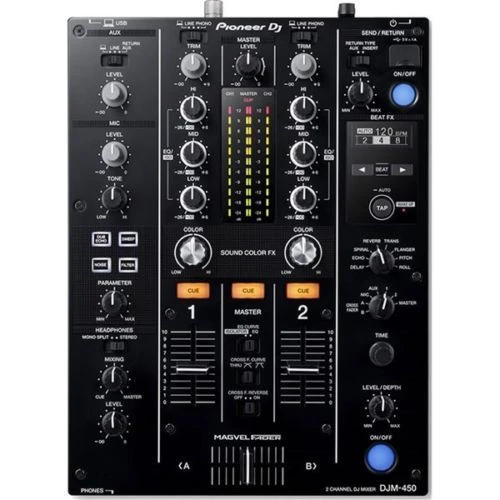
The Pioneer DJM-450 sits in an interesting spot in that market. It's not the cheapest DVS-capable mixer you can buy, and it's nowhere near the most expensive. What it offers is a very specific bundle of club-standard layout, Pioneer's Magvel crossfader, a genuinely useful effects section, and a built-in soundcard that turns two turntables into a full rekordbox setup. Whether that's the right bundle for you depends entirely on what you play, where you play it, and which software you've already committed to.
This guide compares the DJM-450 fairly against the mixers it actually competes with in Australia — including its own cheaper sibling, which is the most honest competitor it has. We'll cover what each option does well, where each falls short, and how to work out which one suits your situation.
The 2026 Two-Channel Mixer Landscape
Before comparing individual units, it helps to understand that "two-channel mixer" now covers at least four distinct product categories, each built around a different assumption about how you play.
| Category | Typical AUD Range | Built For | Representative Models |
|---|---|---|---|
| Entry DVS mixer | $600 – $800 | First-time vinyl-to-digital converts | Pioneer DJM-250MK2, Numark Scratch |
| Club-layout DVS mixer | $900 – $1,400 | Home setups that mirror club gear | Pioneer DJM-450, Allen & Heath Xone:23C |
| Battle / scratch mixer | $1,500 – $2,600 | Turntablists, hip-hop and open-format DJs | Pioneer DJM-S5, DJM-S7, Rane One, Reloop Elite |
| Four-channel step-up | $1,700 – $2,200 | Multi-source setups, small venue installs | Pioneer DJM-750MK2, Allen & Heath Xone:43C |
Pricing above is indicative Australian street pricing and moves with exchange rates and stock cycles — always confirm current pricing before you commit.
The DJM-450 lands squarely in that second tier, and its whole design philosophy follows from that. It's laid out like a shrunken club mixer, not like a battle mixer. The crossfader sits below the channel faders in the conventional position rather than being optimised for fast cutting, and the effects section is borrowed from Pioneer's larger nightclub units. If you've ever stood behind a DJM-900NXS2 or DJM-A9, the DJM-450 will feel immediately familiar — which is precisely the point.
What You Actually Get With the DJM-450
Let's be concrete about the feature set before we start comparing, because a lot of the value here is in details that don't show up on a spec sheet headline.
| Feature | DJM-450 Specification | Why It Matters |
|---|---|---|
| Channels | 2 (phono/line switchable per channel) | Two turntables or two media players, plus DVS |
| Soundcard | 24-bit / 48 kHz, 2-in / 4-out USB | No separate interface needed for DVS or recording |
| Crossfader | Magvel Fader (magnetic, contactless) | Long service life, adjustable curve, reverse switch |
| Beat FX | 11 types with X-PAD control strip | Inherited from Pioneer's flagship club mixers |
| Sound Color FX | 4 types (Space, Dub Echo, Sweep, Filter) | Per-channel tonal shaping without touching EQ |
| EQ | 3-band, switchable EQ / Isolator | Isolator mode gives full-kill for proper blends |
| Send / Return | 3.5 mm stereo send and return | Patch in a phone, pedal or outboard effect |
| Mic input | 1 channel with dedicated EQ | Enough for MC duties or venue announcements |
| Master outputs | Balanced XLR + unbalanced RCA | XLR is the one that matters for real PA systems |
| Booth output | 1/4" TRS with independent level | Separate monitor level, unaffected by master |
| Headphones | 1/4" and 3.5 mm outputs | Works with whatever cans you already own |
| Software | rekordbox dj / rekordbox dvs compatible | Locks you into Pioneer's ecosystem — see below |
The physical footprint is genuinely compact — roughly 240 mm wide and light enough to throw in a bag with a laptop — which makes it a realistic option for mobile DJs who need club-standard controls without hauling a four-channel unit.
The DVS Decision: This Is the Real Fork in the Road
Here's the single most important thing to understand before comparing anything else. The DJM-450 is a rekordbox DVS mixer, not a Serato DVS mixer. Its built-in soundcard is certified to run rekordbox dj and rekordbox dvs, and that's the path Pioneer intends you to take.
This is not a flaw — rekordbox is excellent software, it's the same library system that drives CDJs in virtually every serious club in Australia, and if you ever want to walk into a venue with a USB stick and play on the house gear, having your library already prepped in rekordbox is a real advantage. But if you've spent five years building crates in Serato, buying a DJM-450 means either running Serato without DVS control or rebuilding your workflow. That's a genuine cost, and no amount of good hardware offsets it.
- Choose the DJM-450 if: you're already in rekordbox, or you're starting fresh and want your library to match club CDJs.
- Choose a Serato-certified mixer instead if: your existing library, cue points and crates live in Serato, or you play scratch-heavy styles where the Serato ecosystem dominates.
One practical note: exactly what ships in the box — control vinyl, licence keys, cabling — varies between bundles and territories. Before purchasing, confirm with the retailer whether control vinyl and the DVS licence are included, or whether you'll need to budget separately. Check the current DJM-450 listing and bundle details here.
Head-to-Head: The Comparisons That Matter
DJM-450 vs Pioneer DJM-250MK2 — The Honest Sibling Fight
This is the comparison most buyers should be having, and plenty of shops would rather you didn't. The DJM-250MK2 is roughly $400–$500 cheaper, runs the same rekordbox DVS system, has the same two channels, and includes a soundcard.
What the extra money buys you on the DJM-450:
- Beat FX — the 250MK2 has none. If you use delay, echo, reverb or roll as part of your transitions, this alone can justify the gap.
- Four Sound Color FX instead of one — the 250MK2 gives you a filter and nothing else.
- Magvel Fader — a magnetic, contactless crossfader with adjustable curve and reverse, versus the 250MK2's basic fader.
- Send/Return loop — external effects and phone apps patch straight in.
- EQ/Isolator switching and a more capable mic section.
Verdict: if you mix mostly with EQ and faders and don't reach for effects, the DJM-250MK2 does 80% of the job for roughly 55% of the price, and that's a legitimately smart purchase. If you scratch at all, or if effects are part of your sound, the DJM-450 is worth the step up — the Magvel Fader and Beat FX are the two things you cannot add later.
DJM-450 vs Pioneer DJM-S5 — Club Layout vs Battle Layout
The DJM-S5 costs meaningfully more and is built around a different philosophy entirely. It's a Serato-focused battle mixer with performance pads, a wider crossfader travel, and controls positioned for fast hand movement. Channel faders sit further forward, and the whole unit is designed to be scratched on.
The DJM-450 is not a battle mixer. Its Magvel Fader is good — genuinely good — but the layout puts the channel faders closer to the front edge in the standard club arrangement, which is less comfortable for sustained fader drills.
Verdict: turntablists and scratch DJs should stretch to the S-series or an equivalent battle mixer. Everyone else — house, techno, disco, mobile work, general open-format — will find the DJM-450 the more sensible and more transferable purchase, because it teaches you the layout you'll meet in clubs.
DJM-450 vs Allen & Heath Xone:23C — Sound Character vs Ecosystem
The Xone:23C is the thinking DJ's alternative and deserves serious consideration. Allen & Heath's VCF analogue filter is, for many ears, more musical than anything in the Pioneer Sound Color FX set, and the Xone's 4-band EQ plus dual-input flexibility appeals to DJs mixing multiple sources.
Where the DJM-450 pulls ahead is ecosystem and effects. The Xone:23C has no Beat FX section, its soundcard is built around a different DVS approach, and its layout won't prepare you for the CDJ/DJM booth you'll find in most Australian venues.
| Consideration | DJM-450 | Xone:23C |
|---|---|---|
| Filter character | Digital, clean, predictable | Analogue VCF, warmer and more aggressive |
| Beat-synced FX | 11 Beat FX with X-PAD | None onboard |
| EQ bands | 3-band with isolator mode | 4-band |
| Club transferability | Excellent — mirrors Pioneer booths | Limited outside A&H-equipped venues |
| Best suited to | rekordbox users, club-bound DJs | Techno/electro DJs who prize filter tone |
Verdict: pick the Xone:23C if filter tone is your signature and you don't need onboard effects. Pick the DJM-450 if you want the effects section and the club-standard muscle memory.
DJM-450 vs Numark Scratch — Budget Battle Alternative
The Numark Scratch undercuts the DJM-450 considerably and offers Serato DVS with performance pads and an Innofader Pro. For a beginner scratch DJ on a tight budget, it's remarkable value.
Where it gives ground is in build feel, EQ quality, effects depth and long-term resilience. Pot and fader feel on the DJM-450 is a clear step up, and the Magvel Fader's contactless design means no dust-related crackle years down the track.
Verdict: the Scratch wins on price-per-feature for Serato scratch beginners. The DJM-450 wins on durability, sound quality and the fact that you'll still be happy with it in five years.
DJM-450 vs DJM-750MK2 — Do You Actually Need Four Channels?
Plenty of buyers talk themselves into four channels and then use two for the next three years. Be honest with yourself. Four channels earns its keep when you're running two turntables plus two media players, doing multi-source events with a laptop and a backup, or installing the mixer in a venue where multiple sources need to stay patched.
If you're a bedroom or small-gig DJ with two decks, the DJM-450 saves you around $700 and a significant amount of desk space, and gives up almost nothing you'll miss.
The Complete Comparison Table
| Model | Channels | DVS Platform | Beat FX | Crossfader | Indicative AUD | Best For |
|---|---|---|---|---|---|---|
| Pioneer DJM-450 | 2 | rekordbox | 11 | Magvel (magnetic) | $1,000 – $1,300 | Best all-rounder for club-bound DJs |
| Pioneer DJM-250MK2 | 2 | rekordbox | None | Standard | $600 – $750 | Best budget entry to DVS |
| Pioneer DJM-S5 | 2 | Serato | Yes + pads | Magvel Pro | $1,500 – $1,800 | Best for scratching |
| Allen & Heath Xone:23C | 2 (+ dual inputs) | Compatible | None | Standard | $850 – $1,000 | Best filter tone |
| Numark Scratch | 2 | Serato | Yes + pads | Innofader Pro | $750 – $900 | Best value for Serato beginners |
| Pioneer DJM-750MK2 | 4 | rekordbox | Yes | Magvel | $1,700 – $2,000 | Best for multi-source setups |
Sound Quality, Build and the Things That Age
Spec sheets rarely capture what actually matters after two years of use. A few observations on how these mixers hold up.
The soundcard. The DJM-450's 24-bit/48 kHz interface is entirely sufficient for DVS and for recording sets. It is not a studio interface, and if your goal is mastering-grade capture you'll want something else. For DJ purposes — timecode tracking, clean recording, driving a PA — it's more than adequate, and having it built in removes a box, two cables and a failure point from your setup.
The crossfader. This is where the DJM-450 quietly earns its money. Conventional carbon-track faders wear, collect dust and eventually crackle. The Magvel Fader is contactless and rated for a very high cycle count, which means one of the classic mixer failure modes simply doesn't apply. If you buy secondhand gear regularly, you'll appreciate how much this matters.
The isolator EQ. Being able to switch from standard EQ to full-kill isolator changes how you can blend. It's a small toggle with a large effect on your mixing options, and it's absent on cheaper units.
The XLR outputs. Balanced outputs aren't glamorous, but they're the difference between a clean signal and a buzzing one when you're running long cable to a venue PA. Any mixer you take to paid work should have them.
Value Analysis: Where the Money Goes
| If Your Budget Is | Smartest Choice | Reasoning |
|---|---|---|
| Under $800 | DJM-250MK2 or Numark Scratch | Full DVS capability; accept fewer effects and simpler faders |
| $900 – $1,300 | DJM-450 | The sweet spot — club layout, Magvel fader, full FX, no compromise on outputs |
| $1,400 – $1,900 | DJM-S5 (Serato) or DJM-750MK2 (4-ch) | Only worth it if you genuinely need scratch layout or four channels |
| $2,000+ | DJM-S7, Rane One or wait and save | Diminishing returns unless you're gigging professionally |
Put plainly: the DJM-450 is the point on the curve where you stop giving things up. Below it, you're accepting compromises on effects, faders or outputs. Above it, you're paying for capabilities most DJs use rarely. That's what makes it a defensible recommendation rather than an upsell.
How to Choose: A Practical Decision Framework
Work through these in order. The first question that gives a clear answer usually settles it.
- Which software is your library in? Serato users should look at Serato-certified mixers. rekordbox users, or true beginners, should look at Pioneer. This overrides everything else.
- Do you scratch? If cutting and juggling are core to your style, a battle layout is worth the premium. If you scratch occasionally, the DJM-450's Magvel Fader handles it fine.
- How many sources do you run simultaneously? Count them honestly. Two means a two-channel mixer.
- Will you play on club gear? If yes, matching the Pioneer layout at home shortens your learning curve dramatically.
- Are effects part of your sound? If yes, the DJM-450 over the DJM-250MK2 is straightforward. If no, save the money.
- Does it need to leave the house? Balanced XLR outputs, a booth output and a mic channel are non-negotiable for paid work.
Common Mistakes Buyers Make
- Buying for the DJ you want to be in three years. Four channels and battle layouts get bought aspirationally and used conventionally. Buy for how you actually play now.
- Ignoring the software lock-in. The hardware is the cheap part of switching ecosystems. Your library, cue points and muscle memory are the expensive part.
- Assuming the bundle includes everything. Control vinyl, licence keys and cables vary by bundle. Confirm before ordering.
- Skimping on the mixer to afford flashier decks. The mixer is what every signal passes through and what you touch most. It's the wrong place to economise.
- Overlooking the booth output. Without independent monitor level, you'll be adjusting your monitoring by changing what the crowd hears.
Pros and Cons: The DJM-450 Honestly Assessed
Strengths
- Club-standard Pioneer layout that transfers directly to venue gear
- Magvel Fader — contactless, durable, adjustable curve and reverse
- Genuinely useful 11-type Beat FX section with X-PAD
- Built-in soundcard removes a separate interface from the chain
- Balanced XLR master plus independent booth output — gig-ready
- Send/return loop for external effects or phone apps
- Compact and light enough for regular transport
Limitations
- rekordbox-focused DVS — a real barrier for committed Serato users
- Not a battle mixer; layout isn't optimised for heavy scratching
- Four Sound Color FX rather than the six on higher-end DJMs
- Single mic input may not suit event work with two presenters
- Two channels only — no headroom if your setup grows
- Meaningfully dearer than the DJM-250MK2, which covers the basics
Questions Worth Asking Before You Buy
- Does this bundle include control vinyl and the DVS licence, or are they extra?
- What's the Australian warranty period and who handles service locally?
- Is my laptop's operating system currently supported by the required rekordbox version?
- Do I have the right cables — balanced XLR to my PA, and USB to my machine?
- If I sold this in three years, what would it be worth? (Pioneer holds value well; this is a real part of the value equation.)
View the Pioneer DJM-450 with rekordbox dj DVS at MusiconStage to check current pricing, stock and what's included in the box.
Final Recommendation
The Pioneer DJM-450 is the mixer we'd recommend to most Australian DJs buying a two-channel unit in 2026 — with two clear exceptions.
Buy the DJM-450 if you're building a turntable-plus-DVS setup, you're in the rekordbox ecosystem (or starting fresh), you want effects as part of your mixing, and you'd like the layout at home to match the layout in the booth. It's the point where the compromises stop without the price becoming professional-tier.
Buy something else if your library is deeply invested in Serato — go with a Serato-certified mixer and don't fight it — or if you're a dedicated turntablist, in which case a proper battle layout is worth every extra dollar. And if your budget is genuinely tight and you mix with EQ and faders rather than effects, the DJM-250MK2 is not a downgrade so much as a different, entirely sensible choice.
There's no universally best two-channel mixer. There's the one that matches your software, your style and your gigs. For a large share of DJs, that's the DJM-450 — and knowing precisely why is worth more than any five-star rating.
Frequently Asked Questions
Can the DJM-450 be used without a computer?
Yes. Connect two turntables or media players and it works as a standalone analogue mixer with full EQ, Sound Color FX and Beat FX. The computer is only required for DVS and recording.
Do I need special turntables to use DVS?
No. Any turntable with a decent cartridge works — you play timecode control vinyl on it instead of music. Direct-drive decks with reliable pitch are strongly preferred over belt-drive.
Is the DJM-450 suitable for paid gigs?
Absolutely. Balanced XLR outputs, an independent booth output and a mic channel cover what mobile and small-venue work requires. The main limitation is channel count, not build quality.
Can I record my sets with it?
Yes — the built-in soundcard sends the master output to your computer over USB, so any DAW or recording app can capture your mix without extra hardware.
How does it compare to a DJ controller at the same price?
A controller bundles decks and mixer into one unit and is better value if you only ever play from a laptop. A mixer like the DJM-450 lets you build a modular setup, swap decks independently, and play without a computer — and it holds resale value considerably better.