
Pioneer DJ Opus Quad vs Rivals: Aussie Buyer's Guide 2026
Pioneer DJ Opus Quad vs Rivals: The Complete Australian Buyer's Guide 2026
If you're shopping at the top end of the all-in-one DJ market in Australia, the Pioneer DJ Opus Quad almost certainly landed on your shortlist. It's Pioneer's flagship four-channel standalone system, and it sits in a category where the decision isn't really "good or bad" — every contender here is genuinely capable. The real question is which premium system fits the way you actually play, and whether the Opus Quad's particular blend of design, sound and ecosystem justifies its position at the pointy end of the price ladder.
This guide breaks the Opus Quad down honestly and compares it against the systems Australian buyers cross-shop most often: the Pioneer DJ XDJ-XZ, the DDJ-FLX10, and Denon DJ's Prime 4+. We'll look at features, performance, value across price tiers, and — most importantly — who each one is genuinely the right call for.
The All-In-One Premium Landscape: Where the Opus Quad Sits
Standalone (or "all-in-one") DJ systems removed the laptop from the equation. You load music on USB drives or SD cards, plug straight into a PA, and play — no computer, no driver headaches, no software crashing mid-set. Over the last few years this category has matured from "convenient compromise" into genuine club-grade performance gear, and the premium tier is now where the most interesting design battles play out.
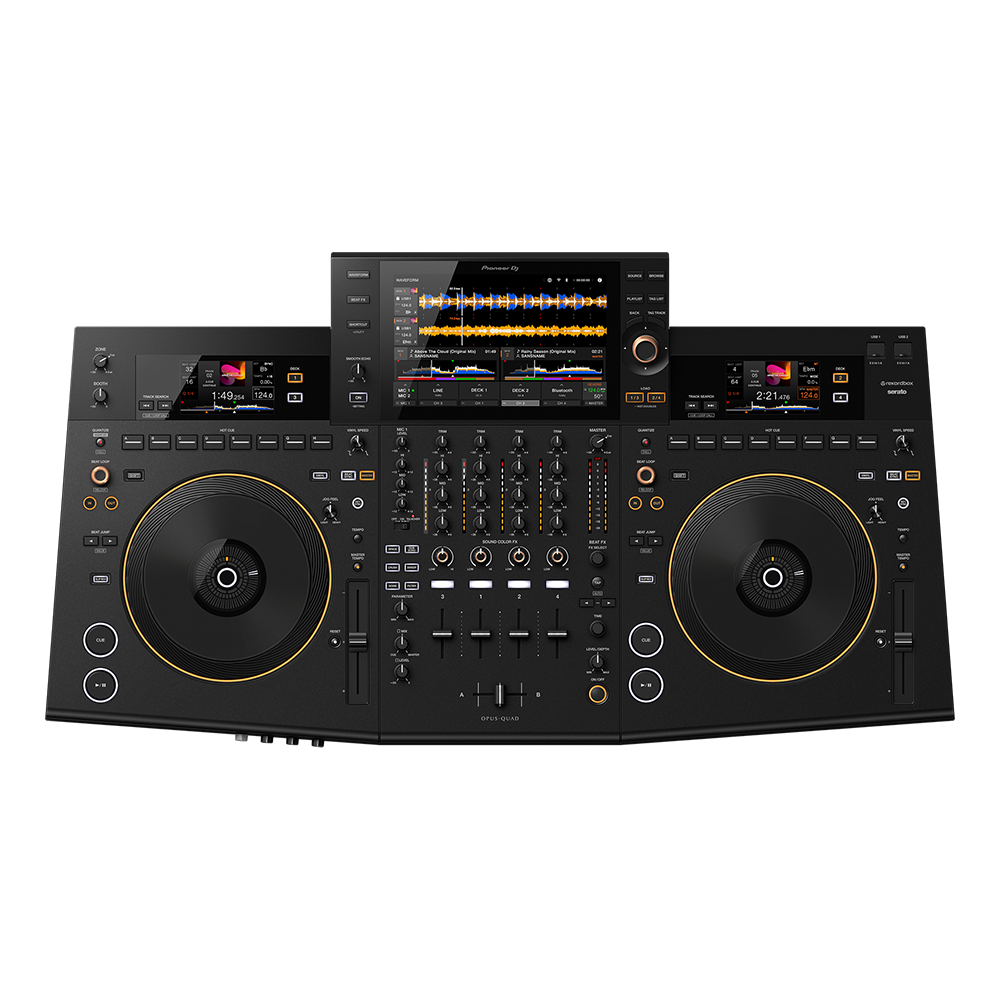
Within that tier, the Opus Quad is deliberately positioned as the design-led, ecosystem-first flagship. Pioneer didn't just bolt four channels onto an XDJ — they reimagined the form factor with a curved, asymmetric chassis, a generous high-resolution touchscreen, and a build quality intended to look as good in a luxury venue or a home listening room as it does in a booth. It's the kind of unit that's meant to be seen.
That positioning matters because it tells you what you're paying for. You're not just buying mixing functionality — you're buying industrial design, premium materials, four-channel flexibility, and deep integration with Pioneer's rekordbox and CloudDirectPlay ecosystem. Whether that's worth it depends entirely on your priorities, which is exactly what the comparisons below are designed to surface.
Key Things to Prioritise Before You Choose
Premium all-in-ones differ in subtle but important ways. Before comparing models, get clear on what actually matters for your situation:
- Channel count: Do you need true four-channel mixing (multiple tracks, acapellas, loops layered live) or is two-channel back-to-back play enough?
- Workflow ecosystem: Are you already invested in rekordbox and Pioneer club standards, or open to Serato/Engine DJ?
- Portability vs. presence: Is this a gigging tool that gets packed and moved, or a centrepiece that mostly stays put?
- Library handling: USB/SD only, internal storage, or cloud streaming and drive support?
- Future-proofing: Will the layout translate to the CDJ/DJM club setups you'll face on bigger stages?
Keep these in mind — they'll do more to guide your decision than any single spec.
Head-to-Head: Opus Quad vs the Main Contenders
Here's how the Opus Quad stacks up against the systems Australian buyers most commonly weigh it against. None of these are bad choices — they simply prioritise different things.
| Feature | Pioneer Opus Quad | Pioneer XDJ-XZ | Pioneer DDJ-FLX10 | Denon Prime 4+ |
|---|---|---|---|---|
| Type | Standalone all-in-one | Standalone all-in-one | Software controller (laptop required) | Standalone all-in-one |
| Channels | 4 | 4 | 4 | 4 |
| Primary software/ecosystem | rekordbox / CloudDirectPlay | rekordbox / Serato | rekordbox / Serato | Engine DJ |
| Display | Large high-res touchscreen | Touchscreen (smaller) | Dual screens on jog wheels | Large touchscreen |
| Design focus | Premium, statement aesthetic | Functional pro layout | Performance/laptop hybrid | Feature-packed, value-driven |
| Internal storage / streaming | Cloud + drive support | USB/SD | N/A (uses laptop) | Internal SATA drive bay + streaming |
| Best suited to | Premium venues, home flagship, brand loyalists | Working pros wanting club-standard layout | Software DJs who want flexibility | Value-focused standalone players |
Opus Quad vs XDJ-XZ: Two Pioneer Flagships, Different Philosophies
This is the comparison that trips up the most buyers, because both are four-channel Pioneer standalones. The honest distinction: the XDJ-XZ leans into a traditional, club-faithful layout — its control surface closely mirrors a CDJ-and-DJM rig, and it supports Serato out of the box, which matters if you're a Serato user. The Opus Quad leans into design, screen real estate and ecosystem polish, with a larger, sharper touchscreen and CloudDirectPlay-style cloud library access.
- Choose the XDJ-XZ if: you want the most direct translation to club CDJ/DJM workflows, you use Serato, and a pure-function layout matters more than aesthetics.
- Choose the Opus Quad if: you want the premium look, the bigger screen for browsing and waveform detail, and deeper rekordbox/cloud integration in a unit that doubles as a centrepiece.
Opus Quad vs DDJ-FLX10: Standalone Freedom vs Software Power
This isn't really a like-for-like fight — it's a fork in the road. The FLX10 is a controller: it needs a laptop running rekordbox or Serato, and in return gives you the full power, screen size and flexibility of computer software (plus standout features like Track Separation). The Opus Quad is standalone: no laptop, no crash risk, plug-and-play reliability.
- The FLX10 wins on: raw software features, cost-per-feature value, and flexibility for DJs who don't mind bringing a laptop.
- The Opus Quad wins on: reliability, simplicity, booth presence, and freedom from a computer entirely.
If the idea of a laptop dying mid-set fills you with dread, standalone is the answer — and that's the Opus Quad's home turf.
Opus Quad vs Denon Prime 4+: Ecosystem and Polish vs Features-Per-Dollar
Denon's Prime 4+ is the value-and-features champion of the standalone world — internal drive bay, generous I/O, and a long spec sheet, all running on Engine DJ. The trade-off is ecosystem: the global club standard remains Pioneer/rekordbox, so if you regularly play venues with CDJs installed, the Opus Quad's familiarity has real-world value.
- Choose the Prime 4+ if: you want maximum features and storage for the spend and you're happy in the Engine DJ world.
- Choose the Opus Quad if: rekordbox compatibility, club-standard muscle memory, and premium build are priorities, and you're willing to pay for them.
Strengths and Trade-Offs: The Opus Quad in Balance
Fair comparison means being honest about both sides. Here's where the Opus Quad genuinely shines and where you should think twice.
Where the Opus Quad Excels
- Standout design and build: Few DJ products feel this considered. The asymmetric chassis and premium finish are a genuine differentiator, not marketing fluff.
- Large, high-resolution touchscreen: Easier browsing, clearer waveforms, and a more comfortable performance experience than smaller-screened rivals.
- Four-channel flexibility: Full creative headroom for layering, transitions and multi-deck performance.
- rekordbox + cloud ecosystem: Smooth library management and cloud access that suits DJs already living in the Pioneer world.
- Standalone reliability: No laptop dependency means one less point of failure on a live gig.
- Pioneer support and resale: Strong brand presence in Australia generally means good support and solid resale value.
Where to Think Carefully
- Price: This is a flagship, priced like one. If aesthetics aren't a priority, rivals deliver similar core functionality for less.
- Footprint and portability: Its design-forward form makes it more of a centrepiece than a grab-and-go gigging unit for tight transport situations.
- Ecosystem lock-in: You're committing to the rekordbox workflow — great if that's your world, less ideal if you're a Serato or Engine DJ devotee.
- Overkill for beginners: A first-time DJ rarely needs this much capability or spend to start learning.
Situation-Specific Recommendations
The "best" system is entirely dependent on who's buying. Here's our honest read:
- Best for premium venues and styled spaces: Opus Quad. Nothing else matches its presence, and the big screen earns its keep on long sets.
- Best for the working club/mobile pro on Serato: XDJ-XZ. Club-faithful layout and Serato support, often at a friendlier price.
- Best for software-first DJs and feature hunters: DDJ-FLX10. Maximum features and flexibility if a laptop in the setup doesn't bother you.
- Best features-per-dollar standalone: Prime 4+. Loaded spec sheet and storage for the spend.
- Best home flagship / centrepiece: Opus Quad. It's the one that looks like a piece of furniture you're proud of.
- Best for absolute beginners: none of these — start on an entry controller and upgrade once your style is clear.
If the Opus Quad's blend of design, screen and standalone reliability matches your priorities, you can view the Pioneer DJ Opus Quad here and check current Australian availability.
A Simple Decision-Making Framework
Cut through the spec overload by working through these questions honestly:
- Laptop or no laptop? If you want zero computer dependency, you're in standalone territory (Opus Quad, XDJ-XZ, Prime 4+) — not the FLX10.
- Which ecosystem do you already live in? rekordbox points to Pioneer; Serato favours the XDJ-XZ/FLX10; Engine DJ points to Denon.
- Is design and presence part of the value to you? If yes, the Opus Quad pulls ahead. If it's purely a tool, weigh the price gap carefully.
- How often will you move it? Frequent, tight transport favours a more conventional gigging unit.
- Where will you play? If you regularly face CDJ/DJM club rigs, Pioneer layout familiarity has real long-term value.
Common Mistakes to Avoid
- Paying for channels you'll never layer. If you genuinely play two-channel, four channels is capability you're funding but not using.
- Ignoring ecosystem switching costs. Migrating libraries and muscle memory between rekordbox, Serato and Engine DJ is real friction — factor it in.
- Buying on looks alone. The Opus Quad is gorgeous, but make sure the workflow and budget genuinely suit you, not just the photos.
- Under-buying then upgrading twice. If you're clearly heading pro, jumping straight to a flagship can be cheaper than two stepping-stone purchases.
Value Analysis Across Price Tiers
Think of this category in three honest tiers. At the value end, the Prime 4+ delivers the most raw features and storage per dollar — ideal if spec sheets and budget drive your decision. In the working-pro middle, the XDJ-XZ and FLX10 offer flagship-class performance with sharper pricing, trading some polish or adding a laptop for the savings. At the premium top, the Opus Quad asks you to pay for design, screen quality and ecosystem refinement on top of the core functionality.
The key insight: above the value tier, you're increasingly paying for experience and presentation rather than fundamental capability. That's not a criticism — for the right buyer, a beautiful, reliable, screen-rich flagship is absolutely worth it. Just be clear-eyed that the premium is largely about how the gear looks, feels and integrates, not whether it can mix four channels.
Final Verdict: Who Should Buy the Opus Quad?
The Pioneer DJ Opus Quad is one of the most desirable all-in-one systems on the Australian market — and it knows it. It's the clear pick if you want a statement-grade, standalone, four-channel flagship with a superb screen, deep rekordbox/cloud integration, and the reassurance of Pioneer's club-standard ecosystem. For premium venues, design-conscious pros, and serious enthusiasts building a centrepiece setup, it's genuinely hard to beat on presence and polish.
Where we'd steer you elsewhere: if you're a committed Serato user, the XDJ-XZ may suit you better; if you're chasing maximum features-per-dollar, the Prime 4+ makes a strong case; and if you're happy with a laptop, the FLX10 stretches your budget further on features. None of those are downgrades — they're different answers to different priorities.
Our honest bottom line: buy the Opus Quad because its specific strengths — design, screen, standalone reliability and ecosystem fit — match what you value, not simply because it's the most expensive option. If they do match, you'll get a flagship that performs as beautifully as it looks for years to come. You can check the latest Opus Quad pricing and availability at MusiconStage to see how it fits your budget.
Still weighing it against another model? Match your top two priorities from the framework above to the comparison table — the right system usually becomes obvious once you stop comparing every spec and start comparing what actually matters to you.