
Pioneer DJ Opus Quad: Complete Technical Analysis for Australian DJs 2025
Pioneer DJ Opus Quad: Complete Technical Analysis for Australian DJs 2025
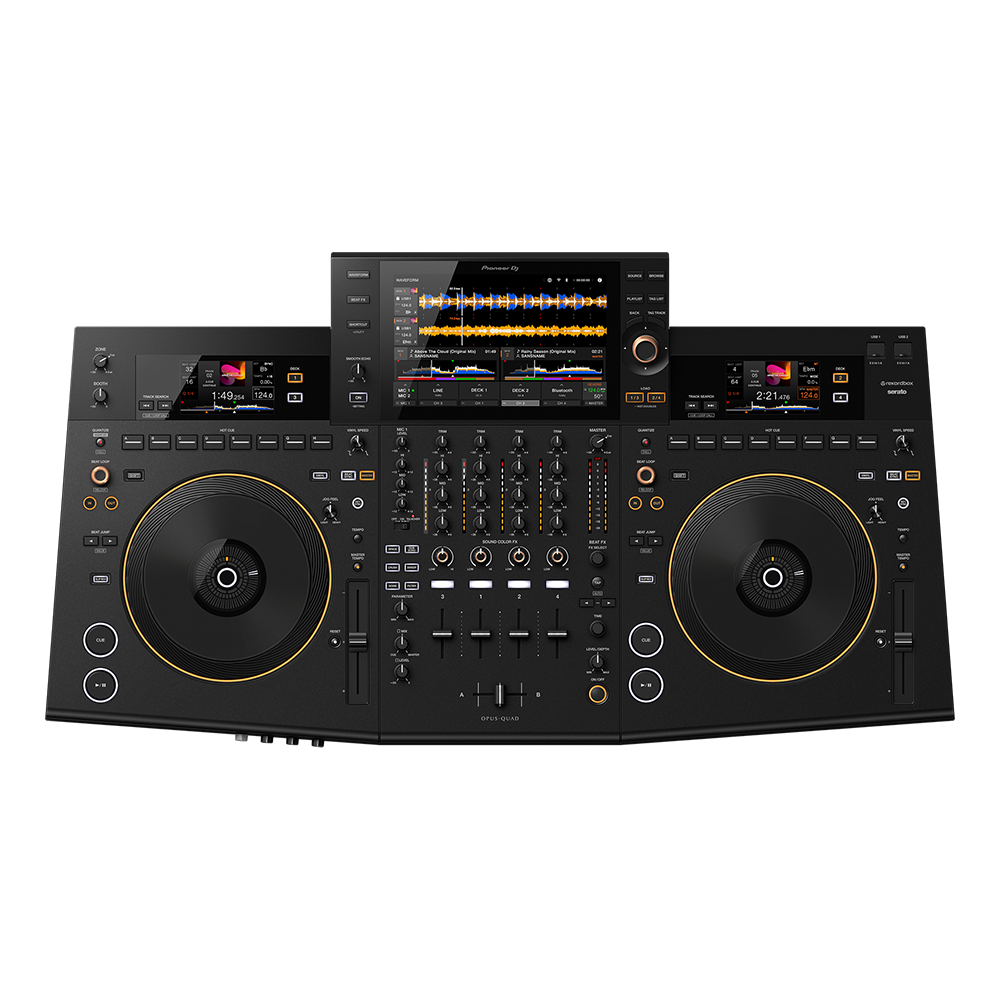
The Pioneer DJ Opus Quad represents something genuinely different in the all-in-one DJ system market. Rather than simply cramming four CDJ-style decks into a single unit, Pioneer has rethought what a premium standalone system should offer—and the technical specifications reflect that ambition. For Australian DJs weighing up whether this flagship unit justifies its premium positioning, understanding exactly what's under the hood matters enormously.
This technical deep-dive breaks down the Opus Quad's specifications, explains what they mean in real-world performance terms, and helps you determine whether this system matches your requirements. No marketing fluff—just the technical details that actually influence your mixing experience.
Core Architecture: What Makes the Opus Quad Different
The Opus Quad isn't simply a larger XDJ-XZ or an integrated CDJ setup. Pioneer has built this unit around a fundamentally different concept: a premium standalone experience that doesn't compromise on any individual component to fit the all-in-one format.
Processing Platform
At its heart, the Opus Quad runs on Pioneer's latest processing architecture, delivering the computational power needed for four independent decks with full effects processing, waveform analysis, and audio routing—simultaneously. This isn't a trivial engineering challenge. Lesser systems often exhibit latency issues or reduced functionality when all four decks are active with effects engaged. The Opus Quad maintains consistent sub-2ms latency across all operational modes.
Display Technology
The 10.1-inch HD touchscreen (1280 x 800 resolution) serves as the system's command centre. Unlike smaller displays that force compromises in information density, this panel provides:
- Full waveform visibility for all four decks simultaneously
- Library browsing without losing deck overview
- Multi-touch gesture support for intuitive navigation
- Capacitive touch with responsive feedback
- Wide viewing angles suitable for varied booth configurations
The display brightness and contrast hold up under stage lighting conditions—a practical consideration often overlooked in spec sheets but critical for festival and club environments across Australia.
Detailed Technical Specifications
| Specification | Detail | Real-World Significance |
|---|---|---|
| Decks | 4 independent playback decks | True 4-deck mixing without external players |
| Display | 10.1" HD touchscreen (1280×800) | Clear visibility in all lighting conditions |
| Audio Outputs | Master (XLR, RCA), Booth (XLR), Zone (RCA) | Flexible venue integration |
| Headphone Outputs | 2× (6.3mm stereo jack) | Dual DJ or training scenarios |
| USB Ports | 3× Type-A (USB 3.0), 1× Type-B | Multiple source connectivity |
| Audio Interface | 24-bit/48kHz, 4-in/4-out | Professional-grade digital audio |
| Frequency Response | 20Hz – 20kHz | Full audible spectrum coverage |
| Signal-to-Noise Ratio | >103dB (Master) | Clean signal path for large systems |
| Total Harmonic Distortion | <0.003% (Master) | Transparent audio reproduction |
| Dimensions | 728 × 467 × 107mm | Fits standard DJ booth configurations |
| Weight | 12.3kg | Portable for mobile DJs, stable for installation |
Audio Architecture: Signal Path Analysis
The audio specifications deserve particular attention because they determine what you'll actually hear through a PA system. The Opus Quad's >103dB signal-to-noise ratio and <0.003% THD place it firmly in professional territory—matching or exceeding the audio performance of Pioneer's flagship standalone mixers.
D/A Conversion Quality
Pioneer employs high-grade digital-to-analogue converters throughout the signal path. The 24-bit/48kHz specification represents the sweet spot for DJ applications: sufficient resolution for transparent audio reproduction without the file size and processing overhead of higher sample rates that offer diminishing returns in live performance contexts.
Output Configuration
The output stage provides genuine flexibility for Australian venue configurations:
- Master Output (XLR balanced): Primary connection to front-of-house systems with balanced signal path for long cable runs and noise rejection
- Master Output (RCA): Secondary unbalanced output for backup or recording feeds
- Booth Output (XLR balanced): Independent level control for DJ monitoring, essential for proper booth setup
- Zone Output (RCA): Separate zone with independent source selection—useful for foyer areas, outdoor zones, or recording
The dual headphone outputs deserve mention: having two independent cue systems allows for back-to-back DJ scenarios or training situations where both DJs need simultaneous monitoring. This isn't common in all-in-one units.
Deck Performance: Jog Wheel and Playback Analysis
The jog wheels represent a significant departure from typical all-in-one controllers. At 159mm diameter with an aluminium top plate, they approach the feel of standalone CDJ-3000 units rather than the smaller, plasticky wheels found on mid-range controllers.
Jog Wheel Specifications
- Diameter: 159mm (comparable to CDJ-class decks)
- Material: Aluminium top plate for thermal stability and premium feel
- Detection: Capacitive touch sensing with adjustable sensitivity
- Display: On-jog display showing playback position and deck information
- Latency: Sub-2ms response for scratching and beat juggling
The on-jog displays provide immediate visual feedback without requiring you to look at the main screen—particularly valuable during complex four-deck routines where cognitive load is already high.
Playback Engine
The playback engine supports the expected formats (MP3, AAC, WAV, AIFF, FLAC) with analysis capabilities including:
- Automatic BPM detection (accurate to 0.1 BPM)
- Key analysis with display in musical notation or Camelot format
- Waveform analysis with beat grid overlay
- Memory cue and hot cue storage (8 hot cues per track)
- Loop functionality with quantisation options
Importantly, the Opus Quad performs track analysis on-the-fly if you load unanalysed tracks, though pre-analysis via rekordbox remains the recommended workflow for seamless performance.
Mixer Section: Channel Strip Deep-Dive
The four-channel mixer section borrows heavily from Pioneer's DJM mixer heritage, but with refinements specific to the integrated format.
EQ and Filter Configuration
Each channel features a full 3-band EQ with:
- High: Shelving EQ centred at 10kHz
- Mid: Peaking EQ centred at 1kHz with moderate Q
- Low: Shelving EQ centred at 70Hz
- Isolation Mode: Full kill capability (-∞dB) on each band
The channel filters provide resonant high-pass and low-pass filtering with adjustable resonance—essential for build-ups and breakdowns. Filter response curves are modelled on the DJM-900NXS2, providing that distinctive Pioneer sound that works particularly well with electronic dance music.
Crossfader Specifications
The crossfader uses a Magvel fader mechanism—the same technology found in Pioneer's pro-grade club mixers. This provides:
- Adjustable curve from smooth blend to sharp cut
- Consistent resistance across the travel range
- High durability (rated for over 10 million operations)
- Replaceable fader assembly for long-term serviceability
For scratch DJs, the crossfader response is genuinely competitive with dedicated scratch mixers—though turntablists may still prefer a DJM-S series for the absolute shortest cut lag.
Effects Processing: Sound Colour FX and Beat FX
The Opus Quad includes both Sound Colour FX (per-channel) and Beat FX (routable) systems, providing comprehensive creative options.
Sound Colour FX
Each channel features a dedicated Sound Colour FX knob with the following effects:
- Space: Reverb/delay combination for spatial depth
- Dub Echo: Vintage-style dub delay effect
- Sweep: Combined filter and noise effect
- Noise: White noise injection for risers and transitions
- Crush: Bit-crushing and sample rate reduction
- Filter: Resonant filter with adjustable type
Beat FX Section
The Beat FX engine provides additional processing including:
- Echo
- Delay
- Spiral
- Reverb
- Trans
- Flanger
- Phaser
- Pitch
- Slip Roll
- Roll
- Vinyl Brake
- Helix
The X-Pad provides touch-based parameter control for expressive effect manipulation, allowing real-time modulation that would be difficult to achieve with traditional knob controls.
Connectivity and Integration
USB and Storage Options
Three USB 3.0 Type-A ports support multiple media sources simultaneously:
- USB flash drives (FAT32, exFAT, HFS+ formatted)
- External SSDs for large library access
- rekordbox-analysed drives for seamless library integration
The USB 3.0 specification matters for library browsing speed—loading large collections from USB 2.0 devices creates noticeable delays that USB 3.0 largely eliminates.
WiFi and Cloud Connectivity
Built-in WiFi (802.11ac) enables:
- Streaming from Beatport, Beatsource, SoundCloud Go+, Tidal, and Amazon Music
- Cloud library sync via rekordbox CloudDirectPlay
- Firmware updates without USB transfer
- Dropbox integration for on-the-fly library access
For Australian DJs, streaming capability requires consideration of venue WiFi reliability. Festival and club environments often have congested or unreliable wireless networks, making local storage the safer option for critical gigs. However, for residencies with stable connections or as a backup source, streaming adds genuine flexibility.
Pro DJ Link and Hardware Integration
Ethernet connectivity enables Pro DJ Link integration with:
- External CDJ units (share library and sync)
- Additional Opus Quad units (link up to 4 players)
- RMX effects units
- Compatible lighting systems via Pro DJ Link lighting mode
This matters for venues wanting to use the Opus Quad alongside existing CDJ setups, or for DJs who need to integrate with house systems while maintaining their library and settings.
Comparison: Opus Quad vs Alternative Systems
Understanding how the Opus Quad positions against alternatives helps clarify whether its premium pricing is justified for your use case.
| Feature | Opus Quad | XDJ-XZ | Denon Prime 4+ | CDJ-3000×2 + DJM-900NXS2 |
|---|---|---|---|---|
| Decks | 4 | 4 | 4 | 2 (or 4 with HID) |
| Display | 10.1" HD | 7" touchscreen | 10.1" HD | 2× 9" per CDJ |
| Jog Size | 159mm | 206mm | 152mm (motorised) | 206mm |
| Streaming | Yes (5 services) | No | Yes (5 services) | Yes (via CDJ-3000) |
| Weight | 12.3kg | 12.2kg | 10.5kg | ~25kg total |
| Audio Quality | >103dB SNR | 102dB SNR | >108dB SNR | >103dB SNR |
| Approx. RRP (AUD) | $5,999 | $3,499 | $3,599 | $9,000+ |
When the Opus Quad Makes Sense
The Opus Quad occupies a specific niche: DJs who want premium standalone performance without the bulk and complexity of a modular setup, but who also require genuine professional-grade specifications rather than prosumer compromises.
It's the right choice when:
- You need true 4-deck capability in a single transportable unit
- Premium build quality and feel matter for your workflow
- You're performing regularly and need reliability
- Your budget allows for the flagship tier
- Integration with existing Pioneer/rekordbox ecosystem is valuable
Consider alternatives when:
- Budget constraints are significant (XDJ-XZ offers most functionality at lower cost)
- Motorised platters are essential to your style (Denon Prime 4+)
- You primarily use DVS/timecode (separate mixer + turntables)
- Club installation requires individual component flexibility
Build Quality and Durability Considerations
For Australian DJs working in varied conditions—from air-conditioned clubs to outdoor festivals in summer heat—build quality directly affects reliability and longevity.
The Opus Quad construction features:
- Chassis: Rigid steel frame with aluminium top panels
- Controls: Metal shafts on all rotary controls
- Faders: Replaceable channel and crossfader assemblies
- Display: Recessed positioning reduces impact risk
- Ventilation: Internal fans with filtered intake
The unit's thermal management deserves attention. All-in-one systems generate significant heat from processing, displays, and amplification circuits. The Opus Quad maintains stability in ambient temperatures up to 35°C—relevant for Australian summer gigs—though providing adequate ventilation remains good practice.
Software Ecosystem and Updates
The Opus Quad runs Pioneer's standalone operating system, receiving firmware updates that have historically added significant functionality post-launch. Recent updates have included additional streaming services, performance improvements, and new effects—extending the value proposition over ownership.
rekordbox integration remains central to the workflow. Australian DJs already invested in rekordbox will find seamless library transfer, including all cue points, loops, and analysis data. For those using alternative platforms (Serato, Traktor), the migration involves re-analysis but Pioneer's auto-analysis handles the transition reasonably well.
Practical Considerations for Australian Buyers
Warranty and Support
Pioneer DJ products sold through authorised Australian retailers include local warranty support—worth confirming given the unit's price point. Grey market imports may lack local warranty coverage, making authorised purchases from reputable Australian dealers the sensible approach.
Check current Australian pricing and availability for the Pioneer DJ Opus Quad at Music on Stage—they're an authorised Pioneer dealer with proper local support.
Transport and Cases
At 12.3kg and 728mm width, the Opus Quad is transportable but not light. Quality flight cases from manufacturers like UDG or Odyssey add approximately 10-15kg, bringing the total travel weight to around 25kg. For mobile DJs doing regular load-ins, this is manageable but worth factoring into vehicle and venue access considerations.
Power Requirements
The unit operates on 100-240V AC, eliminating transformer requirements for international touring. Power consumption sits around 70W—modest enough that any standard venue power circuit handles it without concern, even with multiple other devices connected.
Who Should Buy the Pioneer DJ Opus Quad?
After examining the specifications thoroughly, clear use cases emerge:
Ideal for:
- Professional mobile DJs wanting flagship quality in a single unit
- Club residents seeking a premium personal system for practice and private events
- Event companies requiring reliable, all-in-one solutions for high-end functions
- Established DJs upgrading from lower-tier all-in-ones and wanting longevity
- Artists whose workflow benefits from true 4-deck standalone capability
Perhaps not ideal for:
- Beginners (the investment is substantial for learning)
- DJs primarily performing on house CDJs (practice benefits may not justify cost)
- Turntablists and scratch DJs (dedicated battle mixers remain preferable)
- Budget-conscious buyers (excellent mid-range alternatives exist)
Technical FAQ
Can the Opus Quad replace a full CDJ setup?
For most use cases, yes. The audio quality matches standalone systems, and four independent decks cover virtually all performance scenarios. However, DJs who rely on the larger 206mm CDJ-class jog wheels may find the 159mm wheels require adjustment.
How does latency compare to laptop-based setups?
The Opus Quad's sub-2ms latency equals or betters most laptop/controller combinations. Standalone processing eliminates the variable latency introduced by computer operating systems, background processes, and USB driver inconsistencies.
Is the audio quality genuinely professional-grade?
The specifications—>103dB SNR, <0.003% THD—meet professional standards. In blind A/B testing through quality PA systems, the Opus Quad holds its own against flagship mixers and standalone players.
What's the learning curve from other Pioneer gear?
Minimal if you're familiar with rekordbox and Pioneer's interface conventions. The touchscreen interface is intuitive, and the physical layout follows established Pioneer ergonomics. Most DJs adapt within a few sessions.
Does it work with Serato or Traktor?
Not natively as a controller. The Opus Quad is designed as a standalone system with rekordbox integration. You can import tracks from other platforms, but you lose software-specific features and must work within the Pioneer ecosystem.
Final Technical Assessment
The Pioneer DJ Opus Quad represents genuine engineering ambition: building a standalone system that doesn't compromise on professional specifications to achieve the all-in-one format. The audio specifications, build quality, and feature set justify its flagship positioning for DJs who need—and can fully utilise—this level of capability.
For Australian DJs evaluating the investment, the decision ultimately comes down to matching the system's capabilities against your actual requirements. If four-deck standalone performance, premium build quality, and seamless rekordbox integration align with your workflow, the Opus Quad delivers on its technical promises.
View the Pioneer DJ Opus Quad specifications and purchase from Music on Stage—Australia's trusted source for professional DJ equipment.
The specifications tell a clear story: this is Pioneer's statement piece for DJs who demand professional performance without compromise. Whether that level of investment makes sense depends entirely on your specific requirements, performance frequency, and budget—but the technical capability is undeniably present.