
Pioneer DJ DJM-A9 Mixer: Flagship 4-Channel Specs Decoded 2026
Pioneer DJ DJM-A9 Mixer (Bluetooth, Black): The Technical Deep-Dive Australian DJs Have Been Waiting For
The Pioneer DJ DJM-A9 isn't just another club mixer — it's the brand's statement of intent for what flagship digital mixing should look like in the second half of this decade. Replacing the long-serving DJM-900NXS2 at the top of Pioneer's range, the A9 rebuilds the signal chain from the ground up with a fully redesigned circuit architecture, a hop to 96 kHz/32-bit float internal processing, and — crucially for the modern booth — native Bluetooth audio input. For Australian DJs running everything from intimate Melbourne basement venues to large-format festival stages, understanding what's actually changed under the hood matters far more than the marketing headlines.
This guide breaks down the DJM-A9's specifications in detail, explains why the engineering decisions matter in real-world performance, and helps you decide whether the flagship premium is justified for your setup.
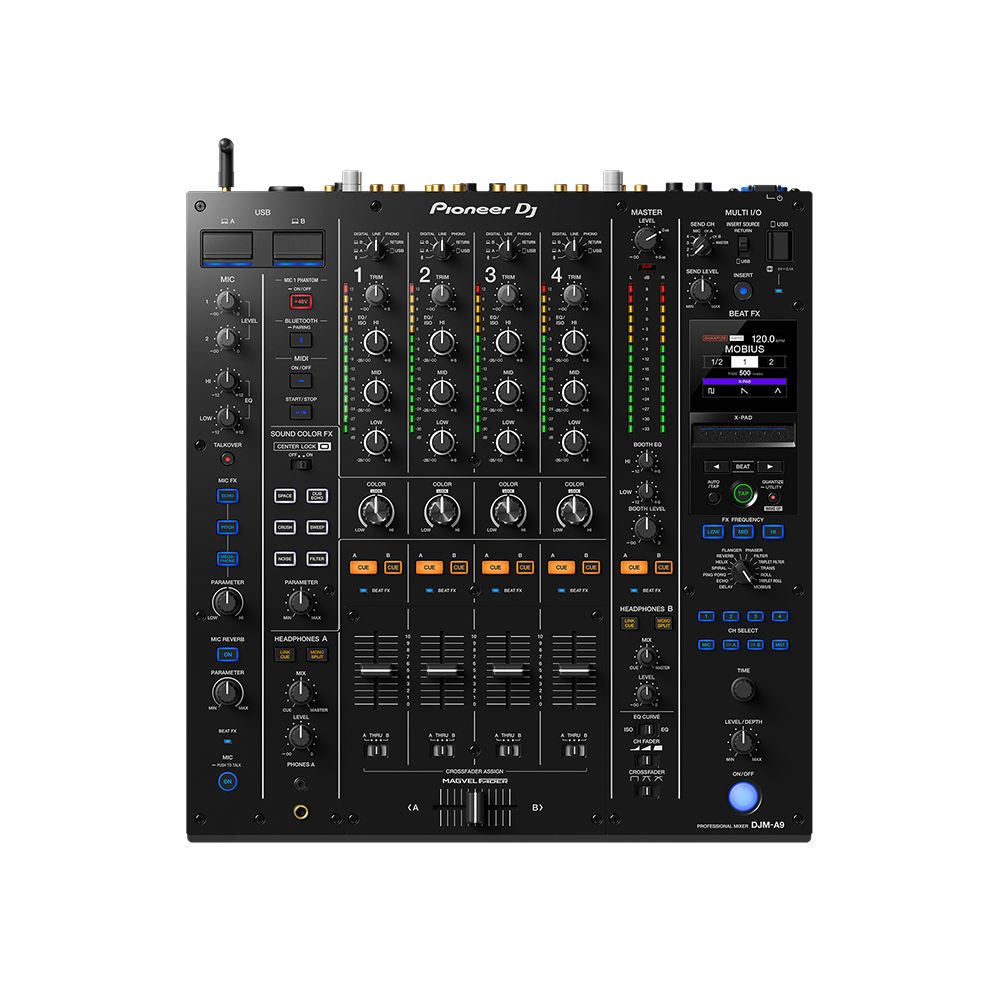
Technical Overview: What the DJM-A9 Actually Is
At its core, the DJM-A9 is a 4-channel professional digital DJ mixer built to the CDJ-3000-era club standard. It carries forward the DJM lineage's familiar control surface — three-band EQ, channel faders, the Magvel crossfader, Sound Color FX and Beat FX — but the internal platform is a genuine generational leap rather than a refresh.
| Specification | Detail | Why It Matters |
|---|---|---|
| Channels | 4 (assignable) | Industry-standard club layout; handles four decks or hybrid digital/analogue setups |
| Internal Processing | 96 kHz / 64-bit DSP, 32-bit float A/D-D/A | Greater headroom and cleaner gain staging; fewer artefacts at extreme settings |
| Sound Card | Built-in 32-bit USB-B audio interface | Direct, high-resolution connection to rekordbox/Serato laptops |
| Bluetooth | Built-in audio input | Stream from phone/tablet without adapters — ideal for requests, warm-ups, backup |
| Crossfader | Magvel Fader Pro (magnetic, contactless) | Rated for long service life; scratch-grade feel and adjustable curve |
| Channel Faders | Smooth, replaceable | Consistent taper across all four channels |
| EQ / Isolator | 3-band, switchable EQ or Isolator (–∞ dB) | Full kills for surgical mixing and mashups |
| Sound Color FX | 6 types (Space, Dub Echo, Sweep, Noise, Crush, Filter) | Per-channel tonal sculpting on the fly |
| Beat FX | 14+ types with X-Pad control | Tempo-synced transitions and build-ups |
| Mic Inputs | 2 (XLR/TRS combo + TRS), with EQ & FX | MC-friendly; full processing on vocals |
| Finish | Black | Standard club aesthetic |
The 96 kHz/32-Bit Float Engine: Why Bit Depth and Sample Rate Matter Here
The single most important technical change in the DJM-A9 is its move to a 96 kHz sample rate with 32-bit float analogue-to-digital and digital-to-analogue conversion, sitting on top of a 64-bit DSP core. This isn't spec-sheet theatre — it has audible, practical consequences.
The previous-generation DJM-900NXS2 already ran 64-bit DSP, but the A9's contribution is in the conversion stages and floating-point headroom. 32-bit float processing effectively removes internal clipping from the equation. In a fixed-point system, pushing channel gain, EQ boosts and FX simultaneously can drive the internal bus past 0 dBFS and introduce hard digital clipping. With floating-point maths, the internal dynamic range is so vast that the signal can swing well past nominal levels and be brought back down cleanly at the output — meaning aggressive EQ stacking and layered effects don't introduce the brittle, fizzy digital distortion that betrays a lesser mixer.
The jump to 96 kHz doubles the available frequency headroom compared with 48 kHz systems, pushing the Nyquist limit to 48 kHz and moving anti-aliasing filter behaviour further away from the audible band. For most listeners this manifests not as "hearing higher frequencies" but as smoother high-end transient response and a more relaxed top end through long sets — exactly where fatiguing harshness usually creeps in on a busy dancefloor.
Redesigned Circuit Architecture and the "Match" Concept
Pioneer rebuilt the A9's analogue circuitry rather than carrying over the 900NXS2 board. Two design goals drove this: a lower noise floor and a warmer, more natural tonal character that the company describes as bridging the gap between clinical digital cleanliness and the musicality engineers associate with analogue desks.
A standout feature is Match — Pioneer's term for the mixer's ability to reproduce a consistent, full-bodied sound by optimising the gain structure and EQ curves so tracks sit together cohesively. In practice, this reduces the need to constantly ride trim and EQ to make successive tracks feel level-matched, which is a genuine workflow advantage during back-to-back sets or fast-moving open-format gigs.
Sound Color FX and Beat FX: The Performance Toolkit
The DJM-A9 retains and refines Pioneer's two-tier effects philosophy:
- Sound Color FX — six per-channel effects (Space, Dub Echo, Sweep, Noise, Crush, Filter) mapped to each channel's colour knob. These are your immediate, tactile tone-shaping tools, perfect for filter sweeps into a drop or adding grit to a transition.
- Beat FX — a deeper suite of tempo-synced effects controlled via the dedicated FX section and the X-Pad touch strip. The new Space and refined echo/reverb algorithms give cleaner, more spacious tails than earlier DJM generations.
Because these run through the new 32-bit float engine, you can layer Sound Color FX and Beat FX simultaneously and push them hard without the output collapsing into distortion — a meaningful difference for DJs who treat effects as a core part of their sound rather than occasional garnish.
Bluetooth Audio Input: More Than a Convenience
The integration of built-in Bluetooth audio input is the headline consumer-facing feature, and it's more useful than it first appears. Yes, it lets a punter's request or a quick phone playlist hit the system without a tangle of adapters — but the professional value is in flexibility and redundancy:
- Background and warm-up music before the main set without occupying a deck or laptop input.
- Emergency backup — if a media player or laptop fails mid-event, a phone can keep audio running while you troubleshoot.
- Mobile and corporate work — for Australian DJs doing weddings, functions and corporate gigs, streaming a curated playlist or a client's specific track on demand is a real-world time-saver.
Treat Bluetooth as a utility and contingency channel rather than your primary playback path — wireless audio still introduces latency and codec-dependent quality limits that make it unsuitable for beatmatched mixing. Used as intended, it's a smart, practical addition that removes a recurring booth headache.
Connectivity and Integration: Building the A9 Into Your Setup
The DJM-A9 is designed to anchor a CDJ-3000-based club system, but its I/O makes it adaptable across hybrid rigs:
| Connection | Use Case |
|---|---|
| USB-B (dual ports) | Two laptops connected for seamless DJ changeovers with rekordbox/Serato DJ Pro |
| Digital + analogue line/phono inputs per channel | Connect CDJs, turntables or external sources flexibly |
| Master out (XLR balanced + RCA) | Clean feed to the venue PA or amplifier |
| Booth out | Independent monitor level for the DJ |
| Send/Return | Patch external FX units or processors into the chain |
| 2x Mic inputs with EQ & FX | MC, host or announcement duties |
| Bluetooth | Wireless source for backup and ancillary playback |
The dual USB sound card connectivity is particularly valuable for venues and touring environments, allowing two DJs to have their laptops connected simultaneously so handovers happen without dead air. Check current availability and pricing on the Pioneer DJ DJM-A9 here.
Build Quality and the Magvel Fader Pro
Flagship status brings flagship hardware. The Magvel Fader Pro crossfader uses contactless magnetic sensing rather than a traditional resistive contact, which delivers two tangible benefits: a consistent, low-friction feel suitable even for scratch work, and dramatically improved longevity because there's no physical wiper to wear out. Pioneer rates the Magvel family for very high actuation counts — a critical consideration for installed club mixers that see relentless nightly use.
Crossfader curve adjustment, reverse and the overall control layout follow the established DJM ergonomic language, so any DJ who's spent time on a 900-series mixer will feel immediately at home. The channel faders are smooth and replaceable, and the metal-bodied chassis is built to survive the rigours of touring and permanent booth installation alike.
How the DJM-A9 Compares: A Technical Perspective
| Consideration | DJM-A9 | DJM-900NXS2 (predecessor) |
|---|---|---|
| Conversion | 32-bit float A/D-D/A | Fixed-point |
| Sample rate | 96 kHz | 96 kHz capable |
| Bluetooth input | Built-in | None |
| Circuit design | Fully redesigned, lower noise floor | Previous-generation board |
| Match function | Yes | No |
| Effects engine | Updated Sound Color FX & Beat FX | Established FX set |
The honest takeaway: if you already own a 900NXS2 in good condition, the A9 is an upgrade of refinement rather than revolution — cleaner headroom, a warmer voice, Bluetooth and the Match workflow. But for new club installs, touring rigs and DJs buying a flagship to last the next half-decade, the A9 is unambiguously the better long-term platform thanks to its rebuilt architecture and floating-point processing.
What Specifications Actually Matter When You Buy
- Internal processing format — 32-bit float is the meaningful differentiator for clean, distortion-free output under heavy effects and EQ use.
- Crossfader technology — magnetic/contactless faders (like Magvel Fader Pro) outlast contact faders and feel better for performance-oriented mixing.
- Sound card integration — dual USB connectivity is essential for professional changeover-friendly setups.
- Build standard — for installed or touring use, chassis durability and replaceable wear parts (faders) directly affect total cost of ownership.
Technical FAQs
Is the DJM-A9 worth the premium over mid-tier 4-channel mixers?
For professional and club-standard use, yes. The 32-bit float engine, redesigned analogue circuitry and Magvel Fader Pro deliver audible and tactile advantages that justify the flagship pricing. For bedroom or entry-level use, a more affordable Pioneer mixer will serve well — but the A9 is built for those who need reference-grade performance and long service life.
Can I beatmatch using the Bluetooth input?
It's not recommended. Bluetooth introduces latency and codec-based quality compromises that make precise beatmatching impractical. Use it for warm-up music, requests and backup — wired sources for serious mixing.
Does the DJM-A9 work with both rekordbox and Serato?
Yes. The built-in sound card and dual USB ports support both rekordbox and Serato DJ Pro, making it a flexible centrepiece regardless of your preferred software ecosystem.
Is it suitable for permanent club installation in Australia?
Absolutely — it's designed as a flagship install and touring mixer. Its durable chassis, contactless crossfader and full club I/O make it ideal for venues, and it pairs naturally with a CDJ-3000 multiplayer setup.
The Verdict: A Flagship That Earns Its Position
The Pioneer DJ DJM-A9 succeeds because it improves the things that actually matter to working DJs: cleaner internal processing with genuine 32-bit float headroom, a warmer and lower-noise signal path, a long-life magnetic crossfader, and practical modern conveniences like built-in Bluetooth. It isn't a gimmick-laden refresh — it's a properly re-engineered flagship that sets the club standard for the years ahead.
For Australian DJs and venues investing in a centrepiece mixer that will anchor their setup for the long haul, the A9 represents Pioneer's most accomplished 4-channel digital mixer to date. View the Pioneer DJ DJM-A9 (Bluetooth, Black) at MusiconStage to check current Australian stock and pricing, and build your booth around a true flagship.