
Mantis Leaf Retro Blinder with Infinite Rotation: Technical Deep Dive 2026
Mantis Leaf Retro Blinder with Infinite Rotation: Technical Deep Dive 2026
The retro-effect lighting category has experienced a remarkable resurgence across Australian nightclubs, mobile DJ rigs, and event production fleets over the past two years. Multi-beam centrepiece fixtures — the spiritual descendants of the iconic Martin Mania DC2 and the original moonflower-style effects — are once again headline gear for designers chasing high-impact aerial coverage on a sensible budget. The Mantis Leaf Retro Light Effect Blinder with Infinite Rotation sits squarely in this revived category, and it deserves a proper technical examination rather than a marketing-led overview.
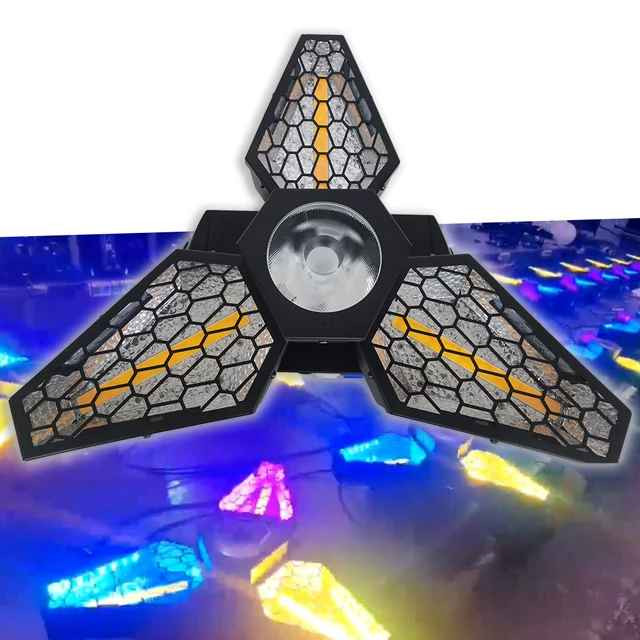
This guide breaks down the engineering behind multi-beam retro effects, evaluates the Mantis Leaf's optical and mechanical design, compares it against competing fixtures in the same tier, and helps you determine whether its specifications align with your real-world deployment needs. If you're evaluating a fixture for purchase or hire-fleet inclusion, the technical detail below should answer the questions your supplier's product page typically glosses over.
What a Retro Multi-Beam Effect Actually Does
Before diving into specifications, it's worth understanding what makes this category distinct from moving heads, washes, or static blinders. A retro multi-beam effect is essentially a centrepiece fixture designed to project numerous narrow, high-intensity beams outward in radial patterns, with continuous (or near-continuous) rotation creating the kinetic "beam-fan" look that defined late-1990s and early-2000s club lighting. Modern LED implementations like the Mantis Leaf reproduce that aesthetic with several practical advantages: substantially lower power draw, cooler operation, longer source life, and integrated DMX control.
The key technical differentiators within this category are:
- Beam count and arrangement — how many discrete beams are projected, and the geometry of their distribution
- Per-beam optical aperture — the beam angle, which dictates throw distance and aerial visibility
- Rotation system — stepper-driven indexed rotation vs continuous ("infinite") rotation, and the resolution of speed control
- Pixel control granularity — whether each beam can be individually addressed for chase patterns and pixel mapping
- Source colour engine — RGBW, RGB, or fixed-colour LED arrays, and the resulting colour gamut
The Mantis Leaf positions itself as a feature-rich entry into this segment, with the infinite rotation system being the headline mechanical specification.
Mantis Leaf Core Specifications at a Glance
Below is the consolidated technical snapshot for the Mantis Leaf retro effect blinder. Treat this as the reference table when comparing it to alternatives in your shortlist.
| Specification | Detail |
|---|---|
| Fixture Type | Multi-beam retro effect / centrepiece blinder |
| Source Technology | High-output LED array (RGBW colour mixing) |
| Rotation System | Infinite rotation, bi-directional, variable speed |
| Beam Geometry | Radial multi-beam projection (leaf-pattern) |
| Control Protocol | DMX-512, plus auto, sound-active, master/slave modes |
| Operating Modes | DMX, Auto, Sound-to-Light, Master/Slave |
| Power Input | AC 100–240V, 50/60Hz (universal) |
| Mounting | Omega-bracket truss clamp / floor stand compatible |
| Cooling | Forced-air convection (low-noise fan) |
| Typical Application | Mobile DJ, small-to-medium venues, event hire, retro nights |
Always confirm exact wattage, channel count, and beam quantity with the supplier before specifying for a permanent install — these vary by production batch in the budget retro-effect segment.
Infinite Rotation: Why It Matters Technically
The phrase "infinite rotation" gets thrown around loosely in lighting marketing, so let's be precise. In the Mantis Leaf, infinite rotation refers to a slip-ring-fed motorised yoke that allows the projection head to rotate continuously through 360 degrees in either direction without cable wind-up. This is mechanically distinct from indexed rotation (where the head can position to a specific angle but cannot continuously spin) and from limited-travel rotation (where stops at, say, 540 degrees prevent cable damage but interrupt long-form effects).
The practical consequences are significant for live programming:
- Sustained beam-fan effects — Designers can run continuous slow rotations through entire DJ sets without encountering the visual jolt of a reset cycle.
- Beat-matched acceleration ramps — Variable-speed control lets you ramp from creep-speed (atmospheric) to high-speed strobe-like rotation (peak energy) in time with the music, with no rotational ceiling forcing a reverse.
- Counter-rotating pair effects — Two units can be programmed to rotate in opposite directions indefinitely, producing the iconic "converging beam" sweep popularised in EDM main-stage design.
- Stepper resolution — Smooth ramps require sufficient DMX granularity. Look for 8-bit (256-step) speed control as a minimum; 16-bit fine control is preferable for cinematic ramps.
If your existing rig uses indexed-rotation effects, swapping in an infinite-rotation fixture genuinely opens up programming possibilities you cannot replicate otherwise. This isn't marketing fluff — it's a legitimate functional upgrade.
Optical Performance: Beams, Throw, and Coverage
The visual impact of any multi-beam fixture comes down to optics. Three parameters dominate the perceived performance:
Beam Angle
Narrow beams (typically 4–7 degrees per LED in this category) produce the sharp, distinct "laser-like" aerial pencils that define the retro look. Wider angles (15+ degrees) blur into a wash and lose visual definition once they leave the fixture. The Mantis Leaf's leaf-pattern projection relies on tight per-beam optics; in haze-rich environments this is where the fixture earns its keep.
Haze and Fog Dependency
Be honest with yourself about this: a multi-beam retro effect without atmospheric haze is a fixture operating at perhaps 30 percent of its potential. Aerial beams require particulates to scatter light along their path. If your venue prohibits haze (common in Australian leagues clubs and some council halls), prioritise fixtures with surface-pattern projection or onboard reflectors instead. The Mantis Leaf is unambiguously an aerial-effect fixture and benefits enormously from a low-output haze machine running concurrently.
Throw Distance
Realistic effective throw for this fixture class — meaning the distance at which beams remain visually distinct rather than diffusing into ambient glow — sits in the 8–15 metre range with adequate haze. For larger venues, deploy multiple units rather than expecting a single fixture to fill the room.
Colour Engine and Mixing
Most current retro effect blinders in this price tier use RGBW LED engines, which provide:
- Full additive colour mixing through DMX-controlled red, green, and blue channels
- True white output from a dedicated white LED, avoiding the mauve-tinged "white" produced by RGB-only fixtures
- Pastel reproduction when the white channel mixes with primary colours, expanding the palette into broadcast-friendly tints
- Higher CRI in white-mode operation, which matters if the fixture occasionally serves as accent illumination on faces or decor
Verify with your supplier whether the Mantis Leaf provides per-beam colour control (true pixel mapping) or fixture-wide colour selection. The former enables far more sophisticated chase and rainbow effects; the latter is simpler to programme but limits creative flexibility. For the typical mobile DJ use case, fixture-wide control is perfectly adequate. For chord-by-chord programming on a band gig, per-pixel addressability is worth paying extra for.
Control Architecture and Programming Modes
The Mantis Leaf supports the four standard operating modes you'd expect in this category, each suited to different deployment scenarios.
DMX-512 Mode
The professional choice. Run the fixture from a dedicated controller (Chamsys MagicQ, Avolites Titan One, ENTTEC USB DMX, or any number of console options) for fully programmed cues, scene recall, and integration with your wider lighting plot. Channel count typically lands in the 8–16 channel range for this fixture class — modest enough that you can comfortably run several units from a 192-channel or larger console without burning through your universe.
Auto / Internal Programs
Pre-baked chase patterns triggered without external control. Useful for unattended installations (foyer effects, retail activations) where running a console is impractical. Quality varies wildly across the category — some auto programs are genuinely well-designed, others are repetitive and fatiguing within 20 minutes of viewing.
Sound-to-Light Mode
An onboard microphone triggers effects in time with audio amplitude. Decent for mobile DJ work where you don't want to programme cues but still want music-reactive lighting. Position the fixture away from monitor speakers to prevent low-frequency rumble dominating the trigger envelope.
Master/Slave
Daisy-chain multiple fixtures via DMX, with one designated master fixture's onboard pattern driving the slaves. Cost-effective for small mobile rigs running 2–4 matching fixtures without a dedicated console.
Mantis Leaf vs Competing Retro Effect Fixtures
The retro-effect blinder category has become crowded over the past 18 months. Here's how the Mantis Leaf typically positions against the alternatives Australian buyers commonly shortlist.
| Feature | Mantis Leaf | Generic Multi-Beam (sub-$300) | Premium Branded (e.g., ADJ/Chauvet) |
|---|---|---|---|
| Rotation | Infinite, bi-directional, variable | Often limited or stepper-indexed | Infinite, with 16-bit fine control |
| Colour Engine | RGBW LED | RGB or fixed-colour | RGBW with calibrated colour mixing |
| DMX Channels | Multiple modes available | Fewer modes, basic control | Extended modes incl. 16-bit fine |
| Build Quality | Solid mid-tier construction | Often plastic-bodied | Metal chassis, road-rated |
| Price Tier (AUD) | Mid-range value | Entry-level | Premium |
| Best For | Mobile DJs, hire fleets, small venues | Bedroom DJs, hobbyists | Touring, permanent installs |
The Mantis Leaf's value proposition is most compelling against the generic sub-$300 tier — you get genuinely usable infinite rotation, a credible RGBW engine, and DMX flexibility without paying premium-brand pricing. Against true premium fixtures, the gap is in long-term reliability, calibrated colour consistency unit-to-unit, and the longer warranty support that comes with established brands.
Real-World Performance: Where the Mantis Leaf Shines
Based on how this category typically deploys in Australian conditions, here's the honest performance breakdown.
Mobile DJ Rigs (200–400 person events)
This is the sweet spot. Two Mantis Leaf units flanking a central DJ booth, paired with a low-output haze machine and a basic moving-head pair, produce a visual show that punches well above its budget. Sound-active mode handles the bulk of programming work, and the infinite rotation provides the kinetic energy that distinguishes a competent rig from a static one.
Small-to-Medium Live Music Venues
Effective as a centrepiece between lighting cues, particularly during DJ-driven interludes between bands. Less suited as a primary stage wash for live performance — that's a job for proper PARs and washes — but excellent as a supplementary effect element.
Hire and Production Fleets
The price-to-impact ratio makes the Mantis Leaf a sensible inclusion in entry-tier hire packages. Its limitations (haze dependency, plastic-component longevity, lack of premium-tier reliability data) are acceptable when fixtures are deployed for single events rather than 6-week tours.
Where It's Less Suitable
- Outdoor events without IP-rated weather protection — confirm IP rating before deploying outside
- Touring rigs that demand consistent unit-to-unit colour calibration across stocked spares
- Permanent installs in venues where service access is difficult — premium brands offer better long-term parts support
- Haze-prohibited venues where aerial beam effects can't develop visually
Specifications That Actually Matter (and Ones That Don't)
Marketing copy in this segment tends to emphasise headline numbers that don't always translate to better real-world performance. Here's how to read between the lines.
What Matters
- Rotation control resolution — 16-bit beats 8-bit for cinematic ramps
- Per-beam pixel addressability — dramatically expands creative options
- Colour engine type — RGBW reproduces white properly; RGB-only does not
- Build materials — metal chassis components last longer in transit
- Fan noise — matters in spoken-word venues, irrelevant in nightclubs
- Power consumption per fixture — affects how many you can run on a single 10A circuit
What Matters Less
- Maximum LED count quoted in marketing — beam quality matters more than raw count
- Auto-program quantity — 60 mediocre programs are no better than 8 good ones
- Lumen ratings — rarely measured consistently across brands in this tier; comparison is unreliable
Want to see the Mantis Leaf's full specification sheet for your venue planning? View the Mantis Leaf Retro Light Effect Blinder at Music On Stage for current pricing, stock availability, and detailed product information.
Power, Mounting, and Practical Deployment
A few practical notes that catch out first-time buyers in this category:
Power Distribution
Australian standard 10A circuits comfortably handle multiple Mantis Leaf units alongside other LED fixtures, but if you're combining with conventional tungsten gear or high-wattage moving heads, run a load calculation before plugging in. LED retro effects are typically modest power consumers — a single fixture rarely exceeds 200W — but cumulative loads add up quickly on a small rig.
Truss Mounting
Use omega brackets and rated safety cables. Don't trust the supplied bracket alone for overhead mounting — secondary safety attachment is non-negotiable for any fixture above audience heads, and Australian event safety standards require it. Floor stands are the simpler alternative for mobile DJ work.
Cable Management for Infinite Rotation
The infinite rotation system handles power and data internally via slip-rings, so you don't need to worry about cable wind-up at the fixture itself. However, your DMX and power feeds entering the fixture should still be strain-relieved — vibration during long sets gradually loosens unsecured connectors.
Heat Management
LED fixtures of this class run cool compared to tungsten predecessors, but the LEDs themselves require active cooling for reliable lifespan. Don't enclose the fixture in tight spaces, don't block the fan intake, and don't operate it inside flight cases with the lid closed. Allow at least 100mm of clearance around all ventilation paths.
Frequently Asked Technical Questions
Can I run the Mantis Leaf without a DMX controller?
Yes — the auto, sound-active, and master/slave modes all operate without external DMX control. For a single-fixture deployment or simple mobile setup, sound-active mode is often the path of least resistance.
How many fixtures can I daisy-chain on one DMX line?
The DMX-512 standard supports up to 32 devices per line before requiring a buffer/splitter, and a single 512-channel universe accommodates the Mantis Leaf's channel count comfortably for typical deployments. For larger rigs, use a DMX splitter and consider distributing units across multiple universes.
Does it work without haze or fog?
Technically yes, but the visual impact drops substantially. Aerial beam effects rely on atmospheric particulates to remain visible. Without haze, you'll see the LED sources and the rotation, but the projected beams effectively disappear. Pair this fixture with a hazer for the intended effect.
Is it suitable for permanent installations?
It's pitched primarily at mobile and event applications. For permanent installs in commercial venues, weigh the cost savings against the longer warranty support and parts availability of established premium brands. For nightclub installations rotating through fixtures every 2–3 years, it's a reasonable choice.
How does the infinite rotation hold up over time?
Slip-ring contacts are wear components — they will eventually require service in any continuously rotating fixture, regardless of brand. In this price tier, expect 2–4 years of regular hire-fleet use before service intervention becomes necessary. Premium fixtures may extend that window further with higher-spec contact materials.
Can I pixel-map the beams for chase effects?
Confirm the specific DMX mode and channel layout with your supplier — pixel-level addressability varies within the category and even within product revisions. If pixel mapping is critical to your design, request the DMX channel chart before purchase to verify per-beam control is available.
Buyer's Decision Framework
Use this checklist to determine if the Mantis Leaf is the right fixture for your scenario:
- You're building a mobile DJ rig and need high-impact aerial effects without premium pricing — strong fit
- You operate a small-to-medium hire fleet and need reliable, replaceable inventory — strong fit
- You're upgrading from a sub-$300 generic moonflower to something genuinely capable — strong fit
- You need fixtures for a national touring rig with consistent calibration — consider premium alternatives
- You're equipping a haze-restricted venue — choose a surface-effect or wash fixture instead
- You require IP-rated outdoor capability — confirm IP rating with supplier; this category is typically indoor-only
For most Australian mobile entertainment, hire-fleet, and small-venue applications, the Mantis Leaf delivers the genuine retro-aesthetic punch that defined the category's recent comeback, with infinite rotation as a meaningful technical differentiator over cheaper alternatives.
Final Technical Verdict
The Mantis Leaf Retro Light Effect Blinder with Infinite Rotation occupies a genuinely useful position in the current Australian lighting market: more capable and better-built than the bargain-bin generics flooding online marketplaces, while priced sensibly below premium-brand equivalents that may offer marginal performance gains for substantial cost premiums. The infinite rotation isn't a marketing gimmick — it's a real functional upgrade that opens programming options you cannot replicate with limited-travel fixtures.
For DJs, event production crews, hire-fleet operators, and small-venue lighting specifiers, this fixture earns its place on the shortlist. As with any LED-based effect lighting, deploy it with adequate haze, mount it with proper safety attachments, and pair it with complementary fixtures rather than expecting it to carry an entire show on its own.
Ready to evaluate the Mantis Leaf for your rig? Browse complete specifications, current Australian pricing, and stock availability at Music On Stage's Mantis Leaf product page, or contact the Music On Stage team for technical questions and bulk-order pricing for hire-fleet purchases.