
Mackie ProFX12v3 12-Channel Mixer: Technical Deep Dive 2026
Mackie ProFX12v3 12-Channel Mixer: Technical Deep Dive for Australian Audio Professionals 2026
The Mackie ProFX12v3 sits in an interesting niche — a compact analogue mixer with serious digital integration ambitions. For Australian gigging musicians, small venue operators, podcasters and houses of worship, it promises something rare at this price point: studio-grade preamps, a comprehensive onboard effects engine, and a true 4x3 USB audio interface, all in a chassis you can carry to a Sunday morning service or a Thursday night pub gig without throwing your back out.
But specifications on a marketing page tell only part of the story. This technical deep dive examines what's actually happening under the hood of the ProFX12v3, how its components measure up against industry benchmarks, and where it makes sense (and doesn't) for the Australian sound professional in 2026.
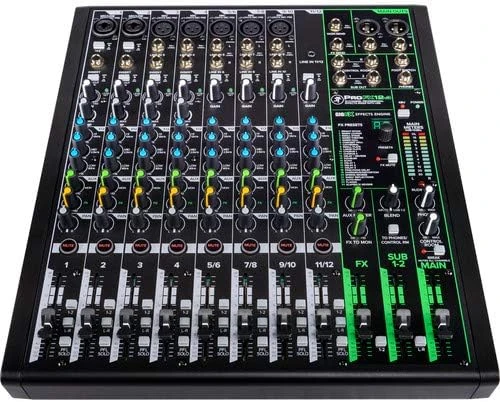
Technical Overview and Core Specifications
The ProFX12v3 is the third-generation revision of Mackie's well-regarded ProFX series, and the engineering changes between v2 and v3 are more substantive than the model number suggests. Where v2 mixers used Mackie's standard preamp design, v3 introduces redesigned Onyx microphone preamps with 60 dB of gain range — a meaningful step up that brings ribbon microphones and dynamic mics like the Shure SM7B into usable territory without an inline booster.
| Specification | Value | What This Means |
|---|---|---|
| Total channels | 12 (6 mono + 2 stereo + dedicated stereo USB return) | Suitable for 4-piece bands with vocals, keys, and playback |
| Mic preamps | 6x Onyx, 60 dB gain | High headroom, low noise — handles SM7B and ribbons |
| Equivalent input noise (EIN) | −129 dBu | Excellent — competitive with mixers 2x the price |
| USB interface | 4-in / 3-out, 24-bit / 192 kHz | True multi-track capable, podcast-ready |
| Effects engine | GigFX, 24 effects, switchable via footswitch | Reverb, delay, modulation — replaces external rack units |
| EQ topology | 3-band per channel, 80 Hz HPF | Standard mid-frequency fixed at 2.5 kHz |
| Aux sends | 2 (1 pre, 1 post-fader, FX) | One monitor mix + FX bus |
| Frequency response | 20 Hz – 30 kHz, +0/−1 dB | Flat through audible spectrum and beyond |
| THD+N | <0.005% (mic in to main out, +4 dBu) | Inaudible distortion at sensible levels |
| Phantom power | +48V global switch | Powers condensers, active DIs, ribbons with active electronics |
| Bluetooth | Yes (stereo channel) | Stream backing tracks or playlists from phone/tablet |
| Dimensions / weight | ~395 x 117 x 391 mm / ~4.6 kg | Genuinely portable; fits in most rolling cases |
Onyx Preamps: What the Specs Actually Mean
Mackie's Onyx preamp design first appeared in their higher-end mixers and has since trickled down through the product line. The implementation in the ProFX12v3 isn't identical to a flagship Onyx — Mackie tunes preamp characteristics across product tiers — but the fundamentals carry over: high common-mode rejection, generous headroom, and a transparent voicing rather than the warm-but-noisy character of older budget consoles.
The headline figure is 60 dB of gain. This matters more than newcomers might realise. Many entry-level mixers cap out at 50–55 dB, which is fine for condensers and bright dynamics, but inadequate for low-output dynamic microphones like the Shure SM7B (a podcaster favourite) or any passive ribbon mic. The SM7B's specifications recommend at least 60 dB of clean gain, and at maximum, you want some headroom above that. The ProFX12v3 sits exactly at the threshold — usable, though you'll be running the gain knob near maximum.
Equivalent input noise (EIN) of −129 dBu with a 150-ohm source is genuinely impressive. For context, that's roughly 4–5 dB quieter than a typical mid-tier analogue mixer and within 1–2 dB of dedicated preamp outboard costing several hundred dollars per channel. In practice, this means recording quiet acoustic sources — fingerstyle guitar, soft vocals, room ambience — without a hissy noise floor obscuring detail.
The 4x3 USB Audio Interface: Beyond Stereo Recording
This is where the ProFX12v3 separates itself from cheaper competitors. Many sub-$1000 mixers offer USB connectivity, but most provide only a stereo (2x2) interface — useful for podcasting, useless for multi-track recording where you want to capture individual channels for post-production mixing.
The ProFX12v3's 4-in, 3-out configuration enables genuine multi-track workflows. You can route channels 1–2 directly to the DAW (typically your two best vocal/instrument mics), capture the main mix as a stereo pair, and use the third return for monitor playback. For a small band recording demos or capturing a live performance for later remixing, this is functional — not as flexible as a dedicated 8-channel interface, but more than capable for the singer-songwriter with a guitar mic and vocal channel, or the podcaster with two hosts and one guest.
Sample rate support extends to 24-bit / 192 kHz, though for most music production 24-bit / 48 kHz is the practical sweet spot — adequate dynamic range, manageable file sizes, and broad compatibility with delivery formats. The interface uses a class-compliant USB driver on macOS and a standard ASIO driver on Windows, with low-latency performance suitable for monitoring through DAW plugins on modern hardware.
View the Mackie ProFX12v3 at MusiconStage →GigFX Engine: Onboard Effects Worth Using
Onboard effects on budget mixers have historically been an afterthought — a single reverb that sounds like a metallic spring and a delay that introduces noticeable artefacts. The GigFX engine in the ProFX12v3 represents a different approach. With 24 effects across reverb, delay, chorus, and combination algorithms, the engine is genuinely usable for live performance.
Effect Categories Available
- Reverbs: Plate, hall, room, chamber, vocal-tuned variants — useful for vocal polish and instrumental space
- Delays: Slap, mono delay, ping-pong stereo, tape emulation — covers most rhythmic delay needs
- Modulation: Chorus, flanger, phaser — for keyboards and clean guitars
- Combinations: Reverb+delay, chorus+reverb — common live vocal treatments in single patches
The crucial design decision is footswitch control. A 1/4-inch footswitch input allows the lead vocalist (or a dedicated tech) to mute/unmute the effects bus during a performance — essential for cutting reverb tails between songs or removing delay during spoken announcements. This is a workflow detail that elevates the mixer from "has effects" to "has effects you'll actually leave engaged."
Performance Analysis: Real-World Deployment Scenarios
Small Venue Live Sound (50–150 capacity)
This is the ProFX12v3's home territory. Six mic preamps cover lead vocal, two backing vocals, kick drum, snare, and an overhead — adequate for an acoustic-electric four-piece. Stereo channels handle keys and a stereo iPad/laptop input for backing tracks. The single monitor send is a meaningful limitation if you need separate mixes for multiple band members, but workable for a single shared wedge or in-ear setup with personal mixers downstream.
Podcasting and Broadcast
The 4x3 USB interface, Bluetooth input for remote guests via phone, and 60 dB Onyx preamps make the ProFX12v3 a strong podcasting choice. Mute groups aren't available (a workflow advantage of dedicated podcast mixers like the Mackie DLZ Creator), but the ProFX12v3 offers more flexibility for hybrid podcast/music workflows where you might also need to mix a band rehearsal or record a live demo.
House of Worship
For small to medium congregations, the ProFX12v3 covers pastor mic, two vocalists, acoustic guitar, keys, and a stereo input for tracks or playback. Phantom power for condenser ambient mics, the 80 Hz high-pass filter for cleaning up handheld vocal mics, and footswitch-controlled effects for vocal reverb during worship songs are all directly relevant features. The Bluetooth input simplifies pre-service music playback from a tablet.
Honest Limitations: What the ProFX12v3 Doesn't Do
Comprehensive coverage requires honesty about constraints. No mixer is universal, and the ProFX12v3 has clear edges:
- No parametric mid EQ: The 3-band EQ is fixed-frequency. Sweepable mid would help dial out problem frequencies on difficult vocals or guitars.
- Single monitor send: Multi-musician setups needing independent monitor mixes will outgrow this quickly. Look at the ProFX16v3 or step up to a digital mixer if you need more.
- No subgroups: All channels go directly to main mix or aux. No drum subgroup mute, no choir level fader during a hot mix.
- Effects bus is one-track-only via USB: You cannot bypass the effects when recording multi-track if you've engaged them — plan your routing before tracking.
- Analogue console means no scene recall: Every gig requires re-setting your channel positions. Fine for resident venues, frustrating for touring engineers handling varied acts.
Comparison Against Direct Competitors
The ProFX12v3 competes against the Yamaha MG12XU, Soundcraft Notepad-12FX, and Allen & Heath ZED-12FX. Each takes a different approach.
| Feature | Mackie ProFX12v3 | Yamaha MG12XU | A&H ZED-12FX |
|---|---|---|---|
| Mic preamps | 6 Onyx (60 dB) | 4 D-PRE (60 dB) | 4 GSPre (60 dB) |
| USB interface | 4x3, 24-bit/192k | 2x2, 24-bit/192k | 2x2, 24-bit/96k |
| Onboard FX | 24 (GigFX) | SPX engine | 16 (FX Returns) |
| Bluetooth | Yes | No | No |
| Footswitch FX mute | Yes | Yes | No |
The ProFX12v3 wins decisively on mic preamp count and USB interface depth. Yamaha's D-PRE topology is arguably warmer-voiced and well-loved by engineers who want subtle character. Allen & Heath's GSPre design is the cleanest of the three but the ZED-12FX's stereo-only USB interface restricts modern hybrid workflows.
Specification Interpretation Guide for Buyers
When evaluating any compact mixer, focus on these technical fundamentals over marketing buzzwords:
- EIN (Equivalent Input Noise): Lower (more negative) is better. Below −127 dBu is professional grade. The ProFX12v3 at −129 dBu is excellent.
- Mic gain range: 60 dB is the modern minimum if you might use dynamic mics like SM7B or ribbons.
- USB I/O count: 2x2 is podcast-only territory. 4x3 or higher enables multi-track recording.
- Sample rate vs bit depth: 24-bit dynamic range matters more than 192 kHz sample rate for most users.
- Aux send count: One aux = one monitor mix + FX. Two aux = two independent monitor feeds. Plan around your stage requirements.
- Phantom power switching: Global is fine for most situations. Per-channel switching is preferable but rare at this price.
Australian Buying Considerations
For Australian buyers, a few practical points worth flagging beyond the technical specifications:
- Authorised dealer warranty: Mackie products purchased from authorised Australian dealers carry full local warranty support. Grey-import units sourced internationally may have limited or no warranty coverage in Australia, and import costs after exchange rates and GST often eliminate any apparent saving.
- Power supply: The ProFX12v3 ships with a universal-voltage power supply suitable for 240V Australian mains. Ensure your unit includes the AU plug version.
- Spare parts and servicing: Mackie maintains an Australian distributor network with parts availability. Faders and pots are user-serviceable for experienced techs.
- Cable budget: Plan to add quality XLR cables, 1/4-inch TRS for monitor sends, and a USB-B cable (some computers may need USB-A to USB-B). Budget at least $100–150 for proper cabling alongside the mixer.
Frequently Asked Technical Questions
Can I record all 12 channels individually via USB?
No. The ProFX12v3's USB interface is 4-in, meaning you can route four discrete channels to your DAW. Most users configure this as channels 1+2 direct, plus the main mix as a stereo pair. For full 12-channel multi-track recording, look at digital mixers like the Allen & Heath SQ-5 or the Mackie DLZ series.
Is the Bluetooth input low-latency enough for live performance?
Bluetooth audio inherently introduces 150–250 ms of latency depending on codec. This is fine for backing track playback between songs but unsuitable for live monitoring or any application where you need sub-50 ms response.
Does the GigFX engine work simultaneously with USB recording?
Yes, but understand the routing. The effects are applied via the FX send/return path. Channels going direct to USB (channels 1–2 typically) are pre-effects, so you record dry signals and add effects in your DAW. The main mix USB return captures the wet, fully-mixed output.
How does the ProFX12v3 compare to the ProFX16v3?
The ProFX16v3 adds four more channels (16 total), an additional aux send, and slightly larger physical footprint. If you regularly mix more than four mics or need two independent monitor mixes, the v16 is worth the price difference. For solo performers, duos, and small bands, the v12 is sufficient.
Is this mixer suitable for streaming and content creation?
Yes — strongly suited. The 4x3 USB interface, Bluetooth input, dedicated headphone out, and Onyx preamps make it competitive with dedicated streaming consoles. The lack of mute groups and pad/effect triggers is the main limitation versus content-creation-specific products like the Mackie DLZ Creator or Rodecaster Pro II.
Expert Recommendation: Who Should Buy the ProFX12v3
The Mackie ProFX12v3 is the right mixer for the Australian buyer who needs more than entry-level capability but doesn't need digital console flexibility. Specifically:
- Solo performers and duos running their own front-of-house
- Small bands (3–5 members) handling pub, club, and small venue gigs
- Podcasters and content creators needing both broadcast and music capabilities
- Houses of worship with modest worship team configurations
- Singer-songwriters wanting one rig for live performance and demo recording
- Educational settings teaching live sound fundamentals
It is not the right mixer if you need scene recall, more than one monitor mix, full multi-track recording, or routing flexibility for complex stage setups. Those requirements push you toward digital mixers in the $1,500–$3,000 bracket — typically the Allen & Heath SQ-5, Yamaha TF1, or Behringer Wing Compact.
Within its target use cases, the ProFX12v3 punches above its weight. The Onyx preamps, GigFX engine, 4x3 USB interface, and Bluetooth integration combine into a feature set that simply didn't exist at this price point five years ago. For the Australian working musician or small venue operator who values reliability, sonic quality, and broad compatibility, it remains one of the most technically credible compact analogue mixers available in 2026.
Buy the Mackie ProFX12v3 from MusiconStage Australia →