
Mackie 1642VLZ4 Analogue Mixer: Technical Deep Dive & Specs 2026
Mackie 1642VLZ4 Analogue Mixer: Technical Deep Dive & Specs 2026
The Mackie 1642VLZ4 occupies a particular niche that refuses to disappear: the do-everything compact analogue console that lives in a venue rack, a recording corner, a houses-of-worship cabinet, and the boot of a working musician's car. In an era dominated by digital desks and app-controlled rack mixers, the 1642VLZ4 is still specified by engineers who want signal to behave predictably the moment they patch in. This guide pulls the desk apart at the specification level so you can decide whether its analogue architecture genuinely suits your workflow, or whether your money belongs elsewhere.
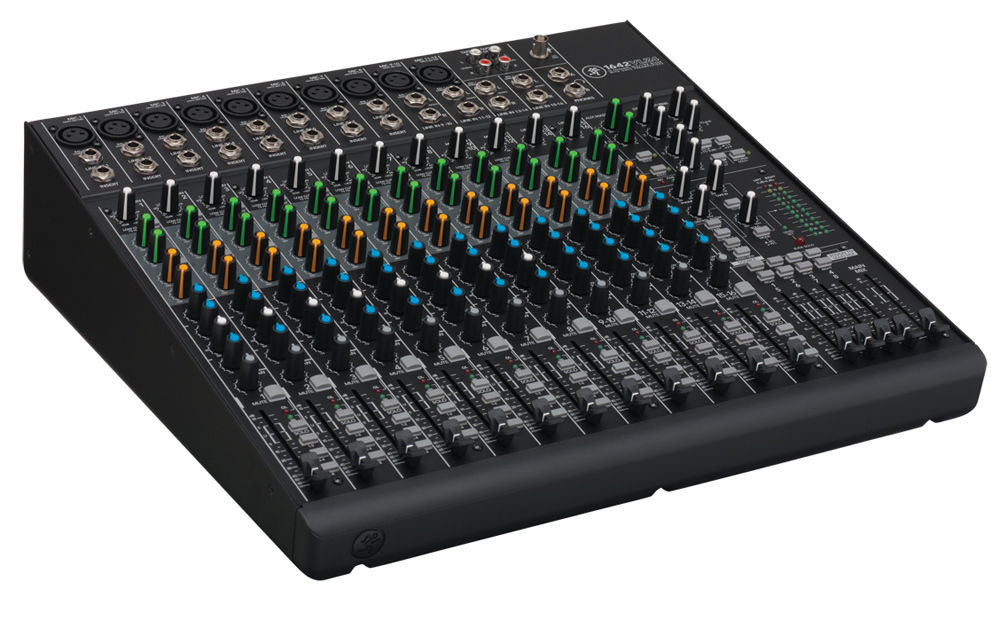
We will not pretend the 1642VLZ4 is the right tool for every job — analogue desks carry real trade-offs in recall, processing and connectivity. But within its design brief, the engineering decisions Mackie made here are deliberate and measurable, and they explain why this chassis has stayed on dealer shelves for years.
Technical Overview: What the 1642VLZ4 Actually Is
The 1642VLZ4 is a 16-channel, 4-bus compact analogue mixer built on Mackie's fourth-generation VLZ (Very Low Impedance) platform. The headline number can be misleading, so it is worth decoding the channel architecture precisely, because it dictates how many discrete sources you can realistically run.
| Specification | Mackie 1642VLZ4 |
|---|---|
| Channel format | 16-channel / 4-bus compact analogue |
| Mono mic/line channels | 10 (channels 1–10) with Onyx preamps |
| Stereo line channels | 3 stereo pairs (channels 11/12, 13/14, 15/16) |
| Mic preamps | 10 × Onyx, up to ~60 dB gain |
| Subgroups / buses | 4 (Sub 1–2, Sub 3–4) plus main L/R |
| Aux sends | 6 aux sends |
| EQ (mono channels) | 3-band with sweepable midrange |
| Low-cut filter | 100 Hz, 18 dB/octave (mono channels) |
| Faders | 60 mm channel faders |
| Phantom power | +48 V |
| Frequency response | ~20 Hz – 30 kHz, +0/−1 dB (typical) |
| Onyx preamp dynamic range | ~123 dB (typical, manufacturer figure) |
| THD | ~0.0007% (typical, manufacturer figure) |
| Chassis | All-metal “Built-Like-A-Tank” construction |
The practical read on this layout: you get ten high-quality mono channels for vocals and instruments, plus three stereo channels that are ideal for keyboards, playback devices, sub-mixers or stereo wireless systems. If your input list is dominated by mono sources — a band with vocals, guitars, bass DI and drum mics — ten Onyx preamps is the number that actually matters, not the “16” on the badge. Always count mono sources first when sizing any compact desk.
The Onyx Mic Preamps: Where the Money Goes
The single most important technical feature of the 1642VLZ4 is the Onyx preamp design. Mackie has used the Onyx name across several product tiers, but the engineering intent is consistent: wide dynamic range, low total harmonic distortion, and enough clean gain to drive low-output dynamic and ribbon microphones without audible hiss.
Three figures are worth understanding in context:
- ~123 dB dynamic range: dynamic range describes the gap between the noise floor and the maximum undistorted level. A figure in the low-120s dB range is genuinely strong for a compact analogue desk and means quiet sources — a softly spoken word, a brushed snare, a fingerpicked acoustic — sit well above self-noise even at higher gain settings.
- ~0.0007% THD: total harmonic distortion at this level is effectively inaudible. In plain terms, the preamp adds almost nothing of its own character; it amplifies what you give it rather than colouring it. Engineers who want a transparent “straight wire with gain” front end will appreciate this; those chasing vintage saturation will need outboard or plugins.
- ~60 dB of gain: this headroom matters most for ribbon and low-sensitivity dynamic mics (think a Shure SM7B-class capsule), which can otherwise leave a desk straining. The 1642VLZ4 has the gain range to drive them without resorting to inline boosters in most live contexts.
The takeaway for buyers: preamp quality is the specification that separates compact mixers that sound “fine” from ones that sound clean under pressure. The Onyx front end is the 1642VLZ4's strongest argument, and it is the area where cheaper 16-channel desks most visibly cut cost.
If your priority is a transparent, low-noise capture path for live vocals and acoustic instruments, the Onyx specification is the reason to view full pricing and availability for the Mackie 1642VLZ4 rather than defaulting to a budget alternative.
Channel Strip and EQ Architecture
Each of the ten mono channels carries a 3-band equaliser with a sweepable midrange. This is a meaningful distinction. Fixed-frequency mid controls (common on entry-level desks) force you to cut or boost at a predetermined point. A swept mid lets you tune the centre frequency — typically across a broad range from the low hundreds of hertz up into the low kilohertz — so you can find and treat the specific problem area in a vocal honk or a boxy guitar before reaching for the fader.
The fixed low and high shelving bands sit at conventional points (low shelf around 100 Hz, high shelf around 12 kHz on this generation), giving you broad tonal shaping without the surgical precision — or the time cost — of a parametric. For live work that balance is sensible: a swept mid solves most real-world tonal problems quickly, and the shelving bands handle overall warmth and air.
Each mono channel also includes an 18 dB/octave low-cut filter at 100 Hz. The slope figure matters as much as the corner frequency: an 18 dB/octave filter rolls off subsonic energy and stage rumble aggressively enough to clean up vocal channels and direct boxes without thinning the source. Engaging this filter on every channel that does not need low end is one of the fastest ways to reduce mix mud and protect headroom on the buses — a discipline this desk makes a one-button habit.
4-Bus Routing and Aux Sends: The Real Workflow Advantage
The “4” in 1642VLZ4 denotes four subgroup buses, arranged as two stereo-linkable pairs (Subs 1–2 and 3–4) feeding the main L/R mix. This is the feature that elevates the desk above simpler stereo-out compact mixers and the reason many engineers specify it for multi-source events.
Practical applications of the 4-bus design include:
- Drum subgrouping: route all drum mics to a stereo subgroup so you can ride the entire kit with one pair of faders, apply group-level dynamics via the inserts, and keep the kit balanced relative to the band.
- Vocal grouping: assign backing vocals to a subgroup for fast level rides during a chorus without touching individual channels.
- Recording feeds: use subgroup outputs as stem feeds to a recorder or interface, capturing grouped sources separately from the main mix.
On the auxiliary side, six aux sends give you generous routing for monitor mixes and effects. In a typical foldback scenario you might dedicate several auxes to stage monitor wedges (pre-fader) and reserve the remainder for outboard reverb and delay (post-fader). The pre/post discipline is the same on every analogue desk, but the count of six on a compact chassis is what makes the 1642VLZ4 viable for bands that need multiple distinct monitor mixes from a small footprint.
Build Quality and Circuit Design
Mackie's “Built-Like-A-Tank” positioning is not just marketing. The 1642VLZ4 uses an all-metal chassis, sealed rotary potentiometers and a circuit design that includes RF interference rejection on inputs — a genuine consideration in venues crowded with wireless systems, LED lighting and mobile devices. Sealed pots resist the dust and beer-spray ingress that kills cheaper faders and knobs over a few hundred gigs; this directly affects the desk's service life in mobile use.
The VLZ circuit topology itself is built around very low impedance design, which reduces thermal noise and improves crosstalk and RF immunity compared with higher-impedance budget circuits. Combined with the negative-gain mix-amp architecture Mackie has long used, the result is a desk that maintains its noise and headroom figures as you add channels — the point at which many inexpensive mixers audibly fall apart.
Real-World Performance Expectations
Specifications only matter if they translate to behaviour under load. Based on the platform's measured characteristics and the way engineers deploy this class of desk, here is what to realistically expect:
- Noise performance: with the low-cut filters engaged and gain structure set correctly, the 1642VLZ4 stays quiet across a full input count. The limiting factor in most real mixes will be the room and the source, not the desk.
- Headroom under transients: the high-headroom design tolerates aggressive drum and brass transients before the mix bus complains, which is exactly where budget desks smear.
- Tonal character: expect honesty rather than flattery. The signal path is transparent; if you want colour, you add it deliberately with mic choice, source and outboard, not by relying on the desk.
- Limitations to plan around: there is no onboard digital effects engine, no scene recall, no USB multitrack interface and no app control. Every change is physical and in real time. For some engineers that immediacy is the point; for others it is a workflow non-starter.
Technical Comparison With Alternatives
The honest way to evaluate the 1642VLZ4 is against the two roads its buyers usually consider: a feature-rich analogue desk with onboard FX, or a compact digital mixer with recall and connectivity.
| Factor | Mackie 1642VLZ4 | Analogue + FX (e.g. ProFX/Signature class) | Compact digital (e.g. Qu/CQ class) |
|---|---|---|---|
| Preamp focus | Onyx, transparent, low THD | Good, often with built-in FX path | Digital preamps, recallable |
| Subgroup routing | 4-bus, dedicated | Often 2-bus or limited | Flexible, software-defined |
| Effects | None onboard (use outboard) | Onboard FX engine | Extensive onboard processing |
| Recall & scenes | None (fully analogue) | None | Full scene/show recall |
| Latency | Zero (analogue) | Zero (analogue) | Low but non-zero (conversion/DSP) |
| Learning curve | Low, immediate | Low | Higher (menus/app) |
| Best for | Reliable transparent live/recording front end | Bands wanting built-in reverb/delay | Engineers needing recall & multitrack |
The decision logic is straightforward. If you value zero-latency, no-menu reliability and a transparent preamp path, and you already own or do not need effects, the 1642VLZ4 is a defensible long-term tool. If onboard effects are essential to your show, a comparable analogue desk with an FX engine saves you carrying outboard. If you need scene recall, multitrack USB and remote mixing, a compact digital console is the correct category — and the 1642VLZ4 will frustrate you.
Specification Interpretation Guide: What Actually Matters
When you compare 16-channel compact mixers on paper, weight the specifications in this order:
- Mono preamp count and quality: count usable mono mic channels, then look at dynamic range and THD figures. This is the spec that defines real-world sound quality.
- Bus architecture: dedicated subgroups (4-bus here) are a workflow multiplier. A desk with more raw channels but no subgroups can be harder to mix than a smaller desk with proper routing.
- Aux send count and pre/post flexibility: this determines how many independent monitor and effects feeds you can build.
- EQ type: a swept mid beats a fixed mid for solving real tonal problems quickly.
- Filter slope: a steep (18 dB/oct) low-cut is far more useful than a gentle one for live cleanup.
- Build and connector quality: sealed pots, metal chassis and RF rejection predict service life in mobile use far better than feature count.
Technical red flags on competing budget desks include unspecified or vague dynamic-range figures, plastic chassis with PCB-mounted jacks, fixed-frequency mids only, and two-bus-only routing dressed up with a high channel count.
Who Should Buy the 1642VLZ4 — and Who Should Not
Strong fit: houses of worship and community venues wanting a reliable, teachable analogue desk; recording setups needing a clean front end for tracking grouped sources; function and covers bands with a mostly-mono input list who value zero-latency immediacy and rugged transport survival.
Poor fit: engineers who require show recall between events, anyone needing onboard reverb/delay without carrying outboard, and operators who want app-based mixing from the floor. These are not weaknesses of the desk — they are simply outside its design brief, and choosing it for those jobs sets you up for disappointment.
If your requirements line up with the strong-fit profile, it is worth checking current stock and Australian pricing — you can see the Mackie 1642VLZ4 specifications and buy online from MusiconStage with local support.
Technical FAQ
How many microphones can I actually run on the 1642VLZ4?
Up to ten, using the ten mono Onyx preamp channels. The three stereo channels are line-level and intended for keyboards, playback and stereo devices rather than microphones, so plan your input list around the ten mono channels.
Does the 1642VLZ4 have built-in effects?
No. It is a fully analogue desk with no onboard effects engine. You route effects via the aux sends to outboard processors and return them to spare channels or the stereo aux returns. If onboard FX is essential, this is the deciding factor against it.
Can I use it as a recording interface?
Not as a USB multitrack interface — it has no digital audio output. You feed its main or subgroup outputs into a separate audio interface or recorder. The 4-bus routing does make grouped stem capture practical when paired with the right interface.
Is the swept midrange worth it over a fixed mid?
Yes, technically. A swept mid lets you locate and treat the exact problem frequency in a source rather than boosting or cutting a fixed point that may not align with the issue. On live vocals and guitars this is the single most useful tonal control on the strip.
How does the noise performance hold up at full channel count?
The low-impedance VLZ topology and negative-gain mix architecture are specifically designed to preserve noise and headroom figures as channels are added. With sensible gain structure and the low-cut filters engaged on channels that do not need low end, the desk stays clean across a full input load.
Verdict: A Transparent Workhorse That Knows What It Is
The Mackie 1642VLZ4 is not trying to be a digital console, and it is the wrong purchase if you need recall, onboard effects or app control. Judged on its actual design brief — a rugged, transparent, low-noise 16-channel analogue desk with proper 4-bus routing and credible Onyx preamps — it remains one of the more defensible compact mixers an Australian engineer can specify. The Onyx front end and the dedicated subgroups are real engineering advantages, not spec-sheet padding, and the build quality is genuinely matched to mobile abuse.
Buy it because you want signal to behave predictably with zero latency and no menus for the next decade, not because you want the longest feature list at the price. If that philosophy matches how you work, check availability for the Mackie 1642VLZ4 at MusiconStage and weigh it honestly against the digital alternatives before deciding.