
Mackie 1402VLZ4 Technical Breakdown: Analogue Mixer Specs That Matter in 2026
Mackie 1402VLZ4 Technical Breakdown: Why This Analogue Mixer Still Holds Its Own in 2026
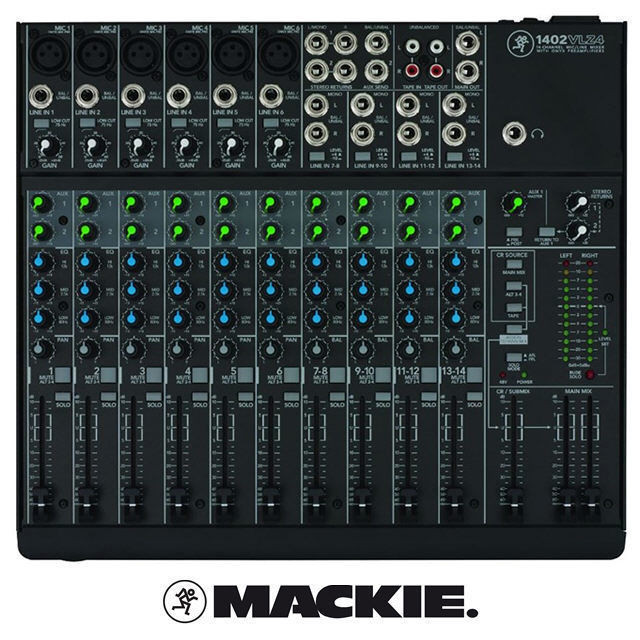
In a market saturated with digital mixers promising app control and wireless everything, the Mackie 1402VLZ4 represents something increasingly rare: a no-nonsense analogue mixer built to a genuine professional standard. If you've mixed live sound or tracked recordings in Australia over the past two decades, you've almost certainly had your hands on a VLZ-series board. The 1402VLZ4 is the fourth generation of that lineage, and it's worth understanding exactly what Mackie has packed into this compact chassis.
This isn't a surface-level overview. We're going deep into the specifications, the circuit topology, and the real-world performance characteristics that determine whether this mixer belongs in your rig. Whether you're running a small venue, setting up a podcast studio, or need a reliable submixer for a larger production, the technical details matter — and that's exactly what we're covering.
Complete Technical Specifications
| Specification | Detail |
|---|---|
| Mic Inputs | 6 (XLR, balanced) |
| Line Inputs | 14 total (6 mono mic/line + 4 stereo line pairs) |
| Preamp Type | Onyx mic preamps |
| Mic EIN | -129.0 dBu |
| Frequency Response | 10 Hz – 150 kHz (+0/−1 dB), 20 Hz – 60 kHz (+0/−0.5 dB) |
| THD | <0.0025% (20 Hz – 20 kHz, +4 dBu output) |
| Dynamic Range | 113 dB |
| Channel EQ | 3-band (High: 12 kHz shelving, Mid: 2.5 kHz peaking, Low: 80 Hz shelving) |
| Aux Sends | 2 (1 pre-fader, 1 post-fader) |
| Buses | Main L/R + ALT 3-4 |
| Phantom Power | +48V (global) |
| Headphone Output | 150 mW into 60Ω |
| Main Output Level | +22 dBu (max) |
| Power Supply | Internal, linear (universal voltage) |
| Construction | Steel chassis, sealed rotary controls |
| Dimensions (W×D×H) | 318 × 340 × 83 mm |
| Weight | 3.6 kg |
Those numbers tell a story if you know how to read them. Let's unpack the ones that actually matter.
Onyx Preamps: What the Specs Actually Mean
The headline feature of the VLZ4 series is the inclusion of Mackie's Onyx mic preamps — the same fundamental preamp design that was previously reserved for their higher-tier Onyx mixer range. This isn't marketing fluff. The Onyx preamps represent a genuine step up from the earlier XDR preamps found in VLZ3-generation boards.
The quoted Equivalent Input Noise (EIN) of -129.0 dBu is measured at 150Ω source impedance with maximum gain, which is the industry-standard measurement condition. To put this in perspective, this figure sits comfortably alongside preamps costing several times more per channel. For Australian musicians tracking vocals with condenser microphones or capturing acoustic instruments, this noise floor means you'll get clean, usable recordings without the hiss that plagues cheaper mixer preamps.
The frequency response specification is equally telling. A bandwidth extending to 150 kHz (at the -1 dB point) indicates extremely low phase shift within the audible range. You won't hear 150 kHz — nobody can — but a preamp that's flat to well beyond 20 kHz will exhibit tighter transient response and better stereo imaging within the frequencies you actually care about. It's the difference between a preamp that sounds "accurate" and one that sounds "open."
THD at less than 0.0025% across the full audible spectrum at +4 dBu output is essentially transparent. At normal operating levels, the preamp isn't adding any audible coloration. This is a double-edged consideration — if you want character and warmth from your preamp, you won't find it here. The Onyx design is deliberately clean, which makes it an excellent front end for further processing either in hardware or in your DAW.
The VLZ4 Build: Engineering That Matters on Australian Stages
Mackie coined the "VLZ" designation — Very Low Impedance — to describe their approach to circuit board design, and it's more than branding. The VLZ4 construction uses thicker copper traces on the PCB and additional ground planes to reduce noise induced by ground loops and electromagnetic interference. In practical terms, this means the 1402VLZ4 is less susceptible to the buzzes, hums, and interference that can plague cheaper mixers, particularly in Australian live venues where electrical earthing quality can be inconsistent.
The steel chassis is a legitimate differentiator. Many compact mixers in this price bracket use plastic enclosures or thin aluminium. Mackie's solid steel construction provides both electromagnetic shielding and genuine impact resistance. If you've ever had a mixer fall off a table during bump-in at a gig in regional Australia, you understand why chassis material matters.
The sealed rotary controls deserve mention because they address one of the most common failure modes in analogue mixers: dust and moisture ingress into potentiometers. Standard open-frame pots degrade over time, developing scratchy audio and unreliable operation. Mackie's sealed design significantly extends the operational lifespan of the controls. For Australian conditions — where dust can be a serious concern at outdoor festivals and regional venues — this is a genuinely practical engineering choice.
One detail that experienced engineers will appreciate: the 1402VLZ4 uses an internal linear power supply rather than an external wall-wart or switching supply. Linear supplies are inherently quieter than switching designs, producing less high-frequency noise that can couple into audio circuits. The trade-off is slightly more weight and heat, but in a mixer where audio quality is the priority, it's the right engineering decision.
Channel Architecture and Routing
The 1402VLZ4 provides six mono mic/line channels and four stereo line channels, giving you 14 inputs to the mix bus. Each mono channel features an XLR mic input with Onyx preamp, a 1/4" TRS line input, and a 1/4" TRS insert point. The insert is post-preamp, pre-EQ — the standard configuration that allows you to patch in compressors or external EQ on individual channels.
The stereo channels accept 1/4" TRS inputs and include the same 3-band EQ section as the mono channels. These are ideal for keyboards, backing tracks, or the stereo output of effects processors. The absence of mic preamps on the stereo channels is a deliberate design choice that keeps the signal path clean and the channel count manageable within the compact form factor.
EQ Section: Fixed but Functional
The 3-band EQ uses Mackie's "British" voicing — a nod to the classic frequency selection and curve shapes associated with British console design. The fixed frequency points are:
- High: 12 kHz shelving (±15 dB)
- Mid: 2.5 kHz peaking (±15 dB)
- Low: 80 Hz shelving (±15 dB)
The 80 Hz low shelving point is worth noting — it's set below the fundamental of most instruments and above the typical frequency range of stage rumble and handling noise. Combined with the switchable 75 Hz high-pass filter on each mono channel, you've got effective tools for cleaning up the low end without thinning out the source. The high-pass filter uses an 18 dB/octave slope, which is steeper than the 12 dB/octave filters found on many competing mixers. A steeper slope means more effective rejection of unwanted low-frequency content with less impact on the frequencies just above the cutoff point.
The 2.5 kHz mid frequency is positioned in the presence range — the region most critical for vocal intelligibility and instrument definition. For a fixed-frequency mid band, this is arguably the most useful single point you could choose. It allows you to push vocals forward in a mix or pull back harsh-sounding instruments without affecting the fundamental tone or the air and sparkle handled by the high band.
Aux Sends and the ALT 3-4 Bus
Two aux sends might seem limited compared to digital alternatives, but the configuration is practical: Aux 1 is pre-fader (ideal for monitor mixes) and Aux 2 is post-fader (ideal for effects sends). This covers the two most common auxiliary requirements for small-format mixing.
The ALT 3-4 bus is one of those features that dramatically increases the mixer's versatility beyond its apparent channel count. It functions as an independent stereo bus that channels can be routed to instead of (or in addition to) the main L/R mix. Common applications include:
- Recording feeds: Route specific channels to ALT 3-4 for a separate recording output while the main mix goes to the PA
- Broadcast splits: Send a submix to a streaming encoder or broadcast feed
- Zone routing: Feed a separate room or area from the same mixer
- Submixing: Group channels to ALT 3-4, then return them to the main mix on a stereo channel for group-level control
This flexibility is something many buyers overlook in the spec sheet but discover to be invaluable in real-world use.
Real-World Performance: Where the 1402VLZ4 Excels
Understanding specifications in isolation only gets you so far. Here's how the 1402VLZ4's technical characteristics translate to actual performance in common Australian applications.
Small Venue Live Sound
For pubs, cafes, small churches, and community venues running up to about six microphones, the 1402VLZ4 is genuinely hard to fault. The Onyx preamps provide enough gain for dynamic microphones on quiet sources (the gain range of 0 to 60 dB is generous for a compact mixer), and the noise floor stays well below audible thresholds at typical operating levels. The +22 dBu maximum output level gives you serious headroom before clipping — important when you need to drive long cable runs to powered speakers.
Podcast and Content Production
Six mic preamps in a compact, quiet mixer makes the 1402VLZ4 an excellent podcast production platform. The clean Onyx preamps work beautifully with popular podcast microphones, and the insert points on each channel let you add hardware compressors for real-time dynamics processing. The headphone amplifier at 150 mW into 60Ω is powerful enough to drive most professional monitoring headphones to comfortable levels.
Recording Submixer
In studio environments, the 1402VLZ4 serves admirably as a cue mix controller, a keyboard submixer, or a monitoring hub. The low noise floor and wide frequency response mean it won't degrade signals passing through it, and the ALT 3-4 bus provides routing flexibility that simplifies complex monitoring setups.
Check the current Australian price on the Mackie 1402VLZ4 at MusiconStage
Technical Comparison: How the 1402VLZ4 Stacks Up
No mixer exists in a vacuum. Here's how the 1402VLZ4's specifications compare against its most likely competitors in the Australian market.
| Feature | Mackie 1402VLZ4 | Allen & Heath ZED-14 | Yamaha MG12 |
|---|---|---|---|
| Mic Preamps | 6× Onyx | 6× (A&H design) | 6× D-PRE |
| EIN | -129.0 dBu | -127 dBu | -128 dBu |
| THD | <0.0025% | <0.003% | <0.03% |
| Frequency Response | 10 Hz – 150 kHz | 10 Hz – 98 kHz | 20 Hz – 48 kHz |
| Aux Sends | 2 | 3 | 2 |
| EQ Bands | 3-band fixed | 3-band (sweep mid) | 3-band fixed (mono) / 2-band (stereo) |
| Channel Inserts | Yes (mono channels) | Yes (mono channels) | No |
| Power Supply | Internal linear | Internal | Internal |
| Construction | Steel chassis | Steel chassis | Metal chassis |
A few observations stand out from this comparison:
The Allen & Heath ZED-14 offers a sweepable midrange EQ, which gives you more flexibility in dialling in precise tone shaping. It also provides an additional aux send. However, the Mackie edges ahead on raw noise performance and harmonic distortion figures. The ZED also includes a USB audio interface — a significant advantage if you need recording capability. If the sweepable mid and USB connectivity matter to your workflow, the ZED-14 deserves serious consideration.
The Yamaha MG12 is typically the most affordable of the three and offers solid build quality and reliability. However, it lacks channel inserts, has a narrower frequency response, and its distortion figure is an order of magnitude higher than the Mackie's. The D-PRE preamps are good, but the Onyx preamps in the VLZ4 are measurably cleaner. The MG12 makes sense on tighter budgets, but the Mackie justifies its premium through superior specifications.
The 1402VLZ4's strongest competitive position is its combination of preamp quality, noise performance, and build durability. If outright audio performance is your priority and you don't need USB connectivity or sweepable EQ, the Mackie is the technically strongest option in its class.
What the Specifications Don't Tell You
Numbers on a spec sheet only capture part of the picture. Here are the practical considerations that experienced engineers factor into a mixer decision:
Ergonomics and Workflow
The 1402VLZ4's compact footprint (318 × 340 mm) means it fits into tight spaces — keyboard stands, small broadcast desks, equipment racks with shelf mounting. The knob spacing is tight but usable, though operators with larger hands may find precise adjustments more difficult during live mixing. The colour-coded knobs (a Mackie trademark) make visual identification of control functions quick and intuitive, even under dim stage lighting.
No USB Audio Interface
This is the most common criticism of the 1402VLZ4, and it's a fair one. Many competing mixers in this format and price range now include built-in USB interfaces for direct recording to a computer. The VLZ4 series deliberately omits this, keeping the signal path purely analogue. Mackie's reasoning is that adding USB conversion introduces potential noise and compromises, and they'd rather you pair the mixer with a dedicated interface if you need digital connectivity. Whether this philosophy aligns with your needs depends entirely on your workflow. For pure live sound applications, the absence of USB is irrelevant. For recording-focused users, it means budgeting for a separate audio interface.
Global Phantom Power
The 48V phantom power is switched globally — it's either on for all mic channels or off for all of them. This is standard at this price point but worth noting if you're using a mix of condenser and ribbon microphones. Modern dynamic mics (like the SM58 or SM57) handle phantom power without issue, but vintage ribbon microphones can be damaged by it. If your setup requires selective phantom power, you'll need an external phantom supply for specific channels or step up to a mixer with per-channel phantom switching.
No Effects Processing
Unlike the 1402VLZ4's sibling, the ProFX series, there's no built-in effects processor. This is a purist decision — the VLZ4 line is about clean analogue signal path without digital processing. If you need reverb or delay, you'll route it via an aux send to an external processor. For live vocal work, this means carrying an additional piece of gear, though many engineers prefer dedicated outboard effects for their superior quality anyway.
Who Should Buy the Mackie 1402VLZ4?
Based on the technical analysis, here's where the 1402VLZ4 makes the most sense:
- Working musicians and small venue operators who need bulletproof reliability and clean sound from a compact mixer that can survive years of regular gigging across Australia
- Podcast producers running multi-mic setups who want professional preamp quality without the complexity of a digital mixer or audio interface
- Studio engineers needing a high-quality submixer, cue mix controller, or monitoring hub that won't degrade signal quality
- Sound designers and AV technicians who need a reliable, professional-grade mixer for installed or semi-permanent applications
- Anyone who values analogue simplicity — no menus, no firmware updates, no touchscreens. Every control is a physical knob or switch with immediate tactile response
Conversely, if you need USB recording capability, built-in effects, or more than two aux sends, look at the Mackie ProFX series, the Allen & Heath ZED-14, or consider stepping into the digital realm with a mixer like the Allen & Heath CQ-12T.
View the Mackie 1402VLZ4 specifications and pricing at MusiconStage
Technical FAQs
Can I use the 1402VLZ4 as an audio interface?
Not directly — there's no built-in USB or digital output. However, you can connect the main outputs or ALT 3-4 outputs to a standalone audio interface for recording. This actually gives you better conversion quality than most built-in mixer USB implementations, provided you invest in a decent interface.
Is the preamp gain sufficient for low-output dynamic microphones?
With 60 dB of gain available, the Onyx preamps will comfortably drive microphones like the Shure SM7B for spoken word applications, though very quiet sources may benefit from an inline preamp like a Cloudlifter. For standard live microphones (SM58, e835, etc.), the gain range is more than adequate.
Can I rack-mount the 1402VLZ4?
Mackie offers optional rack ears for the 1402VLZ4, allowing it to be installed in a standard 19" equipment rack. This makes it an excellent choice for installed systems in venues, broadcast facilities, or portable rack-based PA systems.
How does the VLZ4 compare to the older VLZ3?
The most significant upgrade is the move from XDR to Onyx preamps, which offer lower noise, wider bandwidth, and better transient response. The VLZ4 also features improved build quality with the sealed rotary controls and updated PCB layout for better noise rejection. If you're currently running a VLZ3, the preamp upgrade alone is worth the step up.
Is the 1402VLZ4 suitable for outdoor events?
The steel construction and sealed controls make it more resilient than most compact mixers in outdoor conditions. Dust, moisture, and temperature variations are less likely to cause problems. That said, no mixer should be exposed to direct rain or extreme heat — basic weather protection is still essential for outdoor Australian gigs.
The Bottom Line: Technical Excellence in a Compact Package
The Mackie 1402VLZ4 is a mixer built on a clear engineering philosophy: provide the cleanest possible analogue signal path, in the most durable possible package, with no unnecessary features to compromise either goal. The Onyx preamps deliver genuinely professional-grade performance, the VLZ4 construction ensures long-term reliability, and the routing flexibility (particularly the ALT 3-4 bus) provides real-world versatility that belies the compact form factor.
It's not the right choice for everyone. The absence of USB connectivity and built-in effects means it asks you to bring external gear for those functions. But for Australian sound professionals who prioritise audio quality and reliability over feature lists, the 1402VLZ4 delivers exactly what it promises — and it delivers it exceptionally well.
In 2026, when digital mixers dominate the conversation, there's something genuinely compelling about a mixer that does one thing brilliantly: mix analogue audio with as little noise, distortion, and fuss as possible.
Get the Mackie 1402VLZ4 delivered Australia-wide from MusiconStage