
Luminamotion 1940 Technical Deep Dive: 19x40W LED Beam Wash Analysis 2026
Luminamotion 1940 Technical Deep Dive: 19x40W LED Beam Wash Analysis 2026
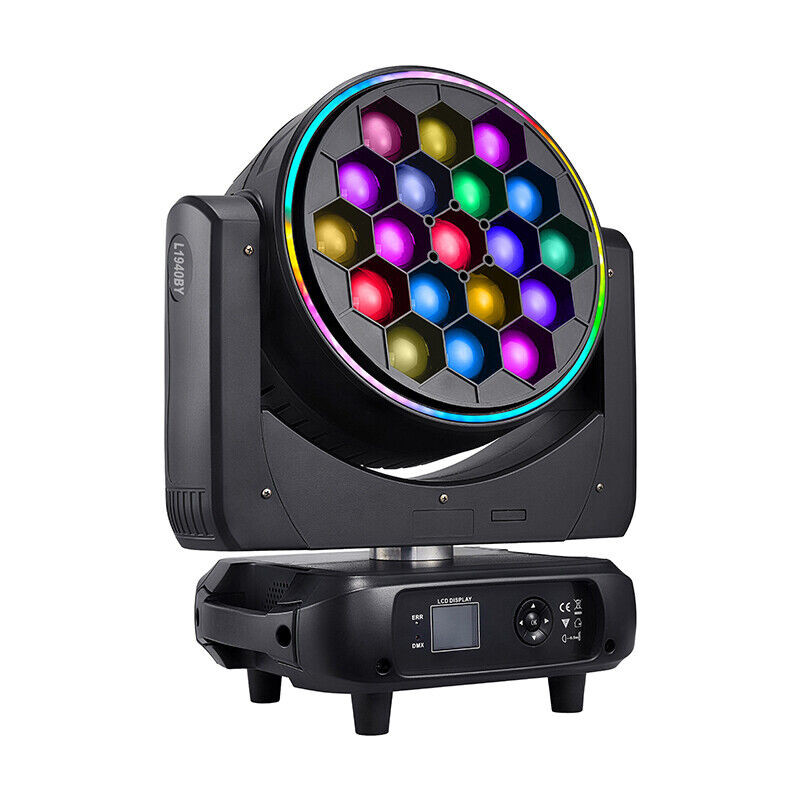
The Luminamotion 1940 sits in an interesting technical category — it's a 19-emitter, 40-watt-per-LED moving head fixture that attempts to bridge three distinct lighting disciplines: tight beam projection, broad wash coverage, and pixel-mapped strip effects. For Australian lighting designers, production companies, and venue operators evaluating mid-tier intelligent fixtures, the spec sheet alone doesn't tell the full story. This technical analysis breaks down what 19 x 40W actually means in practical lumen output, how the optical architecture affects beam quality across modes, and where this fixture genuinely competes against established alternatives in the AU market.
If you're shortlisting fixtures for a tour rig, an installation, or a hire inventory, you can view the Luminamotion 1940 here while we walk through the technical detail.
Technical Overview: What 19 x 40W Actually Delivers
The Luminamotion 1940 uses a 19-LED matrix in the classic centred hex configuration — one central emitter surrounded by six in a primary ring, and twelve more in a secondary outer ring. Each LED is rated at 40W, giving a nominal total electrical input of 760W to the LED array, with total fixture draw landing higher once driver electronics, fans, and the pan/tilt motor system are accounted for.
Here's where spec interpretation matters: nominal LED wattage is not the same as light output. RGBW 40W LEDs typically deliver between 1,200–1,800 lumens per emitter depending on phosphor quality, driver efficiency, and thermal management. For a 19-LED array, this puts realistic total fixture output in the 22,000–32,000 lumen range — competitive with established 19x40W fixtures from manufacturers like Stairville, Eurolite, and the various OEM platforms that share this optical chassis.
Core Specifications at a Glance
| Specification | Value | Practical Meaning |
|---|---|---|
| LED Array | 19 x 40W RGBW | Hex matrix, individually addressable |
| Total LED Power | 760W nominal | Pre-driver electrical input |
| Colour Mixing | RGBW additive | Includes dedicated white emitter for cleaner pastels |
| Beam Angle (zoom) | ~4° to 60° | Tight beam through medium wash |
| Pan / Tilt Range | 540° / 270° | Industry-standard moving head movement |
| Control Protocol | DMX512, RDM typical | Standard console integration |
| Pixel Control | 19 individual channels | Per-LED mapping for strip/chase effects |
| Strobe | 0–25 Hz electronic | Smooth ramps, not just on/off pulse |
| Dimming Curve | 16-bit selectable | Linear, square, inverse square, S-curve |
Optical Architecture: Why the Beam-Wash-Strip Hybrid Works (and Where It Doesn't)
The Luminamotion 1940's headline feature is its triple-personality output — and understanding the optical compromise is essential before specifying it for any serious application.
Zoom Mechanism Analysis
The motorised zoom assembly uses a moving collimation lens array in front of the LED matrix. At its tightest setting (typically 4–6°), the fixture produces a defined, near-parallel beam suitable for aerial effects in haze. At its widest (around 55–60°), it functions as a wash light with even colour blending across the field.
The compromise: dedicated beam fixtures using discharge lamps or single high-power LED sources hit beam angles below 3° and maintain that tightness over distance. The 1940's 19-emitter array produces a composite beam — visually striking but slightly less defined at maximum reach. For a venue with a 15–25 metre throw, this is rarely a practical limitation. For an arena floor needing 40m+ throws, you'd want a dedicated beam fixture instead.
Pixel-Mappable Strip Effects
Individual LED control is where this fixture justifies its position over simpler wash heads. Each of the 19 emitters can be addressed independently via DMX, enabling:
- Chase patterns across the hex matrix for kinetic visual impact
- Half-on, half-off bicolour effects using opposing ring segments
- Pulse-and-trail looks with sequential emitter activation
- Logo or simple pattern projection via pre-programmed macros
- Strobing subsets while other emitters maintain a wash bed
For DJs, EDM events, and live shows wanting strong eye-candy without separate dedicated effect fixtures, this multi-role capability is the genuine value proposition.
Performance Evaluation: Real-World Output and Behaviour
Colour Rendering and Mixing
RGBW (rather than RGB-only) is the technically correct choice for this fixture class. The dedicated white emitter solves two persistent problems with three-colour mixing:
- Pastel and tint accuracy — Pale colours produced by dimming all three RGB channels look murky. A dedicated white injects clean luminance, producing cleaner pinks, sky blues, and warm ambers.
- White output efficiency — Mixed RGB white is inefficient and metameric (looks different under camera vs. eye). A dedicated white channel hits roughly 2x the lumens of mixed RGB white at the same power draw.
What you won't get from a 4-channel RGBW system is the colour fidelity of 6-channel RGBWA+UV or 7-channel HSI fixtures used in broadcast and theatre. For live music, club, mobile DJ, and event production, RGBW is the appropriate technical specification.
Movement Quality
The 540° pan / 270° tilt range matches industry-standard moving head specs. Practical assessment criteria for this fixture class:
- Motor smoothness at slow speeds — Critical for theatrical follow-spot use; fixtures in this price bracket often show stepping at very slow movement rates.
- Pan/tilt resolution — 16-bit fine channels are standard. Coarse-only 8-bit movement is obvious in extended slow sweeps.
- Position hold accuracy — After fast movement and stop, fixtures should settle without drift or overshoot oscillation.
- Noise floor — Fan and motor noise matter for theatre, conference, and broadcast applications. For club and DJ use, ambient SPL renders this irrelevant.
Thermal Management
Sustained 760W LED operation generates significant heat. The 1940 uses active forced-air cooling — standard for this output class. Practical implications:
- Maintain clear airflow around the head (minimum 200mm clearance)
- Avoid prolonged operation at maximum output in enclosed truss configurations without venue HVAC
- Allow 5–10 minutes cool-down before transport in road cases
- Expect filter cleaning at 200–400 operating hours depending on environment
Technical Comparison: Where the 1940 Sits in the Market
vs. Single-Source LED Beams
Dedicated LED beam fixtures (single 150–280W source, narrow 2–3° optics) outperform the 1940 in pure beam definition and throw distance. The trade-off: they cannot wash, cannot do pixel effects, and they double or triple the fixture count required for the same look. The 1940's value is consolidation, not specialist beam performance.
vs. Dedicated LED Wash Heads
Pure wash heads (typically 7x40W or 12x12W RGBW) produce smoother colour fields with less visible pixelation. The 1940's hex array shows individual emitters at close range — fine for crowd-facing work, less ideal for face-lit performance where smooth field is required. Again: the strip-effect and beam-narrow capability is what justifies the architectural choice.
vs. Higher-Tier Hybrids
Premium hybrid fixtures from Robe, Martin, Clay Paky, and Ayrton sit 3–8x the price of fixtures in the 1940's bracket. The premium buys: better optics, quieter operation, longer warranty, longer LED lifespan, more refined colour engines (often including CTC, CTO, and dedicated amber). For a working hire company doing 50+ events per year, that premium pays back. For mobile DJs, small venues, and corporate AV teams, the 1940 hits a different value proposition.
If your applications fit that middle-market profile, check the current Luminamotion 1940 specifications and pricing here.
DMX Control and Console Integration
Channel Modes
Fixtures of this class typically offer multiple DMX modes to balance channel count against control resolution. Expect at least three:
- Basic mode (~16 channels) — Pan, tilt, dimmer, RGBW, strobe, gobo/macro, movement speed. Suitable for mobile DJ controllers with limited channel capacity.
- Standard mode (~24 channels) — Adds 16-bit fine pan/tilt, dimmer fine, individual macro control, colour temperature presets.
- Extended/pixel mode (~80+ channels) — Individual RGBW per emitter (4 channels x 19 LEDs = 76 channels) plus master controls. Required for full pixel-mapped effects.
Verify the exact channel allocation before integrating with your console — particularly if running multiple fixtures in pixel mode on a 512-channel universe, where four fixtures in extended mode will saturate a single universe.
Console Compatibility
The 1940 should patch cleanly on any modern lighting console — grandMA, Avolites, Hog 4, ChamSys MagicQ, Onyx, and entry-level platforms like ChamSys QuickQ or Daslight. For pixel-mapped effects, consoles with native pixel mapper functions (MagicQ, Hog 4, Onyx) make programming dramatically faster than building chases manually.
Power, Rigging, and Practical Deployment
| Consideration | Detail |
|---|---|
| Power Input | 240V AC 50Hz (AU standard) — verify IEC or PowerCON connector |
| Daisy-Chain | Power link-through common; check max linked count (typically 3–4 fixtures per 10A circuit) |
| Rigging | Omega bracket standard, secondary safety wire mandatory for overhead |
| IP Rating | Typically IP20 — indoor / covered outdoor use only unless specifically rated IP65 |
| Weight | Expect 12–18kg depending on chassis — significant for solo rigging at height |
| Operating Position | Most fixtures rated for any orientation; verify before suspended-inverted use |
Technical Considerations for Buyers
What Specifications Actually Matter
When evaluating any 19x40W LED moving head, focus on these technical factors rather than just headline wattage:
- Lumen output (not watts) — Request actual measured lumen figures. Wattage tells you electrical input; lumens tell you light output.
- Dimming curve options — Square law dimming matches human perception; linear dimming is required for video integration.
- Flicker-free rating — For broadcast and video work, the fixture should be rated flicker-free at common shutter speeds (1/50, 1/60, 1/100, 1/120).
- RDM support — Remote Device Management saves significant time on multi-fixture rigs by allowing addressing and mode changes from the console.
- Firmware update path — Reputable manufacturers issue firmware updates. Verify the update method and frequency before committing to a fleet.
Red Flags to Watch For
- Unspecified LED brand — Cree, Osram, and Lumileds emitters significantly outlast unbranded alternatives. Lifespan claims without emitter sourcing are unreliable.
- No published photometric data — Reputable fixtures publish IES files for lighting design software. Absence suggests untested optical performance.
- Generic OEM badging — Many fixtures in this category share the same chassis under different brand names. Local warranty support matters more than the badge.
- Vague control mode documentation — A proper DMX chart with channel assignments, value ranges, and macro definitions is essential.
Future-Proofing Considerations
LED fixture technology evolves quickly. The 1940's architecture (RGBW hex matrix, motorised zoom, individual pixel control) represents current mid-market standards that will remain relevant for 5–7 years of deployment. Areas where the category is moving:
- Wireless DMX and Art-Net/sACN as standard inputs (currently optional or absent at this tier)
- Higher CRI/TLCI ratings for broadcast-grade colour quality
- RGBWA+UV six-colour systems for broader gamut
- Active noise reduction for theatre and conference applications
If any of these are critical for your deployment, budget for the next tier up. If they're not, the 1940 architecture covers current and near-term needs effectively.
Best-Fit Applications
Based on the technical profile, the Luminamotion 1940 sits most naturally in these deployments:
- Mobile DJ rigs — Beam-wash-strip versatility replaces three separate fixture types
- Club installations — Pixel-mappable kinetic effects with sufficient output for medium-sized rooms
- Corporate event production — Wash mode for stage and audience lighting, beam mode for accent effects
- Function bands and live music venues — Single-fixture solution for crowd-facing eye candy and stage wash
- Wedding and event hire inventory — High-utility multi-purpose fixture that earns hire revenue across event types
- School and church performance spaces — Versatile lighting that adapts to drama, music, and assembly use
Where It's the Wrong Tool
Being honest about limitations: this fixture class isn't appropriate for every application.
- Touring arena beam work — Use dedicated discharge or single-source LED beams for 40m+ throws
- Broadcast key lighting — Higher CRI fixtures with tungsten emulation are the correct choice
- Theatrical face lighting — Smooth wash heads or profile spots produce more flattering coverage
- Outdoor permanent installation — Unless specifically IP65-rated, this fixture needs weather protection
- Critical-noise environments — Forced-air cooling is audible in quiet conferences and theatre
Technical FAQs
How does 19 x 40W compare to a 7 x 40W wash head?
Roughly 2.5x the raw output, plus pixel-mapping capability the 7-LED fixture lacks. The trade-off is increased weight, power draw, and price. For most working applications, the additional output and effect versatility justify the step up.
What's the practical throw distance?
In beam mode (tight zoom), expect usable defined beam to 20–25 metres. In wash mode, even coverage extends to 8–12 metres at typical brightness. Both figures assume some atmospheric haze for visible beam definition.
Can it run on a standard 10A AU power outlet?
Yes — a single fixture comfortably runs on 10A. Multi-fixture rigs need careful circuit planning; two to three fixtures per 10A circuit is a reasonable working limit with margin for startup current.
Is RDM addressing supported?
Verify with current product documentation, but RDM is now standard in this fixture class. RDM dramatically simplifies multi-fixture rigging by allowing address and mode changes from the console without physically accessing each unit.
What's the realistic LED lifespan?
Manufacturer claims of 50,000+ hours apply under ideal thermal conditions. Realistic working lifespan with good maintenance: 25,000–40,000 hours to 70% original output. Driver electronics typically fail before LEDs in hard-touring use.
Expert Verdict
The Luminamotion 1940 is a technically competent example of the modern mid-market hybrid moving head category. Its 19x40W RGBW architecture with individual pixel control delivers genuine multi-role versatility — beam, wash, and strip-effect operation from a single fixture. The optical design represents an intelligent compromise rather than best-in-class performance in any single role, and for the working applications that match its profile (mobile DJ, club, corporate event, mid-tier hire), that compromise is exactly right.
Buyers should focus less on the headline 19x40W spec and more on the practical questions: photometric data availability, RDM support, DMX mode documentation, local warranty backing, and the suitability of pixel control for your console workflow. When those technical fundamentals check out, the fixture earns its position in a working rig.
For Australian production professionals, mobile entertainers, and venue operators evaluating this category, the Luminamotion 1940 deserves shortlist consideration. Review the full Luminamotion 1940 specifications at MusiconStage to confirm it matches your specific technical requirements before committing.