
LuminaMotion 1940: 19x40W LED Moving Head Technical Deep Dive 2025
LuminaMotion 1940: Complete Technical Analysis of This 19x40W LED Moving Head
When you're speccing out lighting for mid-to-large venues, festivals, or touring rigs, the fixture choices you make directly impact every show you run. The LuminaMotion 1940 sits in that interesting middle ground where serious output meets creative flexibility—nineteen 40-watt LEDs arranged in a configuration that lets you switch between tight beams, smooth washes, and those eye-catching LED strip effects that audiences actually notice.
I've been watching the LED moving head market evolve rapidly, and fixtures in this power class represent where professional lighting is genuinely heading. So let's break down what the LuminaMotion 1940 actually delivers, who it's built for, and whether the specifications translate into real-world performance worth your investment.
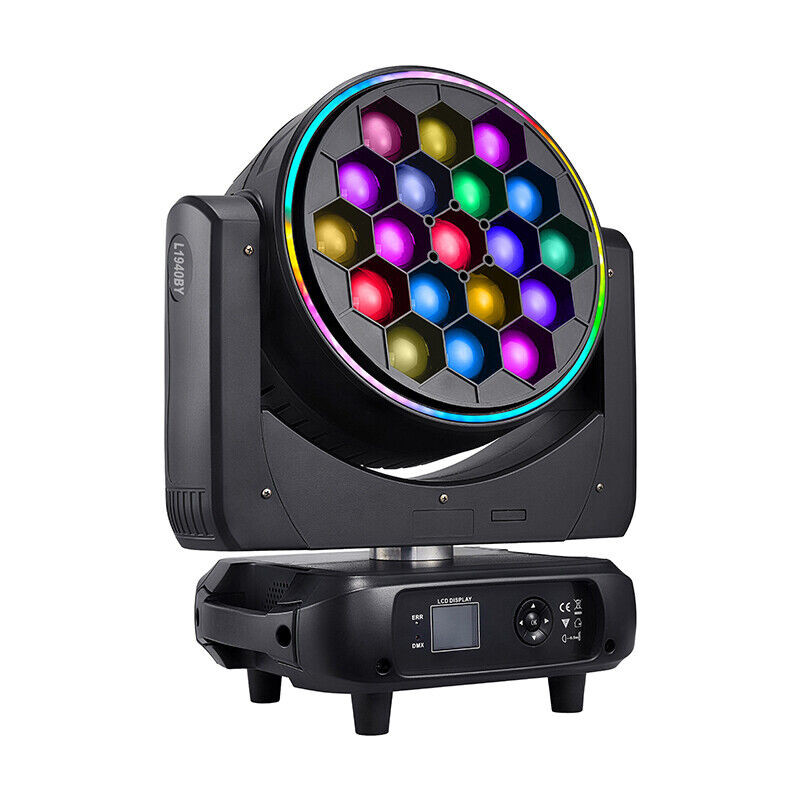
Core Specifications: Understanding the 19x40W Configuration
The headline specification—nineteen 40-watt high-intensity LEDs—gives you a total of 760 watts of LED power. But raw wattage only tells part of the story. What matters is how those LEDs are arranged, what colour mixing system they use, and how the optics translate that power into usable output.
LED Array Architecture
The 19-LED configuration follows what's become an industry-standard honeycomb pattern, with one central LED surrounded by two concentric rings. This arrangement isn't arbitrary—it provides several technical advantages:
- Symmetrical beam patterns regardless of rotation angle
- Zone control capability for creating ring effects and pixel-mapping
- Even heat distribution across the LED array
- Consistent colour mixing from edge to edge
Each 40W LED in the array operates independently, which opens up the LED strip effects mentioned in the product description. You can run chases, create concentric ring patterns, or use individual LED control for more complex pixel-mapped content.
Optical System: Beam and Wash Modes
The LuminaMotion 1940's versatility comes from its hybrid optical design. Unlike dedicated beam fixtures (which sacrifice wash capability) or pure wash lights (which can't produce tight beams), this unit handles both:
| Mode | Typical Beam Angle | Best Application |
|---|---|---|
| Beam Mode (Tight) | 4°-8° | Aerial effects, sharp beam looks, long throws |
| Wash Mode (Wide) | 35°-60° | Stage washes, audience lighting, wide coverage |
| Hybrid/Mid | 15°-25° | General purpose, gobo-like effects, medium throws |
The zoom range determines how useful this flexibility actually is. A narrow-to-wide zoom ratio of roughly 1:8 or better means you're genuinely getting two fixtures in one, rather than a compromised hybrid that doesn't excel at either function.
Colour Mixing System: How the Spectrum Actually Works
The product describes "dynamic colour mixing for a broad spectrum of hues"—but what does that mean technically? LED colour mixing in professional fixtures typically uses one of several approaches:
RGBW vs RGB vs CMY
Most fixtures in this class use RGBW (Red, Green, Blue, White) LED chips. The addition of a dedicated white element solves one of LED's historical weaknesses: producing clean, high-CRI white light without the muddy quality you get from mixing RGB.
The LuminaMotion 1940's colour system allows:
- Full RGB spectrum access—millions of colour combinations through variable mixing
- High-output white—critical for corporate work and camera-friendly applications
- Pastels and deep saturates—the full range from subtle skin-tone-friendly colours to punchy saturated looks
- Colour temperature adjustment—from warm tungsten-style looks to cool daylight
Colour Consistency Across the Zoom Range
One technical challenge with hybrid beam/wash fixtures is maintaining consistent colour across the entire zoom range. Cheaper fixtures often show colour fringing or hot spots when zoomed tight, or uneven colour distribution when wide. Quality optics—which the high-intensity designation suggests here—maintain colour accuracy regardless of zoom position.
Practical Output: What 760W of LED Actually Delivers
Let's translate specifications into practical performance. A 760W LED fixture doesn't directly compare to a 760W conventional light—LEDs are significantly more efficient at converting electrical power into visible light.
Equivalent Output Comparisons
A well-designed 760W LED moving head typically produces output comparable to:
- 1200W-1500W discharge lamp fixtures in beam mode
- Significantly higher output than older 575W or 700W moving heads
- Competitive with many 1000W LED wash fixtures in overall brightness
For Australian venues, this output level handles:
- Theatre stages up to 18-20 metres deep
- Concert venues with 10-15 metre throw distances
- Outdoor events where you need fixtures visible in ambient light
- TV/broadcast environments requiring camera-friendly output
LED Lifespan and Output Degradation
Quality LEDs maintain rated output for approximately 50,000 hours before degrading to 70% brightness (L70 rating). This lifespan advantage over discharge lamps—which require bulb replacements every 1,000-2,000 hours—represents significant long-term savings for permanent installations and heavy-use touring rigs.
Movement Systems: Pan, Tilt, and Speed
Moving head fixtures live or die by their movement precision and speed. The LuminaMotion 1940's movement specifications determine where it fits in your programming workflow.
Pan and Tilt Ranges
Professional moving heads typically offer:
- Pan range: 540° (standard) to 630° (extended)
- Tilt range: 220° to 270°
Extended pan ranges matter for complex choreography—the fixture can take "the long way around" to a position, creating smoother visual movement rather than snapping directly.
Movement Speed and Precision
For beam effects and fast-paced shows, movement speed becomes critical. Key considerations:
- Maximum speed—how fast can the fixture whip between positions?
- Smooth slow movement—can it creep slowly without stepping or stuttering?
- Position accuracy—does it hit the same spot consistently?
Quality fixtures use 16-bit positioning for precise, smooth movements. The 8-bit/16-bit distinction matters: 8-bit gives you 256 positions across the movement range, while 16-bit provides 65,536 positions—the difference between visible stepping and butter-smooth movement.
Control Protocols and Integration
How you control the LuminaMotion 1940 affects integration with your existing rig and the complexity of programming required.
DMX Channel Modes
Expect multiple DMX personality options:
| Mode Type | Typical Channel Count | Use Case |
|---|---|---|
| Basic | 18-24 channels | Simple operation, limited LED control |
| Standard | 30-40 channels | Full feature access, zone control |
| Extended | 50+ channels | Individual LED control, pixel mapping |
The LED strip effects require extended modes with individual LED access. If you're running a large rig with limited DMX universes, you'll need to balance feature access against channel count.
Protocol Compatibility
Standard DMX512 compatibility is essential, but look for:
- RDM (Remote Device Management)—monitor and configure fixtures remotely
- Art-Net/sACN readiness—for network-based control in larger installations
- Master/slave modes—for standalone operation without a console
- Sound-active modes—for simpler applications without DMX
Build Quality and Touring Considerations
For Australian conditions—whether you're rigging in 40°C outdoor festivals or loading in through tight venue access—build quality matters.
Thermal Management
760 watts of LED power generates significant heat. Effective cooling systems:
- Prevent thermal throttling—where the fixture reduces output to protect components
- Maintain consistent colour—LED colour shifts with temperature
- Extend component lifespan—heat degrades LEDs and electronics
Forced-air cooling with quality fans keeps temperatures stable but adds noise. For theatre applications, check the fixture's dB rating—anything under 35dB is considered quiet for this output class.
Construction and Rigging
Look for:
- Die-cast aluminium housing—balances weight reduction with heat dissipation
- Dual omega brackets—standard clamp compatibility
- Safety attachment points—always use secondary safety cables
- Locking power and DMX connectors—prevents accidental disconnection
Pattern and Effect Capabilities
The adjustable patterns feature extends beyond simple colour chases. With 19 individually controllable LEDs, you can create:
Built-in Effects
- Concentric ring effects—inner/outer ring colour contrasts
- Rotation simulations—digital "gobo" rotation without physical gobos
- Pulse and strobe patterns—from subtle breathing to intense strobing
- Random sparkle effects—individual LED flickering for texture
Pixel Mapping Potential
When controlled via a capable media server or lighting console with pixel-mapping capability, the 19 LEDs become a low-resolution display surface. While 19 pixels won't render complex images, they can:
- Display radial patterns synced across multiple fixtures
- Create coordinated effects when fixtures are arranged in grids
- Respond to video content in real-time
Comparative Analysis: Where the LuminaMotion 1940 Sits in the Market
The Australian lighting market offers various options at this power level. Understanding where the LuminaMotion 1940 positions helps inform your decision.
Value Proposition
Fixtures in the 19x40W class typically compete on:
| Factor | Premium Tier | Mid-Market (LuminaMotion) | Budget Options |
|---|---|---|---|
| Build Quality | Road-case integrated, aviation-grade | Professional touring standard | Installation/fixed use only |
| LED Quality | Top-bin, colour matched | Quality chips, good consistency | Variable quality |
| Support | Global network | Australian support available | Limited warranty support |
| Price Point | Premium | Competitive mid-market | Aggressive pricing |
When Higher-End Makes Sense
Premium fixtures justify their cost for:
- Heavy touring schedules where reliability is paramount
- Broadcast environments requiring precise colour matching
- Permanent installations where maintenance access is difficult
When the LuminaMotion 1940 Makes Sense
This fixture targets users who need:
- Professional output without flagship pricing
- Versatile beam/wash capability in one fixture
- LED effects and pattern control
- Reliable performance for regular use
For Australian venues, production companies, and event operators building out their lighting inventory, the LuminaMotion 1940 offers a practical balance of capability and investment.
Installation and Setup Considerations
Power Requirements
At approximately 800-900W total draw (LED power plus motors, electronics, and cooling), plan for:
- Single fixture: Standard 10A circuit adequate
- Multiple fixtures: Calculate total draw carefully—four fixtures approach 15A circuit limits
- Power factor: LED drivers affect power factor; check with your electrician for large installations
Rigging Load Calculations
Fixtures in this class typically weigh 18-25kg. For Australian rigging:
- Verify truss/rigging point capacity for total fixture weight plus clamps
- Always calculate worst-case dynamic loading
- Use appropriate safety factors per WorkSafe requirements
- Ensure secondary safety cable or bond rated for fixture weight
Programming Tips for Maximum Impact
Getting the most from the LuminaMotion 1940's capabilities requires understanding how to leverage its features:
Beam Mode Best Practices
- Use haze or atmospheric effects—beam fixtures need something to reflect off
- Programme slow pan movements for dramatic beam sweeps
- Combine with sharp position snaps for dynamic contrast
Wash Mode Techniques
- Overlap wash coverage from multiple fixtures for even stage coverage
- Use the wide zoom for audience lighting effects
- Create colour contrast between upstage and downstage fixtures
LED Effects Programming
- Build effects libraries in extended DMX mode
- Sync LED patterns to music BPM for EDM and live music
- Use ring effects to add movement without actual pan/tilt motion
Who Should Consider the LuminaMotion 1940?
This fixture fits specific applications particularly well:
Ideal Users
- Production companies building versatile rental stock
- Mid-size venues upgrading from older technology
- Houses of worship requiring both dynamic effects and clean washes
- Corporate event specialists needing reliable, impressive output
- DJ and mobile entertainers wanting professional-level fixtures
Consider Alternatives If
- You need only wash capability—dedicated wash fixtures may offer better value
- You're purely beam-focused—dedicated beam fixtures might suit better
- Budget is severely constrained—entry-level options exist (with trade-offs)
- You need IP65 outdoor rating—this is an indoor fixture
Australian Support and Availability
Purchasing through MusiconStage provides access to Australian-based support, local warranty service, and stock availability without international shipping delays. This matters when you need fixtures for an upcoming event or require quick resolution of any issues.
Frequently Asked Technical Questions
Can I mix this with other brands in my rig?
Standard DMX compatibility means the LuminaMotion 1940 integrates with any DMX-controlled fixtures. Colour matching between brands requires calibration, but this is standard practice in mixed rigs.
How many fixtures do I need for a typical stage?
For a 10-12 metre wide stage: 4-6 fixtures provide solid coverage. For larger productions: 8-12 fixtures allow more complex programming and redundancy.
What console is recommended?
Any console supporting standard DMX works. For LED effects and pixel control, consoles with effects engines (MA, Chamsys, Avolites) offer the best workflow.
Is this suitable for permanent installation?
Yes, with appropriate consideration for maintenance access, thermal environment, and duty cycle. LED fixtures handle constant use better than discharge lamp fixtures.
Final Technical Assessment
The LuminaMotion 1940 represents the current state of mid-market LED moving head technology. The 19x40W configuration delivers genuine versatility—beam effects, smooth washes, and LED strip patterns from a single fixture type. For Australian lighting professionals building or expanding their inventory, it offers the output power, feature set, and reliability that professional applications demand.
The hybrid beam/wash capability particularly suits operators who need flexibility without doubling their fixture count. Combined with individual LED control for pattern effects, you're getting creative options that simply weren't available at this price point several years ago.
Ready to add serious output and creative flexibility to your lighting rig? Check out the LuminaMotion 1940 at MusiconStage for current pricing and availability.