
KV2 EX1.8 vs Rival 18-Inch Subs: Aussie Buyer's Guide 2026
KV2 EX1.8 vs Rival 18-Inch Subs: Aussie Buyer's Guide 2026
Choosing a powered subwoofer is one of the least glamorous and most consequential decisions in a live audio rig. Tops get all the attention, but the sub is what decides whether a kick drum lands in the chest or just rattles the bar fridge, and whether your system still sounds composed at 11pm in a room full of people. If you've landed on the KV2 EX1.8 Active Subwoofer System, you're looking at the 18-inch end of a well-regarded Czech-designed range, and the honest question is whether it earns its place over the many other powered 18s on the Australian market.
This guide is written to help you decide, not to sell you. We'll cover where the EX1.8 sits in the market, how it compares against its own siblings and against the usual rivals, what you're actually paying for, and — importantly — the situations where a different sub would serve you better.
First, a Quick Reality Check on the 18-Inch Category
The powered 18-inch subwoofer category in Australia is crowded and, on paper, confusingly similar. Almost every manufacturer quotes a big wattage figure, a frequency response starting somewhere in the 30s, and a peak SPL number in the mid-130s. Those numbers are measured under wildly different conditions and are close to useless for cross-brand comparison.
What actually separates subs in real use comes down to four things:
- Amplifier behaviour under sustained load — how the sub sounds during the fourth hour, not the first four bars.
- Driver excursion and cabinet loading — whether low output is achieved cleanly or through processing tricks.
- How well it integrates with your tops — crossover point, phase alignment, and whether the manufacturer has done that work for you.
- Weight, size and how many times a night you have to lift it.
Keep those four in mind as we go. They're the axes this comparison actually runs on.
Where the KV2 EX1.8 Sits
KV2 Audio built its reputation on a design philosophy that's genuinely different from the mainstream: an emphasis on analogue signal path integrity, minimal processing latency, and amplifier headroom over headline wattage. The EX series is their portable, active range — the one aimed at hire companies, mid-size venues, corporate AV and touring musicians rather than large-format touring.
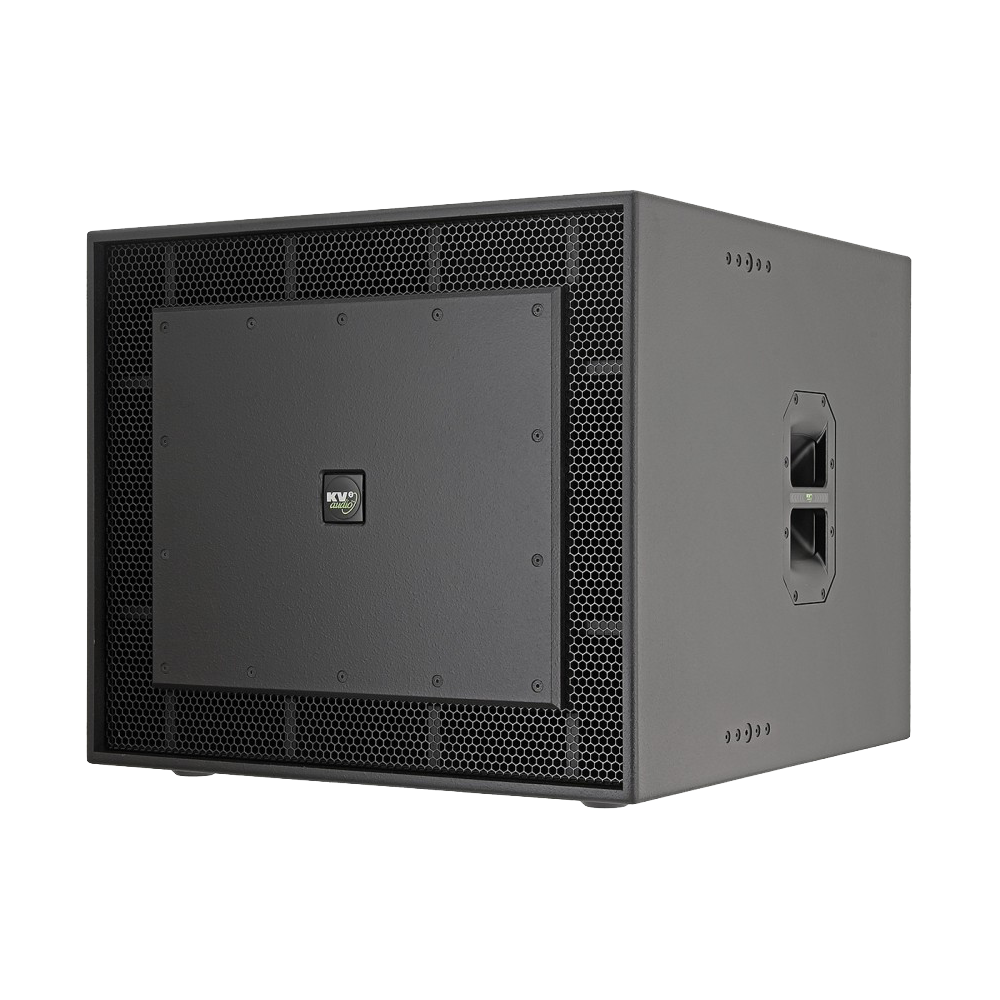
The EX1.8 is the 18-inch member of that family. Its job is to sit underneath EX-series tops (or KV2's ESD install range) and extend the system's low end for larger rooms, outdoor stages and anything bass-heavy. It's positioned as a premium option — it is not competing on price, and pretending otherwise would waste your time.
Indicative Specification Snapshot
Figures below are the commonly published EX1.8 specifications. Always confirm current numbers with the retailer before purchase, as manufacturers revise spec sheets between production runs.
| Specification | KV2 EX1.8 (indicative) |
|---|---|
| Driver | Single 18" long-excursion low-frequency driver |
| Configuration | Active (built-in amplification and processing) |
| Frequency range | Approx. 35 Hz – 150 Hz (usable low end into the 30s) |
| Amplifier | KV2 proprietary design, ~1000 W continuous class rating |
| Cabinet | Braced plywood construction, durable finish |
| Weight | Approx. 55–65 kg (a genuine two-person lift) |
| Typical role | Sub for EX/ESD tops; corporate, hire, live music, install |
Comparison 1: EX1.8 vs Its Own Siblings
Before you compare across brands, compare within the family. A surprising number of buyers over-buy here.
| Model | Driver | Best suited to | Trade-off |
|---|---|---|---|
| KV2 EX1.2 | 12" | Small rooms, speech-plus-music, tight transport | Limited genuine sub-bass extension |
| KV2 EX1.5 | 15" | Pubs, mid-size functions, mobile DJ, corporate | Runs out of headroom in large or open spaces |
| KV2 EX1.8 | 18" | Larger venues, outdoor events, bass-forward music | Weight and footprint; costs more |
| KV2 EX2.2 (dual) | 2 x 18" | Serious output demands, festival-adjacent work | Overkill and impractical for most portable work |
The honest guidance: if your typical gig is a 150-person function room, the EX1.5 will likely do the job and save you real money and real back strain. Step up to the EX1.8 when you're regularly working rooms of 250+, outdoors where there are no walls to reinforce the low end, or with genres where sub-bass content below 40 Hz is central rather than decorative — electronic music, hip-hop, modern worship, DJ-led events.
The EX1.8 is not "the better sub" in the abstract. It's the correct sub for a bigger job.
Comparison 2: EX1.8 vs the Usual Rivals
At the 18-inch powered price point in Australia, the EX1.8 typically finds itself weighed against options such as the RCF SUB 8004-AS, Electro-Voice ETX-18SP, dB Technologies SUB 918, and various Class-D offerings from the larger volume brands. Here's a fair read on how the trade-offs fall.
| Factor | KV2 EX1.8 | Typical premium rivals (RCF, EV) | Value-tier 18" powered subs |
|---|---|---|---|
| Sonic character | Fast, controlled, low-latency; favours definition over bloom | Often a fuller, more forward low-mid presentation | Frequently a tuned "boom" around 60–80 Hz |
| Amplifier philosophy | Headroom-first, conservative ratings | High-efficiency Class-D, aggressive limiting | Big peak claims, earlier limiting under load |
| Sustained-load behaviour | A genuine strength — composed over long sets | Good to very good | Noticeably compresses as the night goes on |
| Onboard DSP/presets | Present but deliberately restrained | Extensive presets, app control on some models | Basic presets, limited adjustment |
| Build and longevity | Built for hire-fleet abuse | Strong | Varies; often the first thing to fail |
| Weight | Heavy — a two-person lift | Comparable or slightly lighter | Often lighter, sometimes at build cost |
| Resale value | Holds value well in the pro used market | Good | Poor |
| Price positioning | Premium | Premium to upper-mid | Budget |
Where the EX1.8 Genuinely Wins
- Low-end definition. KV2's design priorities show up most in how the sub handles fast, complex bass material — bass guitar lines stay articulate rather than merging into a single note.
- Low latency. Minimal processing delay matters more than most people realise for phase alignment with tops and for musicians hearing themselves on stage.
- Consistency over a long night. This is the one that hire companies keep coming back for.
- System coherence with KV2 tops. If you're already running EX or ESD boxes, this is the path of least resistance.
Where Rivals Have a Fair Case
- Price. There's no way around it — you can get a competent 18-inch powered sub for meaningfully less money.
- Feature sets. Some competitors ship with app control, more preset flexibility and richer onboard DSP. KV2's restraint is a design position, but if you want to tinker, it can feel spartan.
- Mixed-brand rigs. If your tops are from another manufacturer, some of KV2's system-level advantages don't fully materialise.
- Dealer and service footprint. The larger brands have broader service networks in regional Australia.
If those points land for you, that's a legitimate reason to buy something else. Fair comparison means saying so.
Check current KV2 EX1.8 pricing and availability at MusiconStage
Value Analysis: What the Premium Actually Buys
The gap between a budget 18-inch powered sub and the EX1.8 is substantial. Whether that gap is justified depends almost entirely on how often the box works.
| Usage pattern | Verdict on the premium |
|---|---|
| Occasional use — a dozen gigs a year, small rooms | Hard to justify. A mid-tier 15" or 18" sub is the sensible call. |
| Regular weekend work — 50-plus gigs a year | Starts to make sense. Reliability and resale close much of the gap. |
| Hire fleet — the box works several times a week | Strong case. Cost per gig drops fast and downtime is expensive. |
| Fixed install in a quality venue | Excellent case. Buy once, forget about it for years. |
| Existing KV2 EX/ESD system owner | The obvious choice — system integration is worth real money. |
The cost-per-gig framing is the one worth internalising. A premium sub across 500 gigs is cheaper than a budget sub replaced twice, once you count the failed show.
Situation-Specific Recommendations
Best for Mobile DJs and Event Companies
Two EX1.8s under a pair of EX tops is a genuinely capable package for weddings, corporate events and mid-size parties. The definition works well with programmed music, and the reliability suits back-to-back weekends. If you're a solo operator, though, be realistic about the weight — plan for a trolley and consider whether two EX1.5s might suit your body and your van better.
Best for Live Music Venues
Bands with real bass players benefit most from this sub's articulation. In a 200–400 capacity room, a pair of EX1.8s placed sensibly (ideally in a horizontal array or close-coupled centrally) gives you even coverage without the front two rows being punished.
Best for Outdoor Events
This is where 18 inches stops being a luxury. Without room gain, low-frequency energy simply disappears outdoors. If you regularly do outdoor work, the step from 15" to 18" is one of the highest-value upgrades in your whole rig.
When to Choose Something Else
- You mostly do speech and light background music. You may not need a sub at all — spend the money on better tops.
- You work alone and load in up stairs. Weight will beat you. Two smaller subs beat one big one for one-person operations.
- You're on a genuinely tight budget. A well-chosen mid-tier sub used correctly beats a premium sub you couldn't quite afford and had to cut corners elsewhere for.
A Decision Framework You Can Actually Use
Work through these in order. They'll get you to the right answer faster than reading more spec sheets.
- What's the largest room you'll realistically work? Not the dream gig — the actual biggest one you get booked for, twice a year or more.
- Indoors or outdoors? Outdoor work pushes you up a size bracket, full stop.
- What music? Sub-bass-heavy genres need extension; acoustic and corporate work needs less than people assume.
- One sub or two? Two smaller subs almost always beat one large one for even coverage. Budget for the pair before you commit to the model.
- Who's lifting it? Be honest. A sub you dread loading is a sub you'll leave at home.
- What are your tops? Brand-matched systems save you setup time and alignment headaches.
- How many gigs a year? This determines whether premium pricing is investment or indulgence.
Common Mistakes Buyers Make
- Comparing peak wattage figures. They're marketing numbers measured inconsistently. Ignore them.
- Buying one sub instead of two. A single sub creates uneven coverage and gets pushed into limiting far sooner.
- Under-buying to save money, then buying again in 18 months. Genuinely common, and the most expensive path.
- Over-buying for the gigs you wish you had. Equally common, and the second most expensive path.
- Ignoring placement. A well-placed budget sub outperforms a badly placed premium one. Corner loading, spacing and polarity matter more than the badge.
- Forgetting the crossover. Set it properly — usually somewhere around 80–100 Hz depending on your tops — or you'll never hear what you paid for.
Pros and Cons at a Glance
KV2 EX1.8 — Pros
- Excellent low-frequency definition and control
- Consistent performance across long events
- Low processing latency; integrates cleanly with KV2 tops
- Build quality suited to hire and touring abuse
- Holds resale value in the professional used market
KV2 EX1.8 — Cons
- Premium pricing; not a budget option
- Heavy — genuinely a two-person lift
- Fewer onboard DSP and connectivity features than some rivals
- Smaller dealer and service network than the volume brands
- Some system advantages are diluted in mixed-brand rigs
The Honest Final Recommendation
The KV2 EX1.8 is a very good 18-inch powered subwoofer that rewards a specific type of buyer: someone who works often, works in larger or outdoor spaces, values low-end articulation over sheer boom, and either already owns KV2 tops or is willing to build a system around them. For that buyer, it's an easy recommendation, and the cost-per-gig maths works out comfortably in its favour.
For everyone else, the fair answer is more nuanced. If you're doing occasional small-room work, the EX1.5 or a solid mid-tier alternative will serve you just as well for less. If you're a solo operator facing stairs every weekend, two lighter subs will make you happier than one heavy one. And if you're mixing brands and don't need the system-level integration, some rivals offer more features per dollar.
Buy the EX1.8 because it matches your actual work, not because it's the biggest thing in the range. That's the difference between a sub you're glad you own and one you're still paying off while it sits in the shed.
View full KV2 EX1.8 specifications and Australian pricing
Still weighing it against the EX1.5 or a competing 18-inch sub? The MusiconStage team deals with these comparisons daily and can talk through your venue sizes, top boxes and budget before you commit. Get in touch or order the KV2 EX1.8 online.