
KV2 EX10 2-Way Active Speaker: Technical Analysis & Specs 2026
KV2 EX10 2-Way Active Speaker: Technical Analysis & Specs 2026
There are loudspeakers that are loud, and there are loudspeakers that are accurate. The KV2 EX10 2-Way Active Speaker System sits firmly in the second camp, and that distinction explains almost everything about how it is engineered, who it is for, and why it commands the price it does. This is not a festival-stack box or a budget powered top — it is a precision point-source tool built around a philosophy most of the pro-audio industry abandoned a decade ago. This guide takes a technical look at what KV2 actually delivers, which specifications matter, and how the EX10 behaves in real Australian rooms.
Who is KV2 and why the engineering matters
KV2 Audio was founded by Ken Hughes, an engineer with a long pedigree in high-output, high-fidelity loudspeaker design. The brand built its reputation on a deliberately contrarian position: keep the signal path analogue, keep the design point-source, and chase distortion figures and transient accuracy rather than headline wattage. Where most modern active speakers route audio through onboard DSP, limiters and FIR filtering, KV2's EX series keeps the entire chain analogue from input to driver. That single decision drives the EX10's character — and it is the first thing a technical buyer needs to understand before reading a single number on the spec sheet.
Technical overview and key specifications
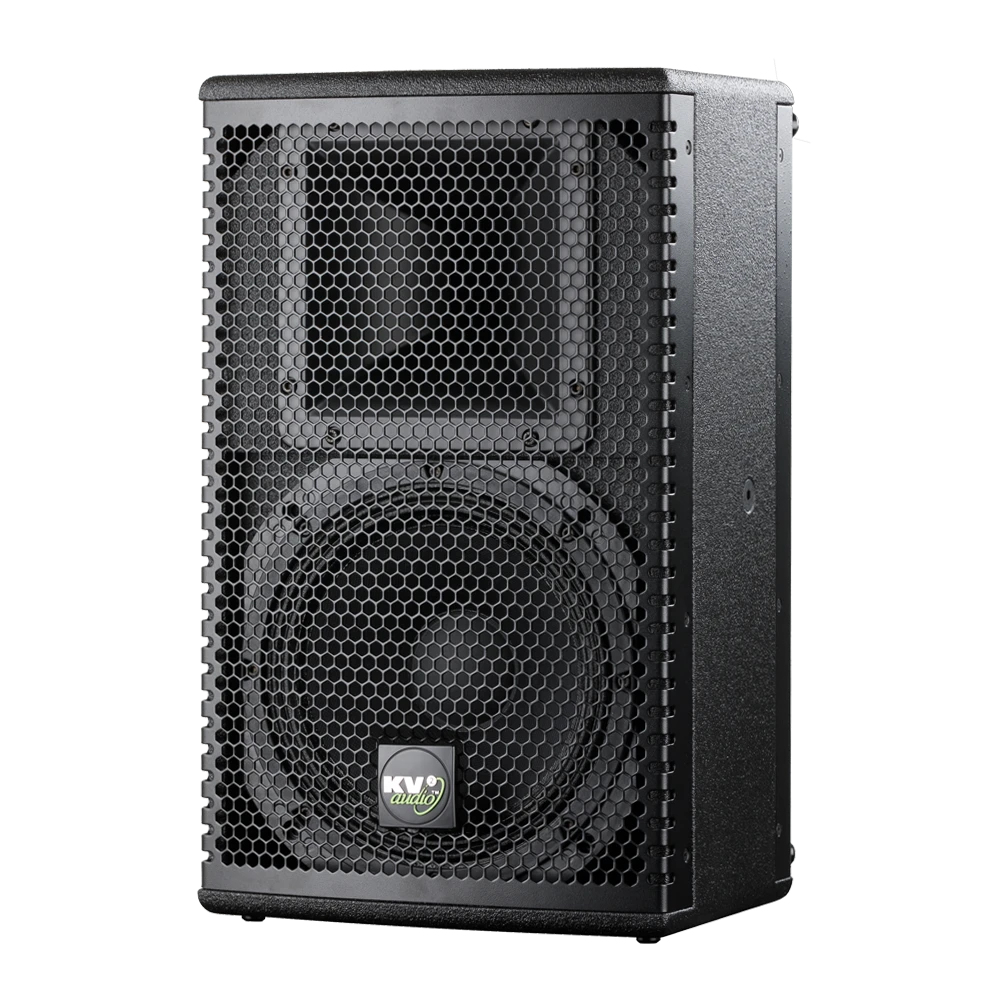
The EX10 is a two-way, full-range active enclosure built around a 10-inch low-frequency driver and a compression driver on a controlled-dispersion horn, with KV2's high peak-current amplification integrated into the power module. Indicative published specifications are summarised below. KV2 has revised the EX line over its lifetime, so always confirm the exact figures for the current revision with MusiconStage before specifying for an install.
| Specification | KV2 EX10 (indicative) |
|---|---|
| Configuration | 2-way active, point source |
| LF driver | 10-inch (254 mm) |
| HF driver | 1.5-inch exit compression driver, titanium diaphragm |
| Frequency response | Approx. 65 Hz – 20 kHz |
| Maximum SPL | Approx. 127 dB |
| Nominal dispersion | Controlled conical pattern (typically ~50–60°) |
| Signal path | Fully analogue, active crossover, no DSP latency |
| Amplification | Integrated KV2 high peak-current amplifier |
| Input | Balanced XLR (analogue line) |
| Cabinet | Birch plywood, multi-angle pole/monitor capable |
| Weight | Approx. 17–18 kg |
Read that table the way an engineer should: the numbers that look modest (a 10-inch driver, ~127 dB) are not the story. The story is what is missing — there is no DSP block, no FIR latency, no software profile to load. The EX10 is a transducer system, not a computer with speakers attached.
Deep dive: the high peak-current amplifier
The single most misunderstood part of a KV2 spec sheet is the amplifier. Most powered speakers quote a continuous (RMS) wattage and a peak figure that is roughly double it. KV2's design philosophy targets very high instantaneous current delivery — the ability to slam a short, demanding transient (a kick drum, a snare crack, a plucked upright bass) without the amplifier sagging or the limiter clamping down.
Why this matters technically: musical signals are not sine waves. They have crest factors of 12–20 dB, meaning the peaks are 16–100× the average power. A conventional amplifier sized to its RMS rating runs out of headroom on those peaks and either clips or hands control to a limiter, which audibly flattens dynamics. KV2's high peak-current approach is designed so the transient passes through cleanly while the average dissipation stays low. The practical result is a speaker that sounds dynamically alive at moderate levels — you hear the leading edge of every note rather than a compressed average. This is why a 10-inch KV2 can out-perform nominally bigger boxes on intelligibility and impact in a mid-sized room.
The trade-off is honesty: the EX10 will not produce the sustained, chest-thumping sub energy of a large two-box system with a dedicated subwoofer. It is voiced for accuracy and dynamics, not for ground-shaking low end. Pair it with a KV2 sub if your programme material is bass-forward.
Deep dive: analogue signal path and point-source coherence
Two engineering choices define the EX10's sound. First, the fully analogue signal path. There is no analogue-to-digital conversion, no DSP processing block, and therefore no processing latency. For live monitoring, theatre, and any application where a performer hears themselves acoustically and through the PA simultaneously, zero latency removes the subtle comb-filtering and timing smear that DSP-laden boxes introduce. It also means the transient response is limited only by the transducers and the analogue crossover, not by filter group delay.
Second, the point-source design. The LF and HF sources are arranged and time-aligned so the system behaves acoustically as close to a single point as practical. The benefit is phase coherence across the crossover region and a stable, predictable polar pattern. In rooms with difficult acoustics — reflective halls, low ceilings, hard surfaces — a coherent point source puts more direct, intelligible sound at the listener and excites fewer problem reflections than a wide, phase-smeared dispersion. This is the technical reason KV2 boxes are favoured in jazz clubs, theatres, houses of worship and corporate AV: speech and acoustic instruments arrive clear, not washed out.
What this means for your room
Because dispersion is tightly controlled rather than deliberately wide, EX10 placement matters more than with a typical 90°×60° plastic-horn box. Aim it. The controlled pattern is a feature for difficult acoustics but it rewards careful coverage planning — a quick prediction or a tape-measure-and-ears session will pay off.
Performance analysis: what to expect in the real world
- Vocal and speech intelligibility: Class-leading. The coherent midrange and low distortion make this one of the most articulate boxes in its size class — ideal for spoken word, acoustic acts and singer-songwriter material.
- Dynamics and transient accuracy: Exceptional. The high peak-current amplifier preserves the attack of percussive and plucked sources where compressed competitors blunt them.
- Throw and projection: Strong for a 10-inch box. The controlled pattern keeps energy on-axis, so it reaches the back of a mid-sized venue with intelligibility intact.
- Low-frequency extension: Tight and accurate to roughly 65 Hz, but it is not a sub. For DJ sets, electronic music or full bands at high SPL, plan for a matched subwoofer.
- Maximum SPL: Around 127 dB peak — comfortably enough for clubs, theatres, conferences and corporate events, but this is a quality-first design, not a maximum-loudness arms race.
How the EX10 compares technically
The honest comparison is not against budget powered tops — it is against other premium point-source systems. The table below frames the EX10's value on technical merit.
| Criterion | KV2 EX10 | Typical premium DSP active 10" | Budget powered 10" |
|---|---|---|---|
| Signal path | Fully analogue, zero latency | DSP with processing latency | DSP with processing latency |
| Transient accuracy | Excellent (high peak current) | Good, often limiter-shaped | Average, heavily limited |
| Distortion at level | Very low | Low–moderate | Moderate–high |
| Pattern control | Tight, coherent point source | Wide, varies by model | Wide, uncontrolled at HF |
| Onboard presets/app | None (deliberate) | Extensive | Basic |
| Best for | Fidelity-critical work | Versatile general PA | Budget general PA |
The takeaway: if your buying criteria are app control, onboard delay and a long preset library, a DSP box is the logical pick. If your criteria are distortion, dynamic accuracy and intelligibility in difficult rooms, the EX10 wins on the metrics that actually correlate with how it sounds. View full EX10 specifications and pricing at MusiconStage.
Specification interpretation guide: which numbers actually matter
- Distortion, not just SPL. Two boxes rated at 127 dB can sound completely different. Ask about THD at operating level — KV2's low-distortion design is the differentiator a raw SPL figure hides.
- Peak current capability over RMS wattage. A high RMS number with a weak transient response sounds dull. KV2 deliberately optimises the opposite trade.
- Latency. If performers monitor acoustically, processing latency causes comb filtering. Zero-latency analogue is a genuine technical advantage here, not marketing.
- Polar pattern consistency. A coherent, frequency-stable pattern predicts real-world intelligibility better than a wide nominal coverage angle.
- Crossover topology. An active analogue crossover with time alignment preserves phase through the crossover region — audible as clarity, not as a number you can see on a box.
Who should buy the EX10 — and who should not
Strong fit: jazz and acoustic venues, theatres and performing-arts spaces, houses of worship, high-end corporate AV and conferencing, audiophile-grade live sound, and engineers who specify on measured fidelity rather than spec-sheet wattage.
Look elsewhere if: you need bass-forward output for DJ or electronic sets without a subwoofer, you want app control and onboard delay/EQ presets, you are price-sensitive and need general-purpose volume, or you require very wide horizontal coverage from a single box.
Technical FAQ
Does the EX10 have onboard DSP or an app?
No, and that is intentional. The EX series keeps the signal path analogue to eliminate processing latency and preserve transient integrity. System processing, if needed, is handled upstream.
Is a subwoofer necessary?
For speech, acoustic, jazz and corporate work, often no. For full bands at high SPL, DJ or electronic programme, pair it with a matched KV2 subwoofer for proper low-end extension and headroom.
Can it be used as a stage monitor?
Yes — the cabinet geometry supports floor-monitor use, and the zero-latency analogue path makes it particularly well suited to monitoring applications.
Why does a 10-inch KV2 cost more than bigger powered boxes?
You are paying for amplifier current capability, low-distortion transducers, an analogue crossover and birch-ply construction — the engineering that drives fidelity, not cone diameter.
What input does it accept?
A balanced analogue line-level XLR input. Confirm the exact connector and any link/through options for the current revision with MusiconStage.
Verdict: a specialist's loudspeaker, judged on the right metrics
The KV2 EX10 is not the speaker you buy on a wattage-per-dollar spreadsheet. It is the speaker you buy when intelligibility, dynamic accuracy and low distortion are the brief — and on those technical criteria it performs at a level its driver size and price tag understate. For Australian theatres, worship spaces, jazz rooms and fidelity-critical AV installs, it is one of the most coherent point-source tools available in its class. Judge it on transient response, distortion and pattern control rather than SPL alone, pair it with a sub where the programme demands, and it rewards the investment. Check current EX10 availability and pricing at MusiconStage.
Specifications are indicative and may vary by revision — confirm current figures with MusiconStage before specifying for a fixed install.