
KV2 ESR 3000 MkII: 3-Way Rackmount Amp Deep Dive 2026
KV2 ESR 3000 MkII: The 3-Way Rackmount Brain Behind the ESR215 MkII
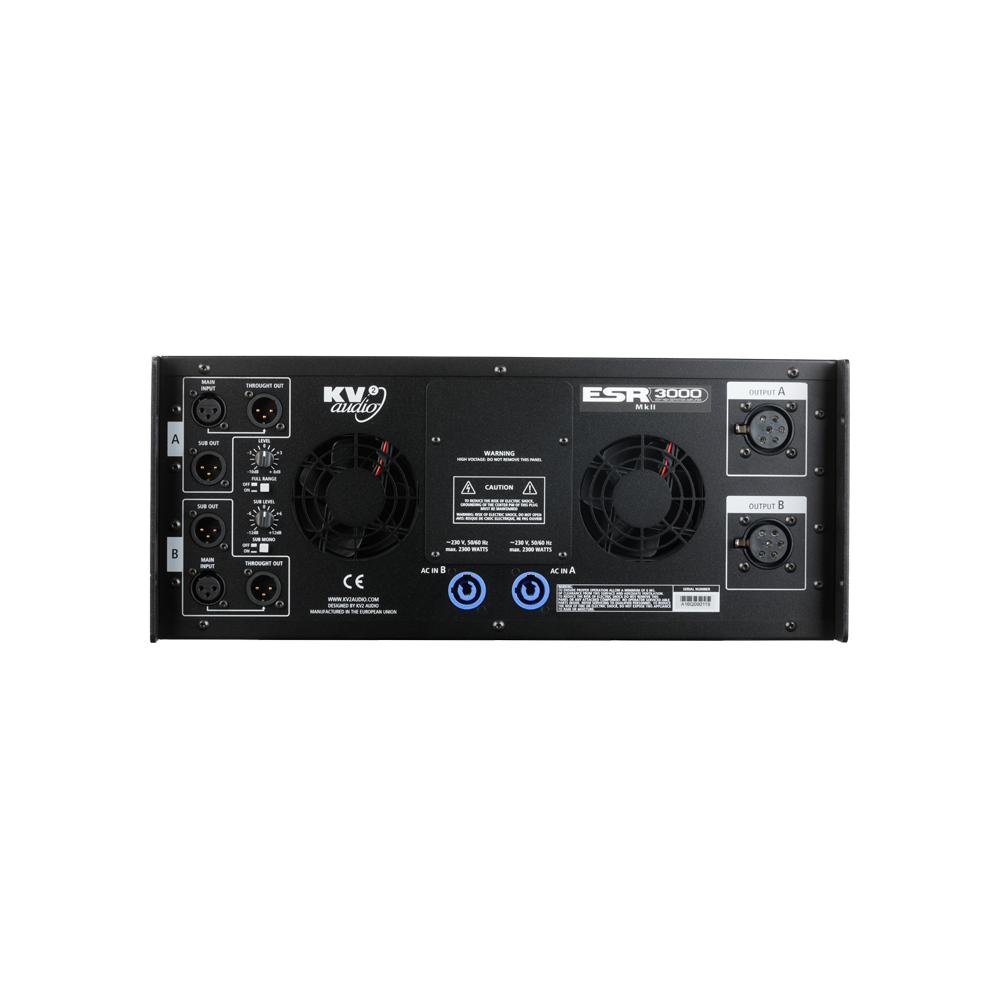
If you've ever stood in front of a KV2 rig and wondered why it sounds so unnervingly clear at volumes that should be turning to mush, the answer usually isn't the speaker box you're looking at. It's the amplifier you're not. The KV2 ESR 3000 MkII is a stereo, 3-way active rackmount amplifier purpose-built to drive the ESR215 MkII full-range system, and it represents one of the more interesting design philosophies in professional audio: keep the loudspeaker passive and dumb, and put all the intelligence in a dedicated, system-matched amplifier.
This isn't a generic power amp you bolt onto whatever cabinet you happen to own. It's a tuned engine designed around a specific transducer set. For Australian sound engineers, installers, and serious mobile operators evaluating KV2's active range, understanding what this box actually does — and why KV2 builds amplifiers this way — matters a great deal when you're justifying the investment. Let's pull it apart properly.
What "Stereo 3-Way Active" Actually Means Here
The terminology gets thrown around loosely, so let's be precise. A 3-way active system splits the audio signal into three frequency bands — low, mid and high — before amplification, then sends each band to its own dedicated amplifier channel and its own dedicated driver. This is fundamentally different from a passive speaker, where a single amplified signal hits a crossover network of capacitors and inductors inside the cabinet that divides the frequencies after the fact.
The ESR 3000 MkII performs that crossover work actively, in the analogue domain, before the power stage. Because it's a stereo unit, it handles a left and right ESR215 MkII enclosure simultaneously — so a single 3000 MkII is the complete electronics package for a stereo pair. Each side gets its three bands driven discretely.
Why does this matter in practice? A few concrete reasons:
- Each driver sees an amplifier optimised for its job. The compression driver isn't being fed through a lossy passive high-pass network; it gets a clean, dedicated channel.
- Crossover points are precise and stable. Active filtering doesn't drift with voice-coil temperature or impedance swings the way passive components can.
- Driver protection is intelligent. Because the amp knows exactly which driver is on each channel, limiting and protection are tailored per band rather than applied as a blunt instrument across the whole signal.
- Damping factor stays high at the driver. With the amp directly coupled to each transducer, cone control is tighter — which is a big part of why KV2 low end sounds defined rather than woolly.
The trade-off, of course, is that the system is a matched pair. You don't mix and match. The 3000 MkII is built for the ESR215 MkII, and that constraint is precisely what allows KV2 to tune it so tightly.
The KV2 Design Philosophy: Why a Passive Cabinet, Active Amp?
Most of the active PA market has gone the opposite direction — cramming Class-D amplifier modules and DSP into the back of every speaker box. KV2 deliberately separates them, and there's solid engineering reasoning behind it.
KV2's founder, George Krampera, has long argued that the biggest enemy of natural reproduction is time-domain distortion and phase error — the smearing of transients that makes a system sound "loud" but fatiguing. By keeping the amplifier as a discrete, serviceable, thermally-managed rack unit rather than bolting it to a vibrating cabinet next to the drivers, KV2 can:
- Run larger, better-ventilated power supplies and heatsinks without weight penalties on the flown speaker.
- Keep sensitive analogue circuitry away from the mechanical vibration and heat of the transducers.
- Service or replace the electronics without pulling a speaker out of a flown array.
- Maintain the signal path KV2 is famous for — a focus on low phase distortion and fast transient response.
The result is a system where the cabinet stays lighter and simpler, and the brains live in a 19-inch rack where they belong. For touring and install work, that serviceability alone is a meaningful operational advantage.
Key Specifications in Context
Exact published figures should always be confirmed against KV2's current datasheet for your specific market revision, but here's how to read the spec sheet of a system amplifier like this and what each number actually tells you.
| Specification | What It Is | Why It Matters |
|---|---|---|
| Configuration | Stereo, 3-way active | Drives a full L/R ESR215 MkII pair with discrete per-band amplification |
| Format | 19" rackmount | Integrates into standard touring and install racks; serviceable and protected |
| Target loudspeaker | KV2 ESR215 MkII | System-matched tuning, crossover and limiting — not a general-purpose amp |
| Crossover | Active, pre-amplification (3 bands) | Precise, stable crossover points unaffected by driver heating |
| Driver protection | Per-band limiting | Tailored protection that maximises usable output without cooking drivers |
| Signal path | KV2 low-distortion analogue design | Prioritises transient accuracy and low phase error over raw spec-sheet wattage |
Notice what I'm not doing: leading with a giant watts-per-channel number. With KV2, that's the point. A system-matched amplifier's headroom is meaningful only in the context of the drivers it controls. The 3000 MkII delivers the power the ESR215 MkII drivers are designed to receive, with limiting set to extract maximum clean SPL before the onset of audible distortion. Comparing its raw wattage against a generic PA amp is a category error — you're measuring different things.
Performance Character: What You Actually Hear
The defining trait of a properly driven KV2 ESR system is clarity at distance and at volume. Several technical factors converge to produce that:
Transient response and phase coherence
Because the crossover work happens actively with carefully managed phase relationships between bands, transients — the snap of a snare, the pluck of an upright bass, the leading edge of a vocal consonant — arrive intact and aligned. Many systems smear these slightly, which the ear reads as "loud but tiring." A coherent system stays intelligible and relaxed even when it's genuinely loud.
Controlled, defined low end
High damping factor at the woofer terminals means the amplifier exerts firm control over cone movement, stopping it precisely when the signal stops. The audible result is bass that's tight and pitched rather than boomy and one-note. For acoustic, jazz, corporate speech and vocal-forward applications, this definition is worth more than brute extension.
Headroom and dynamics
With dedicated power per band, a transient peak in the high frequencies doesn't rob the low-frequency amplifier of supply current. Each band has its own reserve, so the system holds its composure on dynamic material where a single shared amplifier would compress and harden.
Real-world deployment
In practice, the ESR215 MkII driven by the 3000 MkII suits premium installations, high-end mobile rigs, houses of worship, performing arts venues and corporate AV where reproduction quality is non-negotiable. It is not the budget choice, and it isn't trying to be the highest-SPL-per-dollar EDM rig. It's an accuracy-first system. View the KV2 ESR 3000 MkII at MusiconStage to check current Australian pricing and stock.
How It Compares to Conventional Approaches
| Aspect | KV2 ESR 3000 MkII (System Amp) | Powered Speaker (Amp-in-box) | Generic Rack Amp + Passive Box |
|---|---|---|---|
| Crossover | Active, system-tuned, per-band | Active DSP, but mass-tuned | Passive network inside cabinet |
| Driver control | Direct, high damping per band | Direct but shared topology | Through passive components — lossy |
| Serviceability | Excellent — rack unit, separate from box | Poor — pull speaker to service amp | Good — amp is separate |
| Speaker weight | Lighter (passive enclosure) | Heavier (amp + DSP onboard) | Lighter, but amp not matched |
| Tuning precision | Highest — matched pair | Good | Depends on user setup |
| Sonic priority | Transient accuracy, low phase error | Convenience and SPL | Flexibility |
The honest summary: a powered speaker wins on plug-and-play convenience and on not needing a rack. A generic amp-and-passive-box wins on flexibility and lower entry cost. The KV2 system amp wins on sonic accuracy, driver control and long-term serviceability — and it asks you to commit to a matched ecosystem to get there. Which one is "better" depends entirely on what you're optimising for.
Technical Considerations Before You Buy
1. It's a system, not a component
This is the single most important thing to internalise. Budget for the 3000 MkII and the ESR215 MkII together. The amplifier on its own is only meaningful as the engine for that specific cabinet pair. If you're building toward a KV2 ESR rig, the amplifier choice is effectively made for you by the speaker model.
2. Rack space, power and ventilation
Plan your rack. A high-quality analogue power amplifier needs airflow — leave it room to breathe and don't sandwich it between two other heat-generating units. Confirm your mains supply and circuit capacity for the rig, particularly in older Australian venues where available power on a single circuit can be the real-world limiter on what you can run.
3. Cabling and gain structure
Run balanced inputs and keep your gain structure clean from the desk through to the amplifier. The whole point of a low-distortion system is undermined if you're feeding it a noisy or clipped signal. Garbage in, garbage out — only now you're hearing the garbage with exceptional clarity.
4. Future-proofing and resale
KV2 systems hold their value strongly in the professional market precisely because they're built to be serviced and to last, not replaced every product cycle. A matched amp-and-speaker investment from a brand with this reputation is a long-horizon purchase, and the serviceable-rack-amp philosophy directly supports that longevity.
Who Should Buy This
- Premium AV installers specifying fixed systems where reproduction quality is the spec.
- High-end mobile operators and production companies running corporate, awards, conference and live-music work that demands intelligibility.
- Performing arts venues, houses of worship and theatres where speech and acoustic music clarity is paramount.
- Engineers already invested in the KV2 ecosystem who need the matched amplifier for their ESR215 MkII enclosures.
It's not the pick for a first-time buyer wanting one do-everything powered box on a tight budget. KV2 is a deliberate, accuracy-first choice for people who know exactly why they want it.
Frequently Asked Questions
Can I use the ESR 3000 MkII with other speakers?
No — it's tuned specifically for the ESR215 MkII. Its crossover points, limiting and protection are matched to those drivers. Using it on other cabinets would defeat the purpose and risk the drivers.
Does one amplifier cover a full stereo pair?
Yes. It's a stereo, 3-way unit, so a single 3000 MkII provides all three amplified bands for both the left and right ESR215 MkII enclosures.
Why isn't the amplifier built into the speaker like most active PA?
KV2 deliberately separates them to keep the electronics cool, serviceable, and isolated from cabinet vibration, and to preserve a low-phase-distortion signal path. The speaker stays lighter and the amp stays easy to service.
Is the wattage figure comparable to other amplifiers?
Not directly. As a system-matched amplifier, its output is configured around the ESR215 MkII drivers and KV2's limiting strategy. Cross-comparing raw watts against a generic amp tells you very little about real-world performance.
Is it worth the premium over a powered speaker?
If your priority is sonic accuracy, transient clarity and serviceable longevity, yes. If your priority is convenience and lowest cost, a powered box is the more sensible buy. Be honest about which one you actually need.
The Verdict
The KV2 ESR 3000 MkII isn't a power amplifier you shop for on watts-per-dollar. It's the purpose-built electronic engine of the ESR215 MkII system, and it embodies a coherent design philosophy: keep the speaker passive and light, put the intelligence in a serviceable rack unit, and prioritise time-domain accuracy over spec-sheet bragging rights. The payoff is a system that stays clear, controlled and natural at volumes where lesser rigs turn harsh.
For Australian professionals building or maintaining a KV2 ESR rig, this amplifier isn't really optional — it's the heart of the system. The real decision is whether the KV2 accuracy-first approach matches your work, and for premium install, corporate, theatre and acoustic-forward applications, it very often does. Check the KV2 ESR 3000 MkII on MusiconStage for current pricing, or get in touch with the team to spec a complete ESR215 MkII system for your venue or production.