
KV2 ESD10 Passive Speaker: Complete Beginner's Guide Australia 2026
KV2 ESD10 Passive Speaker: A Complete Beginner's Guide for Australian Buyers in 2026
If you're new to the world of professional audio and have started researching speakers for your venue, band, or event business, you've probably come across terms like passive speaker, two-way design, SPL, and compression driver — and felt instantly overwhelmed. Don't worry. Everyone starts somewhere, and this guide is designed to walk you through everything you need to know about the KV2 ESD10 2-Way Passive Speaker without assuming you already know the lingo.
By the end of this article, you'll understand what makes the ESD10 special, whether it's the right choice for your situation, and exactly what you'll need to get it up and running. Let's start from the very beginning.
What Is a Passive Speaker? (Start Here If You're New)
Before we dive into the ESD10 specifically, let's clear up the single most important concept: the difference between a passive speaker and an active (or "powered") speaker.
- Active speakers have an amplifier built into the cabinet. You plug in power and an audio signal, and they make sound. Convenient, but heavier and more expensive to repair if the amp dies.
- Passive speakers like the KV2 ESD10 have no internal amplifier. You need a separate amplifier (often a rackmount unit) to power them. They're typically lighter, more reliable, and easier to service.
Think of it like the difference between an electric car (battery included) and a regular car that needs petrol from a separate pump. Both get you there — they just work differently.
Why Choose Passive in 2026?
You might wonder why anyone would pick passive when active speakers seem more convenient. Here's why many Australian sound pros still prefer passive:
- Lighter cabinets — easier to lift, mount, and tour with
- Centralised amplification — one amp can power multiple speakers from a rack
- Easier repairs — if an amp fails, you replace just the amp, not the whole speaker
- Better for permanent installs — pubs, restaurants, conference rooms where the amp lives in a closet
- Often higher sound quality per dollar — manufacturers can focus the budget on drivers and crossovers
What Does "2-Way" Mean?
Another term you'll see everywhere: 2-way. This refers to how the speaker divides up the audio it plays.
A 2-way speaker has two drivers (the round things that move air):
- A low-frequency driver (the "woofer") for bass and lower midrange
- A high-frequency driver (the "tweeter" or "compression driver") for higher midrange and treble
An internal component called a crossover splits the incoming audio so each driver only plays the frequencies it's designed for. Why does this matter? Because no single speaker driver can reproduce the full range of human hearing well. Splitting the job between two specialised drivers gives clearer, more accurate sound — especially for vocals.
Meet the KV2 ESD10
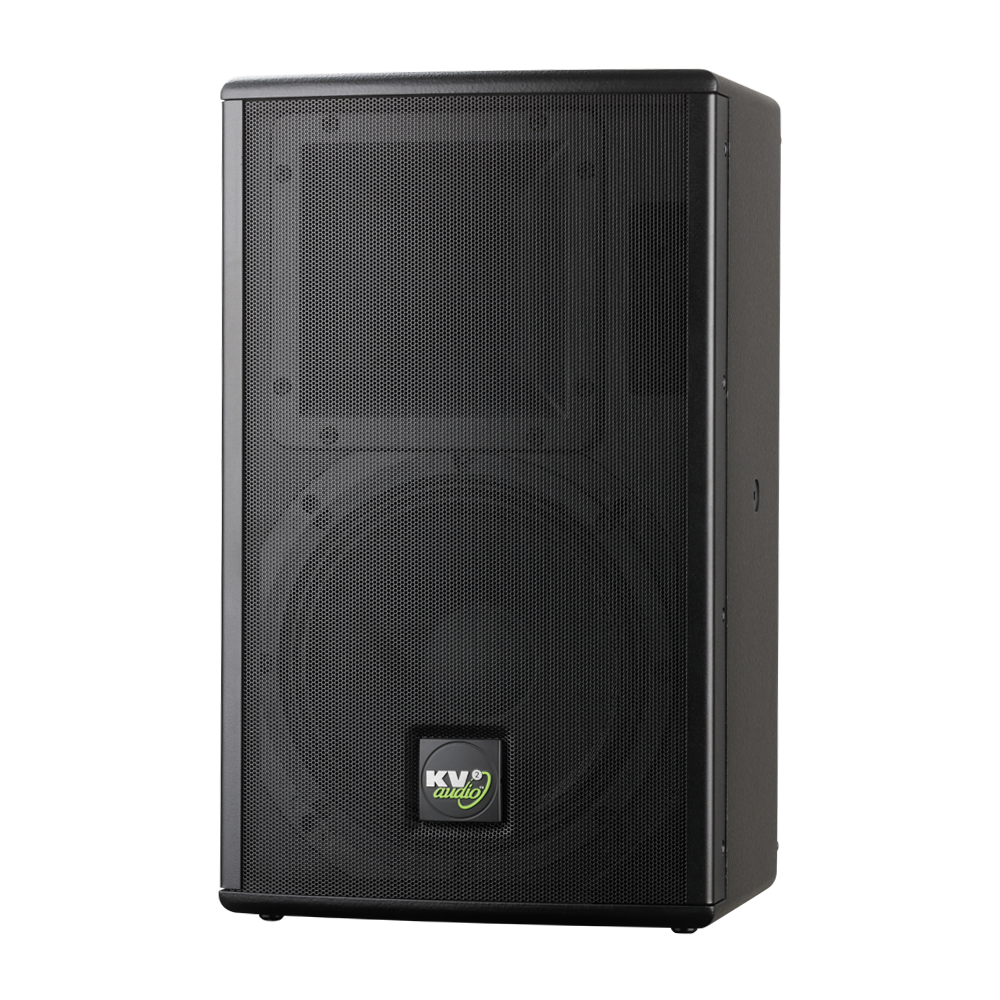
The KV2 ESD10 is a compact, 10-inch, 2-way passive loudspeaker designed by KV2 Audio — a Czech manufacturer with a strong reputation among Australian touring engineers and high-end installers. KV2 isn't a household name like JBL or Bose, and that's actually part of its appeal. The brand is known for an obsessive focus on analogue audio purity and ultra-low distortion, which is why you'll find their speakers in concert halls, jazz venues, and corporate AV installations where sound quality is non-negotiable.
The ESD10 at a Glance
- Type: 2-way passive, full-range loudspeaker
- Low-frequency driver: 10-inch woofer
- High-frequency driver: 1.75-inch voice-coil compression driver on a constant-directivity horn
- Coverage pattern: Wide horizontal dispersion suitable for fills, front-of-house, or stage monitoring
- Cabinet: Lightweight, professional-grade construction with multiple mounting points
- Typical use: Live music venues, houses of worship, conference centres, mobile DJ rigs, monitor wedges
Key Features Explained Simply
1. Compact 10-Inch Format
The "10" in ESD10 refers to the diameter of the woofer in inches. As a beginner, here's a useful rule of thumb:
- 8-inch speakers: Background music, very small spaces, vocal-focused fills
- 10-inch speakers: Sweet spot for small-to-medium venues (50-200 people), live vocals, acoustic acts, monitor wedges
- 12-inch and up: Larger spaces, full-band reinforcement, more bass impact
The 10-inch format makes the ESD10 versatile without being unwieldy. It's small enough for a single person to handle, but punchy enough to hold its own in real-world gigs.
2. Compression Driver for Crystal-Clear Highs
A compression driver is a special type of high-frequency driver that pushes sound through a small opening into a horn. The result? Far more efficiency and clarity than a typical dome tweeter (the kind you'd find in home speakers). For Australian pubs and venues where vocal intelligibility matters more than anything, this is a huge deal. Your singers will be understood, even in noisy rooms.
3. Constant-Directivity Horn
This sounds technical, but the concept is simple: the horn shape is engineered so that the speaker sounds the same whether you're standing directly in front of it or off to the side. Without this, audience members on the edges of the room hear a muffled, dull version of what the centre-row listeners hear. Constant directivity = consistent sound for everyone.
4. Multiple Mounting Options
The ESD10 typically includes a pole-mount socket (for putting it on a speaker stand) and fly points (threaded inserts so it can be safely hung from rigging). This flexibility is gold for beginners because the same pair of speakers can serve a coffee-shop gig on stands one weekend and a wedding reception flown from a truss the next.
Beginner Buying Guide: Is the ESD10 Right for You?
It's a Great Fit If...
- You want professional-grade sound quality rather than the cheapest option that just works
- You're building a system that may grow over time (the ESD10 plays nicely with KV2 subwoofers if you want to add low end later)
- You already own — or plan to buy — a quality power amplifier
- You value clarity and vocal reproduction over chest-thumping bass
- You're doing acoustic gigs, corporate events, houses of worship, jazz, theatre, or spoken-word events
It Might Not Be the Best Fit If...
- You want a true plug-and-play, all-in-one solution — an active speaker would be simpler
- You need earth-shaking bass for EDM or hip-hop (you'd want a subwoofer in any case)
- Your budget is very tight and you just need "something that works" for a one-off party
The Most Common Beginner Mistake: Forgetting the Amplifier
Because the ESD10 is passive, it will not make any sound on its own. You need three things to get it running:
- A mixer (where you plug in microphones, instruments, or your laptop)
- A power amplifier (which takes the small signal from the mixer and boosts it to drive the speakers)
- Speaker cable (typically Speakon connectors — not the same as the RCA or XLR cables you'd use elsewhere)
How much amplifier power do you need? A safe starting rule: choose an amplifier that can deliver about 1.5 to 2 times the speaker's continuous power rating per channel, at the matching impedance (usually 8 ohms for the ESD10). This isn't because you'll run it that loud — it's so the amp has headroom and doesn't clip, which is what actually destroys speakers. Counterintuitive, but true: under-powered amps blow speakers more often than over-powered ones.
Beginner Tip: Match Brands When You Can
KV2 makes their own amplifiers (the EPAK series) specifically tuned for their speakers. If your budget allows, pairing the ESD10 with a KV2 amp gets you the sound the designers intended. It's a bit like buying a guitar and matching pickups designed for that exact body — the synergy is real.
Setup and Getting Started: What to Expect
If you've never set up a passive PA system before, here's the basic signal flow you'll learn:
- Source (microphone, instrument, laptop) → plugs into the mixer
- Mixer output → connects to the power amplifier input (usually via XLR cable)
- Amplifier output → connects to the ESD10 speakers via Speakon cables
- Speakers → placed on stands or flown, facing the audience
The learning curve is real but manageable. Expect to spend a couple of evenings learning gain structure (setting volume levels properly at each stage), how to position speakers to avoid feedback, and how to EQ for the room. The good news? Once you've learned it on one system, the knowledge transfers to every PA setup you'll ever use.
Common Questions from Beginners
How loud will the ESD10 actually get?
Loud enough for most small-to-medium venues comfortably. As a rough guide, a single ESD10 can confidently handle a 100-150 person room for a vocalist with acoustic backing. A pair will cover most pubs, function rooms, and corporate venues up to about 200-250 people. For larger crowds or full bands with drums, add a subwoofer.
Do I need one speaker or two?
Almost always two. Stereo (left and right) coverage gives you wider, more even sound across the room. You'd only use a single speaker for very small spaces, spoken word, or as a monitor wedge.
Can I use it as a stage monitor?
Yes — the ESD10's compact cabinet typically allows for floor wedge placement, and its clear midrange makes vocals easy to hear on stage. Check the model's specific shape, but many compact 2-way passives serve double duty as front-of-house speakers and monitors.
Will it survive Australian touring conditions?
KV2 speakers are built to professional touring standards with robust cabinets and protective grills. With sensible care (don't drop them, use proper cases, avoid extreme heat), they'll last many years. Buying quality once is almost always cheaper than buying budget twice.
What about warranty and support in Australia?
Buying from an authorised Australian retailer like MusiconStage means you get full local warranty support and someone who actually speaks to KV2's distribution channel. Grey-market imports from overseas often have no warranty in Australia and can be a nightmare if something goes wrong.
Your Growth Path: What to Add Later
One of the smart things about starting with a quality system is that you can build on it as your needs grow. A typical journey looks like this:
- Stage 1: Pair of ESD10s + small mixer + amplifier → covers acoustic gigs, small functions, speeches
- Stage 2: Add a KV2 subwoofer → suddenly you can handle DJ sets, dance music, and full bands
- Stage 3: Add a digital mixer with effects → opens up multi-band gigs, recording, and remote mixing via tablet
- Stage 4: Add monitor wedges and in-ear systems → you're now running professional show production
This is the beauty of starting with a brand like KV2: their products are designed to work together, so each upgrade plugs into what you already own without forcing you to start from scratch.
Budget Considerations for Your First Quality Speaker
The ESD10 sits in the mid-to-upper tier of the passive speaker market. It's not the cheapest option, but it's also not at the top-tier touring price point. For a first "serious" investment, this is often the sweet spot: high enough quality to satisfy as your ear develops, but not so expensive that buyer's remorse is a risk.
When budgeting for a complete starter system, plan for roughly:
- The speakers themselves (factor in two for stereo)
- A matched amplifier (~30-50% of the speaker cost is typical)
- A basic mixer (small analogue mixers are very affordable)
- Cables, stands, and a basic stand bag
Think of it as one cohesive purchase rather than buying just the speakers and hoping the other pieces fit. A wise spend across the full chain delivers better results than blowing the budget on one premium component and skimping on the rest.
Final Thoughts: Is the KV2 ESD10 the Right First Step?
If you've made it this far, you now understand more about passive PA speakers than 90% of first-time buyers walking into a music store. The KV2 ESD10 represents a thoughtful choice for newcomers who want to invest in quality from day one rather than upgrading every couple of years. It rewards patient learning, plays well with growing systems, and delivers the kind of clear, honest sound that makes audiences (and performers) happy.
Take your time. Read up on amplifier matching. Ask questions before you buy. And when you're ready, you can view the KV2 ESD10 on MusiconStage with full Australian support, warranty, and expert advice ready to help you build the system that fits your specific needs.
Welcome to the world of professional audio. You're going to enjoy it.