
KV2 ES 1.0 Active-Driven Mid-High Speaker: Technical Guide 2026
KV2 ES 1.0 Active-Driven Mid-High Speaker: The Complete Technical Guide for 2026
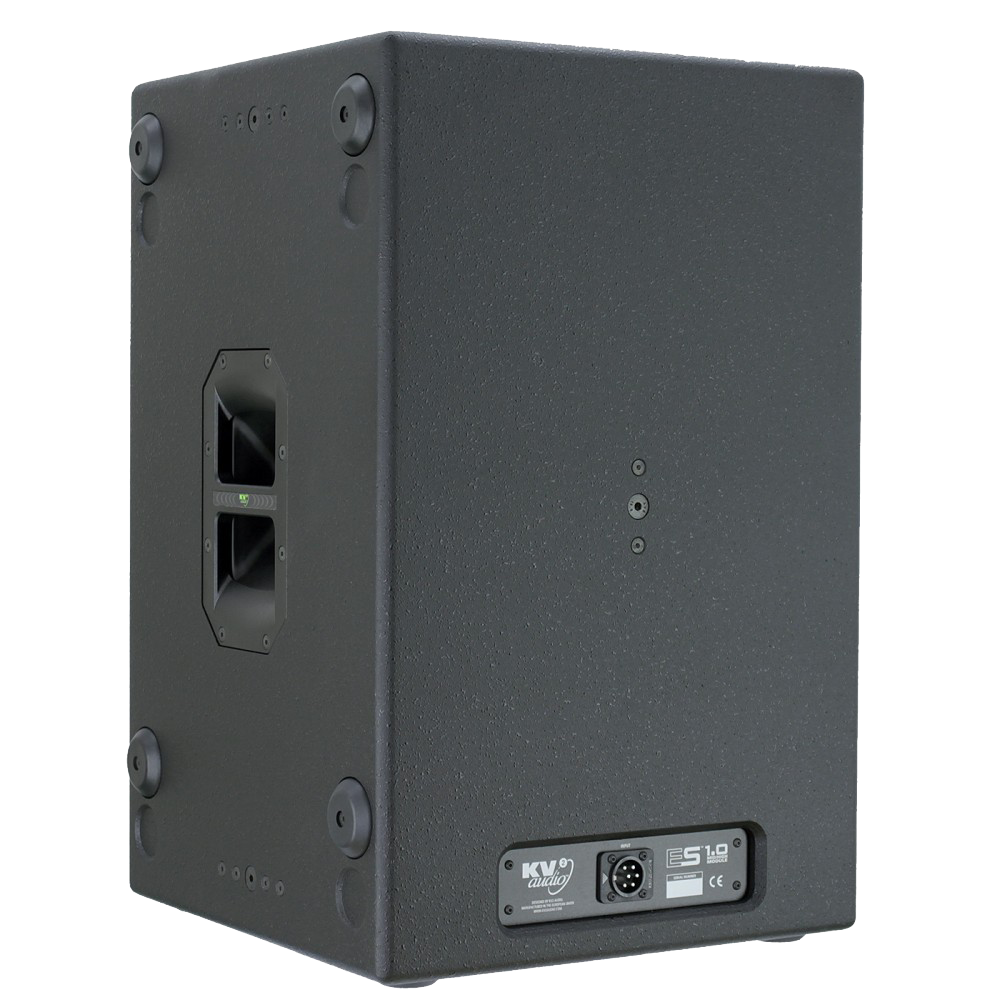
There's a particular category of loudspeaker that doesn't get discussed nearly enough in the Australian live-sound conversation, and the KV2 ES 1.0 sits squarely in the middle of it. This isn't a plastic-cabinet active box you power up and forget about, and it isn't a passive top you hang off a rack amp. It's a purpose-built, 3-way active-driven mid-high element engineered as the intelligible heart of KV2 Audio's ES (Extended System) — and understanding why it's built the way it is tells you almost everything about whether it belongs in your rig.
If you've spent any time chasing that elusive combination of effortless vocal clarity, natural dynamics and long-throw coherence, you'll already know the frustration of systems that sound impressive at first but fatigue you across a four-hour show. KV2's entire design philosophy is a direct answer to that problem. In this guide we'll pull apart the ES 1.0's specifications, explain the active-driven architecture that defines it, look at real-world performance expectations, and help you work out where it fits — and where it doesn't.
What the ES 1.0 Actually Is (and Why That Matters)
Let's clear up the most common point of confusion first, because it changes how you should think about the entire product. The ES 1.0 is described as an active-driven mid-high speaker, not a self-powered active speaker. That distinction is critical.
A conventional "active" PA box contains its own onboard amplifiers and DSP. The ES 1.0 instead houses only the transducers — a dedicated low-mid driver, a midrange, and a high-frequency compression driver — while the amplification, filtering and processing live in an external EnergyPack (KV2's outboard power and system-engine unit). Each driver in the cabinet is fed by its own discrete amplifier channel through a multi-way connection, exactly as you'd wire a high-end studio monitor or a large-format touring system.
Why go to that trouble? Three reasons that KV2 has built its reputation on:
- Zero passive crossover components in the signal path. Passive crossovers use inductors and capacitors that store and release energy, smear transients and burn power as heat. Active driving eliminates them entirely, so each driver receives a clean, precisely band-limited, phase-corrected signal.
- Analogue-domain processing for speed. KV2 is famously committed to keeping the primary signal path analogue where it counts, avoiding the latency and time-smearing that aggressive digital processing can introduce. The result is a system with genuinely low group delay and startlingly natural transient response.
- Perfect amplifier-to-driver matching. Because KV2 designs the drivers and the amp channels together, each transducer is driven exactly as intended — no guessing, no mismatched rack amps, no compromise.
The practical upshot is a mid-high box that behaves like a point source: the multiple drivers integrate so tightly in time and phase that the ear perceives a single, coherent sound origin. That coherence is the ES 1.0's whole reason for existing.
Technical Specifications in Context
Raw numbers only mean something when you understand what they translate to on the ground. Here's how the ES 1.0's key characteristics break down and what each one actually delivers for you.
| Specification | Detail | What It Means in Practice |
|---|---|---|
| System type | 3-way active-driven mid-high | Reproduces the critical vocal and instrument band with dedicated drivers per range — no shared-driver compromise |
| Amplification | External EnergyPack (discrete channel per driver) | Each transducer optimally driven; no onboard amp heat or weight in the cabinet |
| Crossover topology | Fully active, analogue-domain | Low group delay, tight phase coherence, natural transients |
| Design intent | Point-source coherence | Single perceived sound origin; effortless intelligibility over distance |
| Frequency role | Mid-high (pairs with ES bass module) | Handles vocals, guitars, keys and detail; hand off lows to a dedicated sub/bass element |
| Recommended partner | KV2 ES 2.5 active-driven bass module | Completes a full-range ES rig with matched voicing and timing |
| Construction | Timber cabinet, professional-grade transducers | Rigid, resonance-controlled enclosure that supports the coherent voicing |
You'll notice I've deliberately avoided inventing precise SPL, dispersion or wattage figures — always confirm those against the current KV2 datasheet or with the team at MusiconStage, since KV2 periodically refines its published data. What doesn't change is the architecture, and that's where the ES 1.0's value lives.
The Point-Source Advantage: Why Coherence Beats Raw SPL
A lot of buyers shopping in this price bracket fixate on maximum SPL and driver count. It's an understandable instinct, but it misses what separates a system like the ES 1.0 from the crowd. The ES 1.0 is engineered around time and phase coherence — the property that lets a listener 30 metres back hear the same clean, articulate vocal as someone in the third row.
Group Delay and Why Your Ears Notice
Group delay is the amount of time different frequencies take to leave the loudspeaker. In many systems, low-mids arrive fractionally later than highs because of passive crossover phase behaviour and driver offset. Your conscious mind doesn't register it as a delay, but your ear registers it as "smear" — a slight blur that makes consonants mushy and forces you to push the level to compensate. KV2's active-driven, analogue approach keeps group delay exceptionally low, which is precisely why engineers describe these systems as "effortless." You're not fighting the box to get intelligibility; it's already there.
Dynamic Realism
Because there are no passive components soaking up transient energy, the ES 1.0 tracks fast musical peaks — a snare crack, a plucked acoustic string, the leading edge of a consonant — with a realism that's genuinely hard to unhear once you've experienced it. This is the trait that keeps KV2 systems in high-end corporate, theatre, house-of-worship and audiophile-grade live installations across Australia.
How the ES 1.0 Fits Into a Full System
On its own, the ES 1.0 is a mid-high specialist. To build a full-range rig you pair it with a matched bass element — most naturally the KV2 ES 2.5 active-driven bass module, which extends the low end while preserving the same timing and voicing philosophy. Everything runs from the EnergyPack, which acts as the brain and muscle of the system.
A typical ES deployment looks like this:
- ES 1.0 mid-high cabinets — positioned for coverage of the primary listening area.
- ES 2.5 (or matched) bass modules — providing foundation and extension.
- EnergyPack system engine — housing the discrete amplifier channels, crossover and processing for every driver.
The beauty of this modular approach is scalability. You can specify the number of mid-high and bass elements to suit the room, from an intimate 150-capacity function space to a substantial theatre, without ever mismatching amplification to drivers.
| Approach | ES 1.0 (Active-Driven) | Typical Self-Powered Active Top | Passive Top + Rack Amp |
|---|---|---|---|
| Crossover | Fully active, analogue | Onboard DSP (digital) | Passive (in-cabinet) |
| Amp-to-driver match | Designed together, discrete per driver | Fixed onboard | User-dependent, often generic |
| Group delay / coherence | Very low / point-source | Moderate | Variable, usually higher |
| Cabinet weight | Lighter (no onboard amp) | Heavier | Lighter cabinet, separate amp rack |
| Setup complexity | Requires EnergyPack | Plug-and-play | Moderate (amp + processing) |
| Sonic ceiling | Reference / audiophile-grade | Good to very good | Depends heavily on components |
Build Quality and Materials
KV2 cabinets are built to control resonance, and the ES 1.0 follows that lineage with a rigid timber enclosure. This isn't cosmetic. A cabinet that flexes or rings adds its own coloration to the sound, undermining the very coherence the active architecture works to preserve. The enclosure is engineered to be acoustically inert so that what you hear is the drivers, not the box. Combined with professional-grade transducers selected for their linearity and thermal stability, the result is a speaker that holds its voicing consistently across a long, hard-working night.
Real-World Performance Expectations
So what should you actually expect once it's rigged and running? Based on the design principles and the broader ES/KV2 family's reputation, here's an honest picture:
- Vocal intelligibility that carries. This is the ES 1.0's headline strength. Speech and vocals stay crisp and forward across depth, which is why the system is a favourite for spoken-word-heavy applications — conferences, theatre, worship — as well as music.
- Low listening fatigue. The natural transient response and low group delay mean you can run a long event without the harsh, pushed quality that tires an audience (and an engineer's ears).
- Wide, even coverage from a compact footprint. Point-source coherence lets a relatively modest number of cabinets cover a room evenly, with fewer of the comb-filtering hotspots you get from poorly integrated multi-box arrays.
- Headroom that feels generous. Because the amp channels are matched to the drivers, the system tends to feel like it has more in reserve than the raw numbers suggest — it doesn't strain toward the top of its range.
Where does it demand respect? It's a system, not a single box. You need the EnergyPack and appropriate bass elements to realise its potential, and you need to think about the whole rig rather than grabbing a pair of tops and going. That's a feature for serious users and a hurdle for anyone wanting instant plug-and-play simplicity.
Which Specifications Actually Matter When You Compare
If you're cross-shopping the ES 1.0 against other premium systems, here's where to point your attention — and the marketing claims worth ignoring.
Look closely at:
- Crossover topology. Active-driven with per-driver amplification is a genuine engineering advantage. Ask whether a competitor is truly active or just self-powered with a digital crossover.
- Group delay / phase behaviour. If a manufacturer publishes it, that transparency tells you they care about coherence. KV2 builds its identity on this.
- Amp-to-driver integration. Systems designed as a whole outperform mix-and-match rigs almost every time.
- Cabinet resonance control. A rigid, well-damped enclosure is unglamorous but decisive for clarity.
Treat with caution:
- Peak SPL figures in isolation. A big peak number tells you nothing about how the system sounds at a musical, sustained level — which is where you'll actually live.
- Driver count as a proxy for quality. More drivers poorly integrated is worse than fewer drivers perfectly aligned.
- "DSP presets" as a headline feature. Processing helps, but it can't undo the time-smear a passive crossover introduces. Architecture beats presets.
Who Should Buy the ES 1.0?
This is a specialist tool, and being honest about fit will save you money and disappointment.
It's an outstanding choice if you are:
- A production company or venue that values reference-grade clarity and repeat-booking client satisfaction over headline loudness.
- Running theatre, corporate, house-of-worship or high-end music events where vocal intelligibility and low fatigue are non-negotiable.
- Building a scalable, matched KV2 rig around the EnergyPack and ES bass modules.
- An audiophile-minded engineer who can hear the difference coherence makes and won't compromise on it.
It's probably not the right pick if you:
- Need a single, self-contained plug-and-play box you can throw on a stand and power up in seconds.
- Prioritise absolute maximum SPL for a high-energy DJ or festival stage above sonic finesse.
- Aren't ready to invest in the supporting EnergyPack and bass elements the system is designed to work with.
Future-Proofing and Long-Term Value
One underrated aspect of the KV2 approach is longevity. Because the ES 1.0 keeps the amplification and processing in an external, serviceable EnergyPack rather than buried inside the cabinet, you're not tying the lifespan of your loudspeaker to a single onboard amp module that becomes obsolete or fails out of warranty. The modular design also means you can scale the system as your work grows, adding cabinets rather than replacing your whole inventory. For a professional buyer thinking in five-to-ten-year horizons, that architecture is a real hedge against depreciation.
Technical FAQ
Is the ES 1.0 a powered speaker I can plug straight into a mixer?
No. It's an active-driven speaker, meaning it relies on an external KV2 EnergyPack that houses the amplification and processing. Each driver is fed a discrete amplifier channel from that unit. Budget and plan for the full system, not just the cabinet.
What does it pair with for full-range sound?
The natural partner is a matched KV2 ES bass module such as the ES 2.5, so the low end shares the same timing and voicing. The ES 1.0 handles the mid and high frequencies where intelligibility lives.
Why is the active-driven design better than a normal active speaker?
It removes the passive crossover from the signal path and matches each amplifier channel to its driver, delivering lower group delay, tighter phase coherence and more natural transients than a self-powered box with a shared digital crossover.
Is it worth the premium over conventional PA tops?
If your work depends on clarity, low listener fatigue and coherent coverage — theatre, corporate, worship, high-end music — the sonic ceiling justifies it. For casual or maximum-SPL-first applications, a simpler active box may be better value.
How many do I need for my room?
Because it behaves as a point source, you often need fewer cabinets for even coverage than a comparable array. The right count depends on room size and geometry — the team at MusiconStage can help you scope a system properly.
Final Verdict
The KV2 ES 1.0 isn't trying to win a spec-sheet shouting match, and that's exactly the point. It's a reference-grade, active-driven mid-high loudspeaker built around coherence, intelligibility and natural dynamics — the qualities that separate sound that merely reaches the back row from sound that genuinely communicates there. The external EnergyPack architecture, fully active analogue crossover and resonance-controlled cabinet all serve one goal: getting the signal from console to ear with as little smear and fatigue as possible.
For Australian production professionals, venues and installers who understand what they're buying, it's one of the most rewarding mid-high elements in its class. Just go in with clear eyes — this is a considered system investment, not an impulse box. If clarity is your currency, it pays back handsomely.
Ready to build a reference-grade KV2 rig? View the KV2 ES 1.0 at MusiconStage for current pricing, full specifications and expert advice on speccing the complete system for your venue.