
In-Ear Monitoring Explained: Sennheiser EW300 G3 Guide 2026
In-Ear Monitoring Explained: Sennheiser EW300 G3 A IEM System Beginner's Guide 2026
If you have ever watched a band on stage and noticed the small clear earpiece tucked into a singer's ear, you have already seen in-ear monitoring in action. For newcomers, though, the world of wireless monitoring can feel like alphabet soup — UHF, diversity, companders, frequency banks. This guide is written for exactly that person: someone researching their first proper monitoring system who wants the Sennheiser Ew300 G3 A IEM System (B Band, 626–668 MHz) explained in plain English, with honest guidance about whether it is the right starting point.
We will build your understanding step by step. By the end you will know what an IEM system actually does, why performers swear by them, what every spec on the box really means, the Australian frequency rules you genuinely need to understand before buying, and whether this particular Sennheiser is a smart first purchase in 2026.
What Is an In-Ear Monitoring System?
Let's start with the absolute basics. When a musician performs, they need to hear themselves — their voice, their instrument, and the rest of the band — clearly and at the right balance. This is called monitoring. Traditionally this was done with floor wedges: angled speakers on the stage pointing back at the performer.
An in-ear monitoring (IEM) system replaces those bulky wedges with a personalised audio feed sent wirelessly to earphones the performer wears. Think of it as a custom radio station broadcasting only to that one musician, where they fully control what they hear.
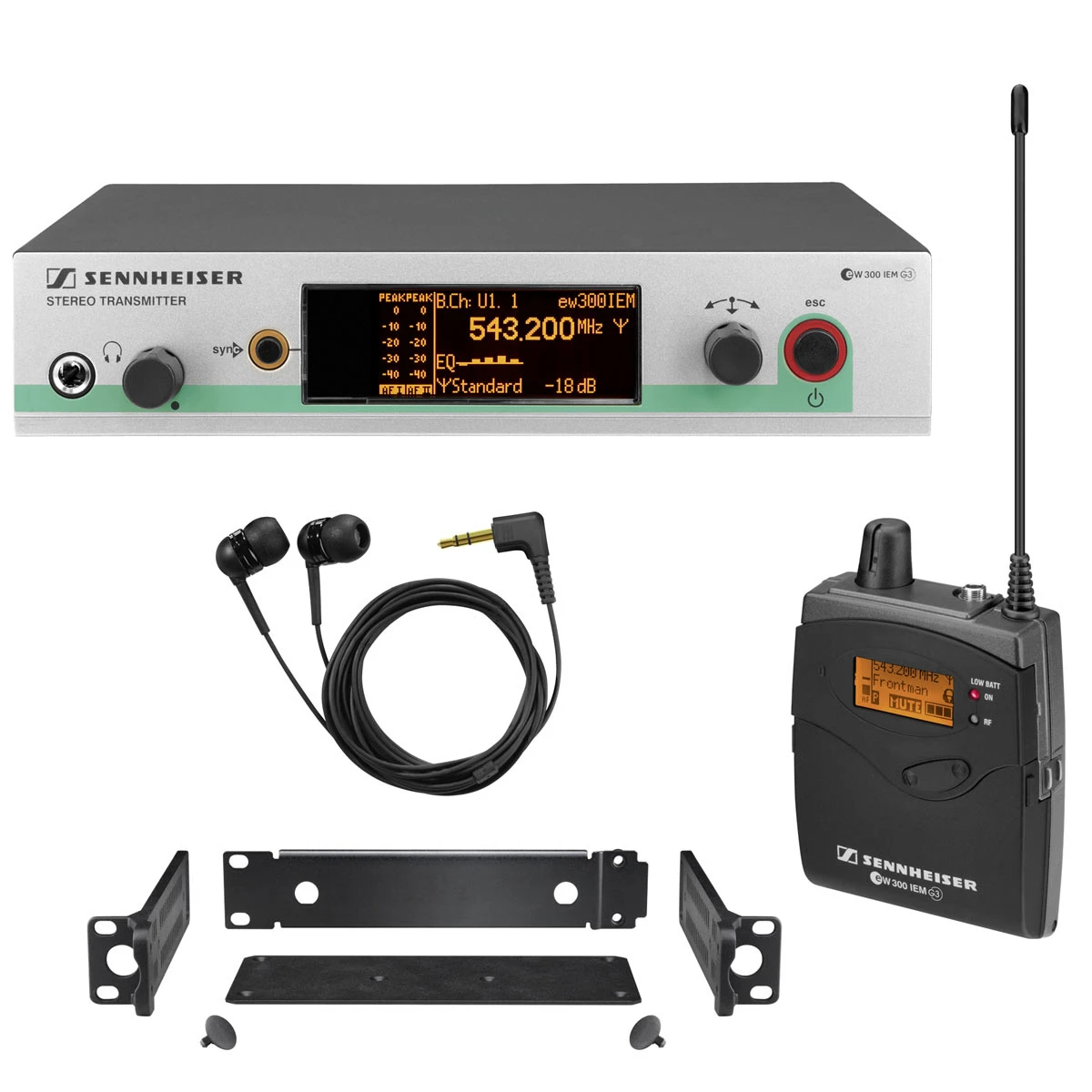
A wireless IEM system has three core parts, and it helps to picture them as a chain:
- The transmitter — a half-rack unit that sits with the sound desk. It receives a custom mix from the mixing console and broadcasts it as a radio signal.
- The bodypack receiver — a small unit the performer clips to a belt or strap. It catches the radio signal out of the air.
- The earphones — sealed earpieces that deliver the sound directly into the performer's ears while blocking out stage noise.
The Sennheiser Ew300 G3 A set follows exactly this pattern: a stationary transmitter, a wearable receiver, and earphones, all communicating over the radio band named in the product title.
Why Performers Moved From Wedges to In-Ears
Understanding the why helps you judge whether you actually need this. Performers switched to IEMs for a handful of very practical reasons:
- Hearing protection. Floor wedges blast the performer at high volume all night. Sealed in-ears let musicians hear a detailed mix at a much safer level — a huge deal for long-term ear health.
- A consistent mix anywhere on stage. With wedges, walking two steps changes everything you hear. With in-ears, your mix travels with you.
- A quieter, cleaner stage. Fewer loud speakers on stage means less sound spilling into microphones, which makes the whole show sound tighter to the audience.
- Personal control. The drummer can have more click track; the singer can have more vocal — each person gets their own world.
Beginner tip: IEMs are not only for arena bands. Solo performers using backing tracks, worship teams, and small function bands often benefit the most, because they remove stage clutter and feedback in tight venues.
Meet the Sennheiser Ew300 G3 A IEM System
Sennheiser's evolution wireless (ew) G3 range has been one of the most widely used professional wireless families in the world. The "300" tier sits in the upper-middle of that line — a serious step above entry-level kits, built for working musicians and venues rather than casual home use.
The model name tells a story once you can read it:
- ew 300 — the product series and performance tier.
- G3 — the third generation of evolution wireless. It is worth being upfront here: G3 is a previous-generation platform (later succeeded by G4). It remains highly respected, reliable and supported, and is often available at strong value, but it is a mature product rather than the newest release. We will return to what that means for your buying decision.
- IEM — this is the in-ear monitoring variant (Sennheiser also makes ew 300 microphone systems, so this label matters).
- A / B Band 626–668 MHz — this describes the radio frequency range the system operates in. This is the single most important part for Australian buyers, and it gets its own section below.
Understanding the Key Features in Plain English
Here is where the jargon usually scares newcomers off. Let's translate it.
Stereo and Focus (Mono) Modes
You can run the system in stereo for a rich, full mix, or switch to focus mode. Focus mode trades stereo for a stronger, more robust mono signal — useful when you would rather have rock-solid reliability than stereo width. Why it matters: beginners often value stability over spatial polish, so having both options is genuinely handy as you learn.
HDX Compander
A compander (compress + expand) is a noise-reduction system. In simple terms, the transmitter intelligently squeezes the audio before sending it and the receiver expands it back out, which keeps the background hiss low and the sound clean. Why it matters: it is a big part of why a quality wireless system sounds clear rather than "radio-ish". You do not configure this — it just works — but knowing it exists explains the price difference versus cheap kits.
Adjustable Frequency Range and Banks
The system covers a wide tuning range and is organised into banks of pre-coordinated frequencies. Think of frequencies like lanes on a motorway: if two wireless systems use the same lane, they crash (you hear dropouts and noise). Banks are pre-planned sets of lanes that do not interfere with each other. Why it matters: if you ever run more than one wireless system, this is what keeps them from clashing.
Pilot Tone and Squelch
A pilot tone is an inaudible signal the transmitter sends so the receiver knows it is listening to the right source. If that tone disappears, the receiver mutes instead of blasting harsh static into your ears. Why it matters: this is an ear-safety and professionalism feature — no nasty surprises if you walk out of range.
Metal Housing and Backlit Displays
Both the transmitter and the bodypack use durable metal construction with clear, readable displays. Why it matters: gear gets dropped, packed, and gigged hard. Build quality is not glamorous, but it is exactly what separates pro tools from disposable ones.
The B Band 626–668 MHz Question: What Australians Must Know
This is the part many first-time buyers skip — and it is the part that can render an otherwise excellent system unusable. Please read this carefully.
Wireless IEM systems broadcast on radio frequencies, and those frequencies are regulated by the government. In Australia, the regulator is the ACMA (Australian Communications and Media Authority). You cannot legally transmit on just any frequency you like.
Here is the beginner-friendly summary for 2026:
- The 520–694 MHz range is generally available for wireless audio devices in Australia under a class licence, but on a "no interference, no protection" basis. In plain terms: you may use it, but you must avoid frequencies used by local digital TV broadcasts in your area, and you get no protection from interference if something else is nearby.
- This product's B Band sits at 626–668 MHz, which falls inside that 520–694 MHz range. That means it is workable in Australia, but only if you coordinate around the active TV channels where you perform.
- The 694–820 MHz band is off-limits. This "digital dividend" spectrum was reallocated to mobile networks years ago. Older overseas systems tuned there are illegal to operate in Australia — another reason to understand bands before buying second-hand.
What this means practically for a beginner: before you commit, check which TV channels are broadcast in the towns and venues where you will perform, and confirm the B Band's 626–668 MHz window has clear space. Sennheiser and the ACMA both publish frequency-finder resources, and a reputable Australian retailer can advise on the right band for your location. Buying the correct band for your region is more important than any feature on the spec sheet.
Beginner warning: never assume a wireless system bought overseas or online is legal to use in Australia. Band compatibility is region-specific, and this is the most common and costly mistake new buyers make.
Is This System Right for Beginners?
Honest answer: it depends on what kind of beginner you are.
It is a strong choice if you are:
- A working or semi-professional musician who has outgrown floor wedges and wants a reliable, pro-grade platform without paying flagship prices.
- Someone who values proven build quality and a system used on countless real stages over the newest model number.
- Comfortable doing — or being guided through — basic frequency coordination for your region.
It may be more than you need if you are:
- A casual home practiser who only needs to hear a backing track — a simple wired in-ear setup is far cheaper and adequate.
- Someone who specifically wants the latest generation with the longest future support window — in that case, look at Sennheiser's newer G4 IEM line and weigh the price difference.
For most gigging beginners stepping up to their first serious wireless monitoring rig, the ew 300 G3 IEM hits a genuine sweet spot of reliability, sound quality and value.
Common Beginner Mistakes to Avoid
- Ignoring the frequency band. Buying the wrong band for your country or region is the number one error. Always confirm Australian compatibility first.
- Skimping on the earphones. The system is only as good as what is in your ears. Poorly fitting or low-quality earpieces undo the benefits of a great transmitter. Budget for a proper, well-sealing fit.
- Expecting wedge-style loudness. IEMs work because they are quieter and clearer, not louder. Resist the urge to crank them — the whole point is hearing protection.
- Running antennas badly. Burying the transmitter behind metal racks or coiling antennas causes dropouts. Give the signal a clear line of sight.
- One mix for everyone. The power of IEMs is personalised mixes. If your console cannot send individual feeds, plan for that before expanding to multiple performers.
Getting Started: What to Expect
Setting up your first IEM system is very achievable. Here is a realistic picture of the learning curve:
- Initial setup (first hour): connect the transmitter to your mixer's output, power it on, run the automatic frequency scan, and sync the bodypack to the transmitter using the infrared sync feature. Sennheiser's auto-scan does a lot of the hard work for you.
- First rehearsal: expect to spend time getting your mix right rather than fighting the gear. The unfamiliar part for most newcomers is the isolated sound of in-ears, not the technology — give yourself a session or two to adjust.
- Ongoing: develop a habit of a quick frequency check at each new venue. It becomes second nature fast.
Realistic learning-curve verdict: the hardware is approachable for a motivated beginner in an afternoon. The art of building a good monitor mix is the part you will keep improving for years — and that is true of any system, not just this one.
Beginner FAQs
Do I need special earphones, or will my normal ones work?
You need sealing in-ear monitors, not ordinary consumer earbuds. The seal is what blocks stage noise and lets you listen safely at lower volumes. Universal-fit IEMs are a fine starting point; custom-moulded ones are an upgrade for later.
Can more than one person use this single system?
One transmitter broadcasts one mix, but multiple bodypack receivers can listen to that same mix. For individual personalised mixes, each performer needs their own transmitter and a console capable of sending separate feeds.
Is wireless really necessary, or can I go wired?
Wired in-ear systems exist and are cheaper and dropout-free, but they tether you to one spot. If you move around the stage, wireless like this Sennheiser is worth it. If you stand still, a wired solution is a sensible budget entry point.
Will it work anywhere in Australia?
It will work where the 626–668 MHz B Band has clear space around local TV broadcasts. Coverage is region-dependent, so always confirm for your specific performance locations before relying on it.
Is buying a previous-generation system a mistake?
Not necessarily. G3 is mature, well supported and proven. The trade-off is a shorter future-support runway versus the newer generation. If long-term futureproofing is your priority, compare with current models; if value and reliability now matter most, G3 remains a credible choice.
Your Growth Path: Where to Go Next
One reason to start on a respected platform is that your skills, not your gear, become the limiting factor. As you grow you might:
- Add a second transmitter so two performers get independent mixes.
- Upgrade from universal to custom-moulded earphones for better isolation and comfort.
- Introduce a personal monitor mixer so each musician adjusts their own balance on stage.
- Move toward a fully coordinated multi-channel rig as your band or venue scales up.
Everything you learn about frequency coordination, mixing for ears, and antenna placement on this system carries directly forward. That is the real value of starting with professional fundamentals.
Final Verdict for Newcomers
The Sennheiser Ew300 G3 A IEM System (B Band, 626–668 MHz) is a professionally proven, well-built wireless monitoring platform that teaches you good habits and rewards you with clean, reliable sound. For a beginner stepping up from floor wedges or a wired setup to their first serious wireless rig, it offers an excellent balance of quality and value — provided you do the one piece of homework that genuinely matters: confirming the B Band is clear and legal to use in the Australian locations where you perform.
Get the frequency question right, pair it with properly sealing earphones, and you will have a monitoring foundation that grows with you for years.
Ready to take the next step? View full specifications for the Sennheiser Ew300 G3 A IEM System at MusiconStage and check the band guidance for your region.
Still weighing it up against other options? Explore the Sennheiser Ew300 G3 A IEM System here — and reach out to the MusiconStage team for friendly, beginner-focused advice on choosing the correct Australian frequency band before you buy.