
HK Audio Sonar 112 Xi Review: 12-Inch Bluetooth PA 2026
HK Audio Sonar 112 Xi Review: The 12-Inch Bluetooth PA That Punches Above Its Price
There's a particular kind of frustration familiar to anyone who plays small-to-medium venues in Australia: you arrive at a 150-capacity room with a pair of powered speakers, and by the third song you realise the top end is harsh, the vocals are fighting the guitars, and you've got no way to fix it without lugging a rack of outboard gear. The HK Audio Sonar 112 Xi is built specifically for that scenario — a 12-inch active speaker with genuine German driver engineering, onboard DSP presets that actually do something useful, and Bluetooth streaming plus app control so you can tune the system from the floor instead of squinting at a rear panel behind the stage.
HK Audio has been making PA in Sankt Wendel, Germany since 1980, and the Sonar series represents their attempt to bring that engineering into a price bracket where most competitors are shipping generic OEM cabinets. The "Xi" suffix marks the current generation, which adds Bluetooth audio streaming and smartphone app control to the original Sonar platform. This guide covers what the 112 Xi actually does well, where it falls short, and — importantly — who should buy something else instead.
What You're Actually Buying: The Short Version
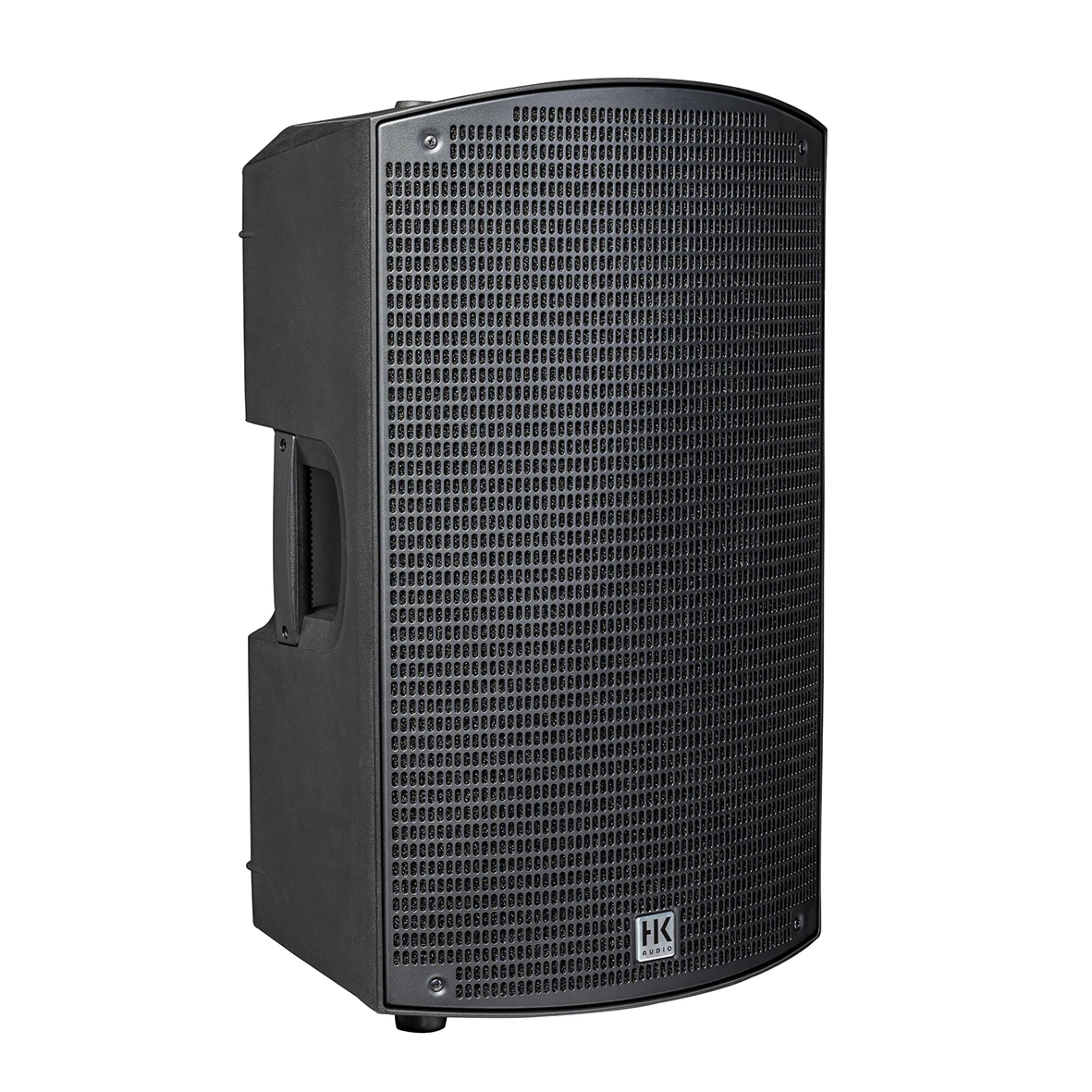
The Sonar 112 Xi is a two-way, bi-amplified active loudspeaker built around a 12-inch woofer and a 1-inch compression driver on a 90° x 60° horn. Power comes from an internal Class-D amp pack rated at 600W programme (typically quoted as 400W LF / 200W HF in the bi-amp split), delivering a maximum SPL in the region of 126 dB. Frequency response covers roughly 60 Hz to 20 kHz, which is honest for a 12-inch box — you get useful low-mid weight and clean extension up top, but you're not getting sub-bass from a single cabinet.
The cabinet is moulded polypropylene, weighs around 15 kg, and includes a 35 mm pole socket, a 55° monitor wedge angle, and multiple M8 fly points for install work. The input section handles two channels — typically a combo XLR/TRS mic-line input and a second line input — with a mix output for daisy-chaining. Add Bluetooth 5.0 streaming and the HK Audio app, and you have a system that covers duo gigs, corporate presentations, school assemblies, dance studios and small-venue front-of-house without needing a mixer for the simplest jobs.
Interested in the specifics? View HK Audio Sonar 112 Xi pricing and full specifications — genuine HK Audio stock with Australian warranty.
The Driver Design: Where German Engineering Actually Shows Up
It's easy to be cynical about "designed in Germany" marketing, so let's be specific about what's different here.
The 12-inch woofer uses a substantial voice coil and a motor structure tuned for the low-mid region rather than raw excursion. This matters more than spec sheets suggest. A lot of budget 12-inch boxes chase a headline SPL figure by pushing a light cone hard, which gives you an impressive number at 1 kHz and a mushy, compressed 200–500 Hz band — exactly where acoustic guitar body, male vocal chest tone and kick drum punch live. The Sonar's woofer holds together noticeably better in that region at three-quarter volume, which is where most gigs actually sit.
Up top, the 1-inch compression driver sits on a 90° x 60° constant-directivity horn. That horizontal 90° pattern is deliberately conservative compared to the 100–110° patterns some competitors use. Wider isn't automatically better: a 90° pattern keeps more energy on the audience and less on the side walls, which in the reflective, hard-surfaced rooms common to Australian pubs and function centres translates directly to better vocal intelligibility. The trade-off is that in a wide, shallow room you'll want the boxes angled in more carefully, or you'll notice the edges going dull.
Bi-Amplification and Why It Matters Here
Bi-amping — separate amplifier channels for woofer and horn, with the crossover applied in DSP before amplification — is standard at this level now, but the implementation quality varies wildly. The practical benefit is that the crossover slopes are exact and unaffected by driver impedance swings, and the HF driver gets its own protection independent of what the woofer is doing. In real terms: when the bass player digs in and the woofer starts working hard, the vocals don't dip in level. Passive crossover designs at this price often can't claim that.
The Xi Generation: Bluetooth and App Control
This is the headline upgrade and it deserves an honest assessment, because "Bluetooth speaker" means very different things depending on context.
What the Bluetooth Streaming Is Genuinely Good For
- Background and interval music — connect a phone or tablet, play your set-break playlist, no cables, no laptop, no extra channel on the mixer.
- Fitness and dance studios — an instructor with a phone and a headset mic has a complete system.
- Corporate and presentation work — walk in, pair, play the video audio from a laptop, done.
- Backing tracks for duo/solo acts — practical, though see the caveat below.
- True stereo pairing — two Xi units can link so one handles left and one right without running a cable across the room.
What It Isn't Good For — And This Is Important
Bluetooth audio carries latency, typically in the 100–200 ms range depending on codec and device. That's fine for playback. It is not fine for anything where you're playing along in time. If you're a solo act triggering backing tracks and singing over them, you need to understand this: the track and your voice will both come out of the speaker together, so you won't hear a sync problem in the room — but if you're running a click to in-ears, or your drummer is playing to the track, or you're using a second wired source alongside the Bluetooth one, the offset will bite you. For anything timing-critical, run a cable. Use the wired inputs and treat Bluetooth as the convenience feature it is.
Bluetooth in a crowded venue also shares the 2.4 GHz band with every phone, wireless mic system and Wi-Fi access point in the building. It's usually fine. "Usually" is not a word you want in your signal path during a paid gig.
The App: The Feature That Actually Changes Your Workflow
The smartphone app gives you remote access to EQ, presets, and system settings. This sounds like a gimmick until the first time you use it properly. Standard practice with pole-mounted PA has always been: set the rear-panel EQ by guess, walk to the middle of the room, listen, walk back, adjust, repeat. With the app, you stand where the audience stands and tune from there. For a solo operator with no sound tech — which describes most gigging musicians in Australia — this is a genuine improvement, not a spec-sheet bullet point.
The onboard presets (typically covering live/FOH, monitor wedge, speech, and sub-satellite modes) are worth using rather than ignoring. The monitor preset in particular applies sensible low-end rolloff and a presence adjustment suited to floor-wedge placement, which saves you from the muddy, feedback-prone result of using a flat FOH curve on the floor.
Real-World Coverage: How Many People Will This Cover?
The most common question, and the one most product pages dodge. Rough working guidance for a pair of Sonar 112 Xi on poles:
| Application | Realistic capacity | Notes |
|---|---|---|
| Solo/duo acoustic, restaurant or bar | 100–150 people | Comfortable, plenty of headroom |
| Full band with live drums | 80–120 people | Add a sub — the kick will demand it |
| DJ / dance event | 60–100 people | Sub essential for any real dance energy |
| Speech, corporate, ceremony | 200–250 people | Speech is far less demanding than music |
| Floor monitors | 2–3 performers each | 55° wedge angle, monitor preset |
| Outdoor (no reflections) | Reduce by ~40% | No room gain to help you |
The single most important caveat: a 12-inch two-way is not a full-range system for amplified music. At 60 Hz on the low end, you're covering bass guitar fundamentals and the body of a kick drum, but not the sub-40 Hz energy that modern electronic music and hip-hop rely on. If your material lives down there, budget for a subwoofer from the start rather than being disappointed and pushing the tops into limiting trying to compensate.
Honest Pros and Cons
What It Does Well
- Low-mid clarity above its class. The driver quality shows up specifically in the 200–800 Hz region where cheaper boxes turn to porridge.
- Controlled dispersion. The 90° x 60° horn keeps energy off reflective surfaces — a real advantage in typical Australian pub and RSL rooms.
- App tuning from the audience position. Genuinely changes how a solo operator works.
- Sensible weight. Around 15 kg is one-hand-onto-a-pole territory for most people, and matters across a long load-in.
- Multi-role competence. FOH, wedge, install (M8 points) and streaming playback from one box.
- Build and support. HK Audio's reputation for longevity and parts availability is well earned; these cabinets tend to still be working a decade on.
Where It Falls Short
- 600W is mid-tier, not top-tier. Competitors at similar money advertise 1000W+ and higher peak SPL. HK's numbers are conservatively rated, but if you're comparing spec sheets in isolation, this looks weaker than it performs.
- Bluetooth latency rules it out for timing-critical use. Covered above — know this before you buy.
- No sub-bass. Inherent to the format, but worth stating plainly.
- Moulded plastic enclosure. Light and durable, but a plywood cabinet of the same size will generally sound marginally tighter in the low-mids and survive touring abuse better.
- Limited onboard mixing. Two inputs is enough for a duo, not a band. You'll still want a mixer for anything beyond the simplest setup.
- Narrower horizontal pattern needs thought. Great for intelligibility, but wide shallow rooms need careful angling.
How It Compares
| Model | Power (programme) | Weight | Standout | Consider it if… |
|---|---|---|---|---|
| HK Audio Sonar 112 Xi | ~600W | ~15 kg | Driver quality, app control, 90°x60° pattern | You value sound quality and controlled dispersion over headline wattage |
| QSC K12.2 | 2000W peak | ~18 kg | Huge SPL, excellent DSP | You need maximum volume and can carry the extra weight and cost |
| Yamaha DBR12 | 1000W peak | ~15.8 kg | Reliability, value | Budget is the priority and you don't need app control |
| Electro-Voice ZLX-12P G2 | 1000W peak | ~15.9 kg | App control, strong value | You want app features at a lower price point |
| RCF ART 912-A | 2100W peak | ~19 kg | Italian driver pedigree, very high SPL | You want maximum output with premium drivers and accept the weight |
| HK Audio Polar 12 | Column array | System | Even coverage, low visual profile | You want one-box column coverage rather than pole-mounted tops |
The honest positioning: the Sonar 112 Xi is not the loudest box in this list, and if raw SPL per dollar is your metric, the QSC and RCF options win on paper. Where the HK earns its place is tonal quality at realistic operating levels and the dispersion control that makes vocals intelligible in difficult rooms. Most gigging musicians spend far more time at 85% volume in a reflective room than at maximum output in an open field — the Sonar is optimised for the former.
Ready to move? Shop the HK Audio Sonar 112 Xi with free shipping across Australia and full manufacturer warranty support.
Setup Advice from Actual Use
- Get the horn to ear height. The single biggest improvement available to you costs nothing. A pole-mounted 112 with the horn at roughly 1.8–2 m puts the HF above the crowd instead of into the back of the front row's heads.
- Start with the preset, then adjust. Choose live/FOH or monitor first — it sets a sensible baseline curve. Don't dial EQ from flat.
- Tune from the audience position using the app. Stand two-thirds of the way back, centre, and adjust from there. That's the seat that matters.
- Don't stack against a back wall. Boundary loading adds 3–6 dB of low-mid that will make everything sound boxy. Pull the speakers forward if you can.
- Toe them in. With a 90° horizontal pattern, angle each cabinet toward the opposite side of the audience. This gives more even coverage than pointing them straight ahead.
- If you add a sub, use the sub-satellite preset. It high-passes the tops so they stop wasting power on frequencies the sub is handling — worth several dB of usable headroom.
- Cable the important things. Bluetooth for playlists, XLR for anything you perform along with.
Australian Buying Considerations
Warranty and support: Buy from an authorised HK Audio dealer. Grey-import PA gear sourced from overseas frequently arrives without valid Australian warranty coverage, and when an amp module fails in year two — which does happen with any powered speaker — you'll be dealing with a distributor who has no obligation to help. HK Audio's Australian support network handles amp module servicing, which is exactly the repair you can't do yourself.
Power: Confirm you're getting the 230–240 V, 50 Hz Australian-market version with a proper AS/NZS-compliant IEC lead. This should be a non-issue from a local dealer, but it's the first thing that goes wrong with imports.
Climate: Australian gigging is hard on electronics. Coastal humidity in Queensland and northern NSW, and 40°C+ ambient temperatures at summer outdoor events, both stress amp modules. Give the rear heatsinks airflow — don't bury a cabinet in a tight alcove or under gear at an outdoor event — and let units cool before packing them into a hot van.
Budget the whole system: A realistic starting rig is two Sonar 112 Xi, two speaker stands, XLR cables, and a small mixer. Add a subwoofer if you're doing DJ or full-band work. Costing this properly up front prevents the common mistake of buying tops at the limit of your budget and then running them into limiting because there's no sub.
Who Should Buy This — and Who Shouldn't
Strong fit
- Solo and duo acts working pubs, clubs, restaurants and function rooms up to ~150 people
- Wedding and corporate suppliers who need speech clarity and clean playback
- Houses of worship, schools and community halls wanting install-capable, good-sounding boxes
- Dance and fitness studios where Bluetooth playback plus a headset mic is the whole system
- Anyone who's owned budget PA and got tired of harsh top end and muddy low-mids
Look elsewhere if
- You need maximum SPL for large or outdoor crowds — step up to 15-inch or higher-powered models
- You're primarily a DJ playing bass-heavy material and won't buy a sub — this isn't the format for you
- You need zero-latency wireless playback for timing-critical performance
- You're touring hard and need road-case-proof plywood construction
- Your budget genuinely can't stretch — the Yamaha DBR12 is an honest, capable alternative at less money
Common Questions
Can I use one Sonar 112 Xi on its own?
Yes, and it's a common configuration for solo acoustic acts, presentations and small function rooms. You lose stereo imaging, but for a single performer that's rarely a real loss. Mono is often the better choice for speech intelligibility anyway. Position it centrally rather than off to one side.
Do I need a mixer?
Not necessarily. Two inputs handles a vocal mic and an instrument, or a mic plus a playback source. Beyond that — a band, multiple mics, any effects — you'll want a small mixer. The mix output lets you feed a second cabinet from the first without a mixer in simple setups.
How does it work as a floor monitor?
Well, and this is one of its stronger arguments. The 55° wedge angle is correct for floor use, the monitor preset applies appropriate EQ, and the controlled horn pattern helps with gain-before-feedback. Two of these will cover a small band's monitoring, or one will happily serve a solo performer.
Can I fly them for a permanent install?
The M8 fly points support it, but rigging overhead loudspeakers is not DIY territory. In Australia, overhead rigging in public venues must comply with WHS requirements — get a qualified rigger and appropriate hardware. The consequences of getting this wrong are severe.
Which subwoofer should I pair with it?
Stay in the HK Audio family if you can — the presets and crossover points are designed to integrate. A single 15-inch or 18-inch active sub transforms the system for band and DJ work. Use the sub-satellite preset on the tops so they're high-passed properly.
Is Bluetooth 5.0 audio quality good enough for a paid gig?
For background music, interval playlists and speech playback, absolutely — it's more than adequate and nobody in the room will notice. For a performance where audio quality is the product, use the wired inputs. The difference is real, if modest.
How long do these last?
HK Audio cabinets have a strong track record for longevity — plenty of their gear from the 2000s is still gigging. The realistic failure point on any powered speaker is the amplifier module, and that's where local warranty support and parts availability matter more than any spec on the box.
The Verdict
The HK Audio Sonar 112 Xi is a considered, well-engineered speaker that makes a specific trade: it gives up headline wattage to competitors in exchange for better driver quality, more controlled dispersion, and smarter workflow features. For the gigging musician, AV supplier or venue that spends its time in real rooms at realistic levels, that's the correct trade.
It's not the right choice if you need maximum SPL, if you play bass-heavy material without a subwoofer, or if Bluetooth latency would break your workflow. Those aren't flaws so much as boundaries, and knowing them before you buy is the difference between a speaker you love for a decade and one you resell in eight months.
If the description of that first frustrating gig at the top of this article sounded familiar — harsh highs, muddy mids, no way to fix it from where you're standing — the Sonar 112 Xi is a direct answer to it. The app control alone changes how a one-person operation tunes a room, and the driver quality means what you're tuning is worth tuning in the first place.
Browse the HK Audio Sonar 112 Xi at MusiconStage — authorised dealer, genuine Australian stock, full warranty and expert advice on matching subs and accessories.
Specifications quoted are based on published manufacturer data and may be updated by HK Audio without notice. Confirm current specifications and pricing on the product page before purchase.