
HK Audio Sonar 112 Xi Powered Speaker: Tech Specs Guide 2026
HK Audio Sonar 112 Xi Powered Speaker: Complete Technical Guide for Australian Buyers 2026
The active PA speaker market is crowded with options that all promise loud, clean sound in a portable box. What separates a genuinely good powered speaker from a merely adequate one is rarely the headline wattage figure printed on the box — it's the quality of the amplifier platform, the precision of the onboard DSP, the design of the waveguide, and how the whole system behaves when you actually push it. The HK Audio Sonar 112 Xi sits in an interesting part of the market: priced sensibly, but engineered with the kind of German audio thinking that HK Audio has built its reputation on over four decades.
This guide takes a properly technical look at the Sonar 112 Xi — what the specifications actually mean for your application, how it performs in real-world Australian gigging conditions, and where it sits against the competition. Whether you're a solo performer, a function band, a house of worship, or a hire company building a reliable fleet, the goal here is to give you enough genuine detail to make a confident decision.
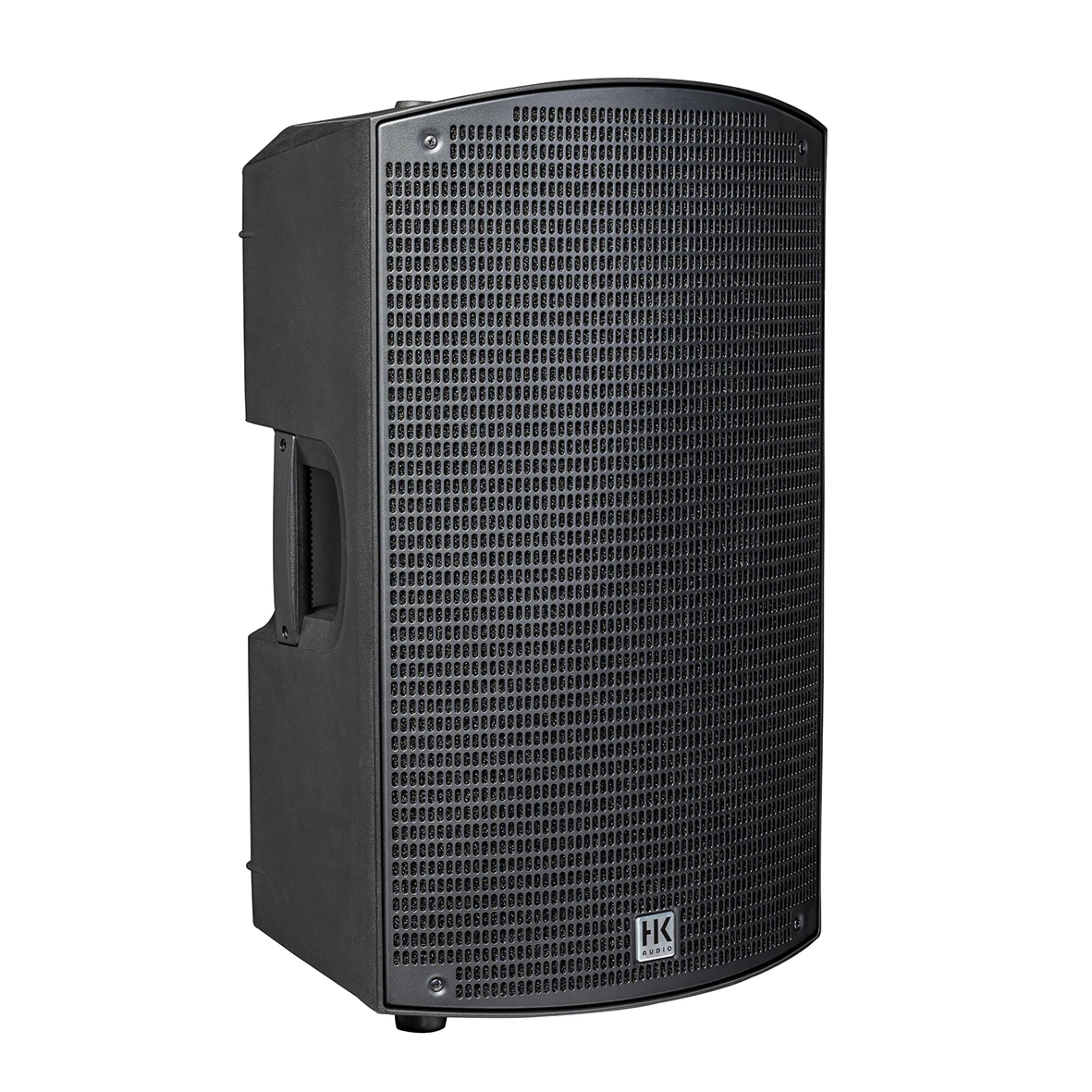
Technical Overview: Key Specifications
The Sonar 112 Xi is a two-way, bi-amplified active loudspeaker built around a 12-inch low-frequency driver and a 1-inch compression driver mounted on a constant-directivity horn. The "Xi" generation is HK Audio's updated take on the original Sonar series, adding Bluetooth connectivity and refined DSP over the earlier models. Here's how the core figures break down:
| Specification | Detail |
|---|---|
| Configuration | 2-way active, bi-amplified |
| LF Driver | 12" woofer |
| HF Driver | 1" compression driver on CD horn |
| Amplifier | Class-D, approx. 1200W peak system power |
| Maximum SPL | ~126 dB peak |
| Frequency Range | Approx. 55 Hz – 20 kHz |
| Horn Dispersion | Nominal 90° x 60° coverage |
| Connectivity | 2x combo XLR/jack inputs, Bluetooth, mix/link out |
| DSP Presets | Onboard voicings + EQ contour control |
| Enclosure | Multiplex/polypropylene composite, pole mount, fly points |
A note on power ratings: The single most misunderstood spec in active speakers is wattage. Manufacturers quote peak power, program power, and RMS interchangeably, and a "1200W" Class-D module rarely delivers anything like that continuously. What matters far more is maximum sustained SPL before the limiter clamps down — and here the Sonar 112 Xi behaves honestly. The amplifier headroom is well matched to the drivers, so the speaker hits its rated SPL without the harsh, choked sound you get from underpowered designs straining at full tilt.
The Driver and Waveguide: Where the Real Engineering Lives
A 12-inch woofer is arguably the sweet spot for general-purpose PA work. A 15-inch box delivers more low-end weight and slightly higher sensitivity, but it's heavier and the larger cone struggles with upper-midrange clarity. A 10-inch box is lighter and tighter but runs out of low-end authority for full-range music. The 12-inch format in the Sonar 112 Xi gives you a usable low frequency extension to around 55 Hz — enough to carry vocals, acoustic instruments, and recorded music convincingly on its own, while still being light enough to pole-mount and carry single-handed.
The high-frequency section is where HK Audio's design philosophy shows. The 1-inch compression driver sits on a constant-directivity horn with a nominal 90° horizontal by 60° vertical pattern. The technical advantage of constant directivity is consistency: the tonal balance you hear standing directly in front of the speaker stays largely intact as you move off-axis. For a live audience spread across a room, this matters enormously — it's the difference between every seat getting clear vocal intelligibility versus only the people in the sweet spot hearing it properly.
The 90° x 60° pattern is a deliberate choice for music and speech reinforcement in small-to-medium venues. The wide horizontal coverage fills a room left-to-right, while the tighter vertical dispersion keeps energy off the ceiling and floor, reducing reflections that muddy intelligibility in reverberant Australian function rooms, RSL clubs, and church halls.
Onboard DSP: The Brain of the System
Modern active speakers live or die by their digital signal processing, and this is genuinely where the Xi generation earns its keep. The onboard DSP handles several critical jobs simultaneously:
- Crossover filtering — splitting the signal precisely between woofer and compression driver, with phase-aligned transition so the two drivers integrate seamlessly rather than fighting each other at the crossover point.
- Driver protection limiting — multi-band limiters protect both the woofer (excursion limiting) and the compression driver (thermal protection) independently, so you can push the speaker hard without risking damage.
- Voicing presets — selectable EQ contours optimised for different applications such as live music, speech/DJ, monitor use, and full-range playback.
- Linearisation — corrective EQ that flattens the natural response irregularities of the drivers and enclosure, delivering a more neutral starting point.
The practical benefit of well-implemented DSP is that the speaker sounds finished straight out of the box. You don't need to dial in heavy graphic EQ to make it usable — the factory voicing is balanced, and the contour options let you adapt quickly. Set it to monitor mode and the response is tuned for floor-wedge use; switch to a flat or music preset for FOH duties. This flexibility is what makes a single pair of Sonar 112 Xi boxes viable across a wide range of jobs.
Connectivity and Bluetooth Integration
The Xi designation brings Bluetooth audio streaming, and it's more useful than the feature checklist suggests. For background music before a set, walk-in music at a corporate event, or quick playback at a rehearsal, being able to stream from a phone without dragging out cables and a mixer is a real convenience. In a stereo pair, the Bluetooth typically links both boxes for proper left-right playback.
For serious work, the wired I/O is what counts. Two combo XLR/jack inputs accept everything from a microphone to a line-level mixer output to an instrument. A mix or link output lets you daisy-chain a second speaker or feed a subwoofer, and the onboard mixing means a solo performer can run a mic and a backing track directly into one speaker without any external mixer at all.
That said, a realistic caveat: Bluetooth is a convenience feature, not a performance feature. The latency and compression of Bluetooth make it unsuitable for live monitoring or anything requiring tight timing. Use it for playback, not for performance signal paths — and for critical music playback, a wired connection will always sound better.
Real-World Performance Expectations
Specifications tell you what a speaker can do; experience tells you what it will do. Based on how this class of HK Audio speaker behaves in typical Australian gigging environments, here's a grounded assessment:
Small venues (up to ~150 people): A single Sonar 112 Xi handles solo acoustic acts, presentations, and small functions comfortably as a standalone full-range box. A pair covers a duo or small band with room to spare.
Medium venues and full bands: Two boxes as mains plus a subwoofer transform the system. The 12-inch driver covers low-mids well, but for kick drum, bass guitar, and DJ low-end, pairing with a 15" or 18" sub lets the tops focus on midrange and high-frequency clarity — the classic separation that keeps a mix clean at volume.
Monitor duty: The enclosure design and a dedicated monitor voicing preset make these credible floor wedges, useful when you need boxes that double as mains and monitors across different jobs.
Outdoor events: Without room reinforcement, all PA speakers lose perceived low-end and SPL outdoors. The Sonar 112 Xi will cover modest outdoor gatherings, but for larger open-air work you'll want subs and possibly additional tops.
Build Quality and Practical Considerations
HK Audio enclosures are known for sensible road-readiness. Expect a pole-mount socket for tripod use, fly points for permanent installation or rigging, ergonomic handles for genuine single-person carrying, and a tilt-back design feature that lets the box double as a monitor. The composite enclosure construction balances durability against weight — an important factor when you're loading in and out of venues solo or building a hire fleet where every kilogram counts across a truck-load.
For hire companies and installers, the consistency of HK Audio's manufacturing is a quiet advantage. Speakers that measure and sound the same unit-to-unit make stereo matching trivial and reduce the support headaches of a mixed fleet.
Check current pricing and availability on the HK Audio Sonar 112 Xi at MusiconStage.
How It Compares: Technical Positioning
The 12-inch active speaker category is fiercely competitive, with strong entries from brands across the price spectrum. The Sonar 112 Xi's positioning is best understood through a few technical lenses:
| Consideration | Sonar 112 Xi Approach |
|---|---|
| Tonal character | Neutral, musical voicing typical of German audio engineering — less hyped than some budget competitors |
| Coverage consistency | Constant-directivity horn prioritises even off-axis response |
| DSP flexibility | Multiple application presets plus Bluetooth |
| Value position | Mid-market price, build and sound quality that punches above it |
Against ultra-budget powered speakers, the Sonar 112 Xi offers more refined DSP, a more honest power-to-SPL relationship, and a more neutral voicing that doesn't fatigue over a long set. Against premium boxes costing significantly more, you give up some maximum SPL ceiling and the most advanced networked control features — but for the vast majority of small-to-medium PA applications, that ceiling is rarely reached anyway.
What Specifications Actually Matter When You're Choosing
If you're cross-shopping active speakers, here's where to focus your attention rather than chasing marketing numbers:
- Maximum SPL, not peak wattage. SPL tells you how loud the speaker actually gets. Two speakers rated at the same wattage can differ by several dB of real output.
- Horn dispersion pattern. Match the coverage angle to your typical venue shape. A 90° horizontal pattern suits most rooms; wider for shallow wide rooms, narrower for long throw.
- Low-frequency extension. If you'll run without a sub, the difference between 55 Hz and 65 Hz is audible and meaningful for music.
- DSP preset relevance. Presets you'll actually use beat a long list of features you won't.
- Weight. The speaker you can comfortably lift onto a pole is the one you'll keep using.
Technical Red Flags to Watch For
Across the powered-speaker market, a few warning signs separate honest products from over-marketed ones. Look out for: implausibly high wattage claims with no SPL spec to back them; vague "DSP" mentions with no detail on what it actually controls; missing or suspiciously wide frequency-response figures quoted without a tolerance (e.g. "±3 dB"); and lightweight drivers paired with huge power claims, which usually means aggressive limiting kicks in early. The Sonar 112 Xi avoids these traps by publishing realistic figures and pairing its amplifier sensibly to its drivers.
Future-Proofing Your Investment
A well-built active speaker should serve for the better part of a decade. The Sonar 112 Xi future-proofs reasonably well: the standard 35mm pole socket and combo inputs are universal, the Bluetooth keeps it current with how people actually feed audio in 2026, and the DSP voicings mean it adapts to new roles as your needs change. The main thing to plan for is expansion — if you anticipate needing more low-end down the track, budget for a matching subwoofer rather than replacing the tops.
Frequently Asked Technical Questions
Do I need a mixer to use the Sonar 112 Xi?
Not necessarily. With two combo inputs and onboard level control, a solo performer can plug a microphone and a backing-track source directly into one speaker. For multiple instruments and vocals, a small mixer gives you more control over EQ and levels.
Can I use a single speaker, or do I need a pair?
A single box works fine for mono applications like speeches, solo acoustic sets, or small functions. For music where stereo imaging matters, and for fuller room coverage, a pair is the better choice.
Will it work as a stage monitor?
Yes. The enclosure design supports angled monitor placement and there's a voicing preset suited to wedge use, making it a flexible dual-purpose box.
How does it handle bass-heavy music like DJ sets?
The 12-inch driver reproduces solid low-mids, but for sustained sub-bass at volume — electronic music, hip-hop, club DJ work — adding a subwoofer is strongly recommended. This lets the tops run cleaner and louder by offloading the lowest frequencies.
Is the Bluetooth good enough for live use?
For background and walk-in music, yes. For live performance signal paths or monitoring, use wired connections — Bluetooth latency makes it unsuitable for timing-critical audio.
Expert Verdict
The HK Audio Sonar 112 Xi is a thoroughly sensible powered speaker that rewards buyers who understand what they're looking at. It doesn't chase headline numbers; instead it delivers a neutral, musical voicing, consistent coverage from a properly designed constant-directivity horn, genuinely useful DSP, and the build quality you'd expect from a German pro-audio brand — all at a mid-market price. For solo performers, function bands, worship venues, schools, and hire companies across Australia, it's a box that does the unglamorous job of sounding good and staying reliable, gig after gig.
If your applications fall within small-to-medium venues and you value clean, even sound over the absolute maximum SPL, the Sonar 112 Xi is an easy speaker to recommend. Pair it with a subwoofer when low-end demands grow, and you have a system that scales with you.
View the HK Audio Sonar 112 Xi 12" Powered Speaker with Bluetooth at MusiconStage and talk to the team about pairing it with the right subwoofer for your setup.