
HK Audio Polar 12 Hire: Column PA Specs Decoded 2026
HK Audio Polar 12 Hire: Column PA Specs Decoded 2026
Column array PA systems occupy an odd place in the hire catalogue. They look like a piece of minimalist furniture, they pack down small enough to fit in a hatchback, and they cost more per watt than a conventional powered top and sub. So when someone puts a HK Audio Polar 12 on a quote, the fair question is: what are you actually paying for, and does the physics justify it?
This is a technical look at the Polar 12 — the driver complement, the amplifier and DSP, what its dispersion pattern really means for coverage, and the situations where a single unit is genuinely the right call versus where you're better off with a pair or a different topology entirely. If you're specifying gear for a wedding, a corporate presentation, a conference room or a small acoustic gig in Australia, the numbers below should let you make that call properly rather than guessing.
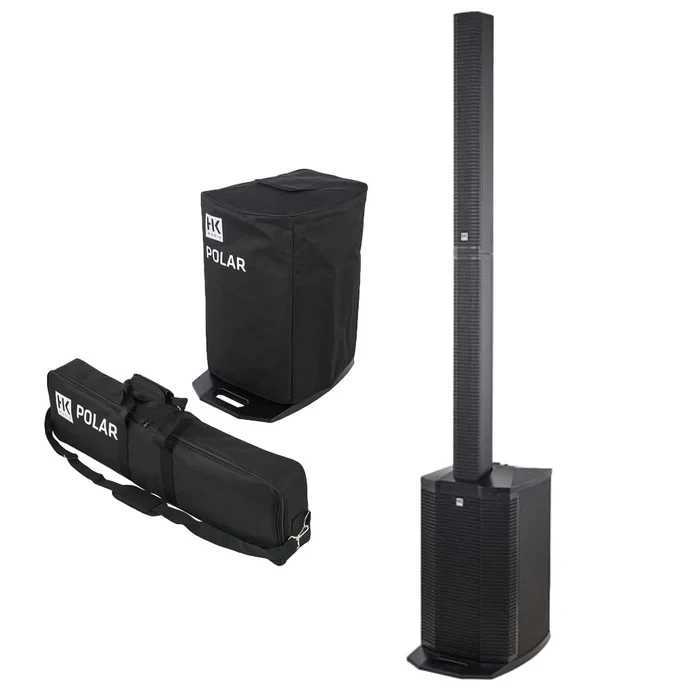
System Architecture: What the Polar 12 Actually Is
The Polar 12 is a three-way active column array, not a two-way powered speaker in a tall box. That distinction matters more than most spec sheets make clear. The system splits into three functional parts:
- The bass cabinet — a 12-inch woofer in a bass-reflex enclosure that also houses all the amplification, the DSP, and the input stage. Everything electronic lives down here, which is why the column itself is a passive, featherweight extrusion.
- The mid/high column — a vertical array of eight 3.5-inch neodymium mid drivers with a dedicated high-frequency driver handling the top octaves. The drivers are spaced closely enough relative to their wavelengths that they behave as a coherent line source through the vocal band.
- The spacer/riser section — sets the array height so the acoustic centre sits above head height. This is functional, not cosmetic: get it wrong and the front two rows of the audience shadow everyone behind them.
The three sections connect via a multi-pin locking connector rather than loose Speakon cables, so assembly is a stack-and-twist operation. Realistically you're looking at under two minutes from case to powered up, which is a large part of why these systems dominate the single-operator hire market.
Full Specification Table
The figures below reflect HK Audio's published data for the Polar 12. As with any long-running product line, minor revisions happen — if a specific number is load-bearing for your design (peak SPL for an outdoor site, or current draw for a shared circuit), confirm it against the exact unit supplied at time of hire.
| Parameter | Specification | What It Means In Practice |
|---|---|---|
| System type | 3-way active column array | Separate amp channels for LF, MF and HF — no passive crossover losses in the critical band |
| LF driver | 1 × 12" woofer, bass reflex | Genuine kick-drum and bass-guitar extension, not just "warmth" |
| MF drivers | 8 × 3.5" neodymium | The line-source element; neodymium keeps the column light enough to lift one-handed |
| HF driver | 1 × 1" driver | Handles roughly 6 kHz up; carries sibilance, cymbals and presence |
| Frequency response | Approx. 38 Hz – 20 kHz | Low corner is genuinely low for a system this size — a separate sub is rarely needed for speech or acoustic work |
| Max SPL | Approx. 129 dB peak | Comfortably covers 150–200 people indoors with headroom to spare |
| Horizontal dispersion | Approx. 120° | Very wide — one unit can cover a room corner-to-corner |
| Vertical dispersion | Narrow (line-source behaviour) | The key spec. Energy stays out of ceilings and floors |
| Amplification | Class-D, multi-channel, DSP-controlled | Cool-running, light, and consistent output as the mains sag |
| Inputs | Multi-channel onboard mixer (combo mic/line inputs plus stereo line/streaming) | Small jobs run without a separate desk at all |
| Protection | Limiter, thermal and excursion protection | You can drive it hard without cooking it |
| Total weight | Approx. 30–31 kg across three pieces | Heaviest single piece is the sub; no piece requires two people |
The Line-Source Principle: Why Column Arrays Behave Differently
This is the section that actually explains the price. A conventional point-source loudspeaker radiates a roughly spherical wavefront. Sound pressure falls off according to the inverse square law — roughly 6 dB for every doubling of distance. Stand 4 metres back instead of 2, and you've lost 6 dB. Go to 8 metres, you've lost 12 dB.
A line source radiates a cylindrical wavefront within its near field. Because the energy is spreading in two dimensions rather than three, the theoretical fall-off is 3 dB per doubling of distance instead of 6 dB. In practice you don't get the textbook figure across the whole audible band — the near-field/far-field transition is frequency dependent, and above a certain distance a short column reverts to point-source behaviour. But through the midrange, where speech intelligibility lives, the difference is real and audible.
The practical consequence: front-to-back level consistency. With a point source, getting the back row loud enough means blasting the front row. With a column, the gap between front and back narrows substantially. For a wedding where the bridal table sits three metres from the PA and the dance floor extends fifteen metres back, that's not a marginal improvement — it's the difference between a workable mix and constant apologies.
The second benefit is the narrow vertical pattern. Most rooms that sound bad sound bad because of ceiling and floor reflections arriving 10–30 ms after the direct sound, smearing consonants. A column array simply doesn't send much energy at the ceiling. In a reverberant space — a church hall, a function room with a hard floor, a glass-walled conference venue — this typically buys you more intelligibility than any amount of EQ on a conventional box.
Check availability and hire rates for the HK Audio Polar 12 here.
Amplification and DSP: Where the Engineering Hides
The Polar 12 runs multi-channel Class-D amplification with active crossovers implemented in DSP rather than passive components. Three things follow from that:
Crossover precision. A passive crossover is a compromise between component cost, insertion loss and phase behaviour. An active DSP crossover lets HK use steep slopes at exactly the right frequencies, with individual delay and phase alignment per band. On a column array this is essential — the physical offset between the 12-inch woofer at floor level and the mid drivers a metre and a half up creates a time-of-flight difference that must be corrected, or the crossover region turns into a comb filter.
Protective limiting that isn't just a brick wall. Modern DSP limiting is multi-band and predictive: it watches driver excursion and voice-coil temperature models, not just output voltage. The audible result is that the system compresses gracefully at the top of its range instead of clipping. For hire stock this is doubly important — it means an inexperienced operator can push the system hard without damaging it, which is why hire companies favour DSP-protected systems.
Consistent output on soft mains. Class-D with a switch-mode supply holds its rails far better than a legacy Class-AB design when the mains voltage dips. On Australian sites — long extension leads, a shared 10 A circuit, a portable generator at an outdoor ceremony — this is a real-world advantage rather than a datasheet footnote.
The onboard mixer deserves a mention too. Combo inputs with mic preamps and phantom power, plus a stereo line/streaming channel, mean a straightforward job — a celebrant's mic, a lectern mic and background playlist — runs entirely from the back of the sub. No desk, no multicore, no additional power drop.
Realistic Coverage Expectations
Manufacturer coverage claims are usually generous. Here's a more conservative read based on how these systems behave in typical Australian venues:
| Application | Audience | Single Polar 12? | Notes |
|---|---|---|---|
| Conference / presentation, speech only | Up to 250 | Yes, comfortably | Speech has low crest factor; you're nowhere near the limiter |
| Wedding ceremony, outdoors | Up to 120 | Yes | No room gain outdoors — position centrally, keep it close to the guests |
| Wedding reception with DJ | 100–150 | Yes, indoors | Above ~150 with sustained dance-floor levels, add a second unit |
| Acoustic duo / solo performer | Up to 150 | Yes | Ideal use case — this is what the topology is built for |
| Full band with live drums | Any | Marginal | The 12" handles more low end than most columns, but a dedicated sub and conventional tops will do better |
| Corporate event, wide/shallow room | 200+ | Pair recommended | Two units at the room's third-points beats one loud unit every time |
| Outdoor festival stage | Any | No | Wrong tool — you need horn-loaded throw and dedicated subs |
Single Unit or a Pair? The Hire Decision
This listing is for a single speaker, and that's deliberate — a surprising proportion of jobs are better served by one column than two. Some reasoning:
One unit is often technically superior for speech. Two spatially separated sources reproducing the same mono signal create interference — comb filtering across the seats where the two arrivals are similar in level but different in time. For a lectern mic feeding a mono programme, a single centrally placed column produces a cleaner, more intelligible result than a stereo pair. Broadcast and conference audio has understood this for decades.
Go to a pair when: the room is wider than roughly 15 metres; there's a physical obstruction (a structural column, a bar, a dance floor split across two zones); music is the primary programme and you want genuine stereo imaging; or you're pushing sustained levels near the system's limit and want the extra 3–6 dB of headroom.
Two units at half throttle always beat one at full throttle. The limiter is doing less work, distortion products are lower, and thermal compression — the gradual output loss as voice coils heat and their resistance rises — is meaningfully reduced across a four-hour reception.
How the Polar 12 Compares Technically
| System | LF Driver | Topology | Technical Position |
|---|---|---|---|
| HK Audio Polar 12 | 12" | 3-way active column | The largest LF driver in the mainstream column class — genuine low-end extension without a separate sub |
| Electro-Voice Evolve 50 | 12" | 2-way column | Closest direct competitor; slightly simpler crossover topology, similar coverage |
| Bose L1 Pro32 | Dual 10" (in-line) | Articulated line array | Exceptional vertical control; less low-end weight from the integrated sub |
| LD Systems MAUI 28 G3 | Dual 8" | Cardioid sub + column | Cardioid bass pattern is genuinely useful on small stages; less raw LF output |
| Conventional 12" top + 15" sub | 15" | Point source | More SPL and more low end for the money — but two heavier boxes, a pole, and 6 dB/doubling fall-off |
The honest summary: if you need maximum SPL per dollar, a conventional top-and-sub rig wins. If you need even coverage, intelligibility in a difficult room, fast solo setup and a system that doesn't visually dominate the space, the column wins — and the Polar 12's 12-inch woofer means you give up less low-frequency extension than most columns ask you to.
Which Specifications Actually Matter
A short guide to reading column-array datasheets sceptically:
- Peak SPL is nearly meaningless on its own. A peak figure is a millisecond-scale transient measured at 1 metre. What matters is continuous SPL at the back of the room with the limiter idle. As a rule of thumb, budget 6–10 dB below the quoted peak for sustained programme.
- Watts are a marketing number. Peak amplifier power tells you nothing about acoustic output. Driver sensitivity and cone area do the work. A 12-inch woofer moves substantially more air than a pair of 8s regardless of what the amplifier is rated at.
- Low-frequency corner needs a tolerance attached. "38 Hz" without a −3 dB or −10 dB qualifier is unverifiable. Treat published low corners as directional, and judge by driver size and cabinet volume.
- Vertical dispersion is the spec that defines the category. If a manufacturer doesn't publish a vertical pattern for a column product, be suspicious — it's the whole reason the format exists.
- Weight of the heaviest single piece matters more than total weight. A 31 kg system in three liftable pieces is a one-person job. A 31 kg system in one piece is not.
Honest Limitations
No system is universal, and a hire recommendation that doesn't state the failure modes isn't worth much:
- It won't do a loud rock band. The 12-inch woofer is excellent for its class, but a drum kit and bass rig at gig levels want a dedicated 18-inch sub. The limiter will protect the system; you just won't get the level you wanted.
- Long-throw is not its strength. Beyond roughly 20–25 metres, the near-field advantage fades and you're back to point-source behaviour with a modest driver complement. Big outdoor sites need a different design.
- The narrow vertical pattern is unforgiving of placement. Put the column on a raised stage and you may fire directly over the audience's heads. Column arrays want to stand on the floor at audience level.
- Wind is a real factor outdoors. A tall, light column on a small base is a sail. Ballast the base or strap it — Australian coastal ceremony sites in particular.
- Onboard mixing is a convenience, not a console. Beyond three or four sources you want a proper desk feeding the line input.
View the HK Audio Polar 12 single-speaker hire listing to check what's included in the package and confirm dates.
Setup Notes Worth Knowing
A few things that separate a good result from a mediocre one:
- Floor placement, not stage placement. Stand the sub on the floor. The narrow vertical pattern needs the array's acoustic centre roughly at or just above standing head height, aimed into the crowd.
- Boundary loading is free gain — and free problems. Placing the sub against a solid wall gains you several dB of low end. In a corner you may gain too much and turn everything muddy. If it sounds boomy, pull it 30–50 cm off the wall before reaching for EQ.
- Use the DSP presets. The speech and music presets adjust crossover and limiter behaviour, not just tone. Selecting the correct one is a genuine performance change.
- Gain structure at the input stage. Set the source hot into the preamp and use the master to control level. Running a weak input with the master maxed raises the noise floor and gets you closer to feedback for no benefit.
- Power planning. A single Polar 12 runs happily from a standard Australian 10 A GPO. If you're adding lighting, a coffee cart or catering equipment to the same circuit, plan the load — a tripped breaker mid-ceremony is a hire company's worst afternoon.
Technical FAQs
Do I need a separate subwoofer with the Polar 12?
For speech, acoustic music, background playlists and most wedding receptions, no — the 12-inch woofer is doing the job a dedicated sub would do on a smaller column. If your programme is heavy electronic music at high level, adding a sub will help, but at that point reconsider whether a column is the right topology at all.
Can it be flown or pole-mounted?
No. Column arrays are ground-stacked systems that rely on the mechanical connection between sections. Treat that as a hard constraint.
How many people can one unit cover?
Roughly 200–250 for speech-only in a typical function room, and 100–150 for music at dance-floor levels. Room acoustics shift these figures significantly — a carpeted, low-ceilinged room is far more forgiving than a tiled atrium.
Is Bluetooth streaming latency a problem?
For background music and playlist playback, no. For anything requiring sync — video playback, a performer playing along to a backing track — use a cable. Bluetooth latency is measured in tens to hundreds of milliseconds and is not appropriate for time-critical material.
How does one column compare to two conventional 12-inch tops on poles?
Two conventional tops will produce more raw SPL. The single column will produce more even coverage, better intelligibility in a reverberant room, and a far tidier setup. Choose based on which of those you actually need.
Will it survive an Australian summer outdoor event?
Class-D amplification runs cool and the DSP includes thermal protection, so heat is unlikely to be the limiting factor. Direct sun on a black enclosure for hours is still worth avoiding, and any moisture exposure needs proper covering — these are not weatherised enclosures.
The Verdict
The HK Audio Polar 12 is a well-engineered answer to a specific and very common problem: covering a room of 100–200 people, evenly, with excellent speech intelligibility, using one person and one car boot. Its 12-inch woofer gives it more low-frequency authority than most of the column field, and the three-way active topology with DSP crossover and alignment is genuinely better engineering than a two-way passive column — you can hear it in the crossover region.
Where it earns its keep is difficult rooms. Hard surfaces, high ceilings, glass walls, awkward geometry — the narrow vertical pattern does work that no amount of EQ on a conventional box will replicate. Where it doesn't earn its keep is loud bands, large outdoor sites and anywhere raw SPL per dollar is the metric. Be clear about which of those your event is, and the decision makes itself.
For most weddings, corporate functions, conferences, presentations and acoustic performances in Australia, a single Polar 12 is a properly considered choice rather than a compromise — and hiring rather than buying means you get a maintained, DSP-protected system without the capital outlay or the storage problem.
Enquire about HK Audio Polar 12 hire and check availability for your event date.