
Electro-Voice Evolve 50 Explained: Column PA Basics 2026
Electro-Voice Evolve 50 Explained: Column PA Basics 2026
If you've ever stood in a music shop staring at a tall, skinny black speaker on a stick and thought "what actually is that thing?" — you're in exactly the right place. Column PA systems have quietly become the default choice for solo performers, duos, wedding DJs, mobile presenters and small venues across Australia, and the Electro-Voice Evolve 50 is one of the most commonly recommended models in the category.
This guide assumes you know nothing about PA systems. We'll define the jargon before we use it, explain why each feature exists rather than just listing specs, and be honest about where the Evolve 50 fits — and where it doesn't. By the end you'll be able to walk into a conversation about column arrays and hold your own.
New to this? Start here: what a PA system actually does
PA stands for "public address". A PA system's whole job is to take a quiet sound — your voice into a microphone, a guitar, a laptop playing music — make it much louder, and spread it evenly across a room so everyone hears roughly the same thing.
Every PA system has three jobs:
- Take inputs — microphones, instruments, phones, laptops, DJ gear
- Amplify — boost that tiny signal into something powerful enough to fill a space
- Project — push the sound out through speakers in a controlled, even way
Traditionally you'd buy those as separate boxes: a mixer, an amplifier, and speakers, plus a rack and a pile of cables. An all-in-one portable system like the Evolve 50 folds all three jobs into one product you can carry in two trips.
What is a column PA system?
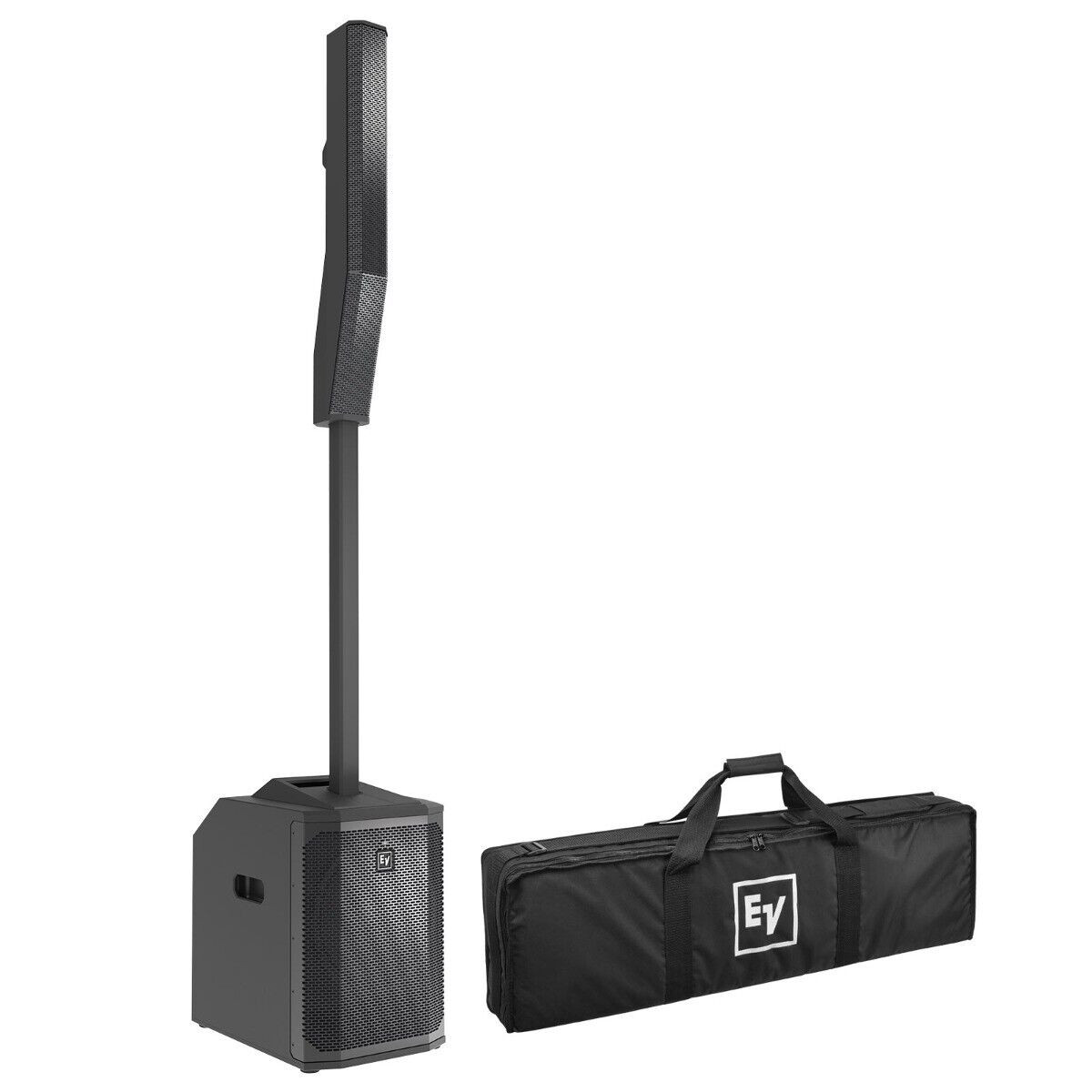
A column PA system (also called a column array or, informally, a "stick system") has two parts:
- A subwoofer that sits on the floor and handles the low frequencies — kick drum, bass guitar, the thump in dance music.
- A tall, slim column that mounts on top of the subwoofer and contains a vertical row of small speaker drivers. This handles everything else — vocals, guitars, cymbals, detail.
Why put lots of small speakers in a line?
Here's the analogy that makes it click. Imagine spraying a garden hose. A normal speaker is like a wide-open nozzle: water goes everywhere, including straight up at the ceiling and down at the floor where nobody is standing. A column array is like adjusting that nozzle to a flat, wide fan: the sound spreads out sideways across the audience, but stays fairly narrow vertically.
That matters for two practical reasons:
- Less room echo. Sound that never hits the ceiling or floor can't bounce back at you as mud. In hard, reflective rooms — think function centres, RSL club function rooms, church halls, marquees with a hard floor — this is the single biggest reason column systems sound clearer than a conventional box on a pole.
- More even coverage front to back. With a normal speaker, the front row gets blasted and the back row strains to hear. A column array evens that out considerably, because the sound doesn't fall away as sharply with distance.
Key learning point: a column system isn't automatically "louder" than a conventional speaker of similar power. What it buys you is clarity, even coverage and a discreet visual footprint — which is usually what actually determines whether a gig sounds good.
Meet the Evolve 50: what you're actually buying
The Evolve 50 is Electro-Voice's flagship portable column system. EV is a long-established American pro-audio brand (now part of the Bosch group) with decades of history in touring loudspeakers and microphones — a name you'll see on stages, in stadiums and in installed systems worldwide. That heritage matters mostly because it means parts, service and spares exist in Australia rather than disappearing after two years.
Here's the system at a glance. These reflect Electro-Voice's published figures at the time of writing — always confirm current specs on the product page before you buy.
| Specification | What it says | What it means for you |
|---|---|---|
| System type | Powered portable column array | Amplifier is built in — no separate amp needed |
| Total power | 1000 W peak, Class-D | Plenty for crowds up to roughly 200–300 people |
| Subwoofer | Single 12" driver, ported cabinet | Real low end, not a token thump |
| Column | Eight 3.5" full-range drivers | The line array that gives even, clear coverage |
| Coverage pattern | Approx. 120° horizontal x 40° vertical | Wide left-to-right, controlled up-and-down |
| Frequency range | Approx. 43 Hz – 18 kHz | Full musical range, deep enough for DJ work |
| Max SPL | Around 127 dB peak | Comfortably loud for pubs, functions and small halls |
| Built-in mixer | 3-channel (2 x mic/line combo, 1 x stereo line/Bluetooth) | Mic and guitar straight in, no external mixer required |
| Processing | QuickSmart DSP with presets, EQ and LCD screen | Sensible sound without needing an engineer |
| Wireless | Bluetooth audio streaming plus app control | Play music and adjust settings from your phone |
| Weight | Roughly 22 kg subwoofer, around 30 kg total | One person can load it in, in two or three trips |
| Setup | Tool-free stacking, under a minute | You're not building furniture before every gig |
Want to check current pricing and availability? View the Electro-Voice Evolve 50 in black at MusiconStage.
The jargon decoder
Spec sheets are written for people who already understand them. Here's the translation.
- Powered / active: the amplifier is built into the speaker. You plug in mains power and a microphone, and it works. "Passive" speakers need a separate amplifier — more boxes, more cables, more to learn. The Evolve 50 is powered.
- Watts (W): a rough indicator of amplifier grunt. Useful for comparing similar products, but a bad standalone measure of loudness. Speaker efficiency matters just as much.
- dB SPL: sound pressure level, the actual measure of loudness. Every 3 dB roughly doubles the power required; every 10 dB sounds about "twice as loud" to human ears. 127 dB peak is very loud — well past what most Australian venues will let you run.
- Frequency response (Hz to kHz): the range of pitches the system reproduces. 43 Hz is deep bass; 18 kHz is the shimmer on cymbals. Human hearing tops out around 20 kHz, less as we age.
- DSP (Digital Signal Processing): a small computer inside the speaker that shapes the sound, protects the drivers from damage, and offers preset modes. Think of it as the difference between a manual camera and one with scene modes.
- Combo input: a socket that accepts either an XLR plug (microphones) or a 6.35 mm jack (guitars, keyboards). Two connector types, one hole.
- Line level vs mic level: microphones produce a very weak signal (mic level) that needs extra boosting; laptops, mixers and keyboards produce a stronger one (line level). Plugging the wrong one into the wrong setting is the most common beginner sound problem. The Evolve 50's combo inputs let you select which you're using.
- Feedback: that horrible squeal when a microphone hears its own amplified sound and loops. Caused by mic placement and EQ, not by faulty gear.
Evolve 50 features explained — and why each one matters
The eight-driver column
Eight 3.5-inch drivers in a vertical line create that controlled 120° x 40° dispersion described earlier. In practice: stand anywhere in a typical function room and the vocal stays intelligible. That's the whole point. Intelligibility — being able to understand words — is the single most underrated quality in a PA system, and it's where column arrays earn their keep, especially for speech, acoustic acts and ceremonies.
The 12-inch subwoofer base
A 12" driver is a genuinely serious size for a portable system. Many competing column systems use a 10" or even 8" sub. The practical difference is DJ and backing-track work: with a 12", kick drums and bass lines land with weight rather than politely tapping. If your work is 80 per cent spoken word, this is more sub than you need. If you play to dancing crowds, it's the reason to choose the 50 over smaller models.
The built-in three-channel mixer
Two combo mic/line channels plus one stereo line/Bluetooth channel. For a solo singer-guitarist that's exactly right: mic in channel one, guitar in channel two, backing tracks over Bluetooth or a cable into channel three. No external mixer, no extra bag.
Beginner warning: three channels is genuinely the limit. If you're a four-piece band with drums, you will need a separate mixer feeding the Evolve 50. That's completely normal and works fine — but budget for it rather than being surprised on the day. (Electro-Voice also make an Evolve 50M variant with a larger onboard mixer and a monitor output, aimed specifically at bands; worth knowing that option exists.)
QuickSmart DSP and the LCD screen
Rather than hiding settings behind cryptic dip switches, the Evolve 50 gives you a small screen with readable menus, a set of application presets (music, speech, and so on), simple EQ, and the ability to save your settings. This is a genuinely beginner-friendly design decision: you can get a good sound by choosing the right preset, without understanding parametric EQ at all, and grow into the deeper controls later.
Bluetooth streaming and app control
Two separate uses that people often conflate. First, you can stream music from a phone for background music between sets or during a break. Second, EV's mobile app lets you adjust the system's settings wirelessly — meaning you can walk out into the audience and tune the sound from where people are actually standing, which is far more useful than tweaking from behind the speaker. That single habit will improve your mixes more than any gear upgrade.
Tool-free setup
The column sections and spacer stack onto the sub without tools or stands. Realistically you're looking at well under a minute to assemble once you've done it twice. For anyone gigging solo — no crew, unloading from the boot of a Corolla — this is a bigger quality-of-life factor than most spec sheets convey.
Who is the Evolve 50 genuinely right for?
Excellent fit:
- Solo performers and duos playing pubs, clubs, wineries and restaurants
- Mobile DJs doing weddings, birthdays and corporate functions up to a few hundred guests
- Celebrants, MCs and presenters who need speech to be crystal clear
- Schools, churches and community halls wanting one portable system for multiple uses
- Anyone who loads in and out alone and values speed
Probably not the right pick:
- Full bands with live drums needing loud onstage monitoring — you'll want a mixer plus dedicated monitors
- Outdoor events for 500+ people, where you need conventional high-output boxes
- Very tight budgets where a basic pair of powered speakers would do the job for less
- Permanent installs — an installed system will serve you better long-term
Beginner buying guide: what to prioritise
When you're new, it's tempting to compare spec sheets column by column. Here's what actually determines whether you're happy in two years.
- Match capacity to your real gigs, not your dream gigs. Buy for the room you play most weekends. Over-buying is expensive and heavy; under-buying means distortion and a system running flat out.
- Weight and trips. Be brutally honest about how many times a week you'll carry this up stairs. Around 30 kg split into two main pieces is manageable solo; a heavier system is not.
- Channel count. Count your inputs, then add two. Three onboard channels is fine for a duo, restrictive for a trio.
- Support and service in Australia. A well-supported brand at a slightly higher price beats a bargain import with no service path. Gear does eventually need repair.
- Ignore peak wattage marketing. Comparing a "2000 W" no-name system to a 1000 W EV tells you nothing useful. Different manufacturers measure differently.
Common beginner mistakes to avoid
- Forgetting the accessories budget. Cables, a spare XLR, a mic, a stand and — importantly — padded covers or bags for transport. Budget an extra 10–15 per cent on top of the system price.
- Placing the sub in a corner and wondering why it's boomy. Corners exaggerate bass dramatically. Move it out.
- Standing in front of the speakers with a live mic. The classic feedback cause. Column arrays are more forgiving than most, but physics still applies.
- Running everything at maximum. If you need to redline the system to be heard, you needed a bigger system. Distortion sounds worse than quiet.
- Never using the app from the audience position. Mixing from behind the speaker is mixing blind.
Your growth path from here
A useful way to think about buying your first serious PA is: what do I add next, rather than replace? The Evolve 50 scores well here. Typical progression looks like:
- Stage one: Evolve 50 on its own — solo and duo work, speech, DJ sets.
- Stage two: add a small digital mixer in front of it when your input count grows. The system becomes your "speakers" and the mixer handles routing and effects.
- Stage three: add a second Evolve 50 for true stereo and wider coverage in bigger rooms. Column systems pair naturally.
- Stage four: add in-ear monitoring or a wedge monitor once you're mixing for a band.
Nothing gets thrown away at any stage. That's the mark of a sensible first purchase. Check current stock and delivery on the Evolve 50 here.
What your first setup will actually be like
Realistic expectations, step by step:
- Position the subwoofer on the floor at the front of your performance area, ideally slightly forward of where you'll stand with a microphone. Keep it out of corners.
- Stack the spacer and column sections on top. They locate and lock without tools.
- Plug in mains power. One power lead for the whole system.
- Connect your sources — mic into channel one, instrument into channel two, phone or laptop into the stereo channel or over Bluetooth.
- Choose a DSP preset on the screen that matches what you're doing (music playback, live vocals, speech).
- Set levels with the gains low and bring them up gradually. Start quiet, walk out into the room, listen, adjust.
- Fine-tune from the app standing where your audience will be.
Honest learning curve assessment: your first setup will take 15–20 minutes because you'll be reading the manual and second-guessing yourself. By the third gig you'll be set up and sound-checked in under ten. The genuinely hard part isn't the Evolve 50 — it's learning general live-sound habits: gain staging, mic technique, and resisting the urge to turn everything up. Those skills transfer to every system you'll ever own.
Honest pros and cons
Strengths
- Genuinely excellent speech and vocal clarity in difficult, reflective rooms
- A 12" sub that delivers real low end for DJ and backing-track work
- Fast, tool-free, one-person setup
- Approachable DSP with a readable screen and useful presets
- App control from the audience position — a real workflow advantage
- Established brand with Australian service and spares
- Discreet, professional appearance for weddings and corporate work
Limitations to go in with your eyes open about
- Three onboard channels is limiting for anything beyond a duo
- No dedicated monitor output on the standard model (the 50M variant addresses this)
- Around 30 kg total is portable but not light — stairs are still stairs
- Premium pricing compared to entry-level column systems
- Not the right tool for large outdoor crowds
- Covers and bags are usually a separate purchase
Beginner questions we hear constantly
How big a crowd will one Evolve 50 handle?
As a general guide, comfortably up to around 200–300 people indoors for typical function and pub work. Outdoors, expect noticeably less — open air offers no walls to reinforce the sound, so halve your expectations. Two units cover more ground and give you stereo.
Do I need a mixer as well?
Not if you have three or fewer sources. Yes, if you have more. A mixer also unlocks better control over EQ and effects when you're ready for it.
Can I use two of them together?
Yes, and it's a common upgrade path. Place one either side of the performance area for stereo and wider coverage.
Is Bluetooth good enough for a paid gig?
For background music between sets, absolutely. For your main performance audio, use a cable — Bluetooth introduces latency and can drop out in crowded venues full of competing signals. This is true of every Bluetooth device, not a criticism of this one.
Will it work with wireless microphones?
Yes. Plug the wireless receiver's output into one of the combo inputs at line level. Just make sure any wireless system you buy is legal on Australian frequencies.
What's the difference between the Evolve 50 and the Evolve 50M?
Broadly: the M version adds a larger onboard mixer and a monitor output, aimed at bands who need more inputs and onstage foldback. The standard 50 is the cleaner, simpler choice if you're feeding it from three sources or an external mixer.
Black or white?
Purely aesthetic — identical performance. Black disappears into most stages and is the safe default; white suits bright wedding and corporate settings.
Your next steps
If you've read this far, you now understand more about column PA systems than most people buying their first one. To finish the job:
- Write down your input list — every mic, instrument and playback device you use. That single list answers the "do I need a mixer?" question instantly.
- Measure your typical room and crowd. Be realistic about your regular gigs.
- Hear one if you can. Nothing beats standing in front of a system. Ask about a demonstration.
- Budget for the extras — cables, covers, a stand and a decent microphone.
- Ask questions. A good retailer would rather steer you to the right system than sell you the wrong one.
The Evolve 50 is popular with Australian solo acts, DJs and presenters for a simple reason: it removes obstacles. It sets up fast, it makes voices clear in rooms that fight you, and it doesn't demand that you become a sound engineer before you can use it. If that's the problem you're trying to solve, it's a strong first serious purchase — and one you'll build around rather than replace.
Explore the Electro-Voice Evolve 50 Portable Column System in black at MusiconStage — and reach out if you'd like help matching it to your setup.