
Electro-Voice EViD S5.2 Install Speakers: Technical Guide 2026
Electro-Voice EViD S5.2 Install Speakers: The Complete Technical Guide for Australian AV Pros (2026)
When you're specifying a surface-mount loudspeaker for a café fit-out in Fitzroy, a covered alfresco area on the Gold Coast, or a retail chain rolling out consistent audio across a dozen stores, the decision rarely comes down to one flashy spec. It comes down to the boring stuff done right: consistent coverage, honest power handling, a bracket that installs fast, and a cabinet that survives whatever the environment throws at it. The Electro-Voice EViD S5.2, sold here as a matched pair with 8-ohm nominal impedance, is one of those quietly capable install speakers that AV integrators keep coming back to precisely because it nails the fundamentals.
This guide takes a proper technical look at the EViD S5.2 — the driver complement, the coverage geometry, how the SST mounting system actually works, and where this speaker sits against the alternatives. If you're weighing it up for a real project, this is the detail you need before you commit.
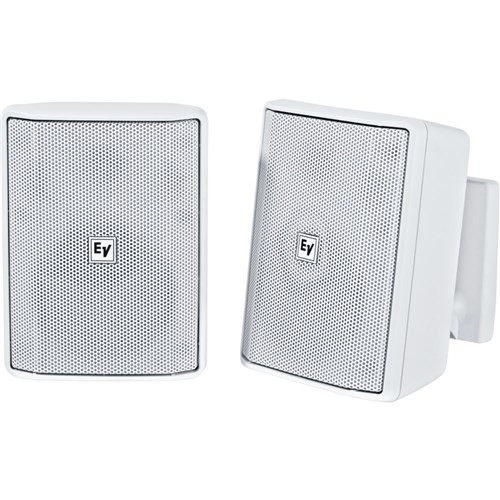
What the EViD S5.2 Actually Is
The EViD S5.2 is a two-way, 5.25-inch surface-mount loudspeaker designed for permanent commercial installation, indoors or in weather-protected outdoor locations. It's part of Electro-Voice's broader EViD (Electro-Voice Installation Design) family, a range engineered specifically for integrators rather than the mobile-PA crowd. The "S" denotes the surface-mount cabinets, the "5" indicates the nominal woofer diameter, and the ".2" is the current-generation revision.
Critically, it's a passive, low-impedance (8-ohm) design in this configuration — not a 70V/100V transformer-tapped model. That distinction matters enormously for how you'll wire and amplify it, and we'll come back to it. Sold as a pair, it's aimed at stereo or dual-mono zones where you want two matched enclosures from the box.
Key Specifications at a Glance
| Specification | EViD S5.2 (8Ω) |
|---|---|
| Configuration | Two-way, passive, surface-mount |
| Low-frequency driver | 5.25" (130mm) woofer |
| High-frequency driver | 1" (25mm) titanium-coated dome tweeter |
| Nominal impedance | 8 ohms |
| Power handling | 100W continuous / 400W peak (typical EViD rating) |
| Frequency response | ~70 Hz – 20 kHz |
| Sensitivity (1W/1m) | ~88 dB |
| Nominal coverage | 100° x 100° conical (rotatable waveguide) |
| Maximum SPL | ~110 dB (peak, per unit) |
| Enclosure | Composite, weather-resistant |
| Mounting | SST integrated bracket system |
| Environmental rating | IP-rated for outdoor/wet-area use (with grille) |
| Finish | Black or white (paintable) |
Always confirm the exact figures on the current datasheet for your revision — Electro-Voice periodically refines drivers and ratings, and installed-sound specs should be verified against manufacturer documentation before final system design.
The Drivers: Why 5.25 Inches Is a Sweet Spot for Install Work
There's a reason the 5-inch class dominates background and foreground music installs. A 5.25" woofer is large enough to move real air for intelligible speech and satisfying music down to around 70 Hz, yet small enough that the cabinet stays visually discreet on a wall or under an eave. The EViD S5.2's woofer is a purpose-built transducer — not a repurposed hi-fi driver — engineered for the thermal stress of continuous commercial duty where a speaker might run eight to twelve hours a day, seven days a week.
Up top, the 1-inch titanium-coated dome tweeter handles the high frequencies. Titanium coating on the diaphragm raises the material's break-up frequency and improves rigidity, which translates to cleaner top-end extension and better power handling than a plain Mylar dome. In a commercial context that means clear consonants in speech reproduction and detail in music that doesn't turn harsh when you push the level up during a busy Friday-night service.
The Rotatable Waveguide — a Genuinely Useful Detail
One feature integrators appreciate is the tweeter's rotatable waveguide. Because installers mount speakers in whatever orientation the architecture allows — horizontal under a soffit, vertical on a column — being able to rotate the HF waveguide lets you keep the coverage pattern aligned with the listening area regardless of cabinet orientation. It's a small thing that separates a speaker designed by people who install speakers from one designed purely on a bench.
Coverage Geometry: Getting Even SPL Across a Room
The EViD S5.2 offers a nominal 100° x 100° conical coverage pattern. This wide, symmetrical dispersion is deliberate — for distributed foreground and background systems, you want overlapping coverage that avoids obvious hot spots and dead zones as patrons move through a space.
Here's the practical implication. With roughly 100° of coverage and a typical 2.7–3m ceiling or mounting height, each speaker covers a usable listening footprint of several metres in diameter at ear level. For even coverage in a café or bar, integrators commonly space surface-mount 5" speakers so their coverage circles overlap at around the -6 dB points — a rule of thumb that keeps perceived loudness consistent as you walk the room. Getting this spacing right matters more to the end result than any single spec on the datasheet; a well-laid-out array of modest speakers beats a sparse layout of powerful ones every time.
The SST Mounting System: Where Install Time Actually Goes
If you've ever installed speakers for a living, you know the mount is where a job either flies or drags. Electro-Voice's SST (Structural Support Technology) bracket is one of the strongest arguments for the EViD range. Rather than a flimsy afterthought U-bracket, SST integrates a robust yoke-style mount that carries the cabinet's weight through a purpose-engineered structure, allowing precise aiming in both the horizontal and vertical planes.
- Single-installer friendly: the bracket holds the cabinet while you make connections, so you're not fighting gravity and a screwdriver at once.
- Concealed, tidy cabling: the mount is designed to route cable neatly, which matters for architectural installs where the wiring must be invisible.
- Secure aiming lock: once you've dialled in the angle, it stays put — no drift over months of thermal cycling.
On a multi-speaker fit-out, shaving even a few minutes off each mount adds up to real labour savings, and that's a genuine part of the EViD value proposition that never shows up on a spec sheet.
8-Ohm Low-Impedance vs 70V/100V: Wiring This Correctly
This is the single most important thing to understand before you buy. The pair discussed here is the 8-ohm low-impedance version. That has direct consequences for your amplifier and cabling strategy:
- Low-impedance (8Ω) wiring is ideal for smaller zones with short cable runs and only a handful of speakers per amplifier channel. You get full-bandwidth fidelity and simple, direct amplification. A stereo pair in a boutique retail space, a small bar, or a treatment room is a textbook use case.
- You cannot simply parallel a dozen 8Ω speakers onto one channel — impedance drops and you risk overloading the amp. For large distributed systems spanning many speakers and long runs, a 70V/100V constant-voltage design (a different EViD model with an onboard transformer) is the correct engineering choice.
So the rule is straightforward: choose the 8-ohm EViD S5.2 pair when you have a defined, contained zone and want the cleanest possible sound with minimal complexity. If your project is a sprawling multi-zone install, confirm whether a constant-voltage variant suits before you order. If you're unsure which topology your site needs, it's worth a conversation with a specialist before committing — view the EViD S5.2 pair here and check the specifications against your zone plan.
Build Quality and Environmental Resilience
The EViD S5.2 uses a composite enclosure engineered for weather resistance, making it suitable for covered outdoor areas — think alfresco dining, poolside bars, and undercover walkways. The grille and hardware are corrosion-resistant, and the cabinet carries an environmental rating appropriate for wet-area exposure when correctly installed under cover.
A word of realism, though: "weather-resistant" is not "submersible." These are built to shrug off humidity, salt-laden coastal air, splashes and the occasional rain blown under an eave — a real consideration in much of coastal Australia — but they should be mounted where they're protected from direct, sustained rainfall and standing water. Specified correctly, they'll deliver years of reliable service in demanding environments.
Paintable Finish for Architectural Integration
Both the black and white versions can be painted to match ceilings, walls or heritage colour schemes without voiding the acoustic performance, provided you mask the grille perforations and driver. For designers who want audio that disappears into the architecture, that flexibility is a real selling point.
Real-World Performance Expectations
Let's be honest about what a 5.25" two-way speaker can and can't do. The EViD S5.2 excels at speech intelligibility and foreground music at conversational-to-lively levels. Vocals sit forward and clear, acoustic and pop material sounds natural, and the wide dispersion keeps things even across a room. For a café, retail space, restaurant, gym reception, office breakout area or house of worship overflow zone, it's genuinely excellent.
What it won't do is deliver club-level low-end on its own. With low-frequency roll-off starting around 70 Hz, deep bass and high-SPL dance music are outside its remit. That's not a flaw — it's physics for a driver this size. When a project needs more bottom-end weight or higher output, the standard EViD approach is to pair the satellites with a dedicated EViD subwoofer and cross them over, letting the S5.2s handle mids and highs while the sub carries the bottom two octaves. Designed as a system, the results punch well above what the cabinet size suggests.
How the EViD S5.2 Compares
| Consideration | EViD S5.2 (8Ω pair) | Generic 5" install speaker | Larger 6.5" install speaker |
|---|---|---|---|
| Mounting system | Engineered SST yoke | Basic U-bracket | Varies |
| Driver pedigree | Purpose-built EV transducers | Often OEM/generic | Varies |
| Coverage control | Rotatable waveguide, 100° | Fixed pattern | Often 90° |
| Low-end extension | ~70 Hz | Varies | Lower (~65 Hz) |
| Visual footprint | Compact, discreet | Compact | Larger |
| Weather resistance | Yes, covered outdoor | Often indoor-only | Varies |
Against budget install speakers, the EViD S5.2 justifies its premium through driver quality, the SST mount, weather resilience and Electro-Voice's reputation for products that keep working long after the warranty lapses. Against larger 6.5" cabinets, the S5.2 trades a little low-end reach and maximum output for a smaller, more discreet enclosure — often exactly the right call in aesthetically sensitive spaces. The choice between 5" and 6.5" usually comes down to room size, required SPL and how visually prominent you can afford the speakers to be.
What Specs Actually Matter When You're Buying
If you take one thing from this guide, let it be how to read past the marketing:
- Impedance topology first. Confirm 8Ω vs 70V/100V matches your system design before anything else. This is the number-one spec that determines whether a speaker fits your project.
- Coverage angle over raw wattage. Even SPL across the room comes from correct dispersion and spacing, not from a big power number. A 100° pattern spaced properly beats a louder speaker in the wrong place.
- Continuous, not peak, power handling. Match your amplifier to the continuous rating and headroom, not the flattering peak figure.
- Mounting hardware quality. A poor bracket costs you labour on install and reliability over time — the SST system is a genuine advantage here.
- Environmental rating vs actual location. Match the IP capability to real exposure. Don't over-spec for a dry indoor bar, and don't under-spec for a coastal alfresco.
Frequently Asked Questions
Can I run the EViD S5.2 pair from any amplifier?
You need a low-impedance amplifier that's comfortable driving 8Ω loads with appropriate power per channel. Match the amp's output to the speaker's continuous power handling with sensible headroom, and never parallel more speakers onto a channel than the amp's minimum impedance allows.
Are these suitable for outdoor installation in Australia?
Yes, in covered or weather-protected outdoor locations such as alfresco dining and undercover areas. They're built to handle humidity, coastal air and incidental moisture, but should not be exposed to direct, sustained rain or standing water.
Do I need a subwoofer with the S5.2?
Not for speech and background/foreground music at moderate levels. If you want fuller low-end or higher output for lively music, adding a matched EViD subwoofer and crossing over transforms the system's bottom-end capability.
Why buy the pair rather than singles?
The pair gives you two factory-matched enclosures ideal for stereo zones or dual-mono coverage, and it's typically the most cost-effective way to buy for a two-speaker zone.
The Verdict: A Reliable Workhorse Done Properly
The Electro-Voice EViD S5.2 isn't trying to be a headline-grabbing speaker, and that's exactly its strength. It's a thoughtfully engineered surface-mount install loudspeaker that gets the fundamentals right: honest coverage, credible driver quality, a mounting system that respects the installer's time, and build resilience suited to Australian conditions. For contained low-impedance zones — cafés, bars, retail, offices, covered outdoor areas — the 8Ω pair is a sound, spec-driven choice that will serve reliably for years.
If your project fits the low-impedance profile and you value getting the boring things right, the EViD S5.2 pair earns its place on the shortlist. Check current pricing and full specifications for the Electro-Voice EViD S5.2 pair and confirm it against your zone plan — and if you're unsure whether low-impedance or constant-voltage suits your site, reach out to the install-audio specialists before you order.