
Electro-Voice EVID P6.2 Pendant Speaker: Australian Buyer's Guide 2026
Electro-Voice EVID P6.2 Pendant Speaker: Complete Australian Buyer's Guide 2026
Choosing the right pendant speaker for a commercial installation isn't something you want to get wrong. Once they're hung, wired, and tuned, swapping them out is expensive, disruptive, and frankly embarrassing if you're the one who specced them. The Electro-Voice EVID P6.2W is one of the most popular choices for Australian venues — but is it actually the right fit for your project?
This guide breaks down everything you need to know about the EVID P6.2, compares it against realistic alternatives, and helps you decide whether it belongs in your next install. Whether you're fitting out a restaurant, retail space, hotel lobby, or house of worship, we'll cut through the spec sheets and give you genuinely useful buying advice.
Why Pendant Speakers? Understanding the Format
Before diving into the EVID P6.2 specifically, it's worth understanding why pendant speakers exist and when they're the correct choice over standard ceiling speakers or surface-mount boxes.
Pendant speakers are designed for spaces with high ceilings, open ceilings, or exposed structural elements where conventional in-ceiling speakers either can't be installed or would be too far from the listening plane. Think warehouse-style restaurants, atriums, convention centres, airport terminals, churches with vaulted ceilings, and modern retail spaces with exposed ductwork.
The key advantages are straightforward:
- Controlled coverage — hanging the speaker lower brings it closer to listeners, improving intelligibility and reducing reflections off distant ceiling surfaces
- Flexible positioning — you can place them exactly where coverage is needed, regardless of ceiling structure
- Aesthetic consistency — a well-designed pendant speaker looks intentional, not like an afterthought bolted to a beam
- Easier maintenance — lower hanging height means simpler access compared to speakers mounted at extreme ceiling heights
The trade-off? They're visible. Unlike flush-mounted ceiling speakers, pendants are part of the room's visual landscape. That's why finish quality, form factor, and colour options actually matter in this category.
Electro-Voice EVID P6.2W: What You're Actually Getting
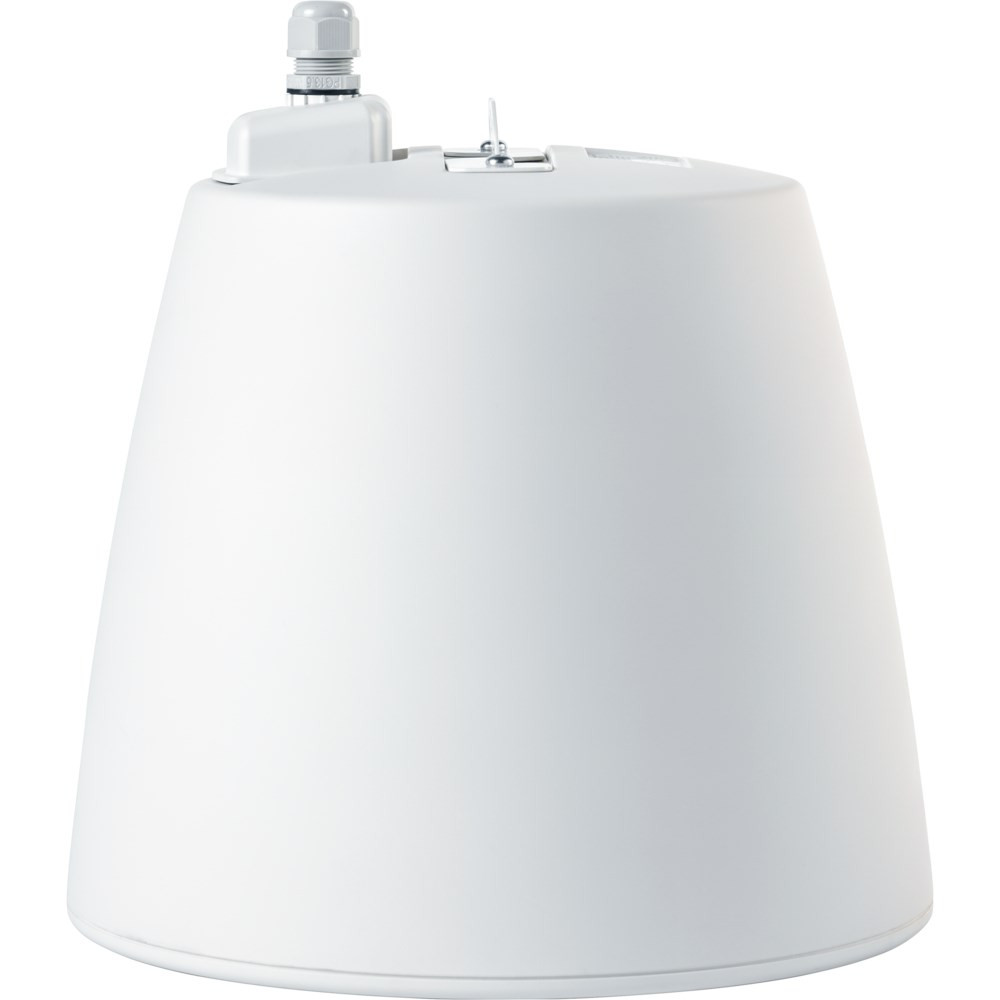
The EVID P6.2W is a 6.5-inch two-way pendant speaker from Electro-Voice's well-established EVID (Electro-Voice Installation Design) series. It's engineered specifically for commercial installations where speech intelligibility and background music reproduction need to coexist reliably.
Key Specifications
| Specification | EVID P6.2W Detail |
|---|---|
| Driver Configuration | 6.5" woofer + 1" titanium tweeter (two-way) |
| Frequency Response | 68 Hz – 20 kHz |
| Coverage Pattern | 120° conical |
| Power Handling | 60W continuous |
| Sensitivity | 88 dB (1W/1m) |
| Maximum SPL | 114 dB peak |
| Transformer Taps | 70V/100V (multi-tap) |
| Impedance | 8 ohms (low-Z bypass available) |
| IP Rating | IP54 (indoor/covered outdoor use) |
| Finish | White (P6.2W) / Black (P6.2B) |
| Weight | Approximately 4.8 kg |
| Mounting | Included cable suspension with safety cable |
What the Specs Actually Mean in Practice
Numbers on a spec sheet only tell part of the story. Here's what matters when these speakers are actually hanging in a real Australian venue:
The 6.5-inch driver is the sweet spot for pendant speakers. Smaller 4-inch pendants struggle with any meaningful low-end, which means background music sounds thin and lifeless. Larger 8-inch pendants deliver more bass but the enclosure size starts to dominate the visual space. At 6.5 inches, the P6.2 delivers enough low-frequency body for music playback while keeping the physical footprint reasonable — a genuine design compromise that EV has landed well.
120° conical coverage is genuinely wide. This matters enormously for installation design because wider coverage means fewer speakers to cover a given area. In practical terms, a single EVID P6.2 hung at 3 metres above the listening plane will provide usable coverage over roughly a 10-metre diameter circle. Compare that to a 90° speaker that would need to be spaced much more tightly. Fewer speakers means lower total project cost, less visual clutter, and simpler wiring.
The 70V/100V transformer is essential for Australian commercial installs. Almost every commercial installation in Australia runs on 100V distributed audio lines. The EVID P6.2's multi-tap transformer lets you set power draw per speaker, which is how you balance levels across zones without individual amplifier channels for every speaker. This isn't a premium feature — it's a baseline requirement, and EV includes it as standard.
IP54 rating opens up semi-outdoor applications. This is where the EVID P6.2 quietly outperforms many competitors. IP54 means it's protected against dust ingress and water splashing from any direction. That makes it suitable for covered outdoor areas — think alfresco dining, covered walkways, hotel pool areas, and brewery courtyards. In the Australian climate, where "indoor" and "outdoor" often blur together, this is a genuinely useful feature.
How the EVID P6.2 Compares: Pendant Speaker Market Overview
The pendant speaker market isn't enormous, but there are credible alternatives. Here's how the EVID P6.2 stacks up against the speakers you're most likely to encounter on Australian distributor price lists.
| Feature | EV EVID P6.2 | JBL Control 65P/T | Bose DS 40F | Apart MASK6CT-W |
|---|---|---|---|---|
| Driver Size | 6.5" two-way | 5.25" two-way | 4.5" full-range | 6.5" two-way |
| Coverage | 120° conical | 150° conical | 160° conical | 120° conical |
| Frequency Response | 68 Hz – 20 kHz | 80 Hz – 20 kHz | 100 Hz – 16 kHz | 70 Hz – 20 kHz |
| Power (Continuous) | 60W | 60W | 40W | 60W |
| Sensitivity | 88 dB | 90 dB | 86 dB | 88 dB |
| IP Rating | IP54 | IP45 (varies) | IP55 | IP64 |
| 70V/100V | Yes (multi-tap) | Yes (multi-tap) | Yes | Yes (multi-tap) |
| Best For | All-rounder: music + speech | Speech-first venues | Background music focus | Budget-conscious installs |
| Price Bracket (AUD) | Mid-premium | Mid-premium | Premium | Mid-range |
EV EVID P6.2 vs JBL Control 65P/T
This is the comparison most integrators wrestle with, since both brands sit under the Harman umbrella and are priced similarly in Australia. The JBL Control 65P/T has a smaller 5.25-inch driver but a wider 150° coverage angle, making it better suited to speech-dominant applications where you want maximum throw width and don't need deep low-end extension.
The EVID P6.2 wins on music reproduction. That extra inch-and-a-quarter of driver diameter translates to noticeably fuller sound, particularly in the 80–200 Hz range where background music either sounds engaging or sounds like it's coming from a telephone. If the venue plays music at any meaningful volume — restaurants, retail, bars — the EV is the stronger choice. For pure paging and announcement systems, the JBL's wider coverage may give you a slight edge in fewer-speaker designs.
EV EVID P6.2 vs Bose DS 40F
Bose occupies a peculiar position in commercial audio. The brand recognition is enormous, which means non-technical clients sometimes request it by name. The DS 40F is a competent pendant speaker, but the 4.5-inch full-range driver and 100 Hz low-end rolloff mean it's fundamentally limited for music. It sounds pleasant for background ambience at low levels, but push it and the limitations become obvious.
The EVID P6.2 is a more capable speaker in virtually every measurable way — better frequency extension, higher output, and a proper two-way design with a dedicated tweeter for high-frequency detail. The Bose typically commands a premium price as well, which makes the value proposition hard to justify on technical merit alone. Choose the Bose only if the client specifically demands the brand or if the application is truly background-only at low SPL.
EV EVID P6.2 vs Apart MASK6CT-W
Apart (now part of the Audioprof group) has been gaining ground in Australian commercial audio, and the MASK6CT-W pendant is a credible alternative. The specs are remarkably similar — same driver size, similar frequency response, comparable power handling. The Apart typically comes in at a lower price point, which matters when you're speccing 40 or 50 speakers for a large venue.
Where the EV distinguishes itself is in build quality, consistency, and brand support. Electro-Voice has decades of commercial installation heritage, an extensive Australian dealer and support network through Bosch Communications, and a parts/warranty infrastructure that gives integrators confidence. The Apart is fine for straightforward installs, but for projects where long-term reliability and brand credibility matter to the end client, the EV carries more weight.
Best Applications for the EVID P6.2 in Australia
Not every pendant speaker suits every space. Here's where the EVID P6.2 genuinely excels — and where you might want to look elsewhere.
Where It Shines
- Restaurants and hospitality venues — The combination of music quality and speech intelligibility is exactly what dining spaces need. The white finish blends with most commercial fit-outs, and the IP54 rating handles kitchen-adjacent humidity without complaint.
- Retail environments with high ceilings — Large-format retail, showrooms, and warehouse-style stores benefit from the wide 120° coverage. Fewer speakers, cleaner look, solid background music reproduction.
- Houses of worship — Churches and worship spaces with vaulted or cathedral ceilings are classic pendant speaker territory. The EVID P6.2's speech intelligibility is critical here, and the 6.5-inch driver handles contemporary worship music with enough authority.
- Hotel lobbies and atriums — High-ceiling reception areas need sound that reaches the floor without harsh reflections. The pendant format brings the source closer to listeners, and the white housing disappears against most lobby ceilings.
- Covered outdoor dining — Australia's alfresco culture means plenty of covered patios, verandahs, and beer gardens. IP54 handles these environments comfortably, and the pendant mount avoids the need for wall or ceiling structure.
Where to Consider Alternatives
- Low-ceiling spaces (under 3m) — If the ceiling is low enough for flush-mount speakers, in-ceiling models will be less visually intrusive and typically cheaper to install. Pendants in low-ceiling rooms look odd and can create hotspots.
- Outdoor areas without cover — IP54 handles splashes, not sustained rain. For fully exposed outdoor installs, look at purpose-built outdoor speakers with IP66 or higher ratings.
- High-SPL entertainment venues — Bars, clubs, and live music spaces need more output than any pendant speaker can deliver. This is point-source or line-array territory.
- Extremely noise-sensitive environments — Recording studios, broadcast facilities, and similar spaces need specialised monitoring, not commercial install speakers.
Installation Considerations for Australian Projects
Getting the speaker choice right is only half the battle. Here are the practical installation factors that Australian integrators need to account for.
100V Line Design
The vast majority of Australian commercial audio installations use 100V distributed lines. The EVID P6.2's multi-tap transformer lets you set each speaker's power draw individually, which is how you manage level distribution across a system. The available taps typically include settings from around 3.75W up to 60W, giving you fine control over the balance between zones and individual speakers.
Critical tip: Always calculate your total transformer tap load and ensure your amplifier can handle the aggregate draw with headroom. A common rookie mistake is tapping every speaker at maximum and then wondering why the amp clips during peaks. A good rule of thumb is to keep total tap draw at no more than 70-80% of amplifier rated power.
Mounting and Safety
The EVID P6.2 ships with a cable suspension system and safety cable. In Australia, all suspended speakers must comply with relevant workplace health and safety regulations, which typically means a primary suspension plus an independent secondary safety attachment. The included hardware addresses this, but always verify compliance with your state's specific requirements and any venue-specific rigging standards.
For high-ceiling installs, consider how future maintenance will work. Can you reach the speaker with a standard elevated work platform? Is there a winch or lowering system that would make servicing practical? These questions are worth answering before the speakers go up, not after.
Acoustic Treatment and Room Considerations
Pendant speakers can't fix bad room acoustics. If you're installing in a highly reverberant space — concrete floors, glass walls, hard ceilings — the speakers will reproduce sound faithfully, but the room will smear it. Budget for acoustic treatment where possible, particularly in hospitality venues where speech intelligibility matters for customer experience.
The EVID P6.2's 120° coverage pattern helps manage this somewhat, as the wider dispersion means lower direct-to-reverberant energy ratio at any given point, which can actually improve perceived evenness in reflective spaces. But it's a mitigation, not a solution.
What to Prioritise When Choosing a Pendant Speaker
If you're still weighing options, here's a decision framework that cuts through the noise:
- Application first, specs second. A speaker that's perfect for background music in a café may be wrong for speech reinforcement in a conference space. Define the primary use case before comparing spec sheets.
- Coverage angle determines speaker count. Wider coverage = fewer speakers = lower total system cost. Don't just compare per-unit prices; model the total number of speakers needed for your space.
- IP rating matters more than you think. Australian venues push the boundaries of "indoor" constantly. An IP54 speaker handles real-world conditions; an unrated speaker is a warranty claim waiting to happen.
- Brand support infrastructure counts. When a speaker fails five years from now, can you get a replacement quickly in Australia? Does the manufacturer have local technical support? Electro-Voice's Bosch-backed Australian distribution network is a genuine advantage here.
- Aesthetic fit is legitimate. These speakers are visible. A pendant that clashes with the interior design will generate complaints from architects, interior designers, and venue owners. Factor finish and form factor into your decision.
Common Mistakes to Avoid
Having seen countless pendant speaker installations across Australian venues, these are the errors that keep recurring:
- Spacing too far apart. Yes, the coverage angle is wide. No, that doesn't mean you can stretch spacing to heroic distances. Overlap between speakers ensures even coverage without dead spots. As a starting point, space speakers at roughly 1.5× to 2× the hanging height above the listening plane.
- Ignoring the ceiling void. Sound doesn't just go down. The energy radiating upward into the ceiling void can cause resonance, rattling of ductwork, or bleed into adjacent spaces. Consider this during the design phase.
- Choosing based on brand alone. Neither the most expensive nor the cheapest option is automatically correct. Match the speaker to the application, environment, and budget holistically.
- Skipping commissioning. Installing pendant speakers without proper DSP tuning, EQ adjustment, and level balancing is like hanging a painting and never straightening it. Budget time for commissioning — it's what separates a professional install from a DIY job.
The Verdict: Should You Buy the Electro-Voice EVID P6.2?
The EVID P6.2W earns its place as one of the most reliable, well-rounded pendant speakers available in Australia. It doesn't try to be everything — it won't replace a proper PA system, and it's not the cheapest option on the market. What it does is deliver consistent, quality audio in exactly the applications pendant speakers are designed for.
The 6.5-inch two-way design hits the practical sweet spot between physical size and acoustic performance. The 120° coverage keeps speaker counts manageable. The IP54 rating handles Australia's love of semi-outdoor spaces. And the EV brand carries genuine weight with integrators, consultants, and end clients who understand commercial audio.
Choose the EVID P6.2 if:
- You need reliable pendant speakers for hospitality, retail, worship, or commercial spaces
- Music reproduction quality matters alongside speech intelligibility
- The installation includes semi-outdoor or humid environments
- Long-term reliability and Australian brand support are priorities
- You want a proven product with a strong installation track record
Consider alternatives if:
- Budget is the absolute primary driver and music quality is secondary (look at Apart)
- The application is purely speech/paging with no music requirement (consider JBL's smaller pendants)
- The space has low ceilings where in-ceiling speakers would work (skip pendants entirely)
For most Australian commercial installations requiring pendant speakers, the EVID P6.2 is a safe, smart, and thoroughly professional choice. It's the speaker that won't generate callbacks, won't disappoint the client, and won't leave you second-guessing your specification.
Ready to spec the EVID P6.2 for your next project? View pricing and availability at MusiconStage — Australian stock with local support.
Need help designing a pendant speaker system for your venue? Get in touch with the MusiconStage team for expert advice on speaker selection, system design, and installation planning across Australia.