
Electro-Voice EVID-C8.2HC Ceiling Speaker: Technical Deep Dive 2026
Electro-Voice EVID-C8.2HC: The Technical Specialist's Guide to Enhanced Pattern Control Ceiling Sound
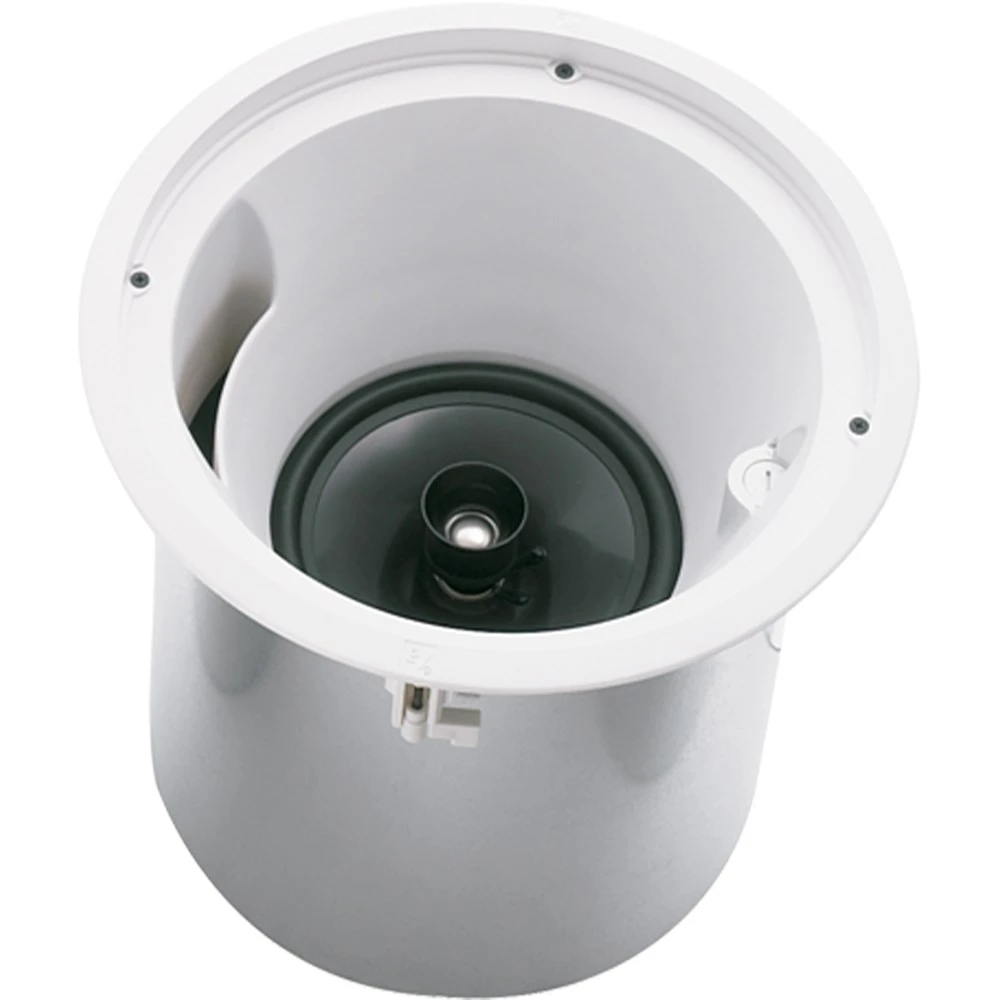
When commercial integrators specify ceiling loudspeakers for high-ceiling environments, retail spaces with hard surfaces, or houses of worship that demand intelligible speech reproduction across uneven seating, the conversation inevitably turns to pattern control. Most ceiling speakers don't have any. They radiate omnidirectionally below the baffle, smearing reflections off polished concrete and glass until your $40,000 distributed system sounds like a tiled bathroom. The Electro-Voice EVID-C8.2HC exists specifically to solve that problem, and it does so with a combination of acoustic engineering that genuinely deserves a closer look.
This guide covers what the EVID-C8.2HC actually does, why its specifications matter for Australian commercial installations, and how it compares to conventional ceiling drivers in real-world conditions. If you're a contractor, integrator, or technical buyer evaluating coaxial constant-directivity ceiling solutions, you'll find the specs and context here that the brochure typically glosses over.
What the EVID-C8.2HC Actually Is
The EVID-C8.2HC is a two-way coaxial pendant-style ceiling loudspeaker built around an 8-inch (203 mm) low-frequency driver and a coaxially-mounted 1-inch (25 mm) titanium-coated compression driver. The "HC" designation stands for High Ceiling, indicating Electro-Voice's enhanced pattern control waveguide that maintains consistent coverage well below the typical 2 kHz roll-off point seen in standard ceiling speakers.
It's part of EV's EVID-C series, which has been a workhorse line for distributed commercial audio since its introduction. The 2HC variant sits at the top of the series for high-ceiling applications, designed specifically for ceiling heights between 4 metres and 12 metres - a range that covers most Australian retail centres, transport hubs, sports facilities, gymnasiums, and house-of-worship sanctuaries.
Key Differentiators at a Glance
- Enhanced 100° conical coverage down to approximately 500 Hz
- Coaxial driver alignment for true point-source dispersion
- Selectable 70V/100V/8Ω operation with multi-tap autoformer
- Bandpass low-frequency loading for extended bass response
- Tile bridge and C-ring suspension included for fast install
- UL 1480 and UL 2043 compliance for plenum-rated installs
Complete Technical Specifications
| Specification | Value |
|---|---|
| Frequency Response (-10 dB) | 55 Hz - 20 kHz |
| Frequency Range (-3 dB) | 70 Hz - 18 kHz |
| Sensitivity (1W/1m, half-space) | 92 dB SPL |
| Maximum SPL (continuous) | 116 dB |
| Maximum SPL (peak) | 122 dB |
| Coverage Pattern | 100° conical (CD) |
| Power Handling (8Ω) | 300W continuous / 600W peak |
| Transformer Taps (70V) | 60W, 30W, 15W, 7.5W |
| Transformer Taps (100V) | 60W, 30W, 15W |
| LF Driver | 8" (203 mm) polypropylene cone |
| HF Driver | 1" (25 mm) titanium-coated compression driver |
| Crossover Frequency | 2.5 kHz, passive |
| Connectors | 4-pole Euroblock terminals (loop-through) |
| Cutout Diameter | 295 mm |
| Mounting Depth | 377 mm |
| Net Weight | 9.5 kg |
| Enclosure Material | ABS with steel back-can |
| IP Rating | IP-x4 (front face) |
The Engineering Behind Enhanced Pattern Control
The reason the EVID-C8.2HC exists - and why integrators specify it over cheaper alternatives - comes down to a single acoustic problem: ceiling speakers stop being directional somewhere around 1.5 to 2 kHz. Below that point, they radiate as a point source into roughly hemispherical (2π) space. In a room with a 9-metre ceiling, that means the listener at floor level receives the direct sound, plus reflections off every wall, the floor, and adjacent ceiling tiles. Speech intelligibility (STI) collapses, and music sounds washed out.
EV's solution combines two engineering approaches. First, the coaxial geometry places the high-frequency compression driver at the acoustic centre of the 8-inch cone, so both drivers radiate from the same point. This eliminates the lobing and comb filtering you get from displaced two-way ceiling speakers as you walk beneath them. Second, the enhanced pattern control waveguide uses the throat of the cone itself as a horn loading surface, narrowing the radiation pattern to a controlled 100° conical beam well below the natural roll-off frequency.
The practical result: at 500 Hz, where a standard 8-inch ceiling driver is essentially omnidirectional, the C8.2HC maintains roughly 100° of usable coverage. That tightens reflections, increases direct-to-reverberant ratio at the listener position, and dramatically improves speech intelligibility in reverberant spaces.
Why Coaxial Beats Coincident
Worth clarifying for anyone comparing spec sheets: coaxial and coincident aren't the same thing. A coincident driver places the tweeter dome inside the woofer's voice coil former, sharing the same axis. A coaxial driver mounts the HF unit directly in front of or within the LF cone but as a discrete assembly. The C8.2HC uses a true coaxial layout where the compression driver fires through a dedicated waveguide that uses the woofer cone as a continuation of its horn flare. The benefit is smoother off-axis response and reduced midrange interaction at the crossover region.
Power Handling and Transformer Configuration
The C8.2HC ships with a multi-tap autoformer that supports both 70V and 100V distributed audio lines, plus an 8-ohm low-impedance bypass for direct amplifier connection. This flexibility matters in Australia, where 100V line systems dominate commercial installations but high-output zones (foyers, atria) sometimes warrant low-impedance dedicated amplification.
| Tap | Sensitivity at Tap | Use Case |
|---|---|---|
| 60W (100V) | ~108 dB max SPL | High-ceiling primary coverage zones |
| 30W (100V) | ~105 dB max SPL | General retail and corporate |
| 15W (100V) | ~102 dB max SPL | Background music in moderate spaces |
| 8Ω Bypass | 116 dB continuous | Premium full-range zones |
The 60W tap on 100V distribution is what you'll typically use in high-ceiling Australian installs. At 12 metres, with the speaker producing 92 dB sensitivity and approximately 18 dB of additional output from the 60W tap, you're delivering around 92 dB SPL at floor level - more than adequate for clear speech reinforcement and comfortable background music.
Check current Australian pricing and stock for the EVID-C8.2HC
Real-World Performance Analysis
Speech Intelligibility (STI Performance)
In modelled simulations using EASE acoustic software with typical Australian retail centre parameters (volume around 8,000 m³, RT60 of 1.8 seconds, ceiling height 9 metres), the C8.2HC at 8-metre spacing on a square grid delivers an STI of 0.62-0.68 across the listening plane. Standard 8-inch ceiling speakers in the same configuration typically achieve 0.45-0.52 - the difference between "acceptable" and "good" intelligibility per IEC 60268-16. In emergency voice alarm contexts, that delta is the difference between marginal and confidently compliant.
Low-Frequency Extension
The 55 Hz -10 dB figure is genuinely useful, achieved through bandpass loading of the rear chamber. It means the speaker reproduces the fundamental of a male speaking voice (around 85-180 Hz) with full energy, and handles background music programme without sounding thin or shouty. Cheap ceiling speakers typically roll off around 90-100 Hz, robbing the lower midrange of warmth.
Coverage Spacing Calculations
For uniform coverage with -6 dB edge-to-edge overlap, the C8.2HC's 100° conical pattern produces the following spacing recommendations:
- 4 m ceiling (2.5 m to ear): 5.95 m on-centre spacing
- 6 m ceiling (4.5 m to ear): 10.7 m spacing
- 9 m ceiling (7.5 m to ear): 17.8 m spacing
- 12 m ceiling (10.5 m to ear): 25.0 m spacing
These are wider than typical 8-inch ceiling speaker spacings (usually 1.5x ceiling height) because the controlled directivity holds together over distance. In practical terms, a high-ceiling installation can use roughly half as many C8.2HC units as it would conventional drivers - which often offsets the per-unit cost premium entirely.
Build Quality and Installation Considerations
The enclosure combines a structural ABS faceplate with a steel back-can, giving it the rigidity needed for plenum-rated installs without the weight penalty of all-metal construction. UL 2043 compliance means the speaker can be installed in air-handling spaces above ceilings - critical for many Australian commercial fit-outs where the plenum doubles as return air. UL 1480 confirms suitability for fire-protective signalling, allowing use in EWIS and emergency communication systems where compliant.
Installation Hardware
- C-ring and rails system for tile-grid ceilings
- Tile bridge for hard ceiling installs
- Pre-installed seismic safety cable attachment points
- Dog-leg clamps with thumb-operated retention
- 4-pole Euroblock with loop-through wiring (no parallel splices required)
The thumb-operated dog-leg clamps deserve a specific mention - they engage and tighten without tools, which sounds gimmicky until you've installed thirty units in a day. Realistic install time per unit, including pull-through wiring and tap selection, is around 18-22 minutes for a competent contractor working from a properly prepared ceiling.
How It Compares to Alternatives
| Specification | EV EVID-C8.2HC | JBL Control 47HC | Tannoy CMS 803 |
|---|---|---|---|
| LF Driver Size | 8" | 6.5" | 8" |
| Coverage Pattern | 100° CD | 110° CD | 90° CD |
| Sensitivity | 92 dB | 89 dB | 91 dB |
| Max SPL | 116 dB | 113 dB | 114 dB |
| Pattern Control Down To | ~500 Hz | ~600 Hz | ~700 Hz |
| Frequency Response (-10 dB) | 55 Hz - 20 kHz | 65 Hz - 20 kHz | 60 Hz - 22 kHz |
The C8.2HC's strongest argument over similar pattern-controlled competitors is its lower-frequency directivity hold and 8-inch driver size. The extra cone area produces both higher sensitivity and stronger pattern control in the 500 Hz to 1 kHz region - exactly where speech consonants live and where reverberant smear typically destroys intelligibility.
What Specifications Actually Matter for Your Application
For Retail and Commercial
Sensitivity and max SPL matter most. You need adequate volume against ambient noise (typically 60-70 dB in busy retail). The C8.2HC's 92 dB sensitivity gives you headroom that thinner-coned ceiling speakers can't match. Coverage pattern matters less because ceilings are typically 3-4 metres - any reasonable ceiling speaker works at that distance.
For Houses of Worship
Pattern control down to 500 Hz is the critical specification. Reverberant sanctuaries destroy speech intelligibility, and only directivity-controlled speakers preserve it. Ceiling height in most modern Australian church builds favours the C8.2HC over short-throw alternatives.
For Sports and Transport
UL 2043 plenum compliance and 70V/100V flexibility are non-negotiable. Power handling and SPL also matter - public address systems in crowded spaces need to cut through 75-85 dB ambient.
For Background Music in High Ceilings
The 55 Hz extension and coaxial smoothness mean the C8.2HC actually reproduces music as music rather than as a thin midrange caricature. If your client is paying for a Spotify-fed BGM system in a $30 million venue, the speaker should sound like more than a corporate intercom.
Technical Red Flags to Watch For
When evaluating any pattern-controlled ceiling speaker, including this one, scrutinise these claims carefully:
- The frequency at which directivity is specified. A speaker with "90° coverage" at 4 kHz is meaningless - all speakers are directional up there. Demand the frequency at which the pattern holds.
- Sensitivity measurement conditions. Half-space (2π) measurements add roughly 3 dB compared to free-field. EV publishes half-space figures, which are honest for ceiling-mounted applications.
- Power handling with the transformer engaged. Some manufacturers quote raw driver handling, then deliver 30W transformers that bottleneck output.
- True UL 2043 testing versus self-certified "plenum compatible" marketing language. The C8.2HC carries genuine UL 2043 certification.
View full specifications and order the EVID-C8.2HC at MusiconStage
Honest Assessment: Where It's Not the Right Choice
The C8.2HC isn't the answer to every ceiling speaker brief. If your install is a low-ceiling office (under 3 metres), you're paying for pattern control that physics doesn't require - a cheaper full-range ceiling driver delivers equivalent results. If you need IP-rated outdoor protection, the front-face IP-x4 rating won't cover full weather exposure. If aesthetics demand an architectural micro-grille appearance, the 295 mm cutout and visible coaxial geometry may not suit minimalist designer briefs.
It's also a serious investment compared to commodity ceiling speakers. The technical justification is strongest in spaces where reverberation is the primary intelligibility enemy and ceilings are at least 4 metres high.
Frequently Asked Technical Questions
Can I run the EVID-C8.2HC in a mixed 70V system with smaller ceiling speakers?
Yes, provided your amplifier has sufficient headroom and total tap loading doesn't exceed amplifier rated power. Mixing different sensitivities does mean different SPL outputs from each speaker - acoustic modelling helps balance zones.
What's the dispersion difference between this and a standard EVID-C8.2?
The C8.2 (without HC) uses a wider, less controlled pattern suitable for low ceilings. The 2HC adds the enhanced waveguide for tighter directivity at lower frequencies, specifically engineered for ceiling heights above 4 metres.
Is the speaker suitable for emergency voice alarm (EVAC/EWIS) systems?
UL 1480 compliance supports its use in fire-protective signalling. Australian compliance under AS 1670.4 should always be verified by the project's certifier, but the speaker meets the underlying performance benchmarks required.
Does the coaxial design create comb filtering directly underneath?
No - that's the entire point of coaxial geometry. Both drivers share an acoustic origin point, so the listening experience is consistent on and off axis without the destructive interference patterns common in displaced two-way ceiling designs.
Verdict for Australian Technical Buyers
The Electro-Voice EVID-C8.2HC is one of those rare commercial install products where the technical specifications translate directly into measurable real-world improvements. The combination of true coaxial geometry, enhanced pattern control to 500 Hz, genuine 8-inch driver output, and proper plenum compliance puts it firmly in the upper tier of pattern-controlled ceiling loudspeakers.
For Australian integrators specifying ceiling distributed audio in high-ceiling reverberant spaces - retail centres, transport hubs, sanctuaries, sports venues, atriums - it represents serious value once you factor in reduced unit count from wider effective coverage and the substantial intelligibility gains over conventional ceiling speakers. It's not the cheapest option, but it's frequently the most cost-effective when total installed performance is the metric that matters.
For low-ceiling, low-reverberation environments, simpler EVID-C series models or even commodity ceiling drivers will deliver comparable results at lower cost. Specify based on the acoustic problem, not the brochure's marketing weight.
Order the Electro-Voice EVID-C8.2HC from MusiconStage - Australian stock, professional install support, and full manufacturer warranty.