
Electro-Voice ETX-15SP Review: 2000W Powered PA Analysed
Electro-Voice ETX-15SP Review: 2000W Powered PA Analysed
There's a specific moment that separates people who buy the Electro-Voice ETX-15SP from people who buy something else: the moment they lift one. At roughly 30kg per cabinet, this is not a speaker you casually toss in the boot of a hatchback. But that weight buys you something real — a 15-inch two-way box that genuinely holds its composure at levels where lighter, cheaper cabinets start to sound compressed, harsh, or simply give up.
This guide is written for people actually deciding whether to spend serious money on the ETX-15SP. We'll cover what the specs mean in practice, where the DSP earns its keep, who this speaker is genuinely wrong for, and how it stacks up against the alternatives Australian buyers are realistically cross-shopping.
Where the ETX Series Sits in Electro-Voice's Range
Electro-Voice has a fairly clear ladder of powered speakers, and understanding it saves a lot of confusion. At the entry level sits the ZLX series — light, affordable, genuinely good value for small gigs and DJs. Above that is the ELX200, which adds more output, better build, and networked control. The ETX sits above both, and above it you're into installed-sound territory and line arrays.
What separates ETX from the tiers below isn't just a bigger number on the amplifier spec sheet. It's the transducer design, the horn, the DSP depth, and the cabinet construction. The ETX-15SP uses a 15-inch woofer paired with a 2-inch titanium-diaphragm compression driver on a 90° x 60° constant-directivity waveguide, driven by a Class-D amplifier package rated at 2000W peak system power (typically quoted as 1350W to the low frequency section and 650W to the high). Maximum SPL sits around 135dB peak.
Those numbers matter less than what they enable: headroom. A speaker rated well above the level you actually run it at will sound cleaner, because you're operating in the linear part of its range rather than riding the limiter. That's the single most honest reason to buy an ETX over a ZLX.
Considering it for your rig? View full ETX-15SP specifications and current Australian pricing.
The Specifications That Actually Affect Your Gig
| Specification | ETX-15SP | What It Means Practically |
|---|---|---|
| Configuration | 15" LF + 2" HF compression driver | Two-way; strong midbass without a sub, real HF extension |
| System power | 2000W peak (Class-D) | Substantial headroom at typical operating levels |
| Max SPL | ~135dB peak | Comfortably covers 300–500 person rooms as a pair |
| Coverage | 90° x 60° constant directivity | Predictable pattern; less room reflection, clearer vocals |
| Frequency range | Approx. 45Hz – 20kHz | Genuinely usable without a sub for speech and acoustic work |
| DSP | FIR-Drive with LCD control | Preset voicings, delay, EQ, crossover, limiting onboard |
| Weight | ~30kg | Two-person lift for most people; wheels are essential, not optional |
| Rigging | M10 points, pole socket, monitor angle | Flexible deployment: stand, fly, or floor wedge |
FIR-Drive: The Part Worth Understanding
Most powered speakers use IIR filters in their DSP — computationally cheap, but they introduce phase shift alongside the frequency correction. Electro-Voice's FIR-Drive processing uses finite impulse response filtering, which allows the crossover and system correction to be applied with linear phase behaviour.
In plain terms: the timing relationship between the woofer and the horn stays coherent through the crossover region. What you hear is a tighter, more focused image — vocals sit in one place rather than smearing, and transients like snare hits keep their attack. It's not a subtle marketing distinction; it's the main reason ETX cabinets image better than most speakers at similar output levels.
Is it magic? No. A poorly placed ETX in a reflective room will still sound worse than a well-placed cheaper speaker. Processing does not fix physics or bad positioning.
The Onboard Control Panel
The rear panel carries a small LCD with a rotary encoder — not a touchscreen, and honestly better for it, because you can operate it in the dark by feel. Through that menu you get:
- System presets — Music, Live, Speech, and Club voicings that meaningfully change the tonal balance rather than just nudging the EQ
- Location EQ — compensation for placing the speaker on a stand, on the floor, against a wall, or in a corner, which addresses real boundary loading rather than guesswork
- Crossover settings — high-pass options when you add a subwoofer, so you're not asking the 15 to do work it shouldn't
- Delay — up to 100ms, useful for delay-fill positions and time-aligning with a sub
- User EQ — parametric bands for room correction
- Save/recall — store your venue settings so setup gets faster over time
The genuinely useful part for working operators is the save/recall. If you play the same three venues on rotation, you build a setting for each and stop re-solving the same room every weekend.
How It Actually Performs
Vocals and Speech
This is where the ETX-15SP is strongest. The 2-inch compression driver on a controlled waveguide produces intelligible, unfatiguing vocal reproduction at high levels. For corporate events, conferences, houses of worship, and any application where the spoken word matters more than chest thump, it's excellent. The 60° vertical pattern also means less energy fired at the ceiling, which is a real advantage in rooms with hard surfaces.
Full-Range Music Without a Sub
A 15-inch woofer in a well-designed cabinet gets you genuine low-mid weight — kick drum has body, bass guitar has fundamental. For acoustic acts, function bands, small corporate events, and background music duty, a pair of ETX-15SPs standalone is perfectly credible.
But be realistic: for DJ work, electronic music, or anything where sub-bass is the point, you'll want subwoofers. A 15-inch cone rolls off well before the 40Hz region that dance music lives in. Electro-Voice's own ETX-15SP or ETX-18SP subs pair natively via the DSP presets, and adding one transforms both the low end and the midrange clarity — because the tops stop working so hard.
As a Stage Monitor
The cabinet has a monitor angle, and it works. That said, a 30kg 15-inch box is a lot of monitor. It's viable for drum fill or a loud side-fill position, but for a vocalist wedge it's overkill and awkward. Purpose-built wedges are lighter and lower profile.
The Weight Conversation — Be Honest With Yourself
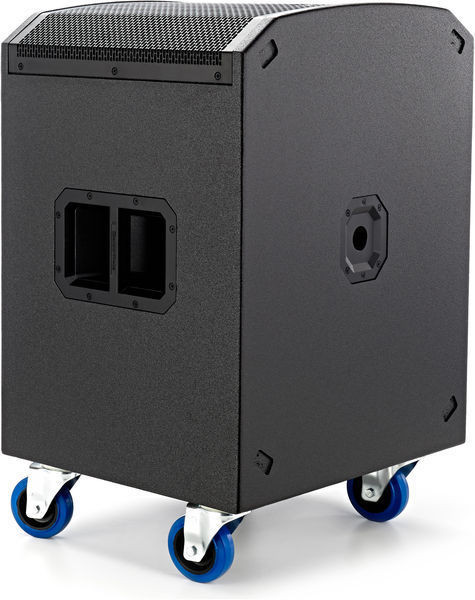
At around 30kg, the ETX-15SP is heavier than most competitors in its class. Electro-Voice included integrated wheels and a retractable tow handle for exactly this reason, and those features are genuinely well executed — you can roll it across a venue floor without a trolley.
But wheels don't help you lift it onto a speaker pole. That's a two-person job for most people, or a one-person job with a lifting stand and good technique. If you're a solo operator loading in and out of venues with stairs, this deserves serious thought before purchase. Plenty of people have bought heavy 15-inch tops and quietly downgraded to 12-inch models within a year because their back made the decision for them.
The honest calculus: if you have a crew, a van with a ramp, or you're doing installed or semi-permanent deployment, the weight is a non-issue and you get the performance benefit. If you're a solo mobile operator, look hard at the ETX-12P or the lighter competitors first.
Honest Pros and Cons
What It Does Well
- Genuine headroom — sounds composed at levels where cheaper boxes strain
- FIR-Drive processing — noticeably better imaging and transient clarity than typical IIR-based rivals
- Excellent vocal intelligibility — the standout characteristic
- Deep, genuinely useful DSP — location EQ and save/recall are practical, not gimmicks
- Build quality — the cabinet, grille, and hardware are built for repeated transport
- Integrated wheels and tow handle — thoughtful and well implemented
- Flexible deployment — pole, fly points, and monitor angle in one cabinet
Where It Falls Short
- Weight — the single biggest practical drawback, no way around it
- Price — a meaningful step up from ZLX or ELX200; you must actually need the extra performance to justify it
- Physical size — takes real vehicle space; two of these plus subs fills a small van fast
- Sub-bass limits — needs subwoofers for DJ and electronic music, as any 15-inch top does
- Menu learning curve — the DSP is powerful but you'll spend time with the manual to use it properly
- Overkill for small rooms — in a 100-person venue you'll never approach its capability
Who Should Buy This — and Who Shouldn't
Strong Fit
- Function and cover bands playing pubs, clubs, and function centres in the 200–500 capacity range
- Production companies needing reliable, road-worthy cabinets that survive constant transport
- Houses of worship where speech intelligibility across a wide seating area is the priority
- Corporate AV operators — the presets and location EQ make unfamiliar rooms far less stressful
- Hire companies — build quality and brand recognition both matter for rental stock
Look Elsewhere If
- You work solo with stairs and no lifting stand — consider the ETX-12P or a lighter 12-inch alternative
- You're playing rooms under 150 people — you're paying for headroom you'll never use
- Budget is genuinely tight — the ELX200-15P delivers a large fraction of the performance for considerably less
- You need a compact vocal wedge — this is the wrong tool
- Your rig is DJ-focused and sub-heavy — budget for subs from the start, or the maths doesn't work
Australian Buying Considerations
Warranty and Support
Electro-Voice is distributed through established channels in Australia, and buying from an authorised dealer matters more than most people realise with powered speakers. The amplifier module is the component most likely to eventually need service, and warranty claims on grey-import stock are a genuine headache — you may end up shipping a 30kg cabinet overseas at your own cost. Confirm your retailer is an authorised EV dealer before you buy.
Power and Mains
The ETX-15SP runs on standard Australian 240V mains with an IEC inlet. Draw is modest under normal programme material, but if you're running several powered boxes plus lighting off a single 10A circuit at a small venue, do the arithmetic before you trip a breaker mid-set. Powered PA plus stage lighting on one circuit is a very common cause of avoidable blackouts.
Shipping and Freight
These are large, heavy items. Metro delivery to Sydney, Melbourne, Brisbane, Adelaide, and Perth is routine, but regional and remote freight can add both time and cost. If you're in regional WA, NT, or far north Queensland, confirm freight arrangements before ordering rather than after. Also check whether the price you're comparing includes freight — that's where apparent bargains often evaporate.
Covers and Cases
Budget for padded covers as part of the purchase, not as an afterthought. A 30kg cabinet in a van without protection develops cosmetic damage quickly, and cosmetic damage substantially affects resale value. EV offers fitted covers for the ETX range.
Ready to move? Shop the Electro-Voice ETX-15SP from an authorised Australian dealer with full local warranty support.
How It Compares to the Obvious Alternatives
| Consideration | ETX-15SP | EV ELX200-15P | EV ETX-12P |
|---|---|---|---|
| Driver | 15" + 2" HF | 15" + 1.5" HF | 12" + 1.25" HF |
| Relative output | Highest | Moderate | High |
| DSP depth | FIR-Drive, extensive | Solid, app control | FIR-Drive, extensive |
| Weight | Heaviest (~30kg) | Moderate | Lighter |
| Best for | Larger rooms, headroom priority | Value-focused working rigs | Same DSP, easier handling |
The comparison that matters most for many buyers is ETX-15SP versus ETX-12P. You get the same processing platform and much of the same sonic character in the 12; you give up low-mid weight and some maximum output, and you gain meaningfully easier handling. If your rooms are moderate and you'll run subs anyway, the 12 is often the smarter working choice. If you need standalone full-range capability or genuine SPL in larger spaces, the 15 is the correct answer.
Against non-EV competitors in this tier, the ETX-15SP's differentiators are the FIR processing and the vocal clarity. Rivals often win on weight. Where you land depends on whether your priority is sound quality at the top of the range or your ability to load in alone at midnight.
Practical Setup Advice
- Set the location EQ first. Before you touch anything else, tell the speaker whether it's on a pole, on the floor, or near a wall. This single step fixes more low-mid mud than any amount of console EQ.
- Choose the right preset. The Speech preset genuinely helps intelligibility for corporate and worship work. Don't leave it on Music out of habit.
- Engage the high-pass when using subs. Letting the 15 run full-range alongside a sub causes cancellation in the crossover region and wastes amplifier headroom.
- Aim the box properly. A 90° x 60° pattern is only useful if it's pointed at the audience. Tilt down toward the seated area rather than firing at the back wall.
- Save your venue settings. Once a room sounds right, store it. Future you will be grateful.
- Watch the limiter indicator. Occasional flicker is fine. Constant activity means you're out of headroom and should add boxes or subs, not push harder.
Common Questions
Do I need a mixer with the ETX-15SP?
Yes, for most applications. It has combo XLR/TRS inputs with level control, so you can plug a mic or line source in directly for very simple use, but any multi-source setup needs a mixer. It's not a mixer-amp.
Will a pair cover a 300-person venue?
For most programme material, yes — comfortably, assuming sensible placement. For loud rock or DJ work in that size room, add subs. The tops will handle the level; the low end is what will feel missing.
Can I fly these?
The cabinet has M10 rigging points. Flying loudspeakers in Australia carries real safety and regulatory obligations — this should be done by a competent rigger using rated hardware and appropriate secondary safety, not improvised.
How does it compare to the ZLX-15P?
Different classes entirely. The ZLX is a capable budget speaker for small gigs. The ETX has substantially more output, far deeper DSP, better transducers, and heavier construction — at a correspondingly higher price. If ZLX is currently handling your gigs without strain, you may not need the upgrade.
Is the DSP hard to learn?
The basics — preset and location EQ — take about five minutes. The full feature set including delay, crossover, and parametric EQ takes an evening with the manual. It's worth doing properly; the depth is genuinely useful once you know it.
Can I use one as a floor monitor?
Yes, there's a monitor angle. But it's heavy and tall for a wedge. Better suited as a drum fill or side-fill than a front-line vocal wedge.
The Verdict
The Electro-Voice ETX-15SP is a genuinely serious powered loudspeaker, and it earns its position through headroom, processing quality, and vocal clarity rather than spec-sheet theatre. For function bands, production companies, worship venues, and corporate operators working rooms in the 200–500 range, it's an easy recommendation — reliable, road-worthy, and consistently good-sounding.
The caveats are real and worth respecting. It's heavy, it's not cheap, and it's more speaker than many buyers actually need. If you're playing small rooms, working solo with stairs, or watching every dollar, the ELX200-15P or the lighter ETX-12P will likely serve you better and you won't feel short-changed.
But if you've outgrown your current rig, you're regularly running out of clean headroom, and you have the logistics to handle the weight — this is the speaker that stops you thinking about your speakers and lets you get on with the mix. That's worth paying for.
Browse the Electro-Voice ETX-15SP — genuine stock from an authorised Australian dealer, with local warranty and expert support if you'd like help specifying the right system for your venue.