
Dynacord CMS 1000-3 vs Rivals: Aussie Mixer Buyer's Guide 2026
Dynacord CMS 1000-3 vs Rivals: Aussie Mixer Buyer's Guide 2026
Choosing a powered mixer in 2026 is harder than it looks. The market is crowded with compact units, lightweight Class-D powerhouses, and feature-laden digital options — yet a small group of analogue powered mixers still dominate small-to-medium gigs across Australia. The Dynacord CMS 1000-3 sits squarely in that category, and it's one of the most frequently shortlisted units for pub bands, function players, houses of worship, and AV hire companies.
But is it actually the right pick for your setup? In this comprehensive buyer's guide, we compare the CMS 1000-3 against its main rivals — Allen & Heath ZED-i series, Soundcraft SX1602FX, Yamaha EMX5, and Mackie ProFX series — and break down exactly when each makes sense for Australian buyers.
The Powered Mixer Market in 2026: Where Does the CMS 1000-3 Fit?
Powered mixers — units combining a mixing console with built-in power amplification — occupy a unique niche. They're not as flexible as separates (mixer + power amp + processor), but they're dramatically simpler to deploy, easier to transport, and often cheaper than equivalent separate systems. For musicians who load in and out weekly, that simplicity is gold.
The Dynacord CMS 1000-3 sits in the premium analogue powered mixer tier, competing against Allen & Heath's separates philosophy, Soundcraft's mid-tier offerings, and Yamaha's EMX series. Pricing in Australia typically lands between AU$2,800–AU$3,400 depending on the retailer, making it a meaningful investment that needs to deliver years of reliable service.
Who Is the CMS 1000-3 Designed For?
- Working musicians playing pubs, clubs, weddings and corporate gigs (200–400 capacity rooms)
- Houses of worship with small-to-medium auditoriums needing a single all-in-one console
- School and community theatre productions where simplicity beats flexibility
- AV hire companies needing rugged, fast-deploy systems for one-off events
- Conference and meeting venues wanting clean speech reinforcement without complexity
Dynacord CMS 1000-3: What You Actually Get
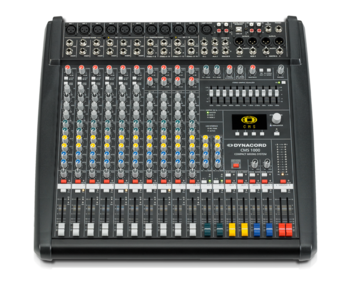
Built in Straubing, Germany (Dynacord is a Bosch-owned brand with serious pedigree), the CMS 1000-3 offers 10 input channels, premium mic preamps, dual onboard effects processors, and 2 × 500W Class-D power amplification. The build quality is genuinely tour-grade — heavy steel chassis, recessed connectors, and rotary controls that feel like they'll outlive the venue you're playing in.
Key Features at a Glance
- 10 input channels (6 mono mic/line + 2 stereo line)
- 2 × 500W power amplifiers (Class-D, 4-ohm)
- Dual independent FX processors with 100 presets each
- Built-in 9-band graphic EQ on main and monitor outputs
- USB record and playback for backing tracks
- Bluetooth audio streaming for break music
- Feedback suppression (FBC) on every channel
- Three operating modes: 2x500W stereo, 1x1000W bridged, or mix/monitor split
Head-to-Head: CMS 1000-3 vs the Competition
Here's where most buyers get stuck. The CMS 1000-3 isn't the cheapest, the smallest, or the most channel-dense option on the market. So why does it keep winning shootouts? The table below highlights the headline differences across the main rivals Aussie buyers consider.
| Model | Channels | Power | FX Engines | Approx. AU Price | Best For |
|---|---|---|---|---|---|
| Dynacord CMS 1000-3 | 10 (6 mono / 2 stereo) | 2 × 500W | 2 independent | $2,800–$3,400 | Pro working bands, HoW, hire |
| Yamaha EMX5 | 12 | 2 × 630W | 1 (SPX) | $1,900–$2,300 | Schools, community gigs |
| Soundcraft SX1602FX (unpowered) | 16 | None | 1 (Lexicon) | $700–$900 | Studio/rehearsal pairing with separates |
| Mackie ProFX12v3+ | 12 | None | 1 (GigFX) | $600–$800 | Podcasters, small venues with own amps |
| Allen & Heath ZEDi-10FX | 10 | None | 1 (FX) | $500–$650 | Recording-first musicians |
Sound Quality and Preamp Comparison
This is where the CMS 1000-3 genuinely shines and where the price gap starts to make sense. Dynacord's WideQ EQ algorithm and high-headroom preamps deliver noticeably more open, dynamic vocals than the Yamaha EMX5 or any of the cheaper Mackie/Soundcraft options. If you've ever struggled to get presence out of a cheaper powered mixer at gig volume, you'll hear the difference within the first soundcheck.
The Yamaha EMX5 isn't far behind on raw amplifier power and it's reliable as a brick, but its preamps feel more sterile — fine for spoken word, less inspiring for vocal-led music. Mackie and Soundcraft compete more on price and channel count than on outright sound quality.
Feature Depth: Where Dynacord Pulls Ahead
Dual independent FX engines are uncommon in this class. With the CMS 1000-3, you can run a hall reverb on vocals while simultaneously sending a tap delay to a featured instrument — without compromising either. The Yamaha EMX5 forces you to pick one or the other.
The feedback suppression (FBC) on every channel is another genuine differentiator. For solo performers and small bands without a dedicated engineer, this single feature can rescue an otherwise problematic room. We've seen it tame difficult stage monitors in carpeted function rooms where conventional ringing-out simply wasn't working.
Pros and Cons: Honest Breakdown
Dynacord CMS 1000-3
- Pros: German build quality, exceptional preamps, dual FX, FBC on every channel, USB + Bluetooth, flexible amp modes, 5-year warranty in Australia via authorised dealers
- Cons: Higher upfront cost, only 10 channels (limits larger bands), heavier than competitors at 11.3kg, no motorised faders or scene recall (it's analogue)
Yamaha EMX5
- Pros: More raw power, more channels, lower price, Yamaha's renowned long-term reliability
- Cons: Only one FX engine, less inspiring preamps, no Bluetooth, dated UI
Allen & Heath / Mackie / Soundcraft (Unpowered)
- Pros: Far cheaper upfront, lighter to carry, more flexibility when paired with active speakers
- Cons: You still need to buy amps or active speakers — total system cost can equal or exceed the CMS 1000-3 with less integration polish
Value Analysis: Is the Dynacord Worth the Premium?
This is the question every Aussie buyer asks. Let's break it down honestly across three realistic scenarios.
Scenario 1: Weekend Function Band (4-piece, vocals + backing tracks)
You're loading in and out 50+ times a year, mostly into wedding venues, RSLs, and corporate functions. Recommendation: Dynacord CMS 1000-3. The build quality, FBC, dual FX, and integrated amplification will pay for themselves in reduced setup time and zero "random gear failure" gigs. Cheaper options will need replacing within 3–4 years; this will likely outlast two of them.
Scenario 2: Community Hall / School Theatre
Budget is tight, the unit gets used by different volunteers, and the priority is rugged simplicity over premium sound. Recommendation: Yamaha EMX5 if budget is the deciding factor. Step up to the CMS 1000-3 only if you have a dedicated, trained operator who'll appreciate the audio quality difference.
Scenario 3: House of Worship (150–300 seats)
You need clean speech reproduction, a couple of vocal mics, an acoustic guitar feed, and reliable music playback. Recommendation: Dynacord CMS 1000-3. The FBC alone justifies the spend in untreated worship spaces, and the Bluetooth + USB make pre-service music effortless for non-technical volunteers. View pricing and stock at MusiconStage.
Scenario 4: Mobile DJ or Singer-Guitarist Duo
You don't need 10 channels, and you'd benefit from something smaller. The CMS 1000-3 is overkill — look at the CMS 600-3 or a powered speaker with onboard mixing instead.
Decision Framework: How to Choose Confidently
Cut through the marketing noise by ranking these factors against your actual use:
- How many inputs will you realistically run? Add 30% to today's number for future expansion. If you'll exceed 10, the CMS 1000-3 isn't the right unit — look at the CMS 2200-3 instead.
- What's your weekly load-in count? Heavy gig schedules justify premium build quality. Occasional use rewards budget options.
- Do you have a trained operator or volunteers? FBC, dual FX, and intuitive layout dramatically improve outcomes for non-engineers.
- What's your speaker pairing? The CMS 1000-3 drives passive 4-ohm speakers brilliantly. If you already own active speakers, an unpowered mixer is more sensible.
- Are you investing for 5+ years? Dynacord units routinely run 10+ years in service. Cheaper options rarely do.
Common Mistakes to Avoid
- Buying on channel count alone. Eight high-quality channels beat 16 noisy ones every time.
- Ignoring the speaker impedance. The CMS 1000-3's 2 × 500W rating is at 4 ohms — at 8 ohms you get roughly half that power.
- Underestimating weight and transport. Powered mixers are heavier than they look. Factor in case costs and physical handling.
- Skipping the trial. Where possible, A/B the CMS 1000-3 against your shortlist with your own microphones and speakers before committing.
Questions to Ask Before You Buy
- Does the dealer offer the full Australian warranty and service backup?
- Are firmware updates handled via the dealer or directly by the user?
- What's included in the box (manual, power cable, dust cover)?
- Is there a case or transport bag available — and is it worth bundling?
- Can you trial the unit or arrange a 30-day return if it doesn't suit your room?
Final Verdict: Is the Dynacord CMS 1000-3 the Right Choice for You?
If you're a working musician, hire operator, or HoW sound lead who values build quality, premium audio, and long-term reliability over rock-bottom pricing, the CMS 1000-3 is one of the smartest investments you can make in 2026. It's not the cheapest option, but it's almost certainly the last powered mixer you'll need to buy for the next decade.
If your priority is maximum channel count for minimum spend, or you already own active speakers, a cheaper unpowered mixer paired with separate amps or active boxes may serve you better.
For most serious Australian buyers in the 200–400 capacity sweet spot, the Dynacord CMS 1000-3 remains a near-unbeatable balance of features, sound, and reliability. Check current pricing and availability at MusiconStage — Australia's trusted Dynacord stockist with full warranty support.
FAQ: Dynacord CMS 1000-3
Is the CMS 1000-3 loud enough for outdoor gigs?
For small outdoor events (up to ~300 people) paired with quality 4-ohm passive tops and a subwoofer chain, yes. For larger outdoor work, you'll want to step up to separates or the larger CMS 2200-3.
Can I use it with active (powered) speakers?
You can, but it defeats the purpose. The built-in amplifiers would sit unused while you'd pay for capability you're not using. Consider an unpowered mixer instead.
How does it compare to the previous CMS 1000-2?
The -3 generation adds Bluetooth, refined Class-D amplifiers (lighter, cooler running), updated FX algorithms, and improved USB recording. If you own a -2 and it works, no need to upgrade. For new buyers, always go the -3.
Does it ship with an Australian power cable and warranty?
Yes — when purchased from authorised Australian dealers like MusiconStage, units ship with local power cabling and the full manufacturer warranty (typically 5 years, dealer-confirmed).