
Dynacord CMS 1000-3 Technical Deep Dive: Specs Decoded 2026
Dynacord CMS 1000-3 Technical Deep Dive: Specs Decoded 2026
The Dynacord CMS 1000-3 sits in a category that's increasingly rare in 2026: the premium analogue powered mixer engineered without compromise. While most manufacturers have shifted budget powered units to entry-level territory, Dynacord continues to build the CMS 3 series with the same German engineering ethos that made the original CMS a workhorse in houses of worship, mid-sized venues, and mobile rigs across Australia. This technical breakdown examines what's actually inside the CMS 1000-3, how its specifications translate to real-world performance, and where it fits relative to the alternatives Australian buyers are weighing in 2026.
Technical Overview: What the CMS 1000-3 Actually Is
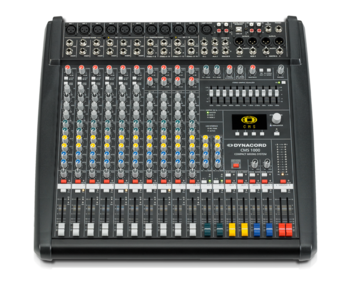
The CMS 1000-3 is a 10-channel analogue mixing console with integrated dual amplification, dual onboard effects engines, USB digital I/O, and Bluetooth audio streaming. It's positioned in the middle of Dynacord's CMS 3 lineup, sitting between the smaller CMS 600-3 and the larger CMS 2200-3. The headline specifications matter, but the engineering decisions behind them matter more — and that's where the CMS 1000-3 separates itself from cheaper powered mixers that look similar on a spec sheet.
Core Specifications at a Glance
| Specification | Value |
|---|---|
| Channel Configuration | 6 mono mic/line + 2 stereo line (10 total inputs) |
| Power Amplifier | 2 x 500W @ 4Ω (Class-D) |
| Mic Preamps | 6 x discrete low-noise with 48V phantom |
| EQ (Mono Channels) | 3-band with sweepable mid (100Hz–8kHz) |
| Aux Sends | 2 (Monitor + FX) per channel |
| Effects | Dual independent FX engines, 100 presets each |
| Master EQ | 2 x 7-band graphic EQ |
| Digital I/O | USB 2.0 stereo in/out, Bluetooth 4.0 audio in |
| Sample Rate (USB) | 48 kHz / 24-bit |
| Frequency Response | 20 Hz – 20 kHz (±1 dB) |
| THD+N | < 0.005% (typical) |
| S/N Ratio | > 105 dB |
| Dimensions (W x D x H) | 434 x 472 x 154 mm |
| Weight | 11.4 kg |
| Power Consumption | 500W (programme), 240V AC (Australian compliant) |
For technical buyers, the numbers worth circling are the THD+N figure and the signal-to-noise ratio. A THD+N of less than 0.005% is genuinely high-end territory — many analogue mixers in this price band sit closer to 0.01–0.02%. The greater than 105 dB S/N reflects discrete preamp design rather than the IC-on-a-chip approach used in budget powered mixers.
View the Dynacord CMS 1000-3 specifications and pricing at MusiconStage →
The Preamp Section: Where Sound Quality Begins
Every mixer's character is defined first by its mic preamps, and the CMS 1000-3 uses Dynacord's discrete preamp topology rather than cost-reduced integrated circuits. Each of the six mono channels offers up to 60 dB of clean gain with an Equivalent Input Noise (EIN) figure of approximately -129 dBu — a benchmark that competes with dedicated outboard preamps costing several hundred dollars each.
What this means in practice: condenser microphones with low output (ribbon mics through a Cloudlifter, certain studio condensers used as live vocal mics) drive cleanly without the hiss that plagues cheaper powered mixers when the gain is pushed past 40 dB. For Australian houses of worship running quiet spoken-word lapel mics, this headroom is the difference between intelligibility and constant noise gating.
Phantom Power Implementation
Phantom power is globally switched at +48V, which is correct standard. The current delivery is rated to support all six channels simultaneously with phantom-hungry mics — a practical concern with active ribbon designs and certain shotgun condensers that draw upwards of 8mA each.
EQ Architecture: 3-Band with Sweepable Mid
The mono channel EQ is a true 3-band design with a fixed-frequency high shelf at 12 kHz, a fixed-frequency low shelf at 80 Hz, and a critical sweepable mid spanning 100 Hz to 8 kHz. The ±15 dB range on each band gives meaningful corrective and creative scope.
The sweepable mid is the technical detail that elevates this mixer above similarly-priced fixed-frequency competitors. Australian rooms tend to suffer from one of two midrange problems: boxy 250–500 Hz buildup in concrete-walled multipurpose halls, or harsh 2–4 kHz peaks in untreated rehearsal rooms. A fixed mid frequency forces compromise; a sweep lets you find and surgically reduce the actual problem frequency. Engineers familiar with parametric EQ workflow will feel at home.
Master Output Graphic EQ
Two independent 7-band graphic EQs handle the master and monitor outputs. The frequency centres (typically 63, 160, 400, 1k, 2.5k, 6.3k, 16 kHz) are well-chosen for live sound corrective work. Both graphics can be assigned to either bus, which matters when you're running floor wedges into the second amplifier channel and need feedback ringing-out capability on monitors.
The Amplifier Section: Class-D Engineering
The dual 500W @ 4Ω Class-D amplifiers are the practical reason most buyers choose a CMS 1000-3 over a separate console-and-amplifier setup. Class-D efficiency translates to real-world advantages: the unit runs cool through long sets, the power supply is compact enough to keep the chassis at 11.4 kg, and current draw stays manageable for venues with marginal mains circuits.
Power output figures need context. The 2 x 500W rating is at 4Ω with 1% THD — typical industry conditions. Driven into 8Ω loads (standard for most passive PA tops and many monitors), expect roughly 300W per channel, which remains adequate for venues up to approximately 200 capacity when paired with sensitivity-matched cabinets in the 96+ dB SPL/W/m range.
Protection Circuitry
The amplifier section includes thermal limiting, DC fault detection, short-circuit protection, and a soft-start circuit that prevents the inrush current spike common when powering on Class-D units. For mobile DJs and bands hauling the unit between venues with varying mains quality, these protections genuinely extend service life.
Digital Integration: USB and Bluetooth
The CMS 1000-3 includes a 48 kHz / 24-bit stereo USB interface alongside Bluetooth 4.0 audio input. Both are useful, but they serve different purposes that buyers should understand clearly.
USB Interface Specifications
- Sample Rate: 48 kHz fixed
- Bit Depth: 24-bit
- Channel Count: Stereo in / stereo out
- Routing: USB return assignable to selectable channel pair
- Latency: Approximately 8–12ms round-trip on properly configured systems
This is sufficient for recording the stereo master output to a laptop, playing backing tracks from a DAW, or running a basic podcast/livestream feed. It is not a multitrack USB interface — buyers who need individual channel recording for post-production should look at digital alternatives or pair the CMS 1000-3 with a multichannel interface taking the direct-out signals from each channel.
Bluetooth Audio
The Bluetooth 4.0 implementation supports A2DP audio streaming with stable pairing range of approximately 10 metres line-of-sight. Useful for break music, walk-in/walk-out playlists at corporate events, and ad-hoc music playback. Audio quality is limited by the SBC codec rather than the mixer itself — for higher-fidelity playback, the USB input or the dedicated stereo line inputs remain superior.
Effects Engine: Dual FX with 100 Presets Each
Dynacord's effects DSP is one of the genuinely differentiating features in this category. The CMS 1000-3 includes two completely independent effects processors, each with 100 presets covering halls, plates, rooms, chambers, choruses, flangers, delays, and pitch effects. This dual-engine architecture means you can apply lush hall reverb to vocals while simultaneously running a tap-delay on a guitar — without the compromise of a single shared effects bus.
The reverb algorithms in particular reflect Dynacord's engineering pedigree. The hall and plate algorithms have a density and decay character that holds up against entry-level dedicated outboard reverb units. For permanently installed church systems where outboard rack space is limited, this onboard quality is genuinely valuable.
Performance Analysis: Where the CMS 1000-3 Excels
Houses of Worship and Conference Venues
The combination of clean preamps, sweepable mid EQ, dual aux sends for monitor mixes, and integrated amplification makes the CMS 1000-3 an obvious specification for 100–250 capacity worship spaces. The discrete preamp noise floor is the single biggest advantage — quiet sermons through lapel mics remain intelligible without the noise gate artefacts that cheaper powered mixers force engineers to deploy.
Mobile Bands and Function Acts
For four-to-six piece function bands, the channel count is exactly right: vocal, vocal, vocal/instrument, kick, snare/overhead pair (stereo channel), and stereo backing track input. The 11.4 kg weight is car-friendly, and the dual 500W amplifiers drive a typical pair of 12" two-way tops to honest 110–115 dB SPL at FOH position in mid-sized venues.
Where It's Not the Right Choice
Be honest about the limits. The CMS 1000-3 is not the right specification if you need:
- More than 6 microphone inputs (consider the CMS 2200-3)
- Multitrack recording capability
- Digital scene recall between events
- iPad-based wireless mixing
- Subwoofer crossover routing without external processing
Technical Comparison: CMS 1000-3 vs Alternatives
| Feature | Dynacord CMS 1000-3 | Typical Budget Powered Mixer | Console + Separate Amplifier |
|---|---|---|---|
| THD+N | < 0.005% | 0.01–0.05% | Varies (0.005–0.02%) |
| Preamp EIN | ~-129 dBu | -118 to -125 dBu | Varies widely |
| Sweepable Mid EQ | Yes (100Hz–8kHz) | Rarely | Console-dependent |
| Effects Engines | 2 independent | 1 (often shared) | External required |
| Build Quality | German engineering, metal chassis | Plastic chassis common | Varies |
| Weight | 11.4 kg | 8–14 kg | 20+ kg combined |
| Service Life Expectation | 15+ years typical | 5–8 years typical | Component-dependent |
The technical case for Dynacord rests on the discrete preamp topology, the sweepable mid EQ, and the build quality that genuinely supports 15+ year service life. That last point matters financially: amortised across actual service life, the CMS 1000-3 frequently costs less per year than budget alternatives that require replacement two or three times in the same period.
Specification Interpretation: What Actually Matters
For technical buyers evaluating this category, certain specifications carry more practical weight than others. Here's how to read them.
Pay Close Attention To
- EIN (Equivalent Input Noise): Below -128 dBu indicates serious preamp design. The CMS 1000-3's ~-129 dBu sets the standard for the category.
- THD+N at rated power: The CMS 1000-3's sub-0.005% figure means transparency, not coloration. If your sound philosophy needs warmth, source it elsewhere in the signal chain.
- Power output methodology: Look for ratings at 1 kHz, 1% THD, both channels driven. Marketing-only figures (peak power, single channel driven, 10% THD) inflate numbers meaninglessly.
- Frequency response tolerance: ±1 dB across 20 Hz – 20 kHz is genuine flat response. ±3 dB indicates audible coloration.
Specifications That Matter Less Than Marketing Suggests
- Total channel count: Quality of preamps matters more than quantity. Six excellent channels beat ten mediocre ones.
- Number of effects presets: Three excellent algorithms beat 200 mediocre ones. Listen to the reverb tails, don't count the menu.
- Bluetooth codec versions: Useful for casual playback; never the right choice for performance audio.
Australian Operating Considerations
The CMS 1000-3 ships with 240V AC compliance for Australian mains. Three practical considerations matter for local buyers:
- Mains conditioning: The Class-D power supply is tolerant of voltage variation, but rural Australian venues with marginal supply still benefit from a power conditioner protecting the unit and connected gear.
- Heat management: Class-D efficiency keeps the chassis cool, but in unconditioned summer venues across northern Australia, ensure ventilation around the heat sink at the rear panel. Avoid stacking cabinets directly on top of the unit.
- Warranty support: Bosch (Dynacord's parent) maintains genuine Australian distribution and warranty service through MusiconStage and authorised partners — meaningful when grey-market alternatives leave buyers stranded for repairs.
Technical FAQ
Does the CMS 1000-3 support speaker presets for specific cabinets?
No. Unlike some integrated systems, the CMS 1000-3 amplifier output is broadband and assumes the connected cabinets handle their own crossover and protection. This is the correct design choice for compatibility with passive cabinets from any manufacturer.
Can the two amplifier channels be bridged?
The CMS 1000-3 amplifier channels operate independently as Master and Monitor outputs by design. Bridging is not supported, which is appropriate for the typical use case of FOH plus monitor wedge feed.
What's the practical maximum room size?
With sensitivity-matched 12" two-way tops at 96+ dB SPL/W/m efficiency, expect honest performance to approximately 200 attendees in moderately-treated rooms, or 250+ in acoustically friendly spaces. Beyond this, consider the CMS 2200-3 or a dedicated console-plus-amplifier specification.
How does the USB interface compare to a dedicated audio interface?
For stereo recording of the master mix or stereo playback into the mixer, the integrated USB is functionally equivalent to a basic 2-in/2-out interface. For multitrack recording or ultra-low latency studio work, dedicated interfaces remain superior.
Is there scene memory or recallable settings?
No. The CMS 1000-3 is an analogue console with no digital scene recall. Effects presets are recallable (per FX engine), but channel strip settings rely on the physical control positions.
Future-Proofing Considerations
Analogue powered mixers occupy a curious position in 2026: digital alternatives offer features the CMS 1000-3 cannot match (scene recall, wireless control, multitrack USB), while analogue mixers offer reliability characteristics digital units rarely achieve. For buyers prioritising long service life, transparent sound, and operational simplicity that any band member can run, the CMS 1000-3 remains a defensible specification for the next decade.
The technical reality: a well-built analogue mixer ages gracefully. There's no firmware to support, no app compatibility to depreciate, no operating system that becomes obsolete. For permanent installs in worship spaces and community halls, this longevity is the dominant value proposition.
Expert Recommendation
The Dynacord CMS 1000-3 is the right technical specification for buyers who need a 6-mic-input analogue powered mixer with serious preamp quality, transparent EQ, dual independent effects, and proven build quality for 15+ year service life. It is purpose-built for houses of worship, mid-sized live venues, conference rooms, and mobile function bands operating in Australian conditions.
It is not the right specification for buyers who genuinely need digital scene recall, multitrack recording, wireless tablet control, or input counts beyond ten channels. For those use cases, examine digital alternatives — but understand the trade-offs in long-term reliability and operational simplicity that come with that choice.
For technically-oriented Australian buyers who value engineering substance over feature-list marketing, the CMS 1000-3 represents what powered mixers should be: precision-engineered tools where every specification has been chosen to serve sound quality and reliability rather than spec-sheet wins.
Check current pricing and Australian stock for the Dynacord CMS 1000-3 at MusiconStage →
MusiconStage stocks the full Dynacord CMS 3 series with genuine Bosch-backed Australian warranty, expert pre-sale technical advice, and post-purchase support from engineers who actually use this gear in the field.