
Dynacord CMS 1000-3 Review: Powered Mixer Guide for Aussie Gigs
Dynacord CMS 1000-3 Review: The Powered Mixer That Refuses to Die
There's a particular kind of gear that working musicians talk about differently. Not with hype, but with a sort of grudging respect — the stuff that's been in the back of the van for a decade and still boots up on a wet Tuesday night in a Ballarat pub. The Dynacord CMS 1000-3 sits firmly in that category, and if you've spent any time around Australian function bands, church AV teams or wedding duos, you've probably seen one.
But here's the honest question worth answering in 2026: does an analogue powered mixer still make sense when a compact digital desk plus a pair of active tops costs roughly the same? The answer isn't a simple yes. It depends entirely on what your gigs actually look like. This guide walks through what the CMS 1000-3 genuinely does well, where it falls short, and the specific situations where it's still the smartest money you can spend.
What the CMS 1000-3 Actually Is
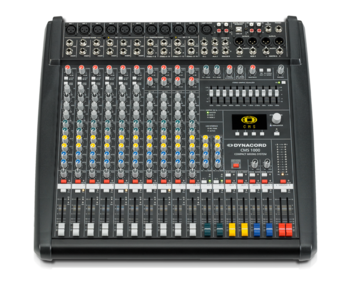
The CMS 1000-3 is a 10-channel powered mixer built by Dynacord — a German manufacturer with roots going back to 1945, now part of the Bosch/Electro-Voice family. "Powered mixer" means the amplifier is built into the same chassis as the mixing console. One box, one power lead, plug your passive speakers straight into the back.
The channel count breaks down as six mono mic/line channels with proper XLR preamps, plus two stereo channels that handle line-level sources. That gives you ten inputs total in the way Dynacord counts them. The onboard power amp delivers around 2 x 500W into 4 ohms, which is genuinely substantial — enough to drive a pair of 12" or 15" passive tops to volumes that will comfortably fill a function room or small club.
What separates the "-3" generation from the older CMS models is mostly the addition of a USB audio interface, refined effects processing, and a few workflow improvements. The core analogue signal path — which is really the whole point of a Dynacord — carries forward largely unchanged.
Key Specifications at a Glance
| Specification | Detail |
|---|---|
| Mono mic/line channels | 6 (XLR + TRS, with phantom power) |
| Stereo channels | 2 |
| Power amplifier | Approx. 2 x 500W @ 4 ohms |
| Amplifier type | Class-D switching |
| Effects | Dual independent FX processors |
| EQ (mono channels) | 3-band with swept mid |
| Aux sends | Monitor + FX sends per channel |
| Master EQ | 9-band graphic on master and monitor paths |
| Feedback control | Onboard feedback suppression |
| Digital I/O | USB audio interface (record/playback) |
| Speaker outputs | Speakon connectors |
| Chassis | Steel, rack-mountable with optional hardware |
Ready to see current pricing? View the Dynacord CMS 1000-3 at MusiconStage — authorised Australian dealer with genuine warranty support.
The Preamps: Where the Money Actually Went
If you only take one thing from this review, make it this. The reason people pay Dynacord prices is the input stage.
Dynacord's mic preamps have a reputation for being unusually clean and open at the top end, with a lot of usable headroom before things get harsh. In practical terms, this means a Shure SM58 through a CMS 1000-3 sounds noticeably less "boxy" than the same mic through a budget powered mixer. Vocals sit forward without needing aggressive EQ carving. Acoustic guitars through a DI retain some air rather than sounding like they've been recorded through a sock.
This matters more than the spec sheet suggests. A lot of live sound problems that get blamed on speakers actually originate at the preamp. If the input stage is already smearing transients and compressing the top end, no amount of downstream EQ fixes it. The CMS series gives you a clean starting point, which means less time fighting the desk and more time actually mixing.
The 3-band EQ with a swept midrange is the right choice for live work. That sweepable mid is the single most useful control on the channel strip — it's how you find and remove the honk in a boomy room, or notch out the frequency that's about to feed back through the wedges. Fixed-mid EQ, which you'll find on cheaper mixers, simply can't do this with the same precision.
Real-World Scenarios: Where This Mixer Earns Its Keep
The Function Band Playing Three Gigs a Weekend
This is the CMS 1000-3's natural habitat. Five-piece covers band, two vocal mics, a DI'd bass, a keyboard stereo pair, an electronic kit or a mic'd snare and kick, and a couple of wedges for monitoring. That's comfortably within the channel count.
The genuine advantage here is setup speed and failure resistance. One box comes out of the van. Two speaker leads, one power lead, done. There's no network to configure, no tablet to pair, no firmware that decided to update itself the night before. When you're loading in at 5pm for a 7pm start at a reception venue where the coordinator is already stressed, that simplicity has real value.
Church and Community Hall Installations
Volunteer-operated sound is a genuine use case where analogue wins. A rotating roster of volunteers can learn a physical knob-per-function layout in one training session. Digital desks with menu diving and scene recall create a dependency on whoever set them up. If that person moves interstate, the system becomes unusable.
The CMS 1000-3's onboard feedback suppression is genuinely helpful in these environments, where speaker placement is often dictated by architecture rather than acoustics and lapel mics are wandering around under a PA cluster.
Duos, Trios and Solo Performers
Slightly over-specified for a solo act, but the headroom is welcome. A duo running two vocals, an acoustic, a backing track over USB and a stereo keyboard uses maybe half the desk. The upside is you never run out of inputs when the guest saxophonist shows up.
Where It's the Wrong Tool
Be honest with yourself about these. If you need more than about eight discrete monitor mixes, individual channel compression, multitrack recording of every input, or the ability to mix from an iPad while standing in the room — a digital mixer is simply the better answer, and it isn't close. The CMS 1000-3 gives you two monitor paths and a stereo USB record feed. That's the ceiling.
Powered Mixer vs. Digital Mixer + Active Speakers
This is the real decision most buyers face in 2026, so let's address it directly rather than pretending the CMS exists in a vacuum.
| Factor | CMS 1000-3 + Passive Tops | Digital Mixer + Active Tops |
|---|---|---|
| Boxes to carry | 3 (mixer + 2 speakers) | 3, but each speaker is heavier |
| Power outlets needed | 1 | 3 |
| Cable runs to speakers | Speaker cable (no mains) | Signal + mains to each speaker |
| Setup time | Very fast | Moderate (network, app pairing) |
| Monitor mixes | 2 | 4–8 typically |
| Channel processing | EQ only | Gate, comp, EQ per channel |
| Multitrack recording | Stereo via USB | Full multitrack |
| Remote mixing | No | Yes, via tablet |
| Learning curve | Minimal | Genuine time investment |
| Failure points | Few | More (network, app, firmware) |
| Upgrade path | Limited | Ongoing feature updates |
The powered mixer's underrated advantage is mains power. In older Australian venues — heritage-listed pubs, RSL halls, community centres — you often have one or two usable outlets on stage and they're already committed to backline. Running Speakon cable to passive tops instead of hunting for power at the front of house is a practical win that never shows up in spec comparisons.
The digital mixer's underrated advantage is that you can walk out into the room and actually hear what the audience hears. That's a genuine mixing improvement that no analogue desk can match.
Neither answer is universally right. Pick based on your gigs, not on what's newer.
Honest Pros and Cons
What It Does Well
- Preamp quality — genuinely a tier above typical powered mixers in this price range
- Build robustness — steel chassis, solid pots, designed for repeated transport
- Serious power reserves — 2 x 500W is more than most small-venue work demands, and the headroom shows in dynamics
- Fast, foolproof setup — no configuration, no network, no app
- Dual FX processors — one reverb for vocals, one delay or second reverb elsewhere, running simultaneously
- Swept mid EQ — properly useful for problem-solving in real rooms
- Long service life — Dynacord gear routinely stays in service for 10–15 years
- Feedback suppression — practical help for volunteer-operated systems
Genuine Limitations
- Only two monitor mixes — a real constraint for bands where every member wants their own wedge mix
- No per-channel dynamics — no compressors or gates on individual inputs; you'll need outboard gear for that
- Stereo-only USB recording — fine for a reference recording of the gig, useless for post-production
- No remote control — you mix from behind the desk, full stop
- Weight — an amplifier inside the mixer means it's substantially heavier than an unpowered console of similar size
- Fixed power rating — you can't scale the amp independently if you later want bigger speakers
- Price — you pay a premium for the German engineering, and cheaper powered mixers exist that will make noise adequately
- Analogue means no recall — every gig starts from wherever the knobs were left
Practical Buying Considerations for Australia
Matching Speakers Properly
This trips people up constantly. The amp is rated into 4 ohms, which means you can run either one 4-ohm cabinet per side, or two 8-ohm cabinets per side wired in parallel. Running a single 8-ohm cabinet per side works fine but you'll get meaningfully less power — roughly half the rated output. If you're buying speakers alongside the mixer, check the impedance before you commit.
Sensible pairings sit in the 12" to 15" two-way passive range from EV, Dynacord's own line, or comparable brands. There's no requirement to stay in-family, but matched systems do tend to behave predictably.
Power and Heat
Class-D amplification runs cooler than older Class-AB designs, but the mixer still has fans and vents. Don't bury it in a flight case with no airflow, and don't stack a laptop bag on the vents during a summer gig in Brisbane. Australian venues get hot; give it room to breathe.
Warranty and Service
Buying from an authorised Australian dealer matters here more than usual. Dynacord is a professional product line, and grey-market imports can leave you without local warranty coverage or parts access. Powered mixers are one of the categories where a failed amp section means the whole unit is out of action, so having a proper local service pathway is worth paying for.
Buying with confidence: Shop the Dynacord CMS 1000-3 with full Australian warranty and dealer support.
Getting the Best Out of It
- Gain stage properly first. Set channel gain with the fader at unity and the master down, using the PFL/peak indicators. Dynacord preamps have generous headroom — use it rather than running everything hot and squashing the top end.
- Use the swept mid before you touch anything else. When a vocal sounds wrong, sweep the mid with a boost until the problem frequency jumps out, then cut it. Faster than guessing.
- Ring out monitors before doors open. The graphic EQ on the monitor path exists for exactly this. Five minutes with the wedges up and a mic in position saves you an hour of feedback anxiety.
- Don't over-rely on feedback suppression. It's a safety net, not a substitute for sensible mic and speaker placement.
- Run one FX processor as reverb, the other as delay. Having both available simultaneously is a genuine advantage — use it rather than leaving the second processor idle.
- Record every gig via USB. Even a rough stereo board mix is enormously useful for improving your live sound over time.
Common Questions
Is 500W per side actually enough?
For pubs, function rooms, church halls, corporate events and small clubs — comfortably yes, provided your speakers are reasonably sensitive. Amplifier watts scale logarithmically, so doubling power gains you only about 3dB. Speaker sensitivity matters far more than amp wattage. Where 500W per side runs out is large outdoor events or venues over roughly 400 people, where you'd want a dedicated subwoofer and separate amplification anyway.
Can I add a subwoofer?
Yes, and for most modern music you should. The practical approach is an active (powered) subwoofer fed from the mixer's line outputs, with the sub's internal crossover feeding your tops. This keeps the CMS's amplifier working on the mid-highs where it's most effective rather than trying to drive low frequencies as well.
How does it compare to the CMS 1600-3?
The 1600-3 is the larger sibling with more input channels and higher power. If your input count regularly pushes past eight sources, or you're running larger rooms, the step up is worth considering. If you're a four or five-piece playing rooms under 200 people, the 1000-3 is the correct size and the extra money on the 1600 buys capability you won't use.
Is analogue still worth buying in 2026?
For a specific set of users, genuinely yes. If your channel count is stable, your monitor requirements are simple, multiple people need to operate the system, and reliability outranks features — analogue is the rational choice. If you're chasing per-channel processing, scene recall or remote mixing, buy digital. There's no shame in either; they're different tools.
Does the USB interface work for recording into a DAW?
It handles stereo in and out, which is fine for capturing a board mix or playing back backing tracks and interval music. It is not a multitrack interface. If you want to record each instrument separately for later mixing, you'll need a dedicated audio interface with more channels.
Who Should Buy This — and Who Shouldn't
Buy it if: You're a gigging band or duo who values setup speed and reliability over feature depth. You run a church or community venue with volunteer operators. You want preamps that make cheap microphones sound respectable. You're tired of gear that needs a firmware update before it'll work. You want something that will still be functioning in 2036.
Look elsewhere if: You need four or more independent monitor mixes. You want to multitrack your gigs. You mix from the room on a tablet. You're building a system you expect to expand significantly. You're on a tight budget and just need something that makes noise — there are cheaper powered mixers that will do that adequately, even if they won't sound as good.
The Verdict
The Dynacord CMS 1000-3 isn't trying to be the most feature-packed mixer you can buy at this price, and if you evaluate it on a feature-count basis it will lose to almost any digital competitor. That's the wrong lens.
What it offers instead is a genuinely excellent analogue signal path, serious amplification, and a design philosophy built around working reliably for a very long time. It's a professional tool aimed at people who make their living from live sound and who've learned that the gear which never fails is worth more than the gear with the longest spec sheet.
If that describes how you work, it's an easy recommendation. If you're excited by app control and multitrack capture, be honest with yourself and buy a digital desk instead — you'll be happier, and this mixer isn't for you. Both are legitimate answers.
Check Dynacord CMS 1000-3 availability and pricing at MusiconStage — authorised Australian dealer, genuine stock, expert advice from people who actually use this gear.