
Dynacord CMS 1000-3 Powered Mixer: Full Technical Breakdown 2026
Dynacord CMS 1000-3 Powered Mixer: Full Technical Breakdown for Australian Sound Professionals
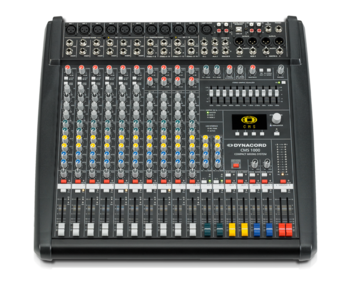
There's a particular challenge in Australian live sound that doesn't get talked about enough: finding a single unit that handles everything from a 50-seat corporate boardroom presentation to a 200-capacity pub gig, without sacrificing audio quality or requiring a road case full of outboard gear. The Dynacord CMS 1000-3 is Dynacord's answer to that challenge — and honestly, it's one of the more compelling powered mixer solutions on the market right now.
Dynacord has been engineering professional audio systems since 1950, originally out of Straubing, Germany, and now operating under the Bosch Communications Systems umbrella alongside Electro-Voice. That lineage matters. The CMS series represents decades of refinement in the "compact mixing system" concept, and the third-generation CMS 1000-3 brings meaningful upgrades over its predecessor while maintaining the reliability that made the series a workhorse in touring, install, and rental fleets worldwide.
Let's pull this unit apart — figuratively — and examine what makes it tick, where it excels, and what you should consider before committing your budget.
What Exactly Is the CMS 1000-3?
At its core, the CMS 1000-3 is an all-in-one powered mixing console. That means your mic preamps, channel processing, effects engine, mix bus architecture, and power amplification all live inside a single chassis. For operators who need to turn up, plug in, and deliver professional sound with minimal setup time, the appeal is obvious.
The "1000" in the name refers to the unit's total power output — approximately 1,000 watts of Class D amplification. The "3" denotes the third generation of this platform, which brought substantial improvements in DSP processing, amplifier efficiency, and overall build quality over the CMS 1000-2 it replaced.
Channel Configuration and Input Architecture
The CMS 1000-3 provides a genuinely useful input layout that reflects real-world application needs rather than raw channel count:
| Input Type | Quantity | Details |
|---|---|---|
| Mic/Line Channels | 6 | XLR + 6.3mm combo jacks, individually switchable +48V phantom power |
| Stereo Line Channels | 4 (2 stereo pairs) | 6.3mm TRS inputs, suitable for keyboards, playback devices, DJ gear |
| Aux Returns | 2 | Stereo returns for external effects or additional sources |
Microphone Preamp Quality
This is where the Dynacord heritage really shows. The mic preamps on the CMS 1000-3 deliver clean, transparent gain with enough headroom to handle everything from close-miked snare drums to delicate condenser work on acoustic instruments. The preamps offer a generous gain range, and the noise floor is impressively low for an integrated unit — you'll notice the difference immediately if you're stepping up from budget-tier powered mixers.
One detail worth highlighting: the phantom power is individually switchable per channel, not a global on/off. This might seem minor, but anyone who's dealt with phantom power issues on dynamic mics or ribbon mics will appreciate the granularity. It's a professional feature that many competitors in this price bracket skip.
Channel Processing — The EQ and Dynamics Story
Each mono mic/line channel features a 3-band equaliser with sweepable mid. The semi-parametric mid is genuinely useful — it lets you hunt for and notch out feedback frequencies, shape vocal presence, or carve space for instruments in a dense mix. The high and low bands operate as shelving EQs.
For the stereo channels, you get a 3-band fixed EQ, which is perfectly adequate for line-level sources that typically need less surgical processing.
What's notably absent — and this is a deliberate design choice — is per-channel compression. Dynacord's philosophy with the CMS series has always been to keep the channel strip clean and fast to operate. If you need dynamics processing, the internal effects engine and the master section's limiter are there, but per-channel compression isn't part of the equation. For most CMS 1000-3 applications (speeches, small live acts, corporate presentations), this isn't a limitation. For a busy 6-piece band, you might wish for at least a vocal compressor.
Built-In Effects Engine
The CMS 1000-3 ships with a 24-bit effects processor powered by a SHARC DSP chip — the same family of processors found in dedicated rackmount effects units. Dynacord has loaded this with a practical selection of effects algorithms focused on what you'll actually use in live sound:
- Reverbs: Hall, plate, room, and chamber variants with adjustable decay time and pre-delay
- Delays: Mono and stereo delays with tempo-syncable parameters
- Modulation: Chorus and flanger effects for instrument sweetening
- Combination presets: Dual-engine patches that stack effects for more complex treatments
The effects quality genuinely punches above its weight class. The reverb algorithms in particular sound smooth and natural, without the metallic or grainy artefacts that plague cheaper integrated effects. There are enough presets to cover most situations, and the parameter adjustment gives you enough control to tailor each effect to the room.
Effects send is available on every channel via a dedicated FX bus with individual send level controls — standard fare, but well-implemented here.
Power Amplification — The Heart of the Matter
This is arguably where the CMS 1000-3 justifies its existence. The built-in power amplifiers deliver serious output from a remarkably compact package:
| Parameter | Specification |
|---|---|
| Amplifier Class | Class D |
| Output Power (per channel, 4Ω) | 2 × 500W |
| Output Power (per channel, 8Ω) | 2 × 350W |
| Total System Power | Up to 1,000W |
| Speaker Outputs | Speakon connectors |
| Protection | Thermal, short-circuit, DC, and limiter protection |
The Class D topology is key here. It's what allows Dynacord to pack 1,000 watts of amplification into a chassis that weighs under 12 kg. Class D amplifiers run significantly cooler and more efficiently than their Class AB counterparts, which means less heat management, smaller transformers, and ultimately a lighter, more portable unit.
Now, a word of context for the spec-savvy buyer: those wattage figures are measured at the edge of clipping, which is industry standard but worth understanding. In real-world use, you'll typically operate at 60-70% of rated power to maintain headroom and clean signal. That still gives you ample output for rooms seating 150-250 people when paired with efficient loudspeakers — which is exactly the target application.
Speaker Management and DSP
Dynacord has built intelligent speaker processing presets into the power amp section, which is a genuinely clever inclusion. These presets optimise the amplifier's output characteristics — including crossover points, EQ curves, and limiter thresholds — for specific Dynacord and Electro-Voice loudspeaker models. If you're running the CMS 1000-3 with, say, a pair of EV ZLX or EKX speakers, you can select the matching preset and know that the system is optimised from mixer output to speaker cone.
This kind of system integration is something you normally only get with dedicated amplifier/processor combinations costing significantly more. Having it baked into the mixer is a real advantage for operators who want predictable, optimised performance without carrying additional DSP units.
Build Quality and Physical Design
The CMS 1000-3 is built with the touring market in mind. The chassis is constructed from steel with a powder-coated finish, and the knobs and faders feel solid and well-damped. This isn't a plastic-shelled consumer product — it's designed to survive life in flight cases, van loads, and the occasional bump that's inevitable in the Australian rental and hire circuit.
| Physical Specification | Value |
|---|---|
| Weight | Approx. 11.5 kg |
| Dimensions (W × H × D) | Approx. 420 × 130 × 465 mm |
| Construction | Steel chassis, powder-coat finish |
| Cooling | Variable-speed fan with convection-assisted design |
| Power Supply | Internal switch-mode, universal voltage (100-240V AC) |
The universal voltage power supply is particularly relevant for Australian buyers. Whether you're operating at 240V here or taking the unit overseas for a tour, you don't need external voltage converters. It just works.
The variable-speed fan deserves mention too. At low output levels — corporate presentations, background music — the fan runs quietly enough not to be an issue. It ramps up under heavier load, which is perfectly acceptable in louder live sound environments where ambient noise masks fan noise anyway.
Connectivity and Routing
Beyond the main speaker outputs, the CMS 1000-3 provides a respectable complement of connectivity options:
- Monitor sends: Dedicated monitor outputs for foldback wedges, allowing independent monitor mixes
- Auxiliary sends: For external effects or additional monitor feeds
- Record outputs: Balanced outputs for feeding recording devices
- Subwoofer output: Dedicated sub output with crossover, allowing you to add a powered sub without external processing
- USB audio interface: Stereo USB connectivity for playback from laptops or basic recording capture
The inclusion of a dedicated subwoofer output with built-in crossover is particularly useful. It means you can run a 2.1 system (two tops plus a sub) directly from the CMS 1000-3 without needing an external crossover processor. For many Australian pub and function band setups, this is exactly the configuration they'll end up using.
Real-World Performance: Where This Mixer Shines
Let's talk about where the CMS 1000-3 genuinely excels and where its design choices start to matter:
Ideal Applications
- Corporate events and presentations: Quick setup, clean speech reproduction, enough power for medium rooms. This is arguably the CMS 1000-3's sweet spot.
- Houses of worship (small to medium): Handles a worship band with vocals, keys, acoustic guitar, and playback comfortably. The speaker presets simplify system tuning for volunteer operators.
- Solo and duo performers: One unit handles everything. Throw in a pair of quality tops and you've got a complete PA that fits in a hatchback.
- Function bands (3-5 pieces): Adequate channel count and power for smaller venue gigs where full production isn't justified.
- Rental and hire fleets: The reliability, simplified operation, and all-in-one design make it ideal for dry-hire situations where the end user might not be a trained engineer.
Where You'll Hit Limitations
- Large bands with extensive backlines: Six mic channels gets tight fast if you're miking drums, multiple amps, and several vocalists. You'll need to be strategic about what gets a mic.
- Outdoor events in large open spaces: While 1,000 watts is respectable, outdoor environments are brutal on sound coverage. For events beyond 150-200 people outdoors, you'll want a more substantial system.
- Applications requiring extensive monitor mixes: The monitor routing is functional but basic. If your performers need four separate monitor mixes, a dedicated console and amplifier setup is the better tool.
None of these limitations are design flaws — they're the natural boundaries of the product category. The CMS 1000-3 is designed to do a specific job exceptionally well, and it succeeds at that.
How It Stacks Up: Technical Comparison with Alternatives
The powered mixer market in Australia includes several serious competitors. Here's how the CMS 1000-3 positions itself:
| Feature | Dynacord CMS 1000-3 | Typical Budget Powered Mixer | Separate Console + Amp Setup |
|---|---|---|---|
| Audio Quality | Professional-grade preamps and conversion | Acceptable but audibly compromised | Depends on component choices |
| Power Output | 2 × 500W @ 4Ω (Class D) | Typically 2 × 200-300W | Scalable to needs |
| Speaker Processing | Built-in presets for EV/Dynacord speakers | Rarely included | Requires separate DSP unit |
| Setup Time | 5-10 minutes | 5-10 minutes | 20-40 minutes |
| Portability | Single unit, ~11.5 kg | Single unit, 8-15 kg | Multiple units, 25-40+ kg total |
| Reliability | German-engineered, Bosch-backed | Variable | Depends on components |
The CMS 1000-3's primary advantage over budget alternatives isn't just raw specifications — it's the integration quality. The preamps, EQ, effects, amplification, and speaker processing are all designed to work together as a cohesive system. Budget powered mixers often feel like someone bolted a cheap amp onto the back of an average mixer. The CMS 1000-3 feels like a unified audio system.
Against a separate console-and-amplifier setup, the CMS 1000-3 trades flexibility for convenience and portability. If you need more channels, more routing, or more power, discrete components are the way to go. But if your requirements fit within the CMS 1000-3's envelope, you'll get there faster, lighter, and with fewer potential failure points.
The Dynacord Ecosystem Advantage
Something that's easy to overlook when evaluating the CMS 1000-3 in isolation is how well it integrates into the broader Dynacord and Electro-Voice ecosystem. If you're already running EV loudspeakers — which are extremely popular in Australian rental inventories — the CMS 1000-3's speaker presets mean you're getting system-matched performance out of the box.
This ecosystem advantage extends to service and support. Bosch Communications has a solid distribution and service network in Australia, which matters when you're relying on gear for revenue-generating work. Warranty support and parts availability are practical considerations that specs sheets don't capture.
Who Should Buy the Dynacord CMS 1000-3?
After pulling apart the specifications and understanding what this unit actually delivers, here's my honest assessment of who this mixer is for:
Buy it if you're:
- A solo performer, duo, or small band needing a complete, professional-quality PA in one box
- A rental company wanting reliable, operator-proof powered mixers for your fleet
- A house of worship or community venue seeking quality sound with simplified operation
- A corporate AV provider handling presentation and event audio
- Anyone who values audio quality and build reliability and is willing to pay the premium for it
Look elsewhere if you:
- Need more than six microphone inputs regularly
- Require extensive monitor mixing capabilities
- Are covering audiences consistently over 250 people
- Need per-channel dynamics processing
Technical FAQs
Can I run the CMS 1000-3 with non-Dynacord/EV speakers?
Absolutely. The speaker presets are optimised for specific models, but the CMS 1000-3 works perfectly well with any speakers that match the output impedance requirements. You'll just bypass the speaker presets and use the master EQ to tune the system to your cabinets.
Is the USB interface suitable for multitrack recording?
No — the USB audio connectivity provides a stereo feed, which is fine for capturing a stereo mix of your performance or playing back tracks from a laptop. For multitrack recording, you'd need a dedicated audio interface and a separate console with direct outputs on each channel.
How does the CMS 1000-3 handle Australian summer heat?
The Class D amplifier topology and variable-speed cooling system work in its favour here. Class D amps generate significantly less heat than Class AB designs, and the thermal protection ensures the unit will limit output before allowing damage. That said, common sense applies — keep it out of direct sunlight and ensure adequate ventilation around the chassis. In a standard covered outdoor or indoor Australian venue, heat shouldn't be an issue.
Can I add a subwoofer to the system?
Yes, and Dynacord has made this straightforward. The dedicated sub output with built-in crossover means you can connect a powered subwoofer directly, and the crossover ensures the frequency ranges are properly divided between your tops and sub without external processing.
Final Technical Verdict
The Dynacord CMS 1000-3 represents what happens when serious engineering meets practical design. It's not trying to be everything to everyone — it's a focused, well-executed powered mixer that delivers genuinely professional audio quality in a package that's fast to deploy and reliable enough to trust on paying gigs.
The combination of quality preamps, effective DSP, clean 1,000-watt Class D amplification, and integrated speaker management puts it in a different league from the budget powered mixers that dominate online search results. Yes, it costs more. But in professional audio, the cost of unreliable or poor-sounding gear — lost clients, compromised performances, gear failures on the job — is always higher than the upfront price difference.
For Australian sound professionals and serious performers who need a compact, reliable, and genuinely good-sounding all-in-one solution, the CMS 1000-3 earns its place on the shortlist.
Ready to add the Dynacord CMS 1000-3 to your setup? Check current pricing and availability at MusiconStage — Australia's trusted pro audio retailer with fast shipping nationwide.