
Dynacord CMS 1000-3 Explained: Beginner's Guide to Powered Mixers 2026
Dynacord CMS 1000-3 Explained: A Beginner's Guide to Powered Mixers in 2026
If you've been searching for a sound system and keep stumbling across terms like "powered mixer," "passive speakers," and "channel count," you're not alone. The world of live sound can feel overwhelming when you're just getting started. This guide is here to change that.
We're going to walk through everything you need to know about the Dynacord CMS 1000-3 — a powered mixer built by one of the most respected names in professional audio. But more importantly, we'll explain what a powered mixer actually is, why you might want one, and how to figure out if it's the right fit for your needs. No jargon. No assumptions. Just clear, practical guidance.
First Things First: What Is a Powered Mixer?
Before we dive into the CMS 1000-3 specifically, let's make sure we're on the same page about what a powered mixer actually does. Think of it this way:
A regular mixer (sometimes called a mixing console or desk) takes audio signals from microphones, instruments, and other sources, lets you adjust their volume, tone, and effects, then sends that combined signal out. But a standard mixer doesn't have enough power on its own to drive loudspeakers — you'd need a separate power amplifier to do that.
A powered mixer combines both jobs into a single unit. It mixes your audio and amplifies it, so you can plug your speakers directly into the mixer without needing a separate amp. It's an all-in-one solution.
Why Does That Matter for Beginners?
- Fewer boxes to buy and carry: Instead of a mixer plus a power amplifier, you've got one unit handling both jobs.
- Simpler setup: Less cabling, fewer connections to troubleshoot, and a faster pack-down at the end of the night.
- Less to go wrong: Fewer components means fewer potential failure points.
- Cost-effective: Buying a quality powered mixer is often more affordable than purchasing a mixer and amplifier separately.
The trade-off? If your amplifier section ever needs repair, the whole unit goes in for service. And you can't easily upgrade just the amp or just the mixer independently. But for most users — especially those starting out — the convenience far outweighs those considerations.
Who Is Dynacord, and Why Should You Care?
If you're new to live sound, you might not have heard of Dynacord. Here's the quick version: Dynacord is a German audio engineering company that's been building professional sound equipment since 1947. That's nearly 80 years of experience. They're part of the Bosch family of brands (alongside Electro-Voice and other pro audio names), and they're particularly well-known for powered mixers — it's one of their signature product categories.
When you see the Dynacord name on a powered mixer, you're looking at a product built by people who essentially helped define the category. That heritage matters because it translates into reliability and thoughtful design — things you'll appreciate when you're setting up under pressure before a gig.
Understanding the Dynacord CMS 1000-3: What You're Getting
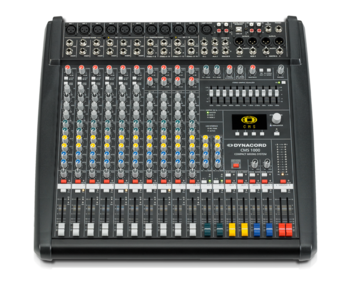
The "CMS" in the name stands for Compact Mixing System, and the "1000" refers to its power output — roughly 1,000 watts. The "3" indicates this is the third generation, meaning Dynacord has refined this product over multiple iterations based on real-world feedback. Let's break down what's inside.
Channels Explained Simply
When audio people talk about "channels," they mean the number of separate audio sources you can plug in and control individually. Think of each channel as its own volume knob and tone control for one microphone or instrument.
The CMS 1000-3 offers a generous channel count with a combination of mono mic/line channels and stereo line channels. In plain language:
- Mono mic/line channels are where you plug in microphones (for vocals, speeches, instruments) or single audio sources. Each gets its own dedicated XLR input with a high-quality Dynacord preamp.
- Stereo line channels are designed for sources that have a left and right signal — things like keyboards, backing tracks from a laptop, or a DJ mixer output.
For a beginner, what matters is this: you've got enough inputs to handle a small to mid-sized band, a corporate presentation with multiple microphones, a worship service, or a school event — comfortably.
Power Output: What 1,000 Watts Actually Means
Power ratings can be confusing because manufacturers measure them differently. Here's what you need to know practically: the CMS 1000-3's built-in amplification is designed to drive passive loudspeakers (speakers without their own built-in amp) at volumes suitable for small to medium venues.
New to this? There are two types of loudspeakers:
- Active (powered) speakers have their own built-in amplifier — you just send them an audio signal.
- Passive speakers need an external amplifier to drive them — which is exactly what a powered mixer provides.
The CMS 1000-3 is built to pair with passive speakers. If you already own active speakers, you don't need a powered mixer — a standard mixer would do the job. This is one of the most common beginner misunderstandings, so it's worth getting clear on from the start.
Built-In Effects: What They Are and Why They Help
The CMS 1000-3 comes with built-in digital effects, primarily reverb and delay types. If you're wondering what that means practically:
- Reverb adds a sense of space to a sound — think of the difference between singing in a tiled bathroom versus a carpeted bedroom. A touch of reverb on vocals makes them sound more polished and professional.
- Delay creates an echo effect, repeating the sound after a short gap.
Having these effects built in saves you from buying separate effects units. For most small venue and event applications, the onboard effects are more than adequate. You can dial in just the right amount on each channel individually, which is a genuinely useful feature when you want reverb on the vocals but not on the speech microphone.
EQ (Equalisation): Shaping Your Sound
Each channel on the CMS 1000-3 includes EQ controls — essentially tone knobs that let you adjust the bass, midrange, and treble of each input independently. There's also a graphic equaliser on the main output, which lets you fine-tune the overall sound of your system to suit the room you're in.
Why does this matter? Every room sounds different. A hall with hard walls will sound bright and echoey, while a carpeted function room might sound dull. The graphic EQ lets you compensate for these differences, and it's one of those features that separates a good-sounding system from a frustrating one.
Dynacord's Signature Reliability
One thing experienced sound engineers consistently say about Dynacord gear: it's built to last. The CMS series features robust construction, effective cooling systems (important when amplifiers are working hard), and protection circuits that guard against common problems like overheating and short circuits. For a beginner investing in their first serious sound system, knowing your gear won't let you down mid-event is genuinely reassuring.
Is a Powered Mixer Right for You? Honest Assessment
Before you decide on the CMS 1000-3 — or any powered mixer — let's think about whether this category of product actually matches your situation. A powered mixer is a brilliant choice in some scenarios and not the best fit in others.
A Powered Mixer Makes Great Sense If You:
- Need a portable, all-in-one PA system for events, gigs, or presentations
- Want to keep your setup simple with fewer separate components
- Already own or plan to buy passive speakers
- Run sound for a small venue, church, school, or community group
- Value quick setup and pack-down over maximum flexibility
- Want professional German engineering without an enormous price tag
You Might Want to Consider Alternatives If You:
- Already own active (powered) speakers — you'd be paying for amplification you don't need
- Need to expand your system significantly in the future — separate components offer more scalability
- Require very high power for large outdoor events — dedicated power amplifiers can deliver more headroom
- Want to use in-ear monitors extensively — a digital mixer might offer better monitor routing options
There's no wrong answer here. It's about matching the tool to your actual needs rather than buying based on specs alone.
Common Beginner Mistakes to Avoid
After helping countless Australians set up their first sound systems, here are the mistakes we see most often — and how to sidestep them:
- Pairing a powered mixer with active speakers: This is the number one confusion. Powered mixer + passive speakers. Standard mixer + active speakers. Mixing these up means you're doubling up on amplification unnecessarily (or worse, potentially causing damage).
- Buying based on wattage alone: A 1,000-watt powered mixer doesn't automatically mean "louder" than a 500-watt one. Speaker efficiency, room size, and how the power is distributed all matter more than raw numbers. Focus on whether the system suits your venue size.
- Ignoring speaker matching: Your powered mixer's amplifier needs to be compatible with your speakers' power handling and impedance (measured in ohms). The CMS 1000-3's manual specifies what speaker configurations work best — read it before buying speakers.
- Skipping the soundcheck: Even the best gear sounds terrible if you don't take 10 minutes to check levels and adjust EQ before your event. Build soundcheck time into your setup routine from day one.
- Cranking everything to maximum: If you find yourself pushing all the faders to the top and it's still not loud enough, you likely need bigger speakers or a more powerful system — not more gain. Pushing a system too hard leads to distortion and potential damage.
What You'll Need Alongside the CMS 1000-3
The mixer itself is one part of your sound system. Here's what else you'll need to get up and running:
- Passive loudspeakers: At minimum, a pair of full-range speakers. Dynacord and Electro-Voice make excellent options designed to pair well with CMS mixers.
- Speaker cables: Not instrument cables, not patch cables — proper speaker cables rated for the power output. This distinction matters for safety and sound quality.
- Microphones: At least one decent dynamic microphone for vocals or speech. Something like a Shure SM58 or sE Electronics V7 is a solid starting point.
- XLR cables: To connect your microphones to the mixer.
- Speaker stands: Getting your speakers up to ear height makes a dramatic difference to how your system sounds in a room.
Setting Up for the First Time: What to Expect
Your first setup with the CMS 1000-3 will take a bit longer than subsequent ones — that's completely normal. Here's a realistic walkthrough:
- Position your speakers on stands, angled slightly inward towards your audience.
- Connect speaker cables from the mixer's speaker outputs to your passive speakers.
- Plug in your microphones using XLR cables.
- Turn everything down first — all faders down, master volume down, gain knobs at minimum.
- Power on the mixer (always turn on the mixer/amp last in the chain, and turn it off first when packing down — this prevents nasty pops through your speakers).
- Bring up one channel at a time: Start with a microphone, slowly increase the gain until you see a healthy signal level, then bring up the channel fader and master volume gradually.
- Adjust EQ to taste once you can hear the signal clearly.
The learning curve is manageable. Most people feel comfortable after two or three setups. Dynacord's layout is logical and clearly labelled, which helps enormously when you're still learning.
Frequently Asked Questions from Beginners
Can I use the CMS 1000-3 for recording?
The CMS 1000-3 is primarily designed for live sound reinforcement. While it has outputs you could route to a recording device, if recording is your main goal, a dedicated USB mixer or audio interface would serve you better. If you need to do both, the CMS handles live sound duties while you could take a recording feed from one of its auxiliary outputs.
How many people can I realistically cover with this system?
Paired with appropriate speakers, the CMS 1000-3 is well-suited for audiences of roughly 50 to 200 people in an indoor setting, depending on the room and your speaker setup. For larger outdoor events, you might want to consider stepping up to a more powerful system or adding subwoofers.
Is Dynacord gear available and supported in Australia?
Yes. Dynacord products are distributed in Australia through established pro audio channels, and servicing is available through authorised dealers. This is worth considering — buying from brands with proper Australian support means you're not stranded if something needs attention down the track.
What's the difference between the CMS 1000-3 and older CMS versions?
The "-3" designation means this is the third generation. Each generation has brought improvements in sound quality, effects processing, amplifier efficiency, and reliability. If you see older CMS models on the secondhand market, they're still solid units, but the current generation represents the most refined version of Dynacord's engineering.
Do I need any technical training to use this?
No formal training is required. If you can adjust volume and tone controls, you can operate this mixer at a basic level. That said, learning some fundamentals of live sound — gain staging, basic EQ techniques, microphone placement — will dramatically improve your results. There are excellent free resources on YouTube and in online forums for beginners.
Who Should Consider the Dynacord CMS 1000-3?
Based on what we've covered, this powered mixer is particularly well-suited for:
- Churches and worship spaces looking for a reliable, quality all-in-one solution
- Schools and community centres that need professional sound for events and assemblies
- Small bands and solo performers who want a portable PA system they can trust
- Corporate AV setups where reliability and simplicity are paramount
- Function and event spaces that need a permanent or semi-permanent sound system
- Anyone upgrading from consumer-grade equipment who wants genuine professional quality
Ready to Take the Next Step?
If the CMS 1000-3 sounds like it could be the right fit for your needs, the best next step is to look at the full specifications and see how it aligns with your specific situation.
View the Dynacord CMS 1000-3 at MusiconStage to see full pricing, detailed specifications, and availability for Australian delivery.
If you're still unsure about which system is right for you, don't hesitate to reach out to the team at MusiconStage. They're experienced with helping beginners find the right setup — no question is too basic, and getting the right advice upfront saves you time, money, and frustration.
Check current pricing and stock on the Dynacord CMS 1000-3
Starting your sound journey with quality gear from a trusted manufacturer like Dynacord means you're building on a solid foundation. The CMS 1000-3 is the kind of equipment that grows with you — reliable enough for your first gig and capable enough to keep performing long after you've found your confidence behind the desk.