
dbx DriveRack PA2 Deep Dive: Complete Sound Management 2026
dbx DriveRack PA2 Deep Dive: Complete Sound Management 2026
If you run a PA system in Australia and you have ever heard a system feed back mid-set, watched a compression driver give up, or struggled to make a room sound anything other than boomy, the dbx DriveRack PA2 is the box that sits quietly between your mixer and your amplifiers solving exactly those problems. It is HARMAN's flagship single-rack-unit loudspeaker management processor, and it has effectively become the default answer when a working engineer needs crossover, EQ, limiting, feedback control and room tuning in one device. This guide is a technical breakdown of what the PA2 actually does, how its signal chain is built, and where it makes sense versus the alternatives.
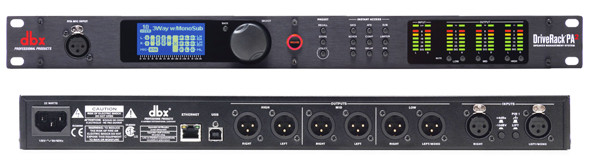
What the DriveRack PA2 Actually Is
The DriveRack PA2 is a 2-in, 6-out digital signal processor that takes the stereo output of your mixer and conditions, protects and distributes that signal to your power amplifiers. It replaced the long-serving DriveRack PA+ and brought two significant changes: a far deeper processing library of HARMAN speaker and amplifier tunings, and full wireless control from a phone or tablet over Wi-Fi. The unit is a 1U rack device with a graphic LCD, a navigation encoder and hard-wired control buttons, but in practice most engineers drive it from the free DriveRack PA2 app while walking the room.
The "Complete Sound Management" package is the configuration that ships with the dbx RTA-M reference measurement microphone. That microphone is not a luxury accessory — it is the sensor that the AutoEQ and RTA functions depend on, so buying the complete bundle saves you sourcing a calibrated mic separately later.
Inside the Signal Chain: Processing Order Matters
Understanding the PA2 means understanding the order in which it processes audio, because the position of each block in the chain is deliberate and changes the result. The signal path splits into a pre-crossover (input) section and a post-crossover (output) section.
Input section (applied before the crossover):
- Subharmonic Synthesizer — generates harmonically related low-frequency content to add weight to the system.
- Graphic EQ / AutoEQ — a 31-band graphic equaliser, or an automatically generated room-correction curve derived from the RTA-M microphone.
- Parametric / Notch filters — surgical tone shaping and ring-out filters.
- Advanced Feedback Suppression (AFS) — automatic, intelligent feedback notching with up to 12 filters.
Output section (applied per output, after the crossover):
- Crossover — divides the full-range signal into low, mid and high bands for bi-amped or tri-amped rigs.
- Parametric EQ — per-driver voicing.
- Alignment delay — time-aligns drivers or fills.
- PeakPlus limiter — driver protection with look-ahead.
- Output gain and polarity.
This architecture is the reason the PA2 is more than a glorified EQ. Room correction happens to the full-range signal, while limiting and delay are applied independently to each amplifier feed so the box can protect a 1-inch compression driver and an 18-inch subwoofer with completely different thresholds at the same time.
Core Specifications
| Parameter | Specification |
|---|---|
| Configuration | 2 inputs / 6 outputs |
| Input connectors | 2 x XLR female, electronically balanced |
| Output connectors | 6 x XLR male, electronically balanced |
| Max input / output level | +20 dBu |
| Input impedance | >50 kΩ balanced |
| A/D – D/A conversion | 24-bit |
| Sample rate | 48 kHz |
| Frequency response | 20 Hz – 20 kHz, ±0.5 dB |
| Dynamic range | >112 dB A-weighted (typical) |
| THD+N | <0.004% typical |
| Propagation delay | Approximately 1.5 ms |
| Network control | Ethernet to Wi-Fi router; iOS/Android app and browser |
| Crossover types | Linkwitz-Riley, Bessel, Butterworth up to 48 dB/octave |
| Feedback filters | 12 AFS filters (assignable fixed/live) |
| Form factor | 1U rackmount, universal 100–240V supply |
The Features That Actually Earn Their Keep
AutoEQ and the RTA-M Microphone
AutoEQ is the headline feature. You place the calibrated dbx RTA-M microphone at the listening position, the PA2 plays pink noise, and its real-time analyser measures how the room and system colour that noise. It then builds a corrective EQ curve to flatten the response toward a chosen target. The technical reality worth understanding: AutoEQ corrects steady-state magnitude response at one measurement point using 1/3-octave resolution. It is excellent at taming gross tonal imbalance — the typical low-mid build-up of a hard-walled function room — but it does not fix phase issues, comb filtering between multiple speakers, or problems caused by speaker placement. Treat the AutoEQ result as an intelligent starting point, then trust your ears and trim by hand. Engineers who run AutoEQ at several positions and average the result get noticeably better outcomes than a single shot from front-of-house.
Advanced Feedback Suppression
AFS is one of the most genuinely useful blocks in the box. It deploys up to 12 very narrow notch filters that automatically detect and attenuate feedback frequencies. Filters can be assigned as fixed (set during a soundcheck ring-out and locked) or live (continuously hunting for new feedback during the show as mics move). Because the notches are far narrower than a graphic EQ band, AFS removes ringing with far less audible damage to overall tone — a critical advantage for spoken word, houses of worship and stage monitors where a graphic EQ approach would gut the vocal.
Subharmonic Synthesizer and PeakPlus Limiting
The Subharmonic Synth offers two adjustable bands that synthesise low-frequency content related to the source material, useful for dance and DJ work where you want chest-thump without a dedicated processor. More important from a protection standpoint are the PeakPlus limiters on every output. These use look-ahead detection so the limiter acts on a transient before it reaches the amplifier, rather than catching it after the damage is done. When you select a HARMAN amplifier tuning during setup, the PA2 pre-loads sensible limiter thresholds matched to that amp and speaker combination — this is the single biggest reason the PA2 saves drivers in hire and education environments where the operator is not always an engineer.
Active Crossover
The crossover supports stereo 2-way, 3-way and various subwoofer configurations with Linkwitz-Riley, Bessel and Butterworth filter alignments and slopes up to 48 dB/octave. Running an active crossover ahead of separate amplifiers — rather than relying on passive crossovers inside the cabinets — gives tighter driver control, better headroom and the ability to time-align and limit each band independently. For anyone bi-amping tops and subs, this alone justifies the unit.
Speaker and Amplifier Tuning Library
The PA2 carries an extensive, regularly updated HARMAN library of factory tunings for JBL and Crown products, plus generic tunings organised by driver size for everything else. A speaker tuning is not just an EQ preset — it bundles voicing, crossover points, alignment and protective limiting designed by the manufacturer for that cabinet. If you run JBL boxes the integration is essentially plug-and-play; if you run other brands, the generic-by-size tunings provide a safe, sensible baseline you can refine.
Wireless App Control
Connect the PA2's Ethernet port to a wireless router and you control every parameter from the DriveRack PA2 app on a phone or tablet. The practical value is enormous: you can stand at the back of the venue, or beside a problem speaker, and adjust the system from where the audience actually hears it. One technical caveat for installers and hire companies — the control link is only as secure as the router you connect. In permanent installs, put the PA2 on a locked-down, password-protected wireless network rather than an open access point so a curious guest cannot dial your subs to full.
Real-World Performance and Where It Shines
For a mobile DJ or covers band running tops and subs, the PA2 is close to ideal: the Auto Setup Wizard walks you through input source, speaker selection and amplifier selection, runs AutoEQ, and you are protected and tuned in minutes. For houses of worship and conference AV, the AFS and parametric tools deliver consistent, feedback-free speech intelligibility that a graphic EQ cannot match. For hire stock, the limiter discipline imposed by the amp tunings dramatically reduces blown-driver call-outs.
Be honest about its limits. The PA2 is a 2-in system, so it is fundamentally a single stereo zone device — it is not a multi-zone matrix processor for a venue with independent bar, foyer and main-room feeds. It runs at 48 kHz with no Dante, AES3 or AVB digital I/O, so it lives in the analogue domain between a mixer and amps. And AutoEQ, while powerful, will occasionally over-correct a dip caused by speaker placement; knowing when to override it is part of using the box well.
Technical Comparison With the Alternatives
| System | I/O | Key strength | Best for |
|---|---|---|---|
| dbx DriveRack PA2 | 2 x 6 | AutoEQ, AFS, app control, HARMAN tunings | Live PA, hire, worship, DJ/band rigs |
| dbx DriveRack PA+ | 2 x 6 | Proven, no Wi-Fi, smaller tuning library | Legacy/budget used market |
| dbx 260 | 2 x 6 | Install-focused, no AutoEQ wizard | Fixed installs by engineers |
| Behringer DCX2496 | 3 x 6 | Cheaper, manual, no auto feedback/EQ | Budget builds, technical users |
| Mixer onboard DSP | Varies | Integrated, no driver-level limiting | Systems without separate amps |
The decisive differentiator is workflow and protection. A DCX2496 can build a crossover and EQ, but it has no automatic feedback suppression, no guided wizard, and no manufacturer-matched limiter library — you supply that expertise. The PA2 packages HARMAN's engineering into a process a non-specialist can follow without destroying equipment, which is exactly why it dominates the working-PA market.
What Specifications Actually Matter When You Buy
- Output count vs your rig: six outputs comfortably handle stereo 3-way or stereo tops plus mono/stereo subs. If you need more than three bands per side, you have outgrown a PA2.
- The measurement mic: AutoEQ and the RTA are only as good as the calibrated mic. The Complete Sound Management bundle including the RTA-M removes that gap from day one.
- Latency: roughly 1.5 ms is inaudible for mains, but worth knowing if you are time-aligning against an acoustic source.
- 48 kHz vs higher rates: for a box doing crossover, EQ and limiting between mixer and amps, 48 kHz is entirely sufficient — sample rate is not the meaningful spec here; the tuning library and limiter behaviour are.
- Network security: plan the router and password, especially for permanent installs.
Frequently Asked Questions
Does the DriveRack PA2 include the measurement microphone? The "Complete Sound Management" package includes the dbx RTA-M reference microphone, which AutoEQ and the RTA require. Confirm the RTA-M is listed before purchase if AutoEQ matters to you.
Can I use it with non-JBL speakers? Yes. There is a generic tuning library organised by driver size, plus full manual control of crossover, EQ and limiters for any brand.
Do I need Wi-Fi to use it? No. Every function is accessible from the front panel. Wi-Fi simply lets you tune from the listening position via the app, which is far more accurate.
Will it stop feedback completely? AFS dramatically reduces feedback with minimal tonal impact, but no processor replaces good gain structure and mic technique. Use it as protection, not a crutch.
Does it replace my graphic EQ and crossover? Yes — that is its purpose. It consolidates crossover, graphic and parametric EQ, feedback suppression, delay and limiting into one rack space.
Expert Verdict
The dbx DriveRack PA2 remains the benchmark loudspeaker management processor for working Australian sound systems in 2026 because it solves real failure modes — feedback, untamed rooms and blown drivers — with a workflow that protects gear even when an expert is not behind it. Its limits are honest and clear: single stereo zone, analogue I/O, 48 kHz. Within those boundaries it is exceptional value, and the Complete Sound Management bundle with the RTA-M microphone is the version to buy if AutoEQ is part of why you want it. View the dbx DriveRack PA2 Complete Sound Management at MusiconStage for current Australian pricing and stock.
For mobile rigs, hire fleets, houses of worship and DJ/band systems, this is one of the few processors that genuinely pays for itself in saved drivers and faster, better-sounding setups. Check availability and order the DriveRack PA2 here.