
DBX 1231 Dual 31-Band EQ: Real-World Uses for Aussie Sound Pros 2026
DBX 1231 Dual 31-Band EQ: How Australian Sound Pros Actually Use It in 2026
If you've spent any time behind a mixing desk in Australia — whether it's a pub gig in Fitzroy, a corporate event in Sydney's CBD, or a community hall install in regional Queensland — you've almost certainly crossed paths with a DBX graphic equaliser. The DBX 1231 Dual Channel 31-Band Equaliser is the kind of gear that doesn't chase trends. It just sits in the rack, does its job brilliantly, and earns its keep night after night.
But here's the thing: a 31-band graphic EQ isn't for everyone. And it's definitely not a plug-and-play magic fix for bad sound. So let's cut through the spec sheets and talk about how this unit actually performs in the real-world scenarios Australian audio professionals face every day.
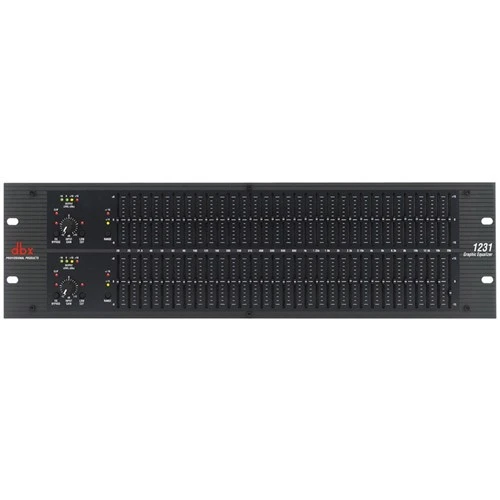
What the DBX 1231 Actually Is (And Isn't)
At its core, the DBX 1231 is a dual-channel, 31-band graphic equaliser housed in a standard 2U rack unit. Each channel gives you 31 individual frequency bands spaced at 1/3-octave intervals, covering the full audible spectrum from 20Hz right up to 20kHz. That's the ISO standard layout you'll find in professional installations worldwide.
What it isn't is a digital processor, a feedback eliminator, or a room correction system. It's an analogue graphic EQ — arguably one of the best-built ones in its price bracket. DBX has been making these for decades, and the 1231 represents that accumulated know-how in a straightforward, reliable package.
Each channel features:
- 31 constant-Q frequency bands with ±6dB or ±12dB range (switchable)
- Low-cut filter at 40Hz to tame rumble
- Bypass switching for A/B comparison
- XLR and 1/4" TRS connections
- Signal and clip LEDs for quick visual monitoring
The constant-Q design is worth highlighting. Cheaper graphic EQs use proportional-Q filters, which means adjacent bands interact heavily — push one slider and the neighbouring frequencies shift too. The DBX 1231's constant-Q filters maintain their bandwidth regardless of how much boost or cut you apply. In practical terms, that means more precise, predictable control when you're sculpting sound under pressure.
Use Case #1: Live Sound in Pubs, Clubs, and Small Venues
This is where the DBX 1231 truly earns its stripes in Australia. If you're running sound in venues seating anywhere from 50 to 500 people, a quality graphic EQ between your mixer output and your amplifiers (or powered speakers) is essential — not optional.
Why It Works Here
Australian pubs and clubs are acoustically challenging spaces. Low ceilings, hard floors, glass walls, oddly shaped rooms — these all create resonances and frequency buildups that your mixer's channel EQ simply can't address. The DBX 1231 lets you tune the PA system to the room before the band even starts soundcheck.
Here's how most sound techs actually use it in this scenario:
- Ring out the monitors first. Run pink noise or gradually bring up vocal mics to identify feedback frequencies, then notch those out on the corresponding channel. The ±12dB range gives you enough cut to tame nasty feedback points without destroying the overall tonal balance.
- Shape the front-of-house response. Every room has a character. Maybe the 250Hz region is muddy because of a low ceiling, or there's a harsh 2.5kHz peak bouncing off a brick wall. A few gentle 2-3dB cuts on the 1231 can transform the sound from "fighting the room" to "working with it."
- Leave it set and forget. Once you've dialled in the room EQ, it stays put. The physical sliders give you instant visual feedback on your settings — no menu diving, no recalling presets. You walk up to the rack, glance at the sliders, and you know exactly what's happening.
The dual-channel design means you can run one channel for FOH mains and the other for monitors, or dedicate each channel to left and right if you're running a stereo PA. For most Aussie pub gigs, the first option is more practical.
Use Case #2: Permanent Installations — Churches, Function Centres, and Schools
This is arguably the DBX 1231's strongest application in Australia, and it's where you'll find thousands of them quietly doing their job across the country.
Why Installers Love It
When you're installing a sound system in a church in suburban Melbourne or a school hall in Perth, you need equipment that:
- Can be set up once and left alone for years
- Doesn't require technical expertise to operate day-to-day
- Is reliable enough that you won't get callback complaints
- Fits a budget that doesn't make building committees faint
The DBX 1231 ticks every one of those boxes. An experienced installer will commission the system, tune the EQ to the room using measurement tools, and then the volunteers or staff running the system weekly don't need to touch the EQ at all. It just sits in the rack doing its thing.
Some installers use the optional security cover (or simply gaffer tape over the sliders — less elegant, equally effective) to prevent well-meaning but untrained operators from "improving" the sound. The physical nature of the sliders actually works in your favour here — if someone does fiddle with it, you can see immediately what's been changed, unlike a digital processor where settings might be altered invisibly.
Common Installation Scenarios
- Houses of worship: Taming reflections from hard surfaces, controlling low-frequency buildup from pipe organs or subwoofers, ensuring speech intelligibility for sermons
- School halls: Multi-purpose rooms that need to work for assemblies, concerts, and presentations — the EQ compensates for the room's worst acoustic characteristics
- Function centres: Rooms that sound different empty vs. full of people — some installers set a compromise position that works acceptably for both
- Retail and hospitality: Background music systems where the EQ shapes the response to suit the space and keep volume levels consistent
Use Case #3: Recording Studios and Rehearsal Rooms
Now, let's be honest here — in a modern recording studio, most engineers reach for parametric EQ plugins or high-end outboard parametric units before they'd grab a graphic EQ. But the DBX 1231 still has its place in certain studio applications.
Where It Fits
Monitor path tuning is the primary studio application. If your control room has acoustic issues that treatment alone hasn't fully resolved, inserting the 1231 between your monitor controller and power amp lets you flatten out room-induced frequency anomalies. It's a more affordable alternative to dedicated room correction processors, and some engineers actually prefer the analogue approach.
In rehearsal rooms, the 1231 is brilliant. These spaces are typically acoustically terrible — concrete walls, low ceilings, gear everywhere creating reflections. Running the PA through a properly tuned 1231 can make a rehearsal room sound dramatically better, and bands will actually be able to hear what they're playing rather than fighting a muddy, feedback-prone mess.
For home studios and project rooms across Australia — and there are thousands of them — the 1231 offers a cost-effective way to tame room modes in the monitoring chain. It's not a replacement for proper acoustic treatment, but it complements it.
Use Case #4: Corporate AV and Conferencing
With the explosion of hybrid work and virtual conferencing across Australia, corporate AV has become a massive sector. The DBX 1231 finds its way into boardrooms, conference facilities, and presentation spaces where speech intelligibility is paramount.
In these environments, you're typically dealing with:
- Ceiling speakers with uneven frequency response
- Rooms with glass walls and hard surfaces
- Multiple wireless microphone systems prone to feedback
- The need for crystal-clear voice reproduction
The 1231 lets the installer shape the system response specifically for voice frequencies (roughly 100Hz to 8kHz) and notch out any feedback-prone frequencies that wireless lapel and headset mics tend to excite. The low-cut filter is particularly handy here — rolling off everything below 40Hz eliminates air conditioning rumble and other low-frequency noise that can make conference audio sound muddy.
Practical Comparison: When to Choose the DBX 1231 Over Alternatives
DBX 1231 vs Digital EQ/Processors (like DBX DriveRack Series)
Digital processors offer more features — crossovers, limiters, delay, auto-EQ — but they also introduce complexity. For installations where simplicity and reliability are priorities, the analogue 1231 wins. No firmware updates, no screen to fail, no latency. It works even if the person operating it has zero technical knowledge. In a digital processor, one wrong button press can collapse the entire system setup.
Choose digital when you need crossover management, multi-zone processing, or automated room correction. Choose the 1231 when you need straightforward, bulletproof EQ.
DBX 1231 vs Budget Graphic EQs
The constant-Q filter design in the 1231 is the key differentiator from cheaper alternatives. Budget graphic EQs (and there are plenty under $300) use proportional-Q filters where adjusting one band significantly affects neighbouring bands. This makes precise tuning frustrating — you end up chasing your tail trying to dial in the right response.
The 1231's filters behave predictably and independently. When you cut 3dB at 1kHz, that's exactly what happens — 1kHz drops by 3dB without pulling 800Hz and 1.25kHz along for the ride. For professional applications, this difference is absolutely worth the extra investment.
DBX 1231 vs Parametric EQ
Parametric EQs offer more surgical precision — variable bandwidth, sweepable frequency centres. They're better for targeting very specific problem frequencies. But they're also slower to set up and harder to read at a glance. The 31-band graphic format gives you speed and visual clarity that parametric EQs can't match, especially in live situations where you need to make quick adjustments between acts.
Who Should Buy the DBX 1231?
Ideal For:
- Live sound engineers working pubs, clubs, and small-to-medium venues who need reliable room EQ and monitor tuning
- AV installers fitting out churches, schools, function centres, and corporate spaces
- Bands and musicians who own their own PA and want better control over their sound in different rooms
- Theatre and community groups needing a set-and-forget EQ for their in-house system
- Studio owners wanting analogue monitor path correction on a reasonable budget
Probably Not Ideal For:
- Large-scale touring where digital processors with comprehensive system management are standard
- Beginners with no understanding of frequency — a 31-band graphic EQ in inexperienced hands can do more harm than good
- Applications requiring dynamic EQ or feedback suppression — this is a static tool; it doesn't react to changing conditions automatically
Getting the Most From Your DBX 1231: Practical Tips
After years of seeing these units in racks across Australian venues, here are the mistakes people commonly make — and how to avoid them:
- Don't boost, cut. The single most important rule of graphic EQ. If something sounds dull, cut the frequencies masking the brightness rather than boosting the highs. Boosting adds noise, increases the chance of feedback, and eats up headroom. Cutting is always cleaner.
- Use the ±6dB range when possible. The ±12dB setting is there for severe problems, but for general room tuning, the ±6dB range gives you finer control with each slider movement. If you find yourself maxing out the ±6dB range across multiple bands, there's likely a bigger problem that EQ won't fix — poor speaker placement, wrong room, or inadequate acoustic treatment.
- Don't make a smiley face. The classic "boost lows and highs, cut mids" pattern looks great on the front panel but usually sounds awful. Trust your ears and a measurement mic, not visual aesthetics.
- Use the low-cut filter. Almost always. Unless you're running dedicated subwoofers through the unit, engaging the 40Hz low-cut cleans up subsonic rubbish that wastes amplifier power and speaker excursion without producing useful sound.
- A/B with the bypass switch. Regularly bypass the EQ to check you're actually improving the sound. Sometimes less is more, and you might find you've over-EQ'd without realising it.
Connectivity and Integration
The DBX 1231 plays nicely with virtually any professional audio setup. Both XLR and 1/4" TRS balanced connections mean it'll integrate seamlessly whether you're connecting to a mixer's insert points, running between a mixer output and amplifier input, or slotting into an existing processing chain.
For Australian installers working with 240V power, the unit handles local power standards without issue. The 2U rack height means it fits standard 19" racks — plan for two rack units in your case or cabinet.
Frequently Asked Questions
Can I use the DBX 1231 as a feedback eliminator?
You can use it to notch out known feedback frequencies, which is one of its primary live sound applications. However, it doesn't automatically detect and suppress feedback like a dedicated feedback eliminator does. You need to identify the problem frequencies yourself — either by ear or with a measurement system — and manually adjust the sliders. For most experienced sound techs, this manual approach actually gives better results because you're in full control.
Is a 31-band EQ overkill for a small venue?
Not at all. Small venues often have worse acoustic problems than large ones because the room dimensions create more pronounced standing waves and reflections. Having 31 bands gives you the resolution to target specific problems without affecting surrounding frequencies. A 15-band EQ might not let you isolate a nasty resonance precisely enough.
Should I put the EQ before or after my compressor/limiter?
For system tuning (room EQ), the standard placement is after the mixer and before the amplifier, typically before any system limiters. If you're using a limiter to protect speakers, the EQ should come first so the limiter sees the corrected signal. This also prevents the EQ from undoing the limiter's protection.
Does it add noise to my signal?
All analogue processors add some noise, but the DBX 1231 has excellent signal-to-noise performance for its class. In any normal live sound or installation scenario, the self-noise of this unit will be completely inaudible — well below the ambient noise floor of any real-world environment.
Can I use one channel for left and one for right?
Absolutely. The two channels are completely independent. In a stereo PA setup, you'd typically set both channels identically for room correction, but you have the flexibility to EQ each side differently if the room's acoustics are asymmetric — which they often are in oddly shaped venues.
The Bottom Line: Is the DBX 1231 Right for Your Setup?
The DBX 1231 isn't glamorous. It doesn't have Bluetooth, a colour touchscreen, or Wi-Fi control. What it has is decades of proven reliability, professional-grade constant-Q filters, and the kind of straightforward operation that working audio professionals genuinely appreciate.
If you're an Australian sound tech, installer, or venue operator who needs dependable graphic EQ that does exactly what it's supposed to do — tune systems to rooms, manage feedback, and shape frequency response with precision — the DBX 1231 is a genuinely smart investment. It's the kind of gear you buy once and use for fifteen years without thinking about it.
For the price point, the build quality, and the sonic performance, it remains one of the best dual-channel 31-band graphic equalisers available in Australia.
Check the current price of the DBX 1231 at MusiconStage — Australian stock with local support and warranty.
Need help choosing the right EQ for your specific setup? Get in touch with the team at MusiconStage — they know their gear and can point you in the right direction based on your actual application.